
Small Business Content Marketing: Planning for Success
Why Content Marketing Planning Separates Winners from the Rest
Content marketing planning is the structured process of defining goals, researching your audience, mapping content to the customer journey, and creating a documented plan for consistent execution. Without it, even the most creative content efforts become scattered, unmeasurable, and ineffective.
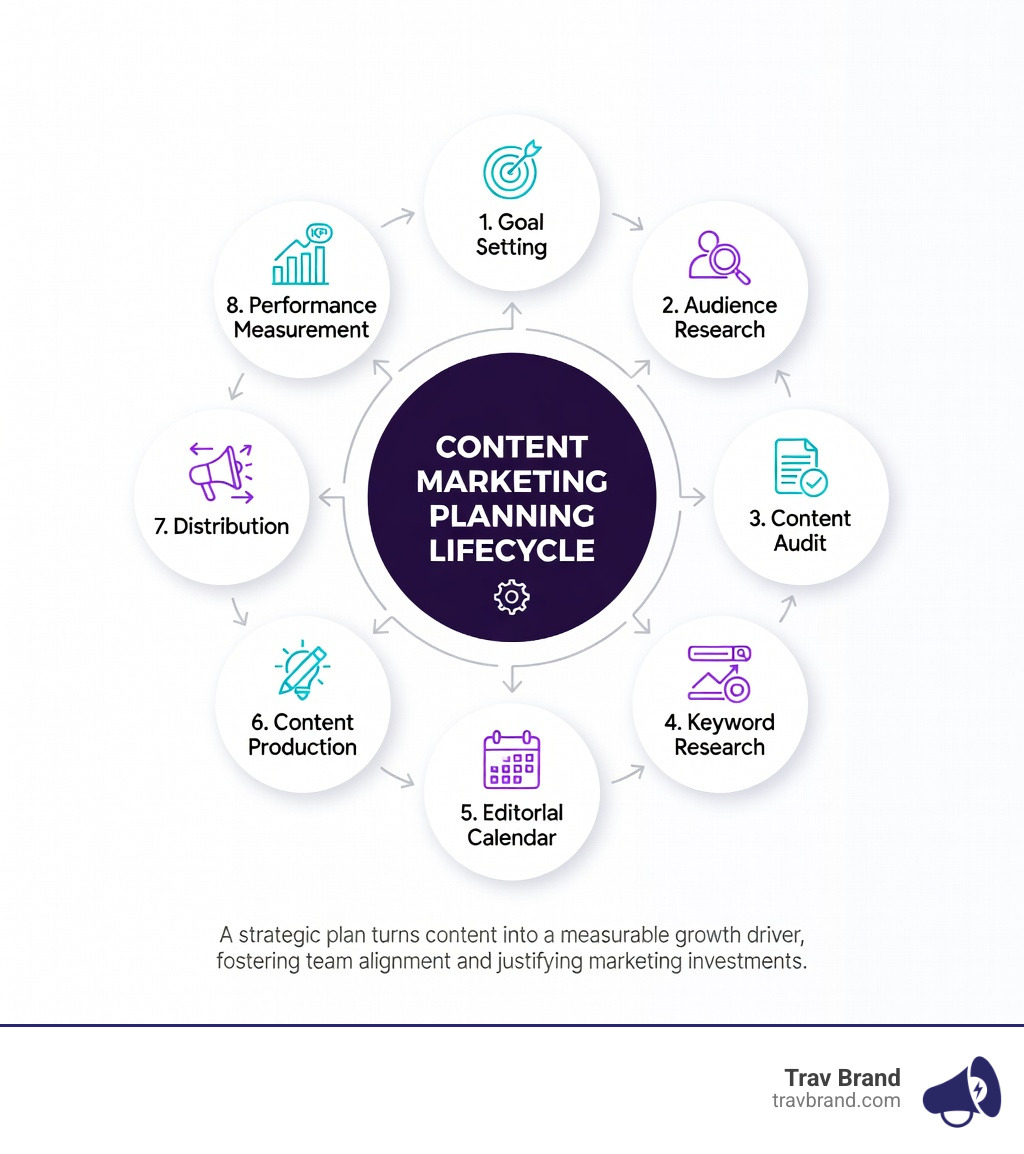
Here’s what effective content marketing planning includes:
- Setting SMART goals tied to business objectives (revenue, leads, brand awareness)
- Defining your target audience through buyer personas and customer journey mapping
- Conducting a content audit to evaluate what’s working and identify gaps
- Performing keyword and competitive research to uncover opportunities
- Building an editorial calendar that balances evergreen and timely content
- Establishing workflows and team roles for efficient content creation
- Planning distribution and promotion across owned, earned, and paid channels
- Measuring performance with clear KPIs to refine your strategy over time
The hard truth? Nearly half of companies don’t have a clearly defined digital marketing strategy. Those that do document their content marketing plans are significantly more likely to consider themselves effective, face fewer challenges, and justify higher marketing budgets.
The problem isn’t creating content—it’s creating content strategically. Too many small businesses jump straight into blog posts, social media, and videos without a plan. They produce content based on gut feeling, chase trending topics, or copy competitors without understanding why that content exists or how it supports business goals.
That approach leads to wasted resources, inconsistent messaging, and zero measurable impact.
A documented content marketing plan changes everything. It transforms content from a cost center into a growth engine. It aligns your team around shared objectives. It makes every piece of content purposeful, measurable, and tied to real business outcomes.
I’m Trav Lubinsky, and I’ve spent my career building brands and scaling companies through strategic marketing. At Trav Brand, we help businesses develop and execute content marketing planning frameworks that drive measurable growth and build lasting brand authority.
Content marketing planning word guide:
The Essentials of Content Marketing Planning
When we talk about content marketing planning, we often see people using terms like “strategy” and “plan” interchangeably. While they are best friends, they aren’t the same thing. Understanding the difference is the first step toward moving from “guessing” to “growing.”
A content marketing strategy is your “Why.” It’s the high-level vision that defines who you are helping and the unique value you provide. A content plan, on the other hand, is your “How.” It documents the specific policies, tasks, and resources needed to execute that strategy. Without a plan, your strategy is just a nice idea sitting in a folder.
| Feature | Content Strategy | Content Plan |
|---|---|---|
| Focus | Goals, Vision, & Audience | Execution, Tasks, & Schedules |
| Question | Why are we doing this? | How and when do we do it? |
| Output | Brand story, personas, mission | Editorial calendar, workflows, audits |
To succeed, we need to document this process. Research shows that businesses with a documented content marketing planning process feel significantly less challenged by every aspect of marketing. It allows you to build a business case to justify your budget and ensures that your brand story remains consistent across every touchpoint. For a deeper dive into the high-level architecture of your digital presence, check out our guide on Web Content Strategy.
Furthermore, the modern buyer is more sophisticated than ever. According to a 2023 Content Preferences Survey by Demand Gen Report, over 70% of B2B buyers prefer content that drills down into specific, relevant topic areas rather than generic fluff. This means your planning must be data-driven and highly targeted.
Defining SMART Goals for Content Marketing Planning
We cannot hit a target we haven’t defined. In content marketing planning, we use the SMART framework to ensure our goals aren’t just “wishes.”
- Specific: Instead of “increase traffic,” try “increase organic traffic to our service pages.”
- Measurable: Attach a number, such as “increase by 20%.”
- Assignable: Who on your team is responsible for this?
- Realistic: Do you have the budget and team to achieve this?
- Time-related: Set a deadline, like “by the end of Q3.”
Common Key Performance Indicators (KPIs) we track include conversion rates (sign-ups or sales), brand awareness (social reach and impressions), and engagement (time on page). If your goal is to generate 50 new leads a month, every piece of content in your plan should have a clear path to that objective.
Mapping the Customer Journey in Content Marketing Planning
Not every visitor is ready to buy the moment they land on your site. We must map our content to the three main stages of the customer journey:
- TOFU (Top of Funnel – Awareness): The user has a problem and is looking for information. Content types: Blog posts, infographics, “how-to” videos.
- MOFU (Middle of Funnel – Consideration): The user is comparing solutions. Content types: Case studies, webinars, comparison guides.
- BOFU (Bottom of Funnel – Conversion): The user is ready to buy and needs a final nudge. Content types: Free trials, demos, testimonials, and Strategic Marketing Content.
A useful tool for this is the First 10 Content Marketing Matrix. This matrix helps us plot content ideas along two axes: Awareness to Purchase and Emotional to Rational. This ensures we have a healthy mix of content that entertains, inspires, educates, and convinces.
Researching Your Audience and Identifying Opportunities
The secret to content that converts isn’t great writing—it’s great research. We need to build buyer personas, which are fictional representations of our ideal customers. We look at their demographics, but more importantly, their motivations, pain points, and decision criteria.
One of our favorite frameworks is “Heroes and Watering Holes.”
- Heroes are the thought leaders and influencers your audience trusts.
- Watering Holes are the places (forums, LinkedIn groups, specific blogs) where your audience hangs out to get information.
By identifying these, we can understand the language they use and the questions they are asking. This is critical for Keyword Analysis and Content Marketing. Trust is the currency of the digital age. As noted in the Edelman Trust Barometer, 67% of consumers are more likely to stay loyal to brands they trust, even if the price is higher. Your content is the primary tool for building that trust.
SEO and Competitive Gap Analysis
We don’t create content in a vacuum. We need to know what our competitors are doing—and where they are failing. A competitive gap analysis involves looking at the keywords your competitors rank for that you don’t. These are “untapped” opportunities.
Using tools like Google Search Console and SEMRush, we can identify search intent. Is the user looking for information (Informational), or are they looking to buy (Transactional)? We want to find the “missing keywords” where we can provide a better, more helpful answer than the competition. For more on this, see our guide on Content Marketing Competitive Analysis.
Brainstorming and Prioritizing Content Ideas
Once we have our research, it’s time to brainstorm. We recommend working with content pillars. These are 3-5 broad topics that represent your brand’s core expertise. Under each pillar, you create topic clusters—specific articles that link back to a main “pillar” page.
When prioritizing, we consider:
- Search Volume: How many people are looking for this?
- Seasonality: Using the Google Adwords Keyword Planner, we can see if interest in a topic peaks at certain times (like “tax tips” in January).
- Business Impact: Does this topic directly support a product launch or a key service?
Conducting a Content Audit and Identifying Gaps
Before you look forward, you must look back. A content audit is an inventory of every piece of content you currently own. It might sound tedious, but it’s where the “gold” is hidden. We use tools like Screaming Frog to crawl your site and pull a list of all URLs.

We then organize this data by:
- Topic and Format (Blog, video, guide)
- Funnel Stage (TOFU, MOFU, BOFU)
- Performance Metrics (Traffic, bounce rate, backlinks)
This allows us to see where we have “content gaps.” For example, you might have 50 blog posts for awareness (TOFU) but zero case studies to help people make a purchase decision (BOFU). To learn more about this process, visit our page on Audit Content Marketing.
Evaluating Existing Content Performance
We don’t just look at page views. We look at engagement data and assisted conversions. Using GA4, we can see if a blog post helped a user eventually find a product page, even if they didn’t buy right away. This is crucial for Content Performance Analysis.
If a page has high traffic but a high bounce rate, it’s a sign of a “broken” experience. Perhaps the content doesn’t match the search intent, or the page is missing a clear Call to Action (CTA). We focus on Optimizing Content for Conversions to ensure your existing traffic isn’t going to waste.
The “Stick, Fix, Nix, Mix” Framework
Once the audit is done, we apply the Stick, Fix, Nix, Mix framework to every asset:
- Stick: These are your winners. They align with your brand and perform well. Leave them alone or update them slightly to keep them fresh.
- Fix: These pieces have potential but aren’t quite there. Maybe they need better SEO, a new headline, or updated statistics.
- Nix: These are outdated, low-quality, or irrelevant pieces. Don’t be afraid to delete them. They are “dead weight” that can hurt your SEO.
- Mix: These are the new ideas that came out of your audit. What’s missing? What should we add to the mix to support our goals?
This is also the perfect time for content repurposing. Can that high-performing 3,000-word guide be turned into five social media snippets, an email series, and a short video? Repurposing maximizes your ROI without requiring you to reinvent the wheel every week.
Building an Editorial Calendar and Execution Workflow
Consistency is the “secret sauce” of content marketing planning. An editorial calendar is your command center. It provides a visual timeline of what is being published, when, and on which channel.
A good calendar includes:
- The Topic/Headline
- Target Audience Persona
- Funnel Stage
- Primary Keyword
- Assigned Author and Editor
- Status (Drafting, Review, Published)
We often use tools like Trello or Google Calendar to keep everything organized. This level of organization is standard in our Content Marketing Services.
Content Creation Workflows and Capacity Planning
One of the biggest pitfalls for small businesses is overbooking. We start with a burst of energy, try to publish daily, and then burn out by week three. Capacity planning means being realistic about how much time your team actually has.
We establish clear workflows:
- Briefing: The strategist creates a template with the goal, keyword, and outline.
- Creation: The writer (or Content Writing Service) produces the draft.
- Review: An editor checks for brand voice and accuracy.
- Design: Visual assets are created.
- QA: A final check for typos and broken links.
Strategic Content Distribution and Promotion
“If you build it, they will come” does not apply to content. You must have a promotion plan. We divide distribution into three categories:
- Owned Media: Your website, email list, and social media profiles.
- Earned Media: Guest posts on other sites, mentions by influencers, and user reviews.
- Paid Channels: Social media ads (Facebook/Instagram), Google Adwords, and sponsored content.
A common mistake is focusing on only one channel. We recommend a multi-channel approach where you “atomize” your content—taking one big idea and spreading it across different platforms in different formats. For e-commerce brands, this is especially vital. Learn How to Write E-Commerce Content Marketing That Converts to see how distribution drives sales.
Frequently Asked Questions about Content Marketing Planning
What is the difference between a content strategy and a content plan?
A content strategy is the high-level “why” and “who”—it defines your goals and your audience. A content plan is the tactical “how” and “when”—it’s the documentation of workflows, calendars, and specific tasks needed to make the strategy a reality.
How often should a small business update its content marketing plan?
Your core mission and business goals should stay relatively stable. However, we recommend reviewing your tactical content plan quarterly. This allows you to adjust for seasonality, new competitor moves, or shifts in audience behavior.
What are the most important KPIs for measuring content ROI?
It depends on your goal! For awareness, look at impressions and organic traffic. For engagement, look at time-on-page and social shares. For revenue, look at conversion rates, customer acquisition cost (CAC), and assisted conversions in GA4.
Conclusion
At Trav Brand, we believe that content marketing planning is the foundation of every successful brand. It’s not just about filling a blog; it’s about building a system that attracts the right people and turns them into loyal customers.
We specialize in helping purpose-driven brands move beyond “random acts of content” toward a strategic execution that delivers measurable results. Whether you need a comprehensive Web Content Marketing Services Complete Guide or a partner to handle the entire ecosystem from strategy to execution, we are here to help.
Ready to stop guessing and start growing? Explore our Branding Services Complete Guide to see how we can help you build a brand that lasts. Let’s get to work.