Nail Your Brand Messaging Strategy and Finally Be Understood
Why Your Brand Messaging Strategy Determines If People Buy — or Bounce
A brand messaging strategy is the foundation of how your business communicates who you are, what you do, and why customers should care — across every channel, touchpoint, and conversation.
Here’s what a brand messaging strategy includes:
- Core message — the single idea your brand owns
- Value proposition — the clear benefit you deliver and why you’re different
- Brand voice and tone — your personality expressed through words
- Messaging pillars — 3–5 themes that support your core message
- Tagline and elevator pitch — short, memorable ways to explain what you do
- Target audience definition — who you’re talking to and what they care about
The numbers make the stakes clear. 80% of your conversion rate is determined by your messaging — not your product, not your design. And 64% of customers want brands to connect with them, with 76% saying they’ll choose a brand they feel connected to over a competitor.
Yet most founders rush through messaging as an afterthought. They build a product, throw up a website, and wonder why nothing sticks.
Here’s the hard truth: if your team can’t clearly answer “what do we do and why does it matter,” your customers can’t either.
I’m Trav Lubinsky — entrepreneur, investor, and founder of Trav Brand, and I’ve built and scaled brands across consumer products, e-commerce, and beyond, which means I’ve seen how a sharp brand messaging strategy is the single lever that turns confusion into conversion. Let’s build yours.
Brand messaging strategy vocab explained:
Defining the Pillars: What is Brand Messaging?
We like to think of brand messaging as your brand’s “verbal identity.” While your logo and colors handle the visual first impression, your messaging does the heavy lifting of persuasion. It is the curated collection of words, phrases, and stories you use to convey your value.
In professional branding, this falls under “non-visual elements.” It’s the strategic bridge between your internal goals and your customer’s external needs. Without a clear brand messaging strategy, even the most beautiful website is just an empty shell. To get started, we often recommend looking at a Brand Positioning Statement Complete Guide to understand where you sit in the market before you decide what to say.
The core of this verbal branding is your Unique Value Proposition (UVP). This isn’t just a list of features; it’s a clear statement of the tangible benefits a customer receives. When combined with your brand story — the “why” behind your existence — it creates a narrative that people actually want to follow. Every business needs a “source of truth” for these elements, which is The Essential Foundation Why Your Brand Needs a Brand Guide.
Why a Strong Brand Messaging Strategy is Your Growth Lever
If you’re wondering whether obsessing over words is worth the time, consider the ROI. Research from the Product Marketing Alliance suggests that a 20% improvement in your messaging strategy has a more profound impact on ROI than a 20% improvement in your product itself.
Why? Because 80% of your conversion rate is determined by your messaging. You could have the best product in the world, but if you can’t articulate why it solves a specific problem, it will stay on the shelf.
Beyond just “making a sale,” messaging builds long-term equity. 64% of customers want brands to connect with them, and 57% of customers say that when they feel that connection, they increase their spending. This isn’t just fluffy marketing talk; it’s measurable growth. In fact, consistent messaging across all channels can increase revenue by 33%.
Look at brands like Yeti. They didn’t become a $5 billion powerhouse just by making coolers; they did it through a brilliant brand messaging strategy that turned a utility item into a status symbol for the “unbreakable” outdoorsman.
Brand Messaging vs. Positioning vs. Voice
We see these terms used interchangeably all the time, but they serve very different roles in your strategy. Think of it like a theatrical production: Positioning is the stage you’re standing on, Messaging is the script you’re reading, and Voice is the way you deliver the lines.
| Element | Focus | Question it Answers |
|---|---|---|
| Brand Positioning | Strategic “Why” | Where do we fit in the market compared to others? |
| Brand Messaging | Tactical “What” | What specific points do we need to say to prove our value? |
| Brand Voice | Personality “How” | What does our brand sound like (witty, authoritative, kind)? |
Your brand persona brings these together. For example, if your positioning is “the most reliable security for families,” your messaging will focus on “24/7 monitoring” and “instant alerts,” while your voice might be “calm, protective, and serious.” If you change the voice to “snarky and humorous,” the message of safety might get lost. Market differentiation happens when all three are aligned to own a specific “white space” in the customer’s mind.
The Essential Brand Messaging Framework
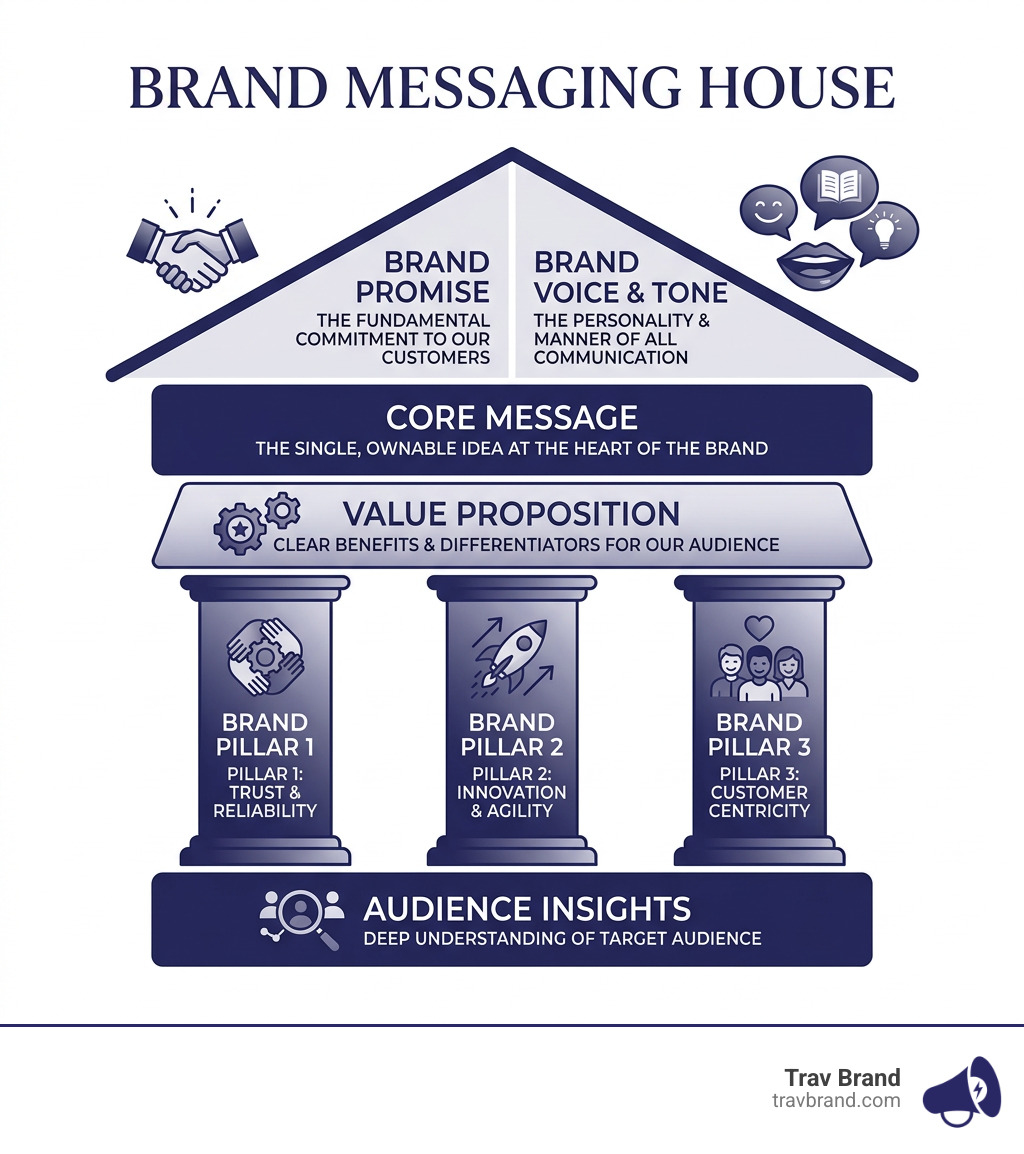
To build a message that sticks, we use a structured framework. Think of this as your “Messaging House.” The foundation is your mission and vision, and the roof is your core promise.
- Core Message: The single, overarching takeaway you want every person to have.
- Mission Statement: What you do, who you do it for, and how you do it.
- Vision Statement: The future you are trying to create.
- Brand Promise: The experience you commit to delivering every single time.
At Trav Brand, we believe the most successful companies are those that lean into An Essential Guide to Purpose-Driven Branding. When your messaging is rooted in a deeper purpose, it resonates on an emotional level that competitors can’t easily replicate.
Your framework should also include an elevator pitch — a 30-second version of your story — and messaging pillars. These pillars are 3–5 core themes (like “Sustainability,” “Ease of Use,” or “Elite Performance”) that act as the supporting columns for everything you write. Each pillar should have supporting talking points backed by data or social proof.
Identifying Your Target Audience and Pain Points
You cannot craft a message if you don’t know who is listening. We start by building detailed buyer personas that go beyond simple demographics. We want to know their psychographics: What keeps them up at night? What are their secret aspirations?
By using emotional triggers — like the desire for belonging, the fear of missing out, or the need for self-improvement — we can craft messages that feel personal. This is where The Power of Storytelling in Building a Strong Brand comes in. Instead of making your brand the hero, make the customer the hero. Your brand is the guide (the “Gandalf” or “Obi-Wan”) that provides the tool they need to overcome their “villain” (their pain point).
Empathy mapping is a great exercise here. Ask:
- What does the customer feel when their problem isn’t solved?
- What language do they use to describe their frustration?
- What does a “win” look like in their own words?
How to Build Your Brand Messaging Strategy in 6 Steps
Building a brand messaging strategy isn’t a weekend project; it’s an exercise in reality. You have to ground your claims in what your product actually does, not just what you wish it did.
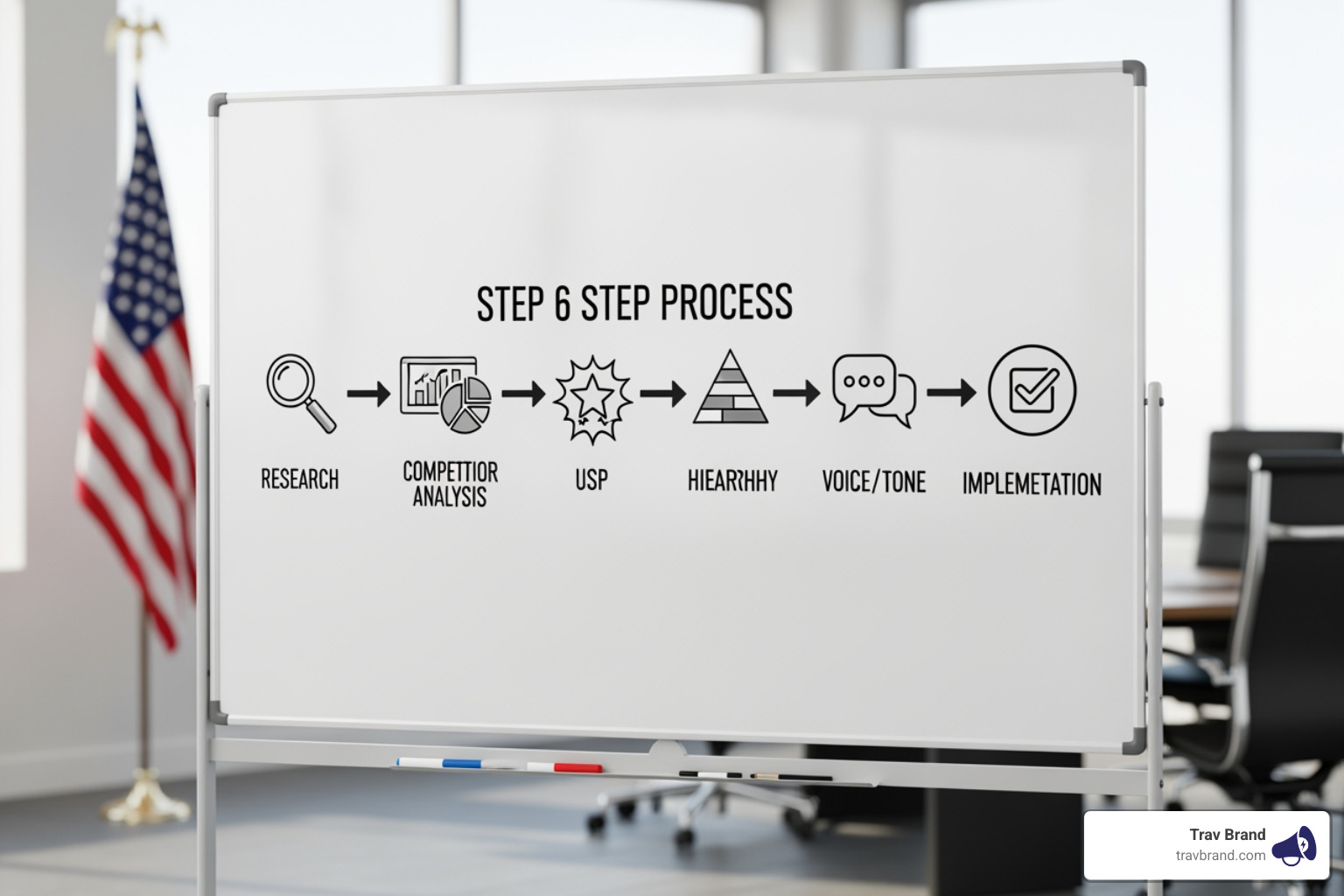
- Internal Audit and Research: Talk to your founders, your sales team, and most importantly, your customers. What are they actually saying about you?
- Competitor Analysis: Look at your top three competitors. What are they promising? Identify the “white space” — the area they are ignoring that you can own.
- Develop Your Unique Selling Proposition (USP): This is your “onlyness” statement. “We are the only [Category] that [Benefit] for [Audience].” For more on this, check out Innovative Brand Building Strategies to Stand Out in a Competitive Market.
- Create a Message Hierarchy: Not all messages are created equal. Your website header needs the “Big Hook,” while your product page needs the “Technical Proof.”
- Establish Voice and Tone Guidelines: Define the “Do’s and Don’ts” of your language.
- Content Auditing and Implementation: Go back through your existing website, social media, and sales decks. If a piece of content doesn’t align with the new strategy, kill it or fix it.
Developing a Unique Brand Voice and Tone
Humanizing your brand is the secret to social media success and customer loyalty. People don’t want to talk to a faceless corporation; they want to talk to a “someone.”
To define your voice, pick 3–4 personality traits. Are you “The Adventurous Expert” or “The Friendly Neighbor”? Once you have these traits, translate them into writing style guidelines. For example, if you are “Playful,” you might use puns and emojis. If you are “Sophisticated,” you use short, punchy sentences and avoid slang.
We also see a huge overlap here with The Power of Personal Branding 3 Ways It Can Help Your Career. For founders, your personal voice often sets the tone for the company’s brand voice in the early stages.
Your brand vocabulary is also crucial. Create a list of “Power Words” you love and “Forbidden Words” that sound too much like your competitors or feel off-brand. This ensures consistency benchmarks are met, no matter who is writing the copy.
Internal vs. External: Applying Your Message Consistently
A common mistake we see is focusing entirely on the customer while ignoring the team. Internal brand messaging is just as important. If your employees don’t understand the mission, they can’t be effective brand ambassadors.
Internal messaging is often more familiar and informative. It’s the “why we do what we do” that fuels company culture. External messaging is the curated, public-facing version designed to convert. Both must be aligned. Consistent messaging can increase revenue by 33% because it builds a sense of reliability. When a customer hears the same core value from a Facebook ad, a sales call, and a support ticket, they start to trust that you actually mean what you say.
Documenting Your Brand Messaging Strategy for Consistency
You cannot leave your messaging to memory. You need a centralized guide — a “Brand Messaging Bible.” This document should be accessible to everyone, from the CEO to the freelance social media manager.
Your guide should include:
- Your Messaging Framework (Mission, Vision, Pillars)
- Target Personas
- Voice and Tone guidelines
- Taglines and Slogans
- Elevator Pitches (for different contexts)
- Approved Sales Scripts and Email Templates
Regularly performing Brand Audit Services will help you see where your messaging is drifting. Training sessions are also vital; we recommend “Messaging Workshops” where team members practice explaining the brand to each other to ensure alignment.
Measuring Effectiveness and Avoiding Common Pitfalls
How do you know if your brand messaging strategy is working? It’s a blend of art and science.
- A/B Testing: Run two ads with the same visual but different headlines. Which one gets the click?
- Sentiment Analysis: Use social listening tools to see what words customers use when they talk about you. Does it match your brand pillars?
- Wynter Testing: Use message-testing platforms to get feedback from your specific target audience on whether your copy is clear or confusing.
- Conversion Rates: If your messaging is sharper, your cost-per-acquisition should go down.
Common Pitfalls to Avoid:
- Feature-Focused Mistakes: Don’t tell us you have a “high-torque motor.” Tell us it “cuts through thick grass in half the time.”
- Generic Jargon: Words like “synergy,” “innovative,” and “next-generation” are invisible. Be specific.
- Casting Too Wide a Net: If you try to talk to everyone, you end up talking to no one. Be brave enough to exclude people who aren’t your ideal customers.
For more tips on staying on track, read our 9 Actionable Strategies to Build a Successful Brand.
Frequently Asked Questions about Brand Messaging
How often should I update my brand messaging strategy?
We recommend a deep dive every 12–18 months. However, you should tweak it sooner if there is a major market shift, a new competitor enters the space, or if you launch a significantly different product line. Messaging is a living document, not a stone tablet.
What is the difference between a tagline and a slogan?
A tagline is permanent and sits next to your logo (e.g., Nike’s “Just Do It”). It represents the overall brand essence. A slogan is temporary and used for specific marketing campaigns or product launches (e.g., “Find Your Greatness”).
How do I know if my brand messaging is actually working?
The “Clarity Test” is the easiest way. If you show your homepage to a stranger for five seconds and they can’t tell you exactly what you do and who it’s for, your messaging is failing. Beyond that, look for an increase in lead quality and a decrease in the “sales cycle” time.
Conclusion
At the end of the day, your brand messaging strategy is about being human. It’s about cutting through the digital noise to say, “We see you, we understand your problem, and we have the best way to fix it.”
At Trav Brand, we don’t just give you a PDF and wish you luck. We focus on purpose-driven growth and measurable results. We take you from strategy to execution, ensuring your message isn’t just written, but heard. Whether you are jumping from DTC to retail or scaling a service-based business, we provide the ecosystem to make it happen.
Ready to stop being the world’s best-kept secret? Check out our Branding Services Complete Guide and let’s start building a message that actually moves the needle.