Buyer’s Guide: Best Content Marketing Services for 2026
Why Content Marketing Services Are Essential for Modern Businesses
Content marketing services help businesses create, publish, and distribute valuable content that attracts customers, builds trust, and drives measurable revenue growth. These services typically include:
- Strategy Development – Audience research, competitor analysis, and content roadmap creation
- Content Creation – Blog posts, white papers, videos, infographics, and social media content
- SEO Integration – Keyword optimization and search visibility improvement
- Distribution & Promotion – Multi-channel content deployment and audience targeting
- Performance Measurement – Analytics, reporting, and ongoing optimization
The numbers tell the story. 70% of users prefer learning about companies through content rather than ads. More than 93% of purchases start with a search engine query. Yet 90.6% of all website content receives zero organic traffic from Google.
That gap represents the challenge—and the opportunity.
Content marketing isn’t about creating more content. It’s about creating better content that serves your audience at every stage of their journey. From awareness to consideration to decision, strategic content builds relationships before asking for the sale.
When done right, content marketing delivers compound returns. It establishes your brand as an industry authority, generates qualified leads, and builds customer loyalty that lasts. Businesses with a content marketing strategy are 13 times more likely to see positive ROI.
I’m Trav Lubinsky, founder of Trav Brand, where I’ve helped brands like HexClad, FightCamp, and Poppi scale through strategic content marketing services and performance-driven brand development. Over the past decade, I’ve learned that the brands that win aren’t just the ones with the biggest budgets—they’re the ones with the clearest message and the most valuable content.
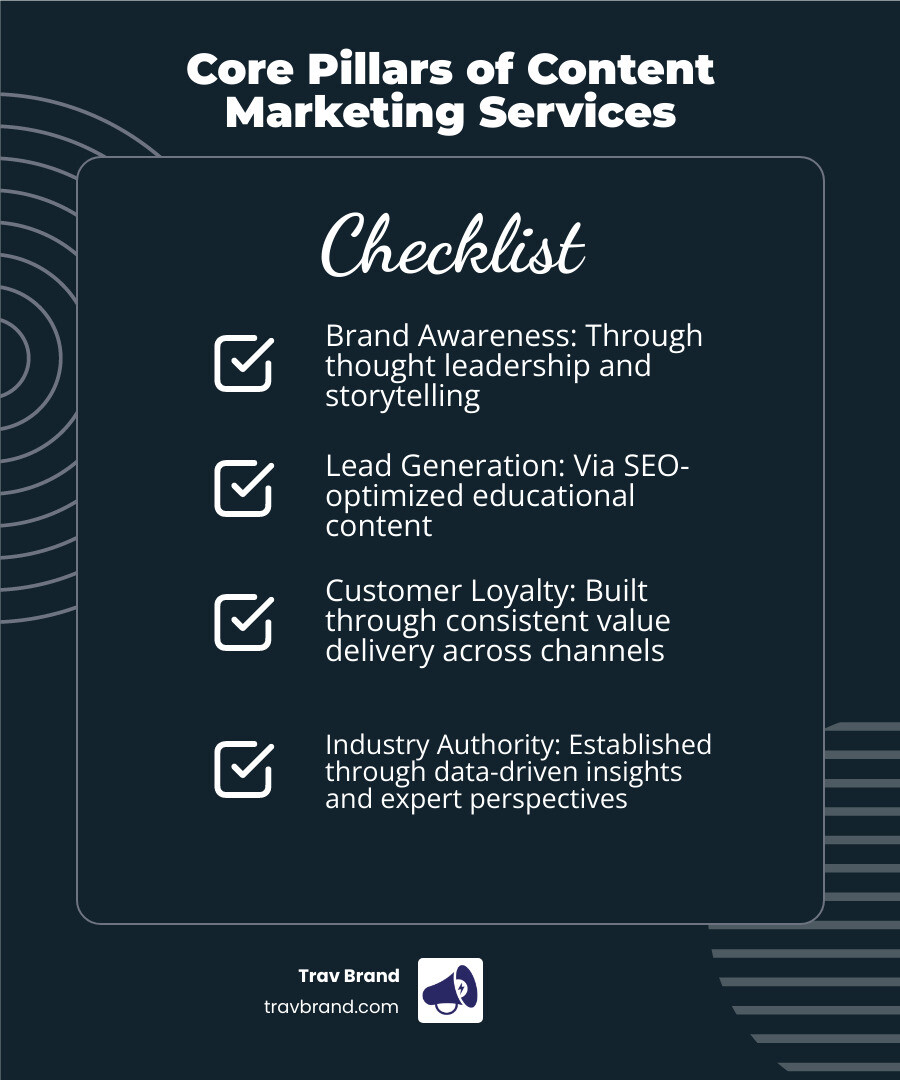
The Power of Content: Fueling Growth and Building Trust
In today’s crowded digital landscape, simply having a product or service isn’t enough. We need to connect with our audience, build rapport, and demonstrate our value long before they’re ready to make a purchase. That’s where content marketing services shine. They empower us to fuel growth and build trust in several critical ways:
- Brand Awareness: Content introduces our brand to new audiences, educating them about who we are and what problems we solve. By consistently publishing valuable content, we expand our reach and ensure our brand is top-of-mind.
- Lead Generation: Strategic content acts as a magnet, attracting potential customers who are actively searching for solutions. Whether it’s a helpful blog post or an in-depth guide, content captures interest and guides prospects toward becoming qualified leads.
- Customer Loyalty: Our relationship with customers doesn’t end after a sale. In fact, 63% of content marketers use their content strategy to build loyalty with their existing clients. Consistent, valuable content keeps customers engaged, informed, and feeling appreciated, fostering long-term relationships and repeat business.
- Building Trust and Credibility: Consumers are savvier than ever, and they prefer to get to know a company through informative content rather than direct advertisements. When we provide non-promotional, helpful articles or videos, we build a foundation of trust. Imagine someone researching a medical center for a complex surgery; learning about the facility and staff through content can build a crucial relationship before they even visit. This principle applies across all industries.
- Establishing Thought Leadership: By consistently delivering valuable, authoritative content that showcases our expertise and insight, we can position our brand as a go-to source for knowledge. This makes us an indispensable resource, leading conversations and guiding decision-makers.
How Content Addresses the Buyer’s Journey
To truly expand our consumer base, we must target potential customers at all stages of their buying journey. Many companies focus heavily on bottom-of-the-funnel (BOFU) customers, seeking immediate sales. While this yields quick results, it limits overall business growth. We need to nurture prospects from the very first spark of interest.

The buyer’s journey typically consists of three stages:
- Awareness Stage Content: At this stage, potential customers are just realizing they have a problem or need. They’re looking for information, not solutions. Our content here should be educational, broad, and easily digestible.
- Blogs: Informative articles (like analyst guest posts) that address common questions or industry trends.
- Social Media: Engaging posts, short videos, or Q&As that spark interest and introduce concepts.
- Videos: Dynamic storytelling that brings insights to life.
- Infographics: Visually compelling stories that simplify complex ideas (like IDC’s infographic solutions).
- Analyst Briefs: Short, sharp papers introducing timely concepts and predictions.
- Consideration Stage Content: Here, prospects have defined their problem and are researching various solutions. They’re evaluating options and looking for more in-depth information.
- Guides & White Papers: Comprehensive documents that explore specific challenges and potential solutions, often blending research with expert points of view.
- Spotlight Papers: Combine expert perspectives with a clear profile of how a solution addresses challenges.
- InfoBriefs: Visually engaging documents spotlighting key market or tech trends with high-level analyst insight.
- Customer Case Studies: Real-world examples of how customers solved challenges, highlighting the solution’s impact.
- Decision Stage Content: At this final stage, prospects are ready to make a purchase. They’re comparing specific vendors and looking for proof points and reassurance.
- White Papers (ROI-focused): Grounded in real user interviews and analyst insight, these papers deliver a clear, credible case for a solution’s ROI.
- Business Value Snapshot Tools: Web-based calculators built on research that show buyers the ROI, value, and impact of a solution.
- Buyer Guide Conversations: Guides that arm sales teams with insights into buyer needs, sharpening value propositions and providing talking points.
- Demos & Free Trials: Direct experiences with the product or service.
40% of buyers engage with at least 3 pieces of content before contacting a business. This highlights the necessity of a comprehensive content strategy that provides value at every touchpoint.
What to Expect from Professional Content Marketing Services
Given the complexities of the buyer’s journey and the sheer volume of content out there (with 90.6% of all website content getting no organic search traffic from Google), leveraging professional content marketing services is no longer a luxury—it’s a necessity. These services offer a complete ecosystem, from initial strategy to ongoing execution and analysis, ensuring your content stands out and delivers measurable results.
Here’s a breakdown of what we can expect from comprehensive content marketing services:
- Content Strategy Development: This is the bedrock of any successful content initiative. It involves:
- Audience Research: Deep dives into your target personas, understanding their pain points, interests, and preferred content formats.
- Competitor Analysis: Evaluating what your competitors are doing well (and not so well) to identify opportunities and differentiate your brand.
- Content Roadmap Creation: Developing a strategic framework that aligns content themes, formats, and channels with your business goals and the buyer’s journey.
- Content Creation Types: This is where ideas come to life. A professional service will offer a diverse range of content formats custom to different objectives:
- Blog Posts: Educational or brand-focused articles that drive website traffic and establish expertise. We can see examples of how trusted analyst expertise can be brought to blogs.
- Ebooks & White Papers: In-depth, long-form content that provides significant value, often used as lead magnets to capture prospect information.
- Infographics & Visual Content: Transform complex insights into compelling, digestible, and shareable visual stories.
- Video Scripts & Production: Bringing insights to life through dynamic video storytelling, which can significantly boost engagement, as pages containing video content get over 80% more traffic than traditional articles.
- Social Media Content: Custom posts, stories, and campaigns designed for specific platforms to engage audiences and amplify messages.
- Email Newsletters: Consistent touchpoints to keep audiences engaged, informed, and nurtured over time.
- Pillar Pages & Cluster Content: Comprehensive resources on core topics, strategically linked to related content to improve SEO and user experience.
- Case Studies: Real-world success stories that bolster trust and provide social proof.
- Webinars & Podcasts: Interactive or audio-based content for educating, engaging, and building rapport with listeners.
- Analyst Insights: Leveraging research and expert commentary, like those from IDC, to add authority and credibility to your content.
- SEO Integration: Content without visibility is like a tree falling in a forest with no one around. Professional content marketing services ensure content is optimized for search engines, including:
- Keyword Research: Identifying high-value keywords and search intent.
- On-Page Optimization: Structuring content for readability and search engine crawlability.
- Technical SEO Considerations: Ensuring the website infrastructure supports content visibility.
- Distribution & Promotion: Creating great content is only half the battle. Services include strategies for getting your content in front of the right audience across multiple channels.
- Performance Measurement: Tracking, analyzing, and reporting on content performance to ensure it’s meeting objectives and delivering a positive ROI.
By partnering with experts, we gain access to a dedicated team, advanced tools, and proven methodologies, allowing us to focus on our core business while our content works tirelessly to attract, engage, and convert.
Crafting a Winning Strategy: Process, Measurement, and the Future
A truly effective content marketing strategy isn’t a one-time project; it’s an ongoing cycle of planning, creation, distribution, and refinement. We believe in a structured, data-driven approach that ensures our content continuously evolves to meet and exceed objectives.
The Content Creation Process
Our process for crafting compelling content, from initial spark to measurable impact, typically follows these stages:
- Ideation & Research: This is where we lay the groundwork. We conduct thorough audience research, keyword analysis, and competitive reviews. We identify content gaps and opportunities, brainstorming topics that resonate with our audience and align with our strategic goals. This context-building phase is crucial for understanding our customers, product, industry, and go-to-market strategy.
- Strategy Formulation: Based on our research, we formulate a custom content strategy. This defines the types of content we’ll create, the themes we’ll explore, the channels for distribution, and the specific objectives for each piece. This is where we combine proven playbooks with mutual goals.
- Creation & Design: Here, our expert writers, designers, and multimedia specialists bring the content to life. Whether it’s a blog post, an infographic, a video script, or a white paper, we craft high-quality, engaging assets that are purpose-built for our goals, industry realities, and adapted for each channel. We ensure our content is rooted in sound data and prioritizes the reader’s experience.
- Publication & Distribution: Once content is finalized, it’s published on relevant platforms. This is often followed by strategic distribution and promotion across various channels—social media, email newsletters, paid campaigns—to maximize its reach and impact.
- Analysis & Optimization: The work doesn’t stop once content is live. We continuously monitor its performance, tracking key metrics and gathering insights. This data allows us to refine our approach monthly, ensuring our content strategy remains agile and effective.

Measuring the ROI of Content Marketing Services
One of the most critical aspects of any successful content strategy is proving its worth. We go beyond vanity metrics like views and shares to track content’s genuine impact on our business. Measuring the ROI of content marketing services involves:
- Attribution Models: Understanding which touchpoints (pieces of content) contribute to conversions and sales, helping us allocate resources effectively.
- Key Performance Indicators (KPIs): We focus on metrics directly tied to business outcomes:
- Lead Quality: Are our content efforts attracting the right kind of leads?
- Conversion Rates: How effectively is our content turning visitors into prospects and customers?
- Customer Lifetime Value (CLV): Is our content helping to nurture long-term, high-value customer relationships?
- Sales Pipeline and Revenue Impact: We connect content engagement to qualified leads, sales pipeline progression, and direct revenue generation. This is about seeing the real business outcomes.
It’s a fact that businesses with a content marketing strategy are 13 times more likely to see positive ROI. Moreover, specialized strategies focusing on emerging search technologies can generate 14X ROI through increased LLM visibility, higher engagement, and optimized conversion paths. This proves that a well-executed strategy isn’t just about creating content; it’s about creating value that translates directly to your bottom line.
Adapting to AI Search and AI-Powered Content
The digital landscape is constantly evolving, and the rise of AI in search is undeniably one of the most significant shifts we’ve seen. With emerging search technologies and generative AI models becoming more prevalent, our content marketing services must adapt to ensure our brands remain visible and authoritative.
- AI Search Impact: Tools like Google’s AI Overviews and other AI-powered answer engines are changing how users find information. This means our content needs to be structured and optimized not just for traditional keyword matching, but also for providing clear, concise, and authoritative answers that AI models can readily interpret and present.
- LLM Optimization (LLMO): This is a specialized approach to optimize content for Large Language Models (LLMs). It involves understanding how these models process information and ensuring our content is authoritative, factual, and contextually rich, allowing our brand to build authority and visibility where audiences are searching.
- AI-Powered Content Creation: AI tools can significantly increase our bandwidth, helping us create content faster and at scale. They can assist with ideation, drafting, and even optimizing existing content. However, the true power comes from combining AI’s efficiency with human expertise.
- The Importance of Human Expertise and Editing: While AI can generate content, it lacks the nuanced understanding of brand voice, strategic intent, and emotional connection that only humans possess. Our expert managing editors and content strategists ensure that AI-generated content is refined, factual, and aligns perfectly with our brand’s unique messaging. This blend of AI and human touch ensures authenticity and authority.
Looking further ahead, we anticipate even more immersive content experiences. For example, in the e-commerce space, content marketing services in 2025 will revolve around interactive content, AI-driven personalization, and immersive formats like augmented reality (AR) or virtual reality (VR). Staying ahead of these trends requires constant innovation and a forward-thinking approach.
How to Choose the Right Content Marketing Partner
Selecting the right partner for your content marketing services is a critical decision that can significantly impact your brand’s growth. With so many options available, understand the key differences and what to look for.
Key Differences Between Various Service Providers
- Full-Service vs. Specialized Agencies: Some agencies offer a broad spectrum of digital marketing services, including content marketing. Others specialize specifically in content, often focusing on particular industries (e.g., B2B SaaS, e-commerce) or content types (e.g., SEO-focused content, video production). A specialized agency might offer deeper expertise in a niche, while a full-service agency provides a more integrated approach across all marketing channels.
- In-House Teams vs. Outsourced Partners: Building an internal content team can offer tight control, but it requires significant investment in hiring, training, and tools. Outsourcing to an agency provides access to a diverse pool of expert talent, technology, and methodologies without the overhead. Many agencies position themselves as an “extension of your team,” offering dedicated support without the complexities of internal hiring.
What to Look For When Choosing One
When evaluating potential partners, we recommend focusing on criteria that align with your business goals and values. Here’s a table comparing key evaluation criteria:
| Evaluation Criteria | Description |
|---|---|
| Specialization & Expertise | Does the agency have a deep understanding of your industry or niche? Do they excel in the specific content types you need (e.g., B2B white papers, e-commerce product descriptions, video marketing)? |
| Proven Process | Do they have a clear, structured methodology for content strategy, creation, and distribution (e.g., ideation, research, creation, analysis)? Can they articulate how their process will achieve your objectives? |
| Data-Driven Approach | Do they emphasize analytics, KPIs, and ROI measurement? How do they connect content engagement to business outcomes like qualified leads, sales pipeline, and revenue? Are they transparent about how they track performance? |
| Reporting Transparency | Will you receive regular, easy-to-understand reports on content performance? Do they offer insights and recommendations for optimization, not just data dumps? |
| Client Communication | How do they typically communicate? Are they responsive, collaborative, and do they prioritize clear, consistent updates? Do they take the time to truly understand your vision and challenges? |
| Talent & Quality | What is the quality of their creative team (writers, editors, designers, strategists)? Do they have a rigorous vetting process for their talent? Can they provide examples of high-quality content they’ve produced? |
| Adaptability & Innovation | Are they aware of and adapting to new trends like AI search, LLMO, and immersive content formats (AR/VR)? Do they have strategies for optimizing content for the evolving digital landscape? |
| Portfolio & Case Studies | Can they demonstrate a track record of success with similar businesses? Look for real-world examples and quantifiable results (e.g., increased organic traffic, lead generation, conversion rates). |
Questions to Ask a Potential Partner
To ensure a good fit, we encourage you to ask probing questions:
- “How do you approach understanding our unique business goals, audience, and competitive landscape?”
- “Can you walk us through your typical content strategy development process, from research to execution?”
- “What specific metrics do you track to measure the success of your content efforts, and how do you report on ROI?”
- “How do you ensure content maintains our brand voice and aligns with our overall marketing objectives?”
- “How do you stay updated on the latest SEO trends and algorithm changes, especially concerning AI search?”
- “What is your process for client collaboration and feedback during content creation?”
- “Can you share examples of successful content campaigns you’ve executed for clients in our industry?”
- “What are your typical timelines for content delivery, and how do you handle revisions?”
By carefully evaluating these aspects, we can find a partner that not only creates great content but also aligns with our strategic vision and delivers measurable growth.
Frequently Asked Questions about Content Marketing Services
We often encounter common questions when discussing content marketing services. Here are some of the most frequent ones:
How does content marketing contribute to SEO?
Content marketing is absolutely fundamental to SEO and online visibility. Think of it as the fuel for your search engine rankings. Here’s how:
- Keyword Integration: High-quality, relevant content allows us to naturally integrate keywords that our target audience is searching for. Search engines see this as a signal that our content is relevant to those queries.
- Authority and Trust: When we consistently publish valuable, well-researched content, we build authority and trust with both our audience and search engines. This is crucial because search engines prioritize content from authoritative sources.
- Backlink Generation: Excellent content is shareable content. Other reputable websites are more likely to link back to our valuable articles, white papers, or studies, which significantly boosts our domain authority and SEO.
- Improved User Experience (UX): Engaging, informative content keeps visitors on our site longer, reducing bounce rates. This positive user behavior signals to search engines that our site provides a good experience, which can improve rankings.
- Addressing Search Intent: Modern SEO isn’t just about keywords; it’s about understanding the intent behind a search query. Content marketing allows us to create specific pieces of content that directly answer those intents, whether it’s informational, navigational, or transactional.
Startling statistic: 90.6% of all website content gets no organic search traffic from Google. This isn’t because the content isn’t useful, but often because it’s not strategically optimized or authoritative enough to rank. Effective content marketing directly addresses this challenge.
How long does it take to see results from content marketing?
Content marketing is a marathon, not a sprint. While some initial signs of increased traffic or engagement can be seen within a few weeks or months, significant, measurable ROI typically takes longer.
- Early Stages (1-3 months): We might observe increased website traffic, higher social media engagement, and possibly some initial lead generation as new content is published and distributed.
- Mid-Term (3-9 months): As our content builds authority and accumulates backlinks, we’ll likely see improved search engine rankings for target keywords, a steady increase in qualified leads, and growing brand awareness.
- Long-Term (9-12+ months): This is when content marketing really starts to deliver compounding returns. We’ll see substantial growth in organic traffic, a consistent flow of high-quality leads, measurable impact on sales and revenue, and a strong position as an industry thought leader.
The exact timeline can vary based on factors like industry competitiveness, content quality, publishing frequency, and the robustness of the distribution strategy. Patience and consistent effort are key.
What makes a content marketing strategy effective today?
In today’s dynamic digital landscape, an effective content marketing strategy is multifaceted and highly adaptable:
- Audience-Centricity: It starts and ends with the audience. Understanding their needs, pain points, and preferences is paramount. Content must provide genuine value, not just promote products.
- Data-Driven Decisions: Every aspect, from ideation to optimization, is informed by data and analytics. We track performance, identify trends, and make adjustments based on what the numbers tell us.
- Integration with SEO and AEO: Content is seamlessly integrated with SEO best practices and optimized for emerging AI search (AEO – Answer Engine Optimization). This ensures maximum visibility across all search platforms.
- Diverse Content Formats: Relying on a single content type is a recipe for stagnation. An effective strategy leverages a mix of blogs, videos, infographics, podcasts, white papers, and interactive tools to engage different segments of the audience.
- Human Expertise & AI Improvement: While AI tools can boost efficiency, human oversight ensures content maintains brand voice, authenticity, and strategic depth. The combination of AI-powered creation and expert human refinement is a winning formula.
- Measurable ROI Focus: The strategy is always tied back to clear business objectives and measurable ROI, demonstrating its impact on lead generation, sales, and customer loyalty.
- Adaptability to Trends: The digital world changes rapidly. An effective strategy is agile, constantly monitoring new trends (like immersive content in e-commerce) and adapting to evolving consumer behaviors and technological advancements.
Conclusion: Invest in Content to Secure Your Brand’s Future
As we’ve explored, content marketing services are far more than just writing articles; they are a strategic imperative for any business looking to thrive in the modern digital age. They are the engine that drives brand awareness, cultivates leads, builds unwavering customer loyalty, and establishes your brand as an undeniable authority in your field.
Investing in content is investing in a long-term strategic asset. It’s about building lasting relationships with your audience, providing them with value, and earning their trust long before they’re ready to buy. The future is undeniably content-driven, and the brands that succeed will be those that prioritize a comprehensive, data-driven, and adaptable content strategy.
At Trav Brand, we understand this deeply. We build and scale brands through comprehensive digital marketing, e-commerce, and content strategies. We offer a complete ecosystem from strategy to execution, focusing on purpose-driven brands and measurable results, rather than just consulting. Let us help you craft the compelling stories that captivate, connect, and convert.
Explore our comprehensive content marketing services.