


Unlock Your Audience: A Comprehensive Guide to Keyword Analysis in Content Marketing
Why Keyword Analysis is the Foundation of Every Winning Content Strategy
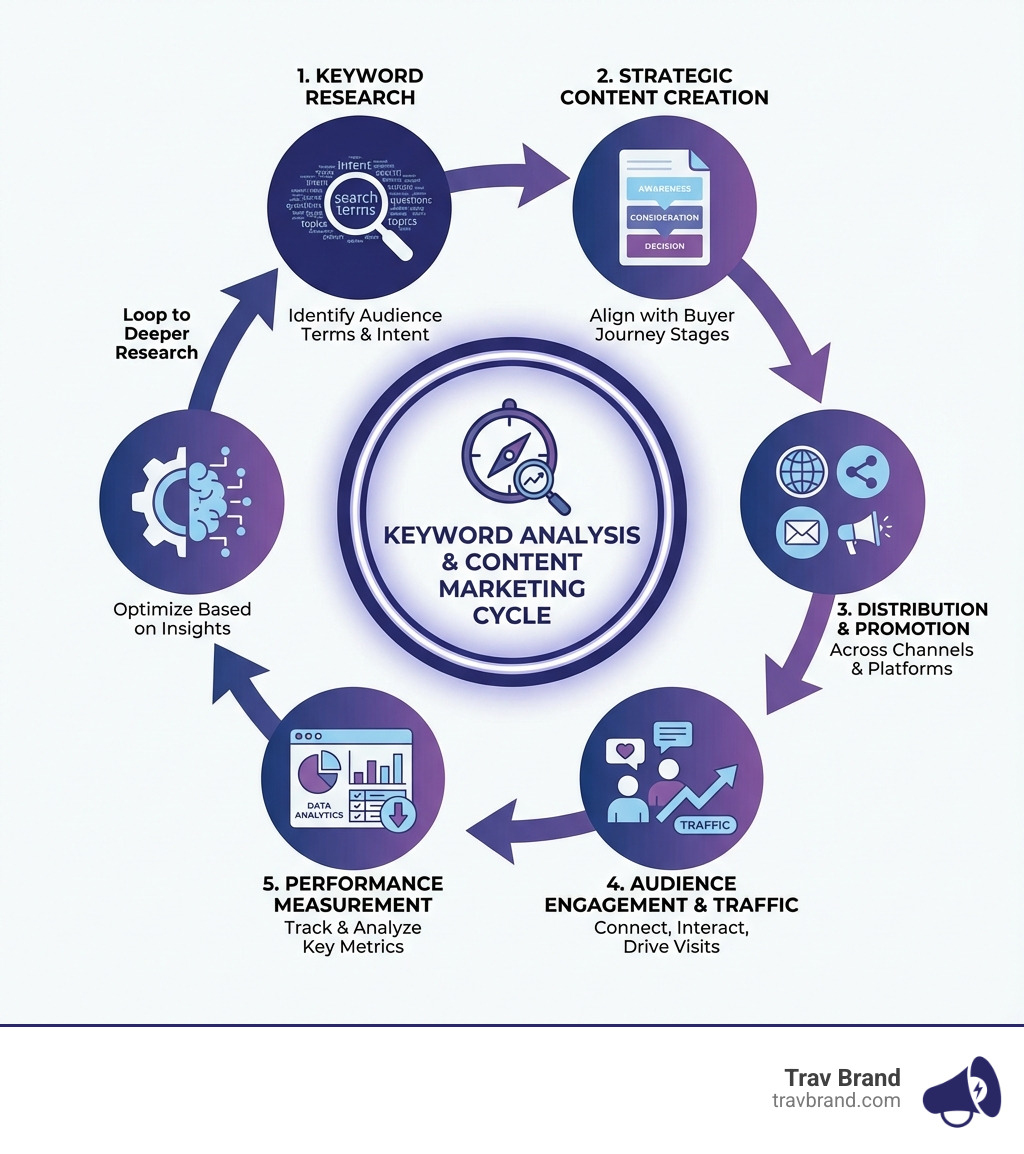
Keyword analysis and content marketing is the strategic process of finding what your audience searches for, understanding their intent, and creating content that meets their needs while driving business results. It’s the bridge between what people want to find and what your brand needs to communicate.
Here’s what you need to know:
- Keyword analysis identifies the specific words and phrases your target audience uses when searching for solutions, products, or information related to your business.
- Content marketing uses those insights to create valuable content that attracts, engages, and converts your ideal customers.
- The connection between them creates a data-driven roadmap for content that ranks in search engines and resonates with real people.
- The outcome is more qualified traffic, better engagement, and measurable business growth.
The reality is stark: 67% of the buyer’s journey now happens online 67 percent of the buyer’s journey. Whether you’re targeting B2B buyers (94% research online before purchasing) 94 percent of B2B buyers or consumers (81% do the same) 81 percent of customers, your audience is searching. The question isn’t whether they’ll find information—it’s whether they’ll find your content or your competitor’s.
Yet here’s what most businesses miss: keyword research isn’t about stuffing words into content anymore. With 88% of people still using Google, but 31% now using social media to search and 12% turning to AI chatbots, the landscape has shifted. Search behavior is fragmenting across platforms. AI algorithms like Google’s BERT and MUM understand context and intent, not just exact-match phrases. The old playbook of targeting individual keywords is dead.
What works now is understanding why someone searches, where they search, and what they expect to find. It’s about building content systems, not just campaigns. It’s about topic authority, not keyword density.
The ‘Why’: Understanding the Strategic Core of Keyword Research
At Trav Brand, we believe that keyword analysis and content marketing isn’t just a technical SEO task; it’s a strategic imperative. It’s the foundational layer that helps us understand our audience, anticipate their needs, and craft content that genuinely resonates. We want to learn from our keyword analysis not just what words people type, but why they type them and what problems they’re trying to solve.
This is crucial because it helps us accurately target our intended customers and create material that speaks directly to their interests. When performed correctly, keyword analysis will help us identify topics that our targeted customers want to read, ensuring our content is valuable for the right audience.
Understanding our audience’s search behavior is paramount. How does your audience search for the product, service, or information you provide? Do they use short, broad terms or detailed questions? By aligning our content marketing efforts with what our targeted audience is searching for, we ensure that our content isn’t just seen, but that it also attracts potential customers. This helps us weed out those who aren’t genuinely interested, saving valuable resources. Whether our content marketing goals are higher conversions, increased brand awareness, or establishing thought leadership, keyword analysis is the roadmap to achieving them.
The Critical Role of Search Intent
The “why” behind a search query is known as search intent, and it’s absolutely critical to align our content with it. Today’s AI-driven algorithms understand context and relationships between concepts, so we must understand the user’s goal when they type something into a search engine.
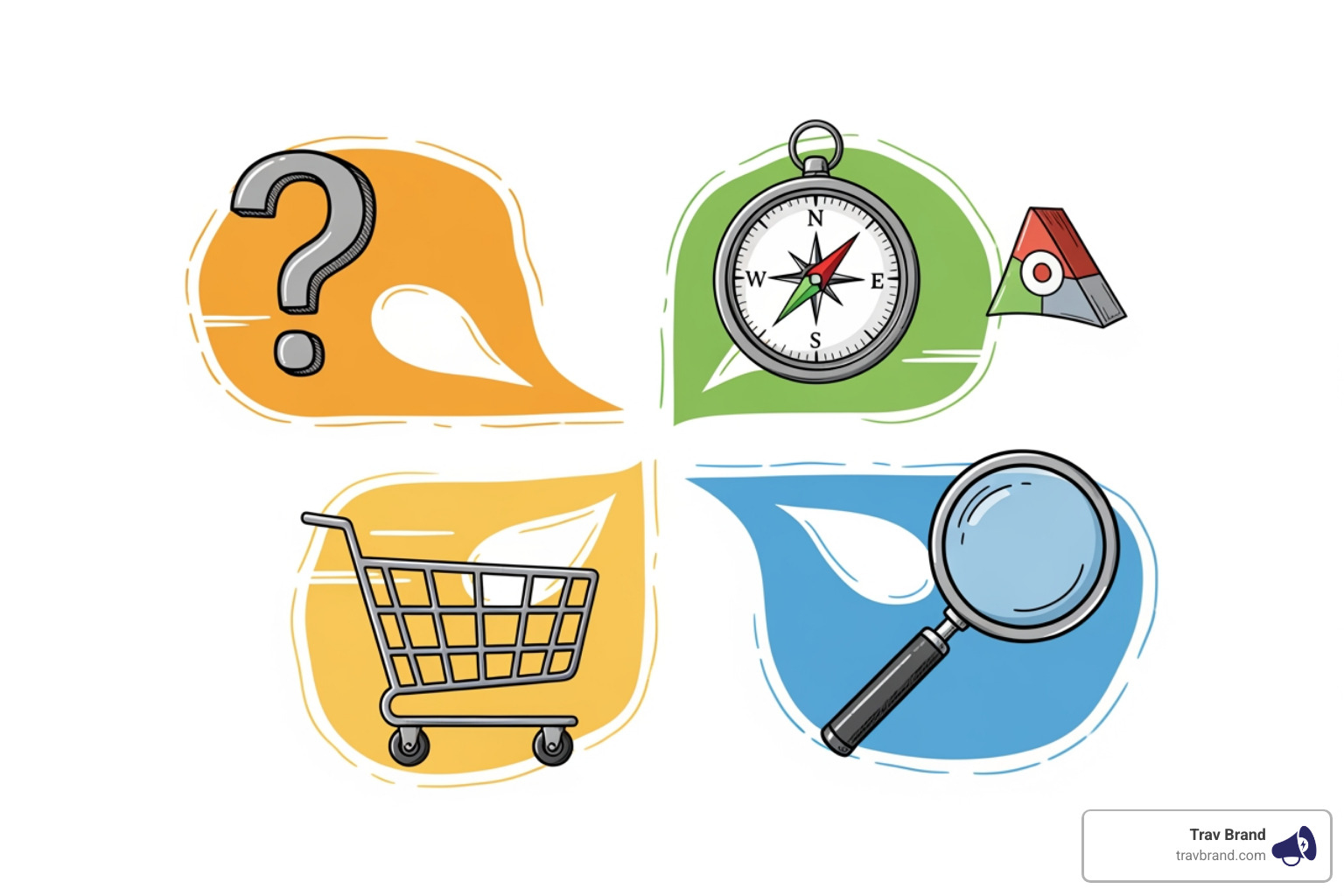
There are generally four main types of search intent, which also align with different types of keywords:
- Informational Intent: The user is seeking information or an answer to a question. They’re often asking “how to,” “what is,” or looking for facts and solutions.
- Example keywords: “how to start a blog,” “what is keyword analysis,” “benefits of content marketing.”
- Navigational Intent: The user wants to find a specific website or page. They already know where they want to go.
- Example keywords: “Trav Brand services,” “Google Keyword Planner login,” “HubSpot blog.”
- Transactional Intent: The user is ready to make a purchase or take a specific action. They’re looking to buy, sign up, or download.
- Example keywords: “buy ergonomic desk online,” “CRM software pricing,” “download keyword research template.”
- Commercial Investigation: The user is researching products or services before making a purchase. They’re comparing options, reading reviews, or looking for the “best” of something.
- Example keywords: “best project management software,” “project management software comparisons,” “reviews for marketing agencies.”
Aligning our content with these intents ensures we’re providing the right information at the right time. For instance, if someone is looking for “how to start a blog,” they need a step-by-step guide, not a sales pitch. This focus on intent helps us create valuable, user-centric content that ultimately drives better results.
Mapping Keywords to the Buyer Journey
Understanding these keyword types becomes even more powerful when we map them to the buyer’s journey. The journey typically consists of three stages: Awareness, Consideration, and Decision. Our content should strategically guide potential customers through each stage.
- Awareness Stage: The buyer is experiencing a problem and is looking for information. They’re typically using informational keywords. Our content here might include blog posts, guides, and infographics that address their pain points without directly selling.
- Consideration Stage: The buyer has defined their problem and is now researching solutions. They’re using a mix of informational and commercial investigation keywords, often longer and more specific (long-tail keywords). Content like comparison articles, case studies, and expert guides are effective here.
- Decision Stage: The buyer is ready to make a purchase and is looking for specific product/service information. They’re using transactional keywords and highly specific long-tail keywords. Landing pages, product pages, and testimonials are perfect for this stage.
For example, an average B2B sale can take as long as 379 days average B2B sale is 379 days, and this decision time is increasing annually. This means we need a robust content strategy that nurtures leads throughout this extended journey. By aligning our content with the buyer journey, we ensure we’re there every step of the way, providing value and building trust.
A Step-by-Step Guide to Keyword Analysis and Content Marketing
Effective keyword analysis and content marketing is a systematic process. It’s not a one-time activity but an ongoing cycle of research, creation, measurement, and refinement. Here’s how we approach it at Trav Brand:

Step 1: Foundational Research and Persona Development
Before diving into tools, we begin with a deep understanding of our business and our audience. We ask ourselves:
- What do we want to achieve? (e.g., higher conversions, brand awareness, lead generation). It’s crucial to focus on a single priority objective for each piece of content to avoid underperforming.
- Who are we writing for? This is where buyer personas come in. We create detailed profiles of our ideal customers, including their demographics, pain points, and buying habits. Tools for creating buyer personas can be invaluable.
- What problems are our target audience trying to solve? We seek to understand customer desires and needs, not just specific terms. This involves talking to customers, sales, and customer service teams to gather qualitative insights.
- What language does our target audience use? This helps us uncover seed keywords—initial terms related to our products, services, or industry.
- Where do they spend time online? Understanding their preferred platforms helps us tailor our keyword research and content distribution. We can use tools like Google Search Console and Google Analytics to see which keywords currently drive traffic to us.
Step 2: Leveraging Tools for Data-Driven Keyword Findy
Once we have our foundational understanding, we turn to keyword research tools to gather quantitative data. These tools help us identify relevant keywords, analyze search volume, and assess competition.
Key Metrics to Evaluate Keywords:
- Search Volume (MSV): The average number of times a keyword is searched per month. A “good” volume depends on your niche; a specific niche might target 10-100 searches, while a broad market aims for thousands. Tools like searchvolume.io or the Keywords Everywhere browser extension can provide this data.
- Keyword Difficulty (KD): Estimates how hard it will be to rank on the first page of Google. A newer site might target keywords with KD under 30, while an established brand can aim for higher.
- Cost Per Click (CPC): While for paid ads, a high CPC can indicate strong commercial intent and value for a keyword in organic search.
- Search Intent: As discussed, understanding why someone searches is paramount.
Our Go-To Tools:
- Google Keyword Planner: An excellent starting point for basic keyword ideas and search volume.
- Google Trends: Essential for checking keyword popularity over time and identifying seasonal patterns.
- Ubersuggest & AnswerThePublic: Great for generating long-tail and question-based keywords to understand informational intent.
- Paid Tools (e.g., Semrush, Moz): For scaling and deeper analysis, professional tools are invaluable. They offer competitive insights, advanced filtering, and more precise metrics.
Step 3: Mastering Market Analysis for a Winning Edge
A crucial part of refining our keyword analysis and content marketing strategy involves analyzing the competitive landscape.
- What keywords are competitors ranking for? We use SEO tools to uncover what our competitors are targeting and how their content performs. This helps us identify new opportunities.
- What gaps exist in competitor content? By analyzing their top-ranking pages, we can spot areas where they’ve missed covering certain aspects or haven’t fully addressed user intent. This is where we can create superior content.
- Identify our true SEO landscape: We categorize competitive insights into three perspectives:
- Keywords to improve: Where we rank but competitors outrank us. These are often “quick wins.”
- New keyword opportunities: Where competitors rank, but we currently don’t.
- Winning keywords: Where we already outrank competitors. Understanding these helps us replicate success.
By systematically analyzing competitors, we gain a bird’s-eye view of the market, allowing us to find content opportunities that our audience is searching for and that our competitors might be overlooking.
Step 4: The Art of Keyword Mapping and Content Planning
With a prioritized list of keywords, the next step is to map them to our content strategy. This answers how keyword analysis and content marketing can inform the editorial calendar.
-
Mapping Keywords to Content Types: We align keywords with the most appropriate content format to meet user intent:
- Informational keywords (“how to do keyword research”): Best for blog posts, guides, and educational articles.
- Navigational keywords (“Trav Brand services”): Direct users to specific pages on our site.
- Transactional keywords (“buy digital marketing package”): Map to product, service, or pricing pages.
- Commercial investigation keywords (“best content marketing agency”): Ideal for comparison articles, reviews, and case studies.
-
Building Topic Clusters and Pillar Pages: Instead of isolated articles, we build topic clusters. This involves a broad Pillar Page (e.g., “Ultimate Guide to Digital Marketing”) and several in-depth Cluster Content articles on sub-topics (e.g., “How to Conduct Keyword Analysis”). This structure signals our authority to search engines.
-
Creating an Editorial Calendar: The keyword mapping process directly informs our editorial calendar. We schedule content creation based on keyword priority, search intent, and the buyer’s journey stage it targets. The main point of keyword research for content marketing is understanding what content exists, what’s missing, and what needs to be created to fill the gap.
From Research to Revenue: Measuring Success and Driving Growth
The power of keyword analysis and content marketing lies not just in creating content, but in measuring its impact and continuously improving our strategy. We connect keywords directly to business goals.
How to Measure the Success of Your Keyword Analysis and Content Marketing
If you can’t measure it, you can’t improve it. We focus on Key Performance Indicators (KPIs) that directly reflect our content marketing objectives:
- Tracking Keyword Rankings: We monitor where our content ranks for our target keywords. Tools like Google Search Console show us which keywords drive traffic and our ranking positions.
- Monitoring Organic Traffic: We look at overall organic traffic, but also segment it by landing page and keyword to understand which content performs best.
- Analyzing Engagement Metrics: This includes time on page, bounce rate, and pages per session. High engagement signals that our content is valuable and relevant.
- Measuring Conversions and Leads: Our content should contribute to business growth. We track conversions (e.g., form submissions, downloads, sales) that originate from organic search traffic.
- Identifying Underperforming Content: By regularly reviewing data, we can spot what content is underperforming and strategize for optimization or removal.
We can also test a keyword’s value by running small Google Ads campaigns before investing heavily in organic content. This helps gauge consumer expectations and conversion potential. For example, a site like Verywellfamily has grown its traffic to millions by creating thousands of pieces of content, demonstrating the power of a consistent, data-driven approach.
Common Mistakes to Avoid in Your Keyword Strategy
Even with the best intentions, it’s easy to stumble. Here are some common mistakes we strive to avoid in our keyword analysis and content marketing efforts:
- Ignoring Search Intent: Creating content that doesn’t align with what the user is actually looking for.
- Focusing Only on High-Volume Keywords: Neglecting long-tail keywords means missing out on highly specific, often high-converting traffic.
- Keyword Stuffing: Overloading content with keywords harms user experience and can lead to search engine penalties. Natural language is key.
- “Set It and Forget It” Mentality: Keyword research and content optimization are ongoing processes, as the search landscape constantly evolves.
- Not Analyzing Competitors: Failing to see what competitors are doing well (or poorly) means missing valuable opportunities and insights.
- Prioritizing Quantity Over Quality: It’s better to create excellent, in-depth content for a few carefully chosen keywords than mediocre content for hundreds.
The Future is Now: Adapting to AI and Evolving Search Behaviors
The landscape of search is undergoing a rapid change, largely driven by advancements in AI and changing user habits. This impacts how we approach keyword analysis and content marketing.
- The Rise of AI in Search: Traditional keyword research focused on exact-match phrases. Today, AI-driven algorithms like Google’s BERT, MUM, and Gemini understand context, intent, and semantic relationships. This means we’re moving from keyword density to topic authority and comprehensive coverage.
- Zero-Click Searches and AI Overviews: A significant trend is the rise of “zero-click searches,” where users find their answer directly on the search results page (SERP). Google’s AI Overviews aim to answer queries directly. This means we need to optimize for featured snippets and structured data to ensure our content is still visible and cited. A study by Sparktoro shows an overall negative trend for US and EU traffic clickthroughs from Google.
- Voice Search: The growing number of voice searches means users are asking full questions and using more natural, conversational language. This reinforces the importance of long-tail and question-based keywords.
- Video Search Platforms: While 88% of people still use Google, a significant portion of younger demographics are starting their searches elsewhere. For example, Axios found that just over a quarter of 18 to 24-year-olds start their search on video platforms like YouTube and TikTok. If our target audience includes this demographic, our keyword research needs to extend to these platforms.
- AI Chatbots: The rise of AI chatbots for search means that some users are turning to conversational interfaces. Our Consumer Trends Report found that men (33%) are significantly more likely than women (25%) to find gen AI-powered search “much” more appealing for online shopping. Users often interact with AI chatbots differently than with traditional search engines, using longer, more conversational, and specific queries. This highlights the need to consider how our content might be consumed and cited by these AI systems.
The shift isn’t something to fear but an evolution to adapt to. We now focus on understanding the broader topic, providing comprehensive answers, and optimizing for semantic intent and conversational queries, ensuring our content is valuable wherever the audience searches.
Frequently Asked Questions about Keyword Analysis
What are the different types of keywords?
Beyond search intent, keywords are also classified by their length and specificity:
- Short-tail (Head) Keywords: Broad, one or two-word terms (e.g., “SEO”). They have high search volume but are very competitive.
- Long-tail Keywords: Longer, more specific phrases (e.g., “how to do keyword research for content marketing”). They have lower search volume but often higher user intent and are less competitive.
- Keywords by Intent: As covered earlier, keywords can also be categorized as Informational, Navigational, Transactional, or Commercial Investigation based on the user’s goal.
How do you find content gaps using keyword research?
Finding content gaps is about identifying what’s missing from your content strategy. We approach this by:
- Analyzing our own content: Using tools like Google Search Console, we see what keywords we rank for and identify topics we should be covering but aren’t.
- Competitor analysis: We examine what keywords our competitors rank for where we don’t, and what topics they cover that we haven’t.
- “People Also Ask” and related searches: These sections in Google reveal common questions and adjacent topics our audience is interested in.
- Audience feedback: Direct input from our audience, sales team, and customer service team can highlight questions and pain points that aren’t being addressed.
How often should you perform keyword research?
Keyword research is an ongoing process, not a one-time task. We recommend a multi-tiered approach:
- Continuous Ideation: Always be on the lookout for new topics and trending queries by monitoring industry news and social media.
- Quarterly Review: Conduct a quarterly review of core keywords and content performance to identify shifts in search volume or emerging trends.
- Annual Deep Audit: Once a year, perform a comprehensive audit of your entire keyword strategy, re-evaluating personas and the competitive landscape.
- Situational Research: Conduct fresh keyword research whenever launching new products or services or entering new markets.
This iterative approach ensures our keyword analysis and content marketing strategy remains agile and effective.
Conclusion
In the dynamic world of digital marketing, keyword analysis and content marketing remains the bedrock of any successful strategy. It’s the essential bridge connecting what your audience seeks with the valuable content your brand provides. We’ve seen how understanding search intent, mapping keywords to the buyer’s journey, leveraging powerful tools, and carefully analyzing the market can transform your content from a mere presence to a powerful revenue driver.
The shift from simple keyword density to semantic understanding and topic authority, propelled by AI and evolving search behaviors, means our approach must be more sophisticated and user-centric than ever before. It’s about building content systems that adapt, measure, and continuously improve.
At Trav Brand, we specialize in helping businesses steer this complex landscape. We build and scale brands through comprehensive digital marketing, e-commerce, and content strategies, focusing on purpose-driven results. Let us help you open up your audience and build a powerful content strategy that truly performs.
Build a powerful content strategy with our expert services.


