
Your Step-by-Step Blueprint for Content Marketing Competitive Analysis
Why Content Marketing Competitive Analysis Is Your Secret Weapon
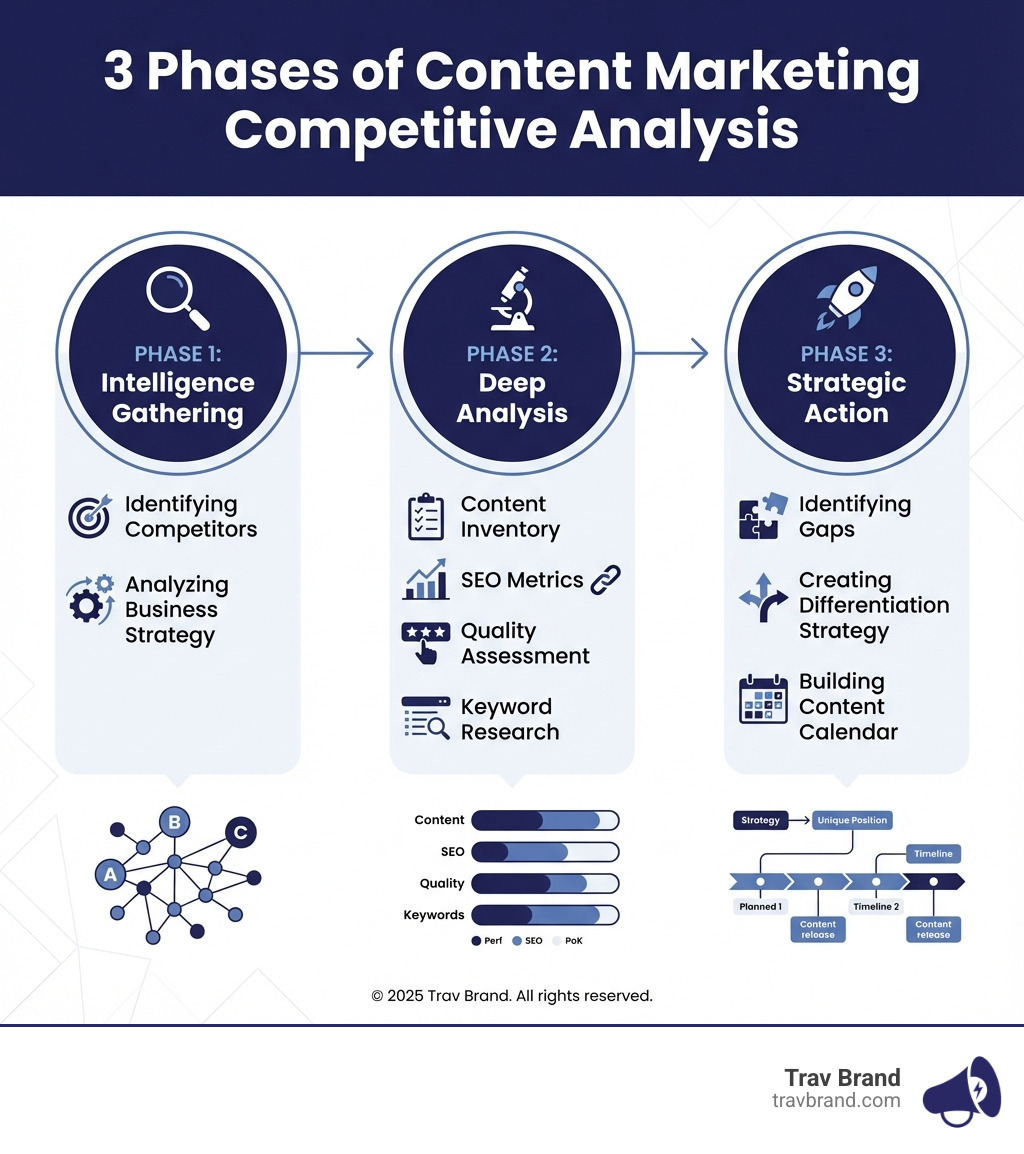
Content marketing competitive analysis is the systematic process of evaluating your competitors’ content strategies, SEO tactics, and audience engagement to identify gaps, benchmark your performance, and uncover opportunities to differentiate your brand. Here’s what a complete analysis includes:
Core Components of a Content Marketing Competitive Analysis:
- Intelligence Gathering – Identify direct, indirect, and search engine competitors
- Content Inventory – Catalog competitor content types, topics, formats, and publishing frequency
- SEO Analysis – Evaluate keyword rankings, backlink profiles, Domain Authority, and organic traffic
- Quality Assessment – Measure content depth, structure, engagement, and performance
- Strategic Action – Identify content gaps, opportunities, and create a differentiated strategy
Most founders create content in a vacuum. They publish blog posts, make videos, and post on social media without knowing what’s already working in their market. The result? Content that blends into the noise instead of cutting through it.
Here’s the uncomfortable truth: your competitors are learning from their past publishing, optimizing their strategies, and regularly analyzing what works. If you’re not doing the same, you’re playing catch-up in a game where the rules keep changing.
Research shows that longreads (7,000+ words) drive nearly 4X more traffic than average-length articles, posts with images get twice as much traffic, and structured content with H2/H3 headings performs 44% better. But here’s the catch—your specific audience might be different. The only way to know is through competitive analysis.
A competitive content analysis isn’t about copying what others do. It’s about understanding the landscape so you can find the white space—the topics, formats, and angles your competitors are missing. It’s the difference between guessing what might work and building a strategy backed by market intelligence.
I’m Trav Lubinsky, and over the past decade building brands like Flex Watches and scaling companies through strategic partnerships with Marcus Lemonis, Daymond John, and billion-dollar enterprises, I’ve learned that successful content marketing competitive analysis isn’t optional—it’s the foundation of every winning content strategy. At Trav Brand, we use this framework to help founders move from reactive content creation to proactive market leadership.
Step 1: Identifying Competitors and Gathering Intelligence
Before we dive into the nitty-gritty of content, we need to understand who we’re up against and what makes them tick. This foundational analysis helps us grasp their overall business and product strategy, which in turn informs their content decisions. Think of it as putting on our detective hats to gather the initial clues.
Who Are Your True Content Competitors?
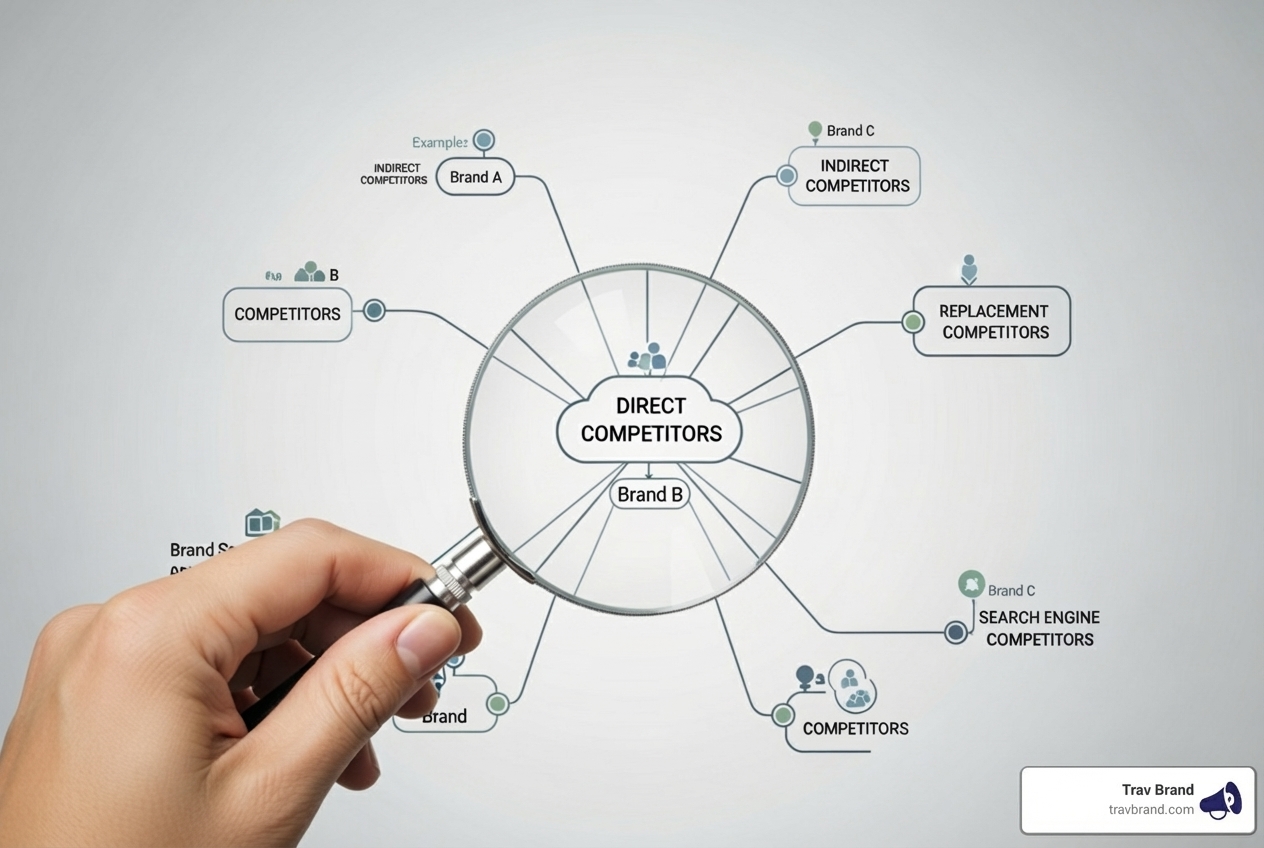
When we talk about competitors, it’s not always as straightforward as identifying who sells the same thing. For a comprehensive content marketing competitive analysis, we need to cast a wider net.
- Direct Competitors: These are the obvious ones. They offer similar products or services to the same target audience as us. If we sell artisanal dog biscuits, another brand selling artisanal dog biscuits is a direct competitor.
- Indirect (or Secondary) Competitors: They might offer different products or services, but they satisfy the same customer need. For our dog biscuit example, this could be a brand selling premium dog food or even a pet toy company that offers subscription boxes. They’re vying for the same customer’s wallet and attention, just with a different solution.
- Substitute Competitors: These are often overlooked but can significantly impact our market. They offer completely different products or services that can still address the underlying customer problem. Picture a nail salon and home nail kits – during the pandemic, one became a substitute for the other. For our dog biscuits, this could be a DIY pet treat blog, or even a brand selling healthy human snacks that pet owners might share with their dogs.
- Search Engine Competitors: This is a crucial category for content marketing. These are any websites ranking for the keywords we want to target, even if they aren’t direct business rivals. They’re competing for the same search visibility and audience attention. A blog about dog nutrition might not sell biscuits, but if they rank for “healthy dog treats,” they’re a content competitor.
If identifying industry players feels like searching for a needle in a haystack, a structured system like the North American Industry Classification System (NAICS) can help. Every business in Canada, for instance, is assigned a six-digit code. We can use the NAICS website to find our business type’s code and related industry data, offering insights into average company size, operating expenses, and even employee wages. This helps us understand the typical landscape.
Beyond structured databases, a simple Google search for our product category or target keywords is invaluable. We examine the top 50 results and even the ads displayed to uncover who’s actively competing for attention in our space. We’re looking for anyone who might be influencing our potential customers’ decisions.
Analyzing Competitor Business and Product Strategy
Once we have our list of competitors, we dig deeper into their overall business and product strategies. This isn’t just about their content; it’s about understanding their motivations and how they position themselves in the market.
- Target Audience & Core Messaging: Who are they trying to reach? How do they talk about themselves and their offerings? We review their homepage copy, title, and meta description (easily viewable manually in Google or using a tool like SEOquake). Their “About Us” pages are also goldmines for understanding their mission and values.
- Product Features and Pricing: What are they selling, and at what price point? The best way to truly understand a competitor’s product strategy is to actually use their product, if feasible. We also scour community forums, review sites, and comparison platforms to see what customers love and hate. Do they offer free trials, freemium versions, or unique perks? Their pricing pages can reveal underserved market segments or opportunities for our own A/B testing.
- Company Size and Funding: This gives us a sense of their resources and ambition. We can use tools like Crunchbase to find information on their funding rounds, key personnel, and employee count. This data helps us gauge their investment capacity in areas like content marketing. We can even look at their job openings on sites like Glassdoor or LinkedIn; new hires in specific departments can signal upcoming product launches or shifts in marketing strategy.
Understanding these broader business elements sets the stage for analyzing their content. It helps us avoid simply copying and instead allows us to find unique angles that align with our business strengths and target audience.
Step 2: The Deep Dive: Analyzing Competitor Content and SEO
Now that we know who our competitors are and what their overall strategy looks like, it’s time to put on our content goggles. This phase is all about dissecting their content output and understanding how it performs in search engines.

Inventorying Competitor Content Assets
The first step in analyzing competitor content is to create a detailed inventory. We want to catalog every type of content they produce and where they publish it. This helps us see the full scope of their content investment and identify popular formats.
Here’s a list of common content formats we inventory:
- Blog posts: The bread and butter for many. We look at topics, length, and frequency.
- Videos: Including YouTube series, product demos, explainers, and social media clips.
- Podcasts: Audio content can reveal their team’s expertise and thought leadership.
- E-books & White papers: Often gated, these indicate their long-form, lead-generation content.
- Webinars: Live or recorded sessions that offer deeper dives into specific topics.
- Case studies: Demonstrating success and building trust.
- Infographics & Presentations: Visual content for quick consumption or thought leadership.
- FAQs & How-to Guides: Addressing common customer questions directly.
- Press Releases & Feature Articles: For public relations and industry authority.
- E-newsletters: What do they deem most valuable to send directly to prospects and customers?
We also note the content channels they leverage. Is it just their website, or do they have a strong presence on YouTube, Instagram, TikTok, LinkedIn, or even niche forums? Understanding their distribution tells us where their audience congregates.
Finally, we tag each piece of content with topics and themes. This allows us to see patterns: what subjects do they prioritize? Are there any recurring themes? This tagging is critical for later identifying content gaps.
Assessing Content Quality and Quantity
Once we have our inventory, we need to evaluate both the volume and caliber of their content.
Quantitative Analysis:
- Publishing Frequency & Content Volume: How often do they publish? Do they have a consistent schedule? A high volume and consistent frequency indicate a strong commitment to content marketing. We tally the number of blog posts per month, videos per quarter, etc.
- Average Word Count: What’s the typical length of their articles? Research shows that longreads (7,000+ words) can drive nearly 4X more traffic than average-length articles (900-1,200 words). We can use tools like Word Counter Plus to quickly measure the word count of any web page. This helps us set targets for our own content length.
Qualitative Analysis:
- Depth and Accuracy: Do they offer surface-level information or deep, well-researched insights? Is the information accurate and up-to-date? This is where we look for true thought leadership.
- Readability and Tone: Is their content easy to understand? Does it have a consistent brand voice? Does it resonate with their target audience?
- Use of Visuals: Do they incorporate images, videos, or infographics? Posts with at least one image receive twice as much traffic as text-only posts, and they also get 30% more shares and 25% more backlinks. We also look for the use of lists, as posts with at least one list per 500 words receive 70% more traffic.
- Author Expertise: Is the content written by recognized experts or industry leaders? Do they have author bios that highlight their credibility?
- Reader Engagement: Beyond just traffic, how do people interact with their content? We look at comments, social shares, and sentiment (if accessible) to gauge how well their content resonates. High engagement often indicates high quality.
By carefully evaluating these factors, we start to paint a picture of our competitors’ content strengths and weaknesses, identifying areas where we can potentially outperform them.
Decoding Their SEO and Keyword Strategy
Even the most brilliant content won’t be found if it’s not optimized for search engines. This step in our content marketing competitive analysis focuses on understanding how competitors are winning (or losing) in search.
- Key SEO Metrics: We begin with a high-level overview.
- Domain Authority (DA) / Authority Score: This metric (from Moz or Semrush, respectively) estimates a website’s overall strength and ranking potential. It helps us benchmark our site against theirs.
- Organic Traffic Estimates: Tools like Semrush or Ahrefs can provide estimates of how much organic traffic a competitor receives monthly. This indicates the overall success of their SEO efforts.
- Backlink Profile Analysis: Backlinks are votes of confidence from other websites. We use tools like Ahrefs to see which pages on a competitor’s site get the most links and who those links are coming from. This reveals their “link magnets” and potential opportunities for us to earn similar links.
- Top Ranking Keywords: What keywords are they ranking for? More importantly, what keywords are they not ranking for that are relevant to our business? Tools like SEMrush give us a full list of keywords that are working for them, allowing us to identify where we can beat them, especially for “low-hanging fruit” keywords they’ve overlooked.
- On-Page SEO Elements: We manually review their pages and use browser extensions to see how they optimize their content.
- Titles & Meta Descriptions: Do they include target keywords? Are they compelling? We can use SEOquake to quickly scrape this information from any page.
- Headings (H1, H2, H3): Are they using a clear, hierarchical structure? Research shows that posts with a simple structure (using H2 and H3) perform well in terms of traffic and engagement.
- Keyword Density: Are they naturally incorporating keywords throughout their copy, or is it keyword-stuffed?
- Internal Linking: How do they link to other relevant content on their site?
- Content Structure & Lists: Beyond headings, we look at how they organize information. As mentioned, posts with lists tend to perform better, so we check if they incorporate these effectively.
By dissecting their SEO strategy, we uncover not just what they’re doing well, but also the crucial gaps and weaknesses we can exploit to gain a competitive edge.
Step 3: From Data to Dominance: Your Content Marketing Competitive Analysis Action Plan
We’ve gathered intelligence, we’ve dove deep into their content and SEO, and now it’s time for the exciting part: turning all that data into actionable strategies that will help us differentiate and dominate our market.
Identifying Content Gaps and Strategic Opportunities
This is where the real magic happens. Our content marketing competitive analysis isn’t just about knowing what competitors are doing; it’s about finding what they aren’t doing.
- Topic Gaps: What topics relevant to our audience and industry are our competitors neglecting or only scratching the surface of? This is our prime opportunity to establish thought leadership. For instance, if a competitor is strong in “e-commerce platforms” but weak in “e-commerce for technical users,” that could be a significant gap to fill.
- Format Gaps: Are they only focusing on blog posts? Perhaps there’s an opportunity for us to excel in video tutorials, interactive quizzes, in-depth podcasts, or comprehensive webinars. Expanding into new content channels before competitors do, like YouTube or TikTok, can capture an audience they’re missing.
- Audience Segment Gaps: Are there specific buyer personas or stages of the buyer’s journey that our competitors aren’t adequately addressing with their content? This could be a niche we can own.
- Keyword Opportunities (“Low-Hanging Fruit”): Based on our SEO analysis, we identify keywords that our competitors aren’t ranking for, or where their ranking is weak, but which still have decent search volume. These are easier targets for us to rank for initially, building authority that can eventually help us compete for higher-competition terms.
- Applying Blue Ocean Strategy Concepts: This strategic framework encourages us to create new market space rather than competing in existing, crowded ones. By understanding our competitors’ current offerings, we can identify features to eliminate, reduce, raise, or create in our own content strategy. Exploring Blue Ocean Strategy can help us visualize our unique positioning.
- Creating a SWOT Analysis: A classic but powerful tool. We summarize our competitors’ Strengths, Weaknesses, Opportunities (for us), and Threats (they pose to us). This structured approach helps us prioritize our content efforts.
The goal isn’t to clone our competitors’ strategies. As the saying goes, “Everything you do needs to be on purpose.” Our purpose is to create unique, valuable content that truly stands out.
Presenting Findings and Choosing Your Tools for Content Marketing Competitive Analysis
Once we’ve carefully gathered and analyzed our data, the next critical step is to present our findings in a clear, actionable way. This ensures that everyone on our team understands the competitive landscape and how our content strategy will adapt.
We typically present our findings via a concise deck or a Google Doc, often incorporating visuals to make the data digestible. A summary report highlights the key takeaways, allowing us to focus on the most impactful insights. For organizing the raw data, a competitive research template, like this free Google Sheets template, is incredibly useful.
Here’s a simplified table comparing three hypothetical competitors based on key metrics we’d gather:
| Metric | Competitor A | Competitor B | Competitor C | Our Target |
|---|---|---|---|---|
| Domain Authority (DA) | 65 | 48 | 72 | 55 |
| Blog Frequency | 4/month | 1/week | 2/month | 2/week |
| Top Content Format | Long-form guides | Video Tutorials | Case Studies | Mixed |
| Avg. Word Count | 2,000 | 500 (scripts) | 3,500 | 1,800 |
| Backlink Profile | Strong | Moderate | Very Strong | Growing |
| Content Gap | Podcasts | In-depth FAQs | Short-form video | N/A |
To assist in this entire process, a suite of tools is indispensable:
- SEO Platforms: Tools like Semrush, Ahrefs, and Moz (with its Domain Overview tool) are crucial for keyword research, backlink analysis, traffic estimates, and competitive SEO insights.
- Social Listening Tools: Platforms like Awario and Mention help us track brand mentions, sentiment, share of voice, and popular topics related to our competitors.
- Content Research Tools: BuzzSumo can show us a competitor’s most shared posts, providing inspiration for high-engagement content.
- Website Analysis Tools: BuiltWith and What Runs can reveal a competitor’s technology stack, giving us clues about their infrastructure and capabilities.
- Browser Extensions: SEOquake and Word Counter Plus offer quick, on-page insights.
Choosing the right tools, and organizing the findings, transforms raw data into a compelling narrative that informs our content strategy.
How Often Should You Perform a Content Marketing Competitive Analysis?
A content marketing competitive analysis isn’t a one-and-done task. The digital landscape is constantly shifting, and our competitors are always evolving. We recommend conducting a full competitive analysis at least once a year, with more frequent check-ins.
- Ideal Frequency: While a deep dive annually is a good baseline, we find it beneficial to revisit key metrics and competitor activity quarterly. If our competitors are particularly active or our market is volatile, even more frequent monitoring might be necessary.
- Triggers for a New Analysis: Certain events should prompt a fresh look:
- New Competitor Emerges: A new player entering the market, especially one with a strong content game, warrants immediate attention.
- Significant Market Shift: Changes in consumer behavior, new technologies, or economic shifts can alter the competitive landscape.
- Performance Plateau: If our content performance stagnates, a competitive analysis can often reveal why and where new opportunities lie.
- Continuous Monitoring vs. Deep Dives: We advocate for a blend. Use lightweight tools and processes for continuous monitoring of competitor content and SEO performance. Then, schedule comprehensive deep dives to re-evaluate their entire strategy and pinpoint new strategic directions. This approach ensures we stay agile and informed without getting bogged down in constant, exhaustive analysis.
Staying on top of our competitors’ moves helps us remain proactive, not reactive. For a glimpse into how these analyses translate into real-world strategies, you can see an example of a completed project in our portfolio.
Frequently Asked Questions about Content Marketing Competitive Analysis
What is the biggest mistake to avoid in a competitive content analysis?
The biggest mistake is blindly copying competitors. The goal is to use the data to learn, find unique opportunities, and differentiate your brand, not to clone what others are already doing. Simply mimicking what’s already out there will only ever make us “second best” or another voice in the noise. Our analysis should empower us to identify white space and carve out a distinctive presence.
How do I compete with brands that have much larger content budgets?
It’s a common challenge! The key is not to compete on volume, but on smart strategy. Focus on their weaknesses:
- Target Niche Topics: Larger brands often aim for broader appeal, leaving smaller, highly specific topics underserved. We can dominate these niches with in-depth, high-quality content.
- Excel in Underused Formats: If they’re all about blogs, maybe we can own the video space with compelling tutorials or a unique podcast.
- Build Stronger Community: Large brands can sometimes feel impersonal. We can foster a more engaged, loyal community through personalized content and direct interaction.
- Quality over Quantity: As the research shows, long, well-structured articles with visuals perform exceptionally well. A few outstanding pieces can outperform dozens of mediocre ones.
Compete on quality, focus, and connection, not just sheer content output.
Is it necessary to analyze indirect competitors?
Yes, absolutely. Indirect competitors can be a fantastic source of content inspiration, reveal broader audience interests, and highlight potential partnership opportunities you might otherwise miss. They often address the same underlying customer needs or problems, just with different solutions. Understanding their content can uncover new angles, pain points, or even adjacent topics that our direct competitors aren’t covering, giving us a fresh perspective and a unique edge.
Conclusion: Turn Your Analysis into Market Leadership
A thorough content marketing competitive analysis is more than just a research project; it’s a strategic imperative. It transforms us from reactive content creators, guessing what might work, into proactive market leaders, making data-driven decisions. By systematically identifying competitors, dissecting their content and SEO, and pinpointing gaps and opportunities, we build a robust blueprint for our own content strategy.
This analysis allows us to benchmark our efforts, identify our unique advantages, and craft content that genuinely differentiates our brand. It’s the foundation for sustainable growth, ensuring our content not only reaches our audience but resonates deeply, driving engagement and conversions.
At Trav Brand, we believe this analysis is the first step in building a content engine that truly stands out. For brands looking to turn these insights into a comprehensive growth strategy, we offer an ecosystem of services from analysis to execution, helping you not just compete, but lead.
Develop your winning content strategy with our expert services