The Ultimate Guide to Web Content Strategy: Plan, Create, and Conquer
Why Your Brand Needs a Web Content Strategy
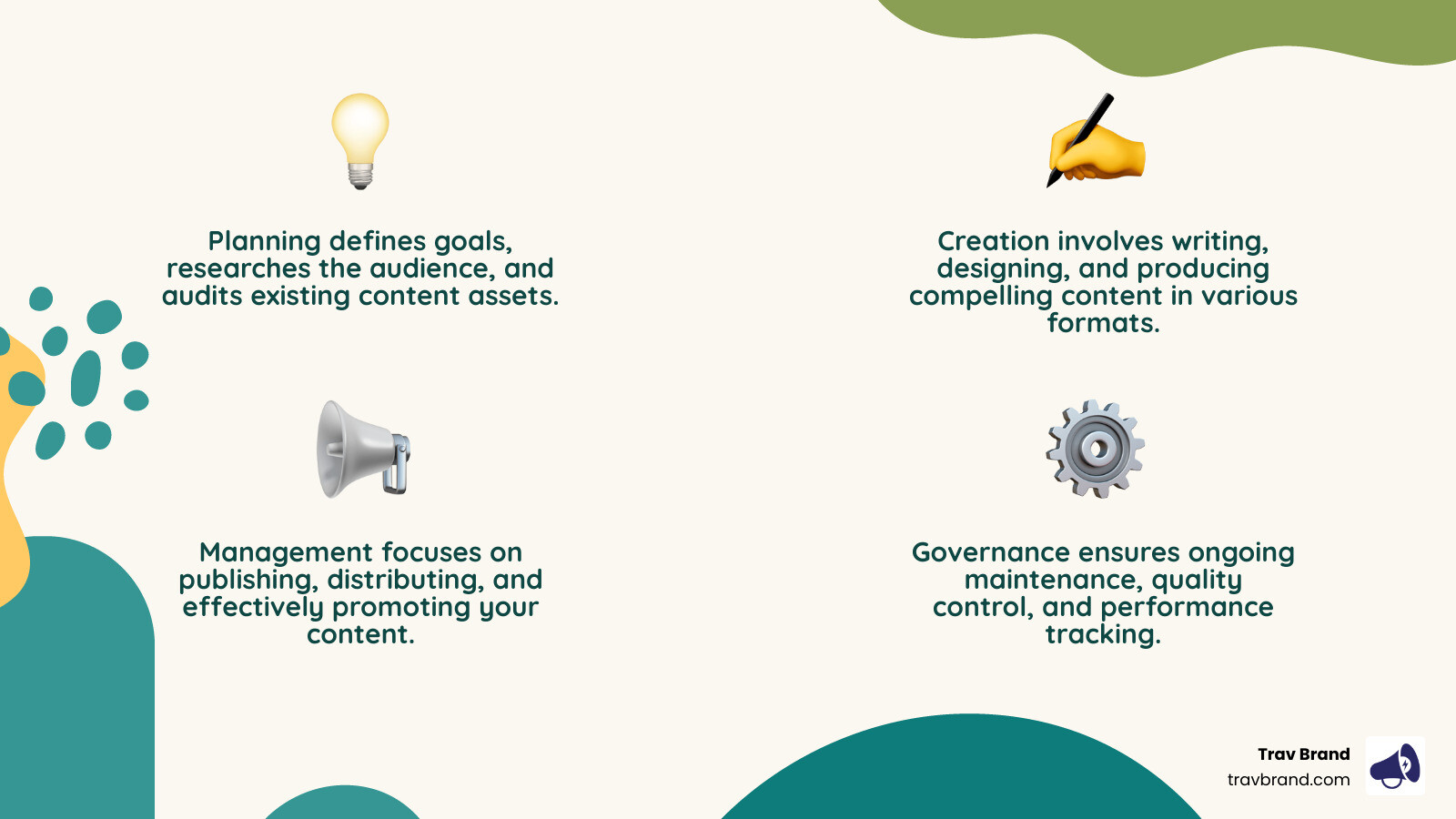
A web content strategy is your roadmap for planning, creating, delivering, and managing content that meets user needs and achieves business goals. It’s not just about what you publish—it’s about why, when, where, and how you publish it.
Quick answer: A web content strategy defines:
- Purpose – Why the content exists and what business goals it serves
- Audience – Who needs the content and what problems it solves for them
- Substance – What content to create, in what formats, and with what voice
- Structure – How content is organized, tagged, and made findable
- Workflow – Who creates, reviews, approves, and maintains content
- Governance – How content quality and consistency are maintained over time
Here’s the hard truth: content is one of the main components of a great user experience. Yet many organizations treat it as an afterthought, wasting time and money on content that’s pointless for users and profitless for the business. Companies without a strategy end up with scattered messaging, confused customers, and website projects that drag on for months.
The investment in getting your strategy right pays dividends. Customers who find your site through strategic, SEO-optimized content tend to have greater lifetime value. A strong strategy helps teams move from creating random one-off pieces to building an efficient system where content works together to amplify your brand message and drive measurable results.
I’m Trav Lubinsky, and I’ve spent over a decade helping consumer brands and high-growth companies build powerful web content strategies that drive engagement and revenue. Through my work with brands like HexClad, FightCamp, and Poppi—and partnerships with everyone from Marcus Lemonis to Jake Paul—I’ve seen how strategic content transforms businesses.
What Is a Web Content Strategy and Why Is It Crucial?
A web content strategy is the ongoing practice of planning for the creation, delivery, and governance of useful, usable, and effective content about a particular topic or set of topics. It’s the blueprint that ensures every piece of content we produce serves a legitimate purpose for both our business objectives and our users’ needs.
Why is this so important? Because, as Kristina Halvorson, author of Content Strategy for the Web, wisely put it, “Content has the power to make or break the user experience: it’s impossible to design a good user experience with bad content.” If our users don’t find our content useful or trustworthy, they might not return.
The reality is that accessing useful content is one of the main reasons users will visit our website before starting on commercial buying journeys with us. A well-crafted web content strategy ensures that we’re not just publishing for the sake of it, but genuinely helping our audience.
Historically, the content part of any web project has often been the most convoluted and problematic element—and the main reason for delays. Without a clear strategy, teams tend to invest a lot of time and money into one-off pieces of content that don’t always work together. A robust digital content strategy helps us shift from this reactive approach to efficiently creating content that amplifies our brand’s message and drives business across all digital channels. It’s about being proactive, not just productive.
For a deep dive into web content strategy, we highly recommend consulting authoritative industry resources like Kristina Halvorson’s seminal work, Content Strategy for the Web.
The Difference Between Strategy and Tactics
This is a common pitfall we see many brands stumble into. People often confuse web content strategy with content-related tactics, like copywriting or editing, making videos, designing infographics, and posting social media promotions. While these are all essential activities, they are tactics—the “how-to” of content.
A web content strategy comes before tactics. It plans, clarifies, and connects those tactics to a meaningful purpose. Think of it this way: strategy is our game plan, outlining our objectives and how we intend to win; tactics are the individual plays we execute on the field. Without a strategy, our tactics become “random acts of content,” often leading to wasted effort and unclear results. As Halvorson notes, many organizations still treat content as an afterthought instead of an asset, prioritizing interface design over the actual information people need. We believe in prioritizing content first.
The High Cost of Neglecting Strategy
Ignoring the need for a solid web content strategy can be incredibly costly, both in terms of resources and reputation. We’ve seen how organizations waste money and resources creating and maintaining content that’s pointless for users and profitless for the business. This often leads to:
- Wasted resources: Time, money, and effort poured into content that doesn’t resonate or perform.
- Inconsistent messaging: Different parts of your organization speaking with different voices, confusing your audience and diluting your brand.
- Poor user experience: Content that is hard to find, difficult to understand, or irrelevant to user needs, leading to frustration and abandonment.
- Project delays: Content bottlenecks are notorious for derailing website redesigns and new initiatives.
- Damaged brand reputation: A lack of useful, trustworthy content can erode audience trust and make your brand seem unreliable.
As Kristina Halvorson stated, “Content has the power to make or break the user experience: it’s impossible to design a good user experience with bad content.” The investment and time spent on getting your web content strategy right – and then measuring the success of that content – is an essential piece of work to be successful in competitive and crowded markets. It’s about building a strong foundation for long-term success.
The Foundational Pillars of Your Web Content Strategy
To build a robust and effective web content strategy, we focus on several core components, or “pillars,” that support all our content efforts. These pillars ensure our content is not only creative and engaging but also purposeful and measurable. We can think of them in terms of Substance, Structure, Workflow, and Governance, all built upon a clear Purpose and understanding of our Audience.

Pillar 1: Purpose and Business Goals
Every piece of content we create must have a clear “why.” Defining the purpose of our content is the first and most critical step in our web content strategy. Without it, we’re just creating noise.
Our content strategy must align directly with our overarching business goals. Are we aiming to:
- Increase brand awareness? (e.g., through informative blog posts, social media engagement)
- Generate leads? (e.g., through gated content like whitepapers, webinars)
- Drive sales and conversions? (e.g., through compelling product descriptions, case studies, clear calls-to-action)
- Improve customer retention and loyalty? (e.g., through helpful FAQs, community content, support documentation)
- Establish thought leadership? (e.g., through in-depth guides, research reports)
We need to set SMART goals for our content: Specific, Measurable, Achievable, Relevant, and Time-bound. For example, instead of “get more traffic,” a SMART goal might be “increase organic traffic to product pages by 20% in the next six months.” This focus allows us to prioritize content elements that are most critical to business, drive audience engagement, and align with team resources.
Pillar 2: Audience and Needs
To truly get web content strategy right, we must not only understand who our customer is, but also her motivations, pain points, decision criteria, and how she searches for information. Designing web content without considering the user feels like the brand didn’t design for them.
This pillar involves deep audience research to create detailed audience personas. These aren’t just demographic sketches; they dig into psychographics, behaviors, and challenges. We use these personas to map out the user journey, identifying every touchpoint where content can inform, persuade, or support.
How do we understand these needs? We gather insights through:
- Surveys and interviews: Directly asking our audience about their questions, pain points, and desired outcomes. We also ask customer service teams about common issues.
- Analytics data: Observing how users interact with our current content, what they search for, and where they drop off.
- Industry studies: Reading up on broader trends and behaviors within our market.
Understanding our audience ensures our content enables high-quality engagement from the target audience. It helps us understand what will attract these personas to our website at different stages of the marketing funnel.
Pillar 3: Brand Voice and Messaging
Our brand’s personality should shine through every piece of content we publish. This pillar defines our unique brand voice and tone. Our voice is consistent (who we are), while our tone adapts (how we speak) to suit various contexts, content types, and communication channels.
Developing clear voice and tone guidelines ensures consistency across all content. We ask ourselves:
- Are we formal or casual?
- Authoritative or friendly?
- Humorous or serious?
- What jargon do we use, and what do we avoid?
For instance, we might consider how our team’s personality and linguistic style fit within established brand guidelines, like the University of Minnesota voice and tone, to resonate with our audience. We then write content that adapts to suit various contexts, content types, and communication channels.
We also create a messaging framework that outlines our core value propositions, key differentiators, and how we articulate them consistently. This ensures that whether someone is reading a blog post, a product description, or an email, they get a cohesive and authentic brand experience.
How to Develop Your Strategy: A Step-by-Step Guide
Developing a web content strategy might seem daunting, but we approach it as a repeatable process. It’s about systematic planning and delivery, ensuring every step builds upon the last.
Step 1: Conduct a Content Audit and Gap Analysis
Before we create new content, we need to understand what we already have. A content audit is a comprehensive review of all existing content assets on our website. This involves:
- Inventorying existing content: We compile a list of every page, article, image, video, and downloadable file. For larger sites, we use crawlers like Screaming Frog to pull a full list of URLs. To get started, we use a customizable content inventory spreadsheet template.
- Evaluating performance: We analyze metrics like page views, time on page, bounce rate, and conversion rates to understand how each piece of content is performing. We also look at SEO metrics like rankings and backlinks.
- Identifying content gaps: Once we know what we have and how it’s performing, we identify what’s missing. Are there topics our audience is searching for that we don’t cover? Are there stages of the customer journey where we lack supportive content?
This process involves both qualitative analysis (is the content high-quality, on-brand, accurate?) and quantitative analysis (what do the numbers tell us?). It helps us decide what content to keep, update, repurpose, or remove.
Step 2: Perform Market and SEO Analysis
With a clear understanding of our existing content, we then look outward. Market and SEO analysis helps us understand the competitive landscape and identify new opportunities for our content.
- Analyzing industry content: We scout out competitors’ websites to understand their content strategies, what’s working for them, and where we can differentiate ourselves. This isn’t about copying; it’s about research and inspiration.
- Identifying opportunities: We look for underserved topics, unique angles, or content formats that our competitors aren’t fully leveraging.
- Keyword research: This is crucial for guiding our content creation. Using tools such as Moz or Semrush gives us insights into what keywords, phrases, or new content our website would benefit from. It helps us understand user search intent – are they looking for information, comparison, or ready to buy? SEO plays a pivotal role by helping create targeted content, optimize product descriptions, and drive massive traffic to our website. Google rewards content that solves real problems, is helpful, and earns engagement.
After carrying out these changes and ensuring your web content strategy is based on keyword research and insights, you should see an increase in your website’s organic visibility and performance. For more information about our strategic approach, you can explore our portfolio-intro.
Step 3: Create Your Content Plan and Calendar
This is where we translate our research and insights into a concrete content plan and content calendar. This step defines the “who, what, when, and where” of our future content.
- Developing a work plan: We outline the types of content we’ll create (blog posts, videos, infographics, etc.), the key themes and topics, and how they align with our business goals and audience needs.
- Prioritizing topics: Based on our audit, gap analysis, and keyword research, we prioritize content that will have the biggest impact. We consider factors like search volume, competitive difficulty, and alignment with our unique value proposition.
- Creating a content calendar: This is our central hub for managing content production. It includes publication dates, content types, responsible team members, and the stage of the content lifecycle. It helps us maintain a consistent content flow.
- Assigning roles and responsibilities: Clear ownership for content creation, review, approval, and publication is essential for efficiency.
Here are some essential tools for content planning:
- Task management: A visual project management tool like ClickUp or Asana is useful to keep track of the content calendar and workflows.
- Keyword research: Moz or Semrush for in-depth keyword analysis.
- Spreadsheets: For content inventories and initial planning.
Trav Brand recommends using visual project management tools to streamline your content planning process, ensuring everyone is on the same page and deadlines are met.
From Creation to Governance: Executing Your Plan
Once our strategy and plan are in place, we move into the execution phases: content creation, delivery, and ongoing management. This involves understanding the full content lifecycle and establishing robust production workflows to maintain quality and consistency over time.
Content Creation and Structuring
This is where the magic happens, changing ideas into engaging digital assets.
- Content models: We define content models that outline the structure and elements for each content type (e.g., a blog post model might include title, author, publish date, body text, featured image, call-to-action). This ensures consistency and makes content more adaptable for different platforms.
- Page tables: We use page tables as a guide for content creation, ensuring consistent choices across similar web pages as we go. These tables outline the specific content requirements for each page type, ensuring nothing is missed.
- Writing for the web: Online readers are often time-poor and scan rather than read every word. We prioritize readability and simplicity of structure and language. This means using shorter paragraphs, bullet points, clear headings, and illustrative images or videos to break up text.
- Plain language: We speak directly to our audience, avoiding complex terms or jargon when not needed. This helps more people understand our message, making our content more accessible and effective.
- Voice and tone: As discussed, we adhere to our established voice and tone guidelines to ensure consistency and brand alignment across all content.
To see an example of our work in action, you can check out a portfolio-item.
Establishing Governance for Your Web Content Strategy
Content governance is about the rules we set in place for content success. It’s the framework that ensures our content remains useful, usable, and effective long after it’s published. This includes:
- Brand and regulatory standards: We maintain consistency with University of Minnesota brand guidelines, including logos, colors, and messaging. Ensuring all content aligns with our brand identity and values is paramount. We also ensure that our content adheres to pertinent laws and regulations, including data protection and copyright laws.
- Accessibility guidelines: We adhere to established guidelines set by the Office for Digital Accessibility (ODA) and follow WCAG 2.1 Level AA standards in all content creation. This ensures all website visitors, including those with disabilities, can access and benefit from our content.
- Maintenance plan: Content is not a “set it and forget it” asset. We establish a plan for ongoing content maintenance and governance, including regular reviews to ensure accuracy, relevance, and compliance. We recommend starting with at least a 3-month interval for reviewing content and supporting collateral.
- Unpublishing process: Content has a lifecycle, and eventually, some content needs to be retired. Our governance plan includes a clear process for unpublishing content, considering factors like SEO consequences (e.g., implementing redirects to avoid broken links) and archiving requirements. We determine who makes the final call on removing content and where it will be kept if an archive is needed.
Launching and Promoting Your Content
Once our content is created and approved, it’s time to share it with the world!
- Pre-launch checklist: Before going live, we verify clear calls-to-action, functioning links and forms, meta descriptions, accessibility compliance, and branding consistency.
- Soft launch: For major content initiatives, we might consider a soft launch, testing with a smaller audience to gather feedback and make adjustments before a full public release.
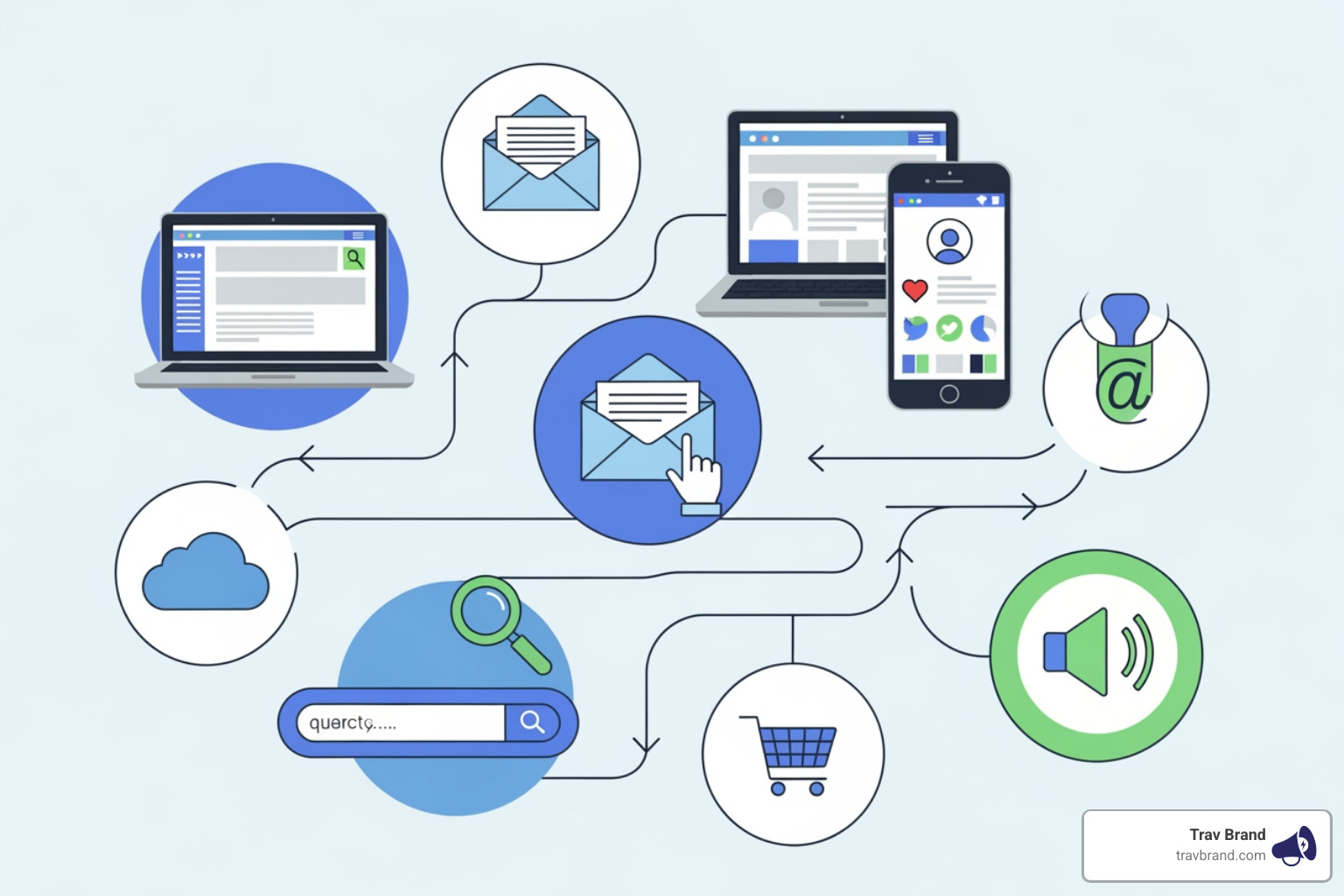
- Content promotion channels: We strategically promote our content across various channels to reach our target audience effectively:
- Social media: Organic posts and paid ads on platforms where our audience spends time.
- Email marketing: Newsletters, nurture campaigns, and dedicated emails to our subscriber list.
- Paid promotion: Targeted ads on search engines and social media to boost visibility.
- Internal referencing: Linking new content from relevant existing pages on our website.
Trav Brand recommends using social media management tools like Hootsuite to pre-schedule posts and manage all your social channels from one UI, streamlining your promotion efforts. Marketing automation tools like HubSpot can help with lead generation and nurture emails.
Measuring Success and Adapting Your Strategy
The work isn’t over once content is live. A crucial part of any web content strategy is measuring its success and continuously adapting. This is how we prove ROI and ensure our efforts are truly impactful.
Key Performance Indicators (KPIs) for Your Web Content Strategy
To measure success, we define specific Key Performance Indicators (KPIs) that align with our initial business goals. Google Analytics is the most widely used platform to measure website performance and see how users interact with our content.
Here’s a table comparing common KPIs across different objectives:
| Objective | Brand Awareness KPIs | Engagement KPIs | Conversion KPIs |
|---|---|---|---|
| Metrics | – Unique Visitors | – Time on Page / Dwell Time | – Conversion Rate |
| – Page Views | – Bounce Rate | – Lead Generation | |
| – Social Shares | – Pages per Session | – Sales Revenue | |
| – Mentions / Backlinks | – Comments / Interactions | – Customer Lifetime Value | |
| – SEO Rankings | – Scroll Depth | – Assisted Conversions |
We regularly track these metrics to understand how our content is performing. For example, if a blog post aims to build brand awareness, we’d look at unique visitors and social shares. If a product page aims for conversions, we’d focus on its conversion rate and assisted conversions.
The Cycle of Improvement
A web content strategy is not a static document; it’s a living, breathing framework that requires continuous care and feeding. We accept a cycle of improvement that involves:
- Regularly reviewing performance: We monitor our KPIs monthly and conduct deeper dives quarterly to identify trends, successes, and areas for improvement.
- Gathering user feedback: Beyond analytics, we actively seek feedback through surveys, user testing, and direct conversations to understand user sentiment and identify pain points.
- A/B testing: For critical content elements (e.g., headlines, calls-to-action), we run A/B tests to optimize for better performance.
- Adapting the strategy based on data: We use our findings to inform adjustments to our content plan. This might mean creating more of what’s working, revamping underperforming content, or exploring new topics based on emerging user needs.
- Iterating on our content plan: Our content calendar is flexible. We adjust it based on performance data, new opportunities, and changes in market trends or business priorities.
This iterative approach ensures our web content strategy remains agile, relevant, and consistently drives measurable results for our brand.
Frequently Asked Questions about Web Content Strategy
What role does SEO play in a content strategy?
SEO is a critical component of a web content strategy, not an afterthought that we bolt on at the end. It informs what content to create by identifying user search intent and keywords. By integrating SEO from the planning phase, we ensure our content is findable, relevant, and authoritative, driving organic traffic and helping to achieve business goals. For example, doing keyword research using tools like Moz or Semrush helps us understand what questions our audience is asking, which then guides our content creation to provide direct, helpful answers. Google rewards content that solves real problems, is helpful, and earns engagement.
How do you create content models and workflows?
Content models define the structure and elements for each content type (e.g., a blog post, a case study, an FAQ item). They ensure consistency by specifying fields like title, author, publication date, body, images, and calls-to-action. This structured approach makes content easier to manage, reuse, and adapt across different platforms.
Workflows map out the entire content lifecycle, from ideation and creation to review, approval, publishing, maintenance, and eventual unpublishing. They clarify roles, responsibilities, and processes for each stage, making content production efficient and scalable. A well-defined workflow prevents bottlenecks, ensures quality control, and helps teams collaborate effectively.
How often should a content strategy be reviewed and updated?
A web content strategy is a living document, constantly evolving with our business, our audience, and the digital landscape. While a major, comprehensive review should happen annually or when significant business goals or market conditions change, we continuously monitor performance. Performance metrics (KPIs) should be tracked monthly, allowing for quick tactical adjustments. We also recommend a quarterly review of the content calendar to make more substantial adjustments based on performance data, new opportunities, and changing market trends. Regular reviews ensure our strategy remains relevant and effective.
Conclusion
Developing and maintaining a robust web content strategy is no small feat, but it’s an indispensable investment for any brand aiming for sustained digital success. We’ve explored how a clear strategy moves us beyond random acts of content, ensuring every piece we create serves a purpose, resonates with our audience, and drives measurable results.
From defining our purpose and understanding our audience, to meticulous auditing, planning, and executing with governance in mind, each stage is crucial. And the journey doesn’t end at launch; it’s a continuous cycle of measuring, learning, and adapting.
At Trav Brand, we believe content is more than just words and images—it’s a powerful business asset that builds trust, fosters engagement, and fuels growth. We help purpose-driven companies build and scale their brands by crafting comprehensive web content strategies that don’t just consult but deliver a complete ecosystem from strategy to execution.
Ready to build a web content strategy that drives results? Explore our services. Want to learn more about how we approach our projects? Check out more info about our process.