
Crafting Compelling Digital Marketing Copy: A Beginner’s Guide
Why Digital Marketing Copy is the Foundation of Online Success
Digital marketing copy is the text you create to persuade someone to take action online—whether that’s clicking an ad, signing up for a newsletter, or making a purchase. Unlike content writing (which aims to inform or educate), copywriting drives conversions.
What digital marketing copy includes:
- Website copy – homepages, product pages, landing pages
- Ad copy – social media ads, Google Ads, display banners
- Email copy – subject lines, promotional emails, automated campaigns
- Social media copy – captions, posts, bios
- CTAs – buttons and phrases that prompt immediate action
The digital advertising industry is projected to reach $786.2 billion by 2026, yet most businesses struggle to convert clicks into customers. The problem? Poor copy. With the average reader’s attention span at just eight seconds, your words need to work fast. On average, 8 out of 10 people will read your headline, but only 2 out of 10 will read the rest. That’s why every sentence matters.
Here’s the reality: copywriting isn’t about sounding clever. It’s about solving problems, building trust, and guiding people toward decisions. Whether you’re writing a Facebook ad or a product description, your copy needs to be clear, concise, and persuasive—or it’s invisible.
I’m Trav Lubinsky, and I’ve spent over a decade building brands and scaling companies through strategic marketing, including developing high-converting digital marketing copy for consumer products, e-commerce, and multi-million dollar campaigns. From launching Flex Watches to advising billion-dollar brands, I’ve learned that great copy is the difference between noise and revenue.
This guide will show you how to write digital marketing copy that actually works—no jargon, no fluff, just proven strategies you can use today.
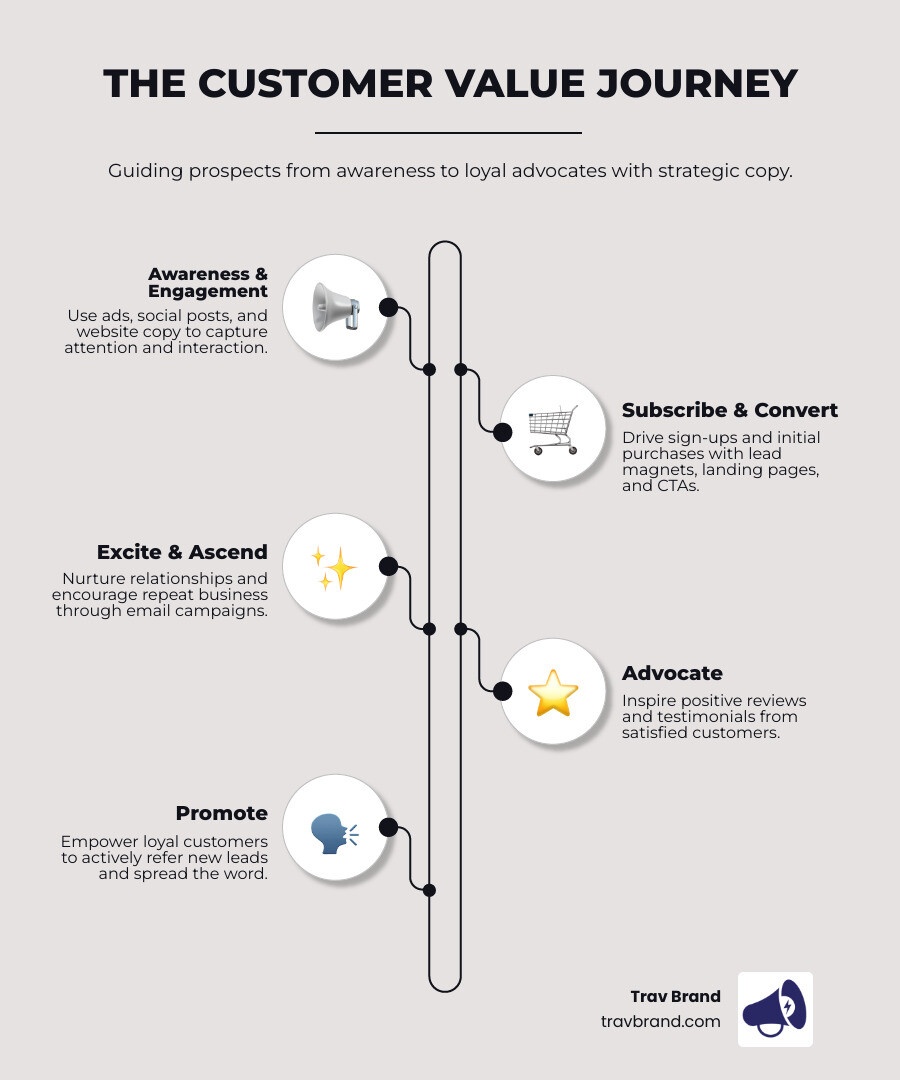
The Foundation: What is Digital Marketing Copy?
At its core, digital marketing copy is text created for online channels to persuade a reader to take a specific action—like making a purchase, signing up for a newsletter, or clicking a link. It’s the engine that turns passive browsers into active customers. In a digital world overflowing with information, your words are often your first and only chance to make an impact. Strong copy communicates your brand’s value, establishes its voice, and makes a crucial first impression. Without it, even the best products get lost in the noise.
Copywriting vs. Content Writing in a Digital Context
While often used interchangeably, copywriting and content writing serve distinct purposes. Understanding this difference is crucial for an effective strategy.
| Feature | Copywriting | Content Writing |
|---|---|---|
| Primary Goal | Persuade, drive immediate action (e.g., buy, sign up) | Inform, educate, entertain, build trust/relationship |
| Length | Often short and concise | Typically longer-form |
| Urgency | High, often creates a sense of immediacy | Low, focuses on long-term value |
| SEO-Dependency | Less directly dependent, but still a factor | Highly dependent, works closely with SEO |
| Primary Outcome | Conversion, leads, sales | Engagement, authority, brand loyalty |
Copywriting is about persuasion. Its goal is to get a reader to perform a specific action, often with a sense of urgency. It’s concise, action-oriented, and focused on immediate results.
Content writing, on the other hand, aims to educate, inform, or entertain. Its purpose is to build trust and authority over time, nurturing leads through the sales funnel. Blog posts and guides fall into this category. While content can lead to an action, that isn’t its primary goal.
Both play vital roles in guiding customers. Compelling storytelling, often found in content writing, can lay the groundwork for a conversion-focused piece of digital marketing copy. We believe in The Power of Storytelling in Building a Strong Brand.
Why Your Business Needs Strong Digital Marketing Copy
In today’s competitive online environment, strong digital marketing copy is a necessity. It drives action, builds your brand, and increases conversions.
- Drives Action: Effective copy transforms passive readers into active users by moving them toward a desired outcome, from a click to a purchase.
- Builds Brand Identity: Your copy is a direct reflection of your brand’s personality. A consistent voice across all digital touchpoints fosters recognition and trust.
- Increases Conversions: Well-written digital marketing copy speaks to your audience’s needs, offering solutions that resonate. Research from Harvard Business Review shows that an emotional connection to a brand provides more value, and copy forges that connection.
- Supports Marketing Goals: Whether your goal is lead generation or sales, strategic copy is the tool that helps you achieve it.
- Competitive Advantage: In a crowded marketplace, unique and compelling copy differentiates you from competitors by articulating your unique selling propositions in a way that captures attention.
The Anatomy of Effective Digital Marketing Copy

Effective digital marketing copy crafts messages that resonate, persuade, and convert. Truly compelling copy is clear, concise, empathetic, and persuasive, all while maintaining brand consistency.
Essential Quality 1: Connects Emotionally
Humans make decisions based on emotions, a powerful truth we leverage in digital marketing copy. Copy that connects emotionally builds a stronger, more memorable bond. When we tell a story or appeal to a deeper feeling, we’re not just selling a product; we’re selling a solution, a feeling, or an aspiration.
Whether it’s humor, empathy, or excitement, tapping into emotional triggers makes our message stick. As Harvard Business Review research highlights, customers with an emotional connection to a brand represent more value. This isn’t manipulation; it’s about understanding our audience’s motivations and showing them how our offerings can genuinely improve their lives.
Essential Quality 2: Crystal Clear and Reader-Focused
The average reader’s attention span is just eight seconds. Our digital marketing copy must be crystal clear and reader-focused to cut through the noise.
- Simple Language: Avoid jargon and complex sentences. Write as if you’re speaking to a friend.
- Benefit-Oriented: Focus on what’s in it for them. Instead of “Our phone has a 5000 mAh battery” (feature), say, “Enjoy all-day power without searching for an outlet” (benefit).
- Addresses Pain Points: Acknowledge your audience’s challenges and position your offering as the solution to build trust.
- Scannability: Use short paragraphs, bullet points, and white space to make copy easy to digest. This ensures key messages are captured quickly.
The Role of SEO in Digital Marketing Copy
Search Engine Optimization (SEO) helps our digital marketing copy reach the right audience at the right time.
- Keyword Research: We start by understanding what our audience is searching for, then integrate these keywords naturally into our copy.
- User Intent: Modern SEO is about understanding user intent. We write for people first, ensuring our copy provides genuine value and answers a user’s query.
- On-Page SEO Elements: We optimize elements like meta descriptions and title tags. These snippets act as mini-ads in search results and can significantly improve click-through rates.
- Readability: Well-structured, easy-to-read copy with clear headings not only pleases search engines but also keeps human readers engaged, which search engines highly prioritize.
By integrating SEO best practices, we ensure our compelling digital marketing copy is findable. For a deeper dive, check out our guide on SEO best practices for content creators.
Types of Digital Marketing Copy and Their Strategic Uses
Digital marketing copy isn’t a one-size-fits-all solution. Different platforms and goals require different approaches. We categorize digital marketing copy into several types, each with its specific uses:
- Short Digital Ad Copywriting: For PPC ads, social media ads, display banners. Designed for quick attention and immediate action.
- Website Content Writing: Covers homepages, about pages, product descriptions. Informs, educates, builds brand identity, and drives engagement.
- SEO Blog Posts: Long-form content designed to attract organic traffic, establish authority, and nurture leads over time.
- Press Releases: Formal announcements for newsworthy information, media outreach, and crisis management.
- Email Marketing Copy: Subject lines, promotional emails, newsletters, automated campaigns. Nurtures leads, drives repeat business, and builds customer loyalty.
- Direct Response Copywriting: Highly conversion-focused, aiming for immediate action (e.g., “Buy Now,” “Sign Up Today”).
- Social Media Copywriting: Short, engaging text for posts, captions, and bios across various platforms. Builds community and increases brand visibility.
- Creative Copywriting: Used for brand campaigns and advertisements that aim to establish a strong emotional connection, using storytelling, humor, or clever wordplay.
Website & Landing Page Copy
When someone lands on our website, the copy must work hard to guide them toward engagement, whether that’s signing up, clicking to another page, or making a purchase. It appears everywhere, from the homepage and our about page to product descriptions and the footer.
- Homepage Copy: Introduces the brand and its value proposition, guiding visitors to key areas.
- About Us Page Copy: Builds trust by sharing our story, values, and mission.
- Product Descriptions: Highlight benefits over features to answer questions and drive sales.
- Landing Pages: Highly focused on a single conversion goal with clear copy and a prominent Call-to-Action (CTA).
This type of digital marketing copy is crucial for converting visitors into loyal customers. To master this, understanding your customer journey is key. We often refer to Understanding E-commerce and Funnels as a foundational resource.
Email Marketing Copy
Email remains a powerful tool, and compelling copy is its backbone. Research shows significant e-commerce purchases driven by email, making it a proven method for nurturing leads and driving repeat business.
- Subject Lines: The subject line is the gatekeeper. Since a reported 47% of recipients open emails based on the subject line alone, we craft them to be personal, relevant, urgent, or curiosity-provoking.
- Body Copy: This is where we deliver value and build rapport. Whether it’s a promotion or a newsletter, the body copy needs to be clear and engaging.
- Calls-to-Action (CTAs): Our emails need clear, action-oriented CTAs that guide the reader to the next step.
Email marketing copy allows for personalized experiences that can significantly boost engagement, as 91% of customers are more likely to do business with companies that offer them. For more on optimizing your email strategy, explore Maximizing Growth: The Power of Email and SMS Automation.
Social Media & Ad Copy
On social media, our copy needs to grab attention instantly. Social media and ad copy are typically short, platform-specific, and designed for immediate engagement.
- Social Media Posts: These are for real-time engagement and community building. We tailor our tone to each platform—humorous for Instagram, professional for LinkedIn, concise for X (formerly Twitter).
- Ad Copy: For a Facebook ad, Google Ad, or display ad, the copy must be concise, benefit-driven, and include a clear call to action. We use A/B testing to see what messages resonate most with our target audience.
The goal is to interrupt scrolling, spark interest, and drive a click. We strategically use platforms like Facebook to grow brands, as detailed in Use Facebook to Grow Your Brand.
Proven Strategies for Writing Copy That Converts
Writing digital marketing copy that truly converts isn’t magic; it’s a strategic process. Over the years, we’ve found that certain frameworks and techniques consistently yield better results. Models like AIDA (Attention, Interest, Desire, Action) and PAS (Problem, Agitate, Solve) provide excellent blueprints for structuring persuasive messages. Incorporating strong verbs, creating a sense of urgency, and focusing on the reader’s journey are all vital.
Master the Headline
The headline is arguably the single most important line of copy we write. Why? Because on average, 8 out of 10 people will read headline copy, but only 2 out of 10 will read the rest. A great headline is our shortcut to success; a bad one means our content doesn’t resonate at all.
Here’s how we master them:
- Grab Attention: We use compelling language that stops the scroll.
- Promise Value: Our headlines clearly communicate a benefit or solution the reader will gain.
- Use Numbers: Specificity sells. “5 Ways to Boost Your Sales” is often more effective than “Ways to Boost Your Sales.”
- Ask Questions: Engaging the reader directly, like “Struggling with writer’s block?” pulls them into our narrative.
- Spark Curiosity: We hint at an interesting insight without giving everything away, encouraging them to read more.
The 80/20 rule of headlines underscores their power: dedicate significant effort here. For a deeper dive into crafting headlines that command attention, dig into the insights on The 80/20 rule of headlines.
Craft Irresistible Calls-to-Action (CTAs)
Our Call-to-Action (CTA) is the moment of truth in our digital marketing copy—it’s where we ask the reader to take the next step. An irresistible CTA is clear, compelling, and leaves no doubt about what action we want them to take.
- Action-Oriented Language: We use strong verbs that clearly state the desired action: “Shop Now,” “Learn More,” “Get Your Free Guide.”
- Clear Benefits: We ensure the CTA communicates what the user gains. Instead of just “Click Here,” we might say “Get Your First Month Free” or “Save $10 When You Buy Today.”
- Create Urgency: Sometimes, a gentle nudge is needed. Phrases like “Limited Time Offer,” “Only 3 Spots Left,” or “Expires Tonight” can encourage immediate action.
- Reduce Friction: We make the next step feel easy and remove any potential barriers.
- Visual Prominence: Our CTAs stand out visually, whether through button design, color, or placement, making them impossible to miss.
Effective CTAs are crucial for driving conversions. To truly master the art of prompting action, we recommend exploring our resource on Effective Call to Action Examples.
Modern Tools, Common Mistakes, and Measuring Success
In the changing landscape of digital marketing copy, staying sharp means embracing new tools, learning from missteps, and rigorously measuring our efforts. It’s a cycle of creation, analysis, and improvement.
Leveraging AI in Copywriting (and Its Limits)
Artificial Intelligence (AI) has emerged as a powerful assistant in copywriting, streamlining our workflow.
- Idea Generation: AI tools are fantastic for overcoming writer’s block, brainstorming headlines, or generating initial drafts.
- Efficiency: For formulaic or short-form copy, AI can be incredibly efficient, with some arguing it already outperforms humans for optimized headlines.
- Assistant, Not Replacement: It’s crucial to view AI as an assistant. Humans still possess the mastery for complex ideas, humor, and empathy. The copywriter of the future will likely brief AI, sense-check its output, and act as a high-level creative.
Our role is to shape and edit AI-generated content, ensuring it aligns with our brand voice and resonates emotionally. For more insights, dive into How Brands Are Leveraging AI to Scale Smarter.
Common Mistakes to Avoid
Being aware of common pitfalls helps us create more effective digital marketing copy.
- Grammar and Spelling Errors: According to a Tidio survey, over 50% of people feel grammar mistakes ruin a company’s professional image, and 35% say they impact credibility. We use tools like Grammarly or Hemingway to catch these errors. For more, check out the impact of grammar mistakes.
- Vague Language: Be specific. Use concrete examples, numbers, and clear benefits to keep readers engaged.
- Forgetting the Audience: Writing for everyone means writing for no one. Always put the reader first, understanding their needs and pain points.
- No Clear Call-to-Action (CTA): If you don’t tell readers what to do next, they won’t do anything. Every piece of copy needs a clear CTA.
- Inconsistent Brand Voice: Your brand voice should be consistent across all platforms to maintain user trust.
How to Measure Copywriting Success
The beauty of digital marketing copy is that its impact is measurable. We analyze, optimize, and improve.
- Conversion Rate: The ultimate metric. How many people took the desired action after engaging with our copy?
- Click-Through Rate (CTR): For ads and emails, CTR tells us how effectively our copy prompted clicks.
- Bounce Rate: A high bounce rate suggests the copy isn’t engaging or relevant.
- Time on Page: Longer time on page indicates that our copy is holding the reader’s attention.
- A/B Testing Results: We continuously test variations of headlines, CTAs, and body copy to see what performs best using A/B testing platforms.
- Google Analytics & Search Console: These tools help us track engagement, traffic, and keyword performance to identify areas for improvement.
By tracking these metrics, we gain insights into what resonates with our audience, allowing us to refine our digital marketing copy for greater impact.
Frequently Asked Questions about Digital Marketing Copy
How long does it take to become a good copywriter?
Becoming a good copywriter is a journey of consistent effort. Mastery comes with:
- Practice: The more you write, the better you get. Keep your writing muscles warm.
- Reading: Read widely about copywriting, psychology, and marketing. Follow top industry blogs.
- Feedback: Accept constructive criticism to learn and improve your work.
- Specialization: Over time, you might find a niche (e.g., e-commerce, B2B SaaS) where your skills shine.
- Continuous Learning: The digital landscape changes constantly, so stay current with trends and tools.
There’s no magic number of hours, but dedication to these steps will accelerate your growth.
Can I write good copy if I’m not a “creative” person?
Yes. While creativity helps, copywriting is more science than art. It relies on proven principles, not just inspiration.
- Use Formulas: Structures like AIDA (Attention, Interest, Desire, Action) or PAS (Problem, Agitate, Solve) provide a clear roadmap.
- Focus on Psychology: Understanding human behavior and motivation is more critical than being “creative.”
- Be Data-Driven: Use analytics and A/B testing to validate what works, removing guesswork.
- Prioritize Empathy: The ability to connect with your audience’s needs is the most important skill.
If you can understand people and clearly articulate solutions, you can become an excellent copywriter.
What’s the single most important element of digital marketing copy?
If we had to pick just one, it would be audience understanding.
Without deeply understanding your audience—their pain points, desires, and the language they use—even the most clever headline or perfectly crafted CTA will fall flat.
- Audience understanding informs everything else: the problems to solve, emotions to tap into, benefits to highlight, and tone of voice to use.
- While the headline is critical for grabbing attention and the Call-to-Action is vital for driving conversion, both are ineffective if they don’t speak to the right person.
All effective digital marketing copy flows from a profound empathy for the person on the other side of the screen.
Conclusion
We’ve journeyed through the intricate world of digital marketing copy, uncovering its definition, crucial importance, and diverse applications. We’ve seen how it differs from content writing, focusing on persuasion and action, and why every business needs it to thrive online. We’ve explored the anatomy of effective copy, emphasizing emotional connection, crystal-clear communication, and the strategic role of SEO. From website pages to social ads, each type of copy serves a specific purpose in guiding our audience.
Digital marketing copy is both a science and an art. It’s the science of understanding human psychology and data, and the art of crafting words that resonate and move people to action. In a digital landscape projected to reach nearly $800 billion, the power of well-chosen words cannot be underestimated. It’s the difference between being heard and being ignored, between a click and a conversion, between noise and revenue.
At Trav Brand, we believe in the transformative power of strategic content and compelling digital marketing copy. We don’t just consult; we partner with purpose-driven brands to build and scale through comprehensive digital marketing, e-commerce, and content strategies, ensuring measurable results.
Ready to transform your brand’s online presence with words that work? Let us help you craft the compelling narratives and conversion-driven messages that will truly connect with your audience. Build your brand with our expert services today.