Unlocking Customer Insights: Mapping the E-commerce Experience
Why E-commerce Customer Journey Mapping Drives Sustainable Growth
E-commerce customer journey mapping is the process of visualizing every interaction a customer has with your brand—from initial findy through post-purchase—to identify friction points, optimize touchpoints, and increase conversions.
Quick Overview: The E-commerce Customer Journey
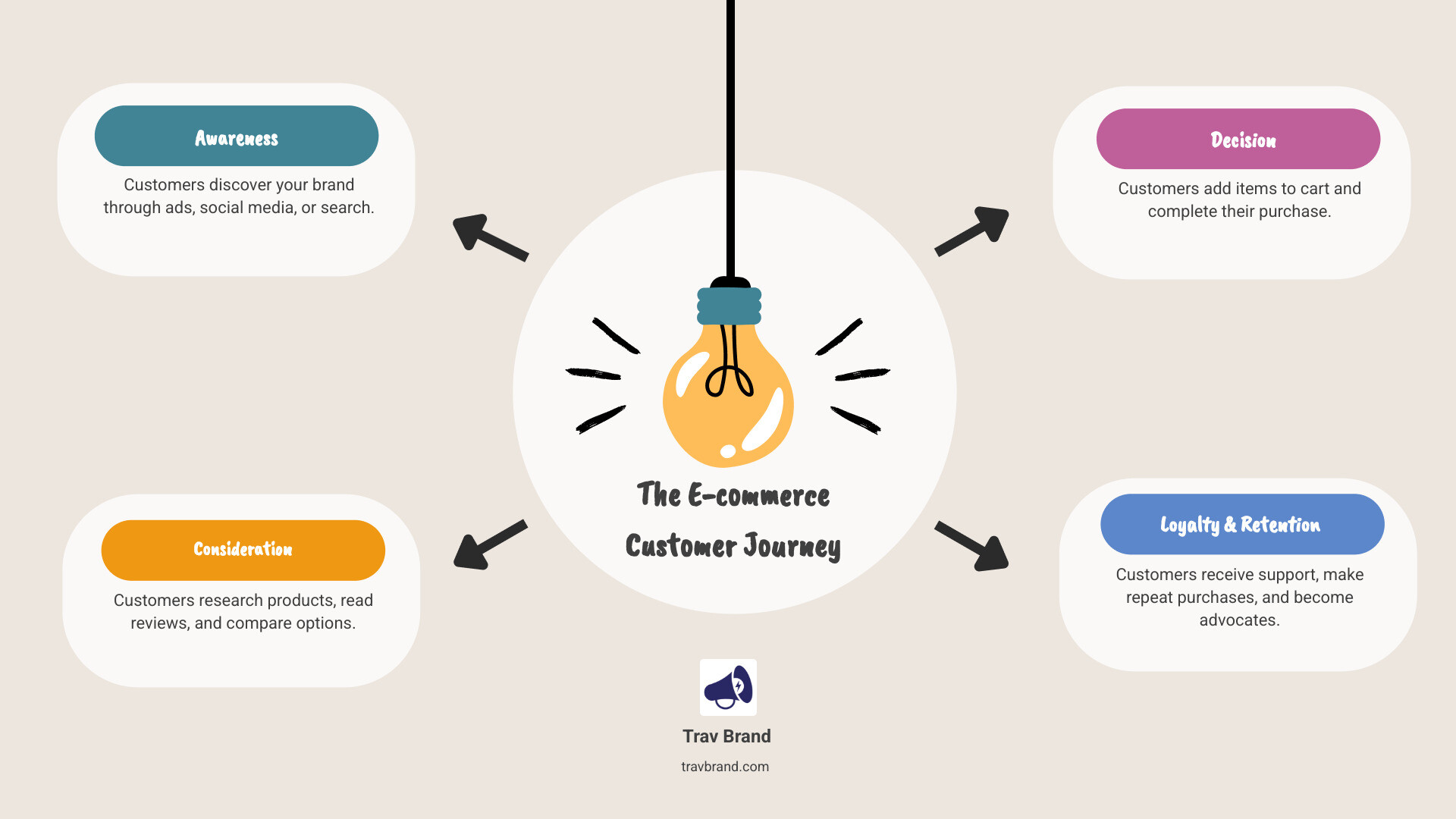
- Awareness – Customer finds your brand through ads, social media, or search
- Consideration – Customer researches products, reads reviews, compares options
- Decision – Customer adds items to cart and completes checkout
- Service – Customer receives order and may need support
- Loyalty – Customer returns for repeat purchases and becomes an advocate
The rapid acceleration of e-commerce means the traditional customer journey is no longer linear. Customers face several microdecisions between interacting with your brand for the first time and becoming loyal customers. Around 70% of products added to the cart eventually get abandoned, and 80% of online shoppers never return after a single purchase. Why? Often, the answer lies in a disjointed customer journey.
Success today hinges on understanding that customers create their own journeys—businesses don’t control them. Your role is to anticipate customer goals and build an omnichannel environment that supports them at every stage. When customer data lives in separate databases, you only see fragments of the journey. A unified view is essential.
The brands that win do more than just sell products—they consistently deliver value throughout the customer journey. Despite only accounting for 21% of a brand’s audience, loyal customers contribute 44% of a merchant’s total revenue. This is why mapping the journey matters: it reveals where you’re losing customers and where you can create lasting relationships.
I’m Trav Lubinsky, and I’ve spent years building and scaling e-commerce brands, from launching Flex Watches to advising billion-dollar enterprises on growth strategy. Through this work, I’ve seen how E-commerce customer journey mapping transforms struggling brands into high-performing businesses by creating clarity around what customers actually need at each stage.
What is E-commerce Customer Journey Mapping?
At its core, E-commerce customer journey mapping is the strategic visualization of the end-to-end experience a shopper has with your business. It isn’t just a pretty flowchart; it’s a living document that captures the actions, thoughts, and emotional states of your customers as they move through your digital ecosystem.
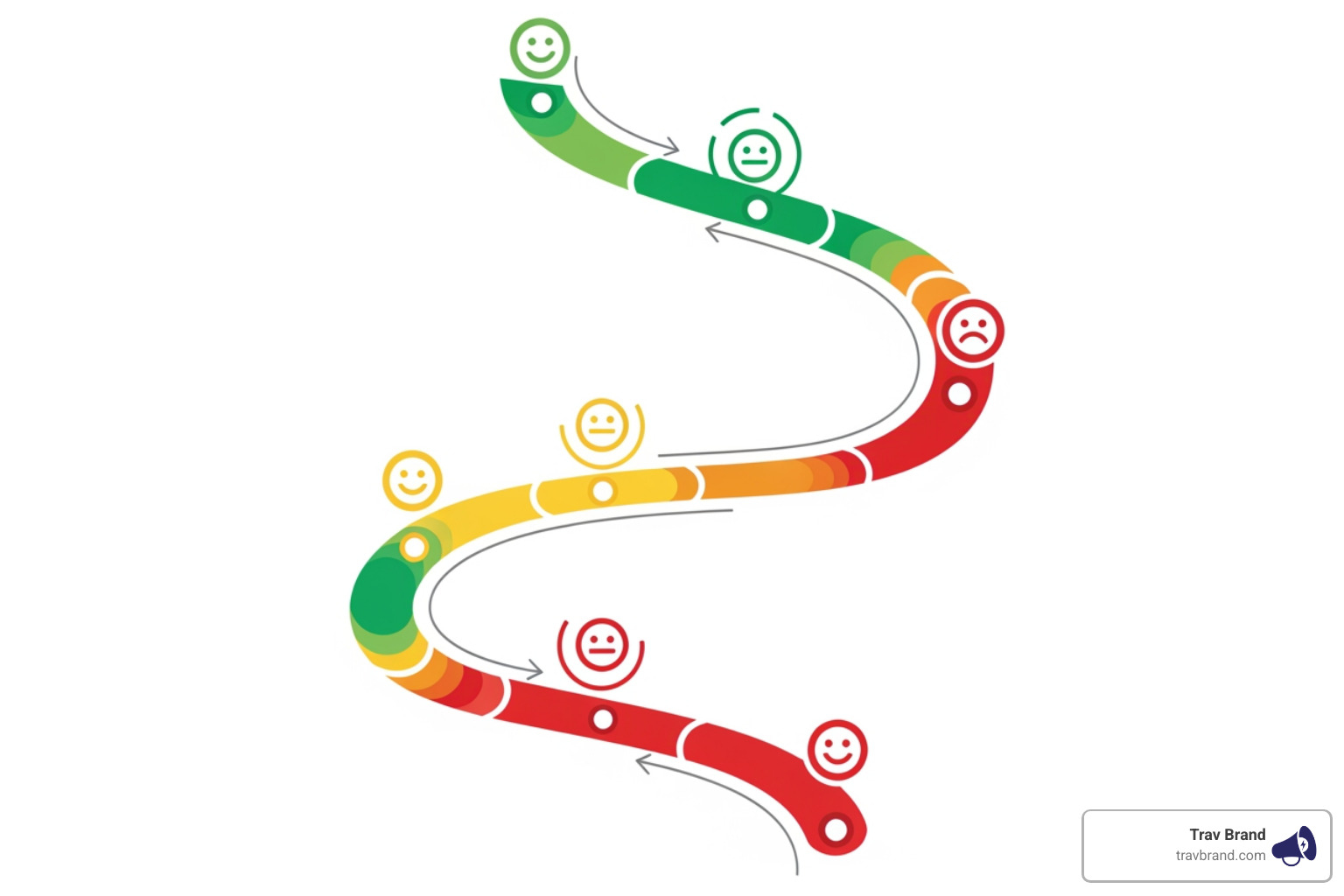
We often think of the shopping process as a straight line: see ad, click link, buy product. But as McKinsey describes the shift from touchpoints to journeys, it is entirely possible for a business to have every individual touchpoint performing well (like a fast website or great ads) while still suffering from high churn. This happens because the pathways linking those touchpoints aren’t designed with user goals in mind.
By mapping the journey, we shift our perspective from “What do we want to sell?” to “What is the customer trying to achieve?” This helps in significant churn reduction because we can spot exactly where a user feels confused or frustrated. For a deeper dive into how these paths function, check out our guide on Understanding E-commerce and Funnels.
The Role of Buyer Personas in E-commerce Customer Journey Mapping
You cannot map a journey if you don’t know who is walking the path. Creating a journey map without personas is like trying to give directions to “everyone and no one” at the same time. We use buyer personas—realistic, data-driven representations of your key audience segments—to ground our mapping in reality.
Detailed persona development involves looking at more than just demographics like age or location. We need to understand:
- Motivations: What is driving them to look for a solution right now?
- Pain Points: Have they been burned by slow shipping or poor quality elsewhere?
- Behavioral Triggers: Do they shop exclusively on mobile during their lunch break?
When we understand these nuances, we can tailor our Web Content Strategy to speak directly to their needs, ensuring the journey feels personalized rather than generic.
Aligning Customer Goals with Business Objectives
A successful journey is a value exchange. The customer has a goal (e.g., “I need a durable pair of running shoes for a marathon”), and we have a business objective (e.g., “Increase conversion rate and AOV”).
Mapping allows us to align these two. During the problem identification stage, the customer wants education. If we provide a “How to Choose the Right Shoe” guide, we satisfy their goal while moving them closer to our conversion objective. This alignment is the foundation of Conversion Rate Optimization Ultimate Guide. If we ignore the customer’s goal and just push a “Buy Now” button too early, we create friction and lose the sale.
Key Stages of the Modern E-commerce Journey
The modern journey is non-linear and spans multiple devices and platforms. However, we can generally categorize it into five macro-stages to make it manageable.
- Awareness: The customer realizes they have a need or finds your brand.
- Consideration: The “research” phase. They are eliminating concerns and comparing you to others.
- Decision: The “magic” moment of conversion—or the tragic moment of abandonment.
- Service/Ownership: Everything that happens after the “Pay” button is clicked.
- Loyalty/Advocacy: Turning a one-time buyer into a brand ambassador.
To ensure each stage is performing at its peak, we follow E-commerce Conversion Best Practices to remove any problems that might stop the momentum.
Identifying Touchpoints in E-commerce Customer Journey Mapping
Touchpoints are the specific moments of interaction. These are often digital and varied. For example, Rare Beauty social storytelling uses Instagram not just to sell, but to build awareness and community. This is a top-of-funnel touchpoint that focuses on brand building.
Other critical touchpoints include:
- Email Marketing: Nurturing those in the consideration phase.
- Payment Methods: Offering trusted options like Shop Pay integration can increase the likelihood of additional purchases by 77%.
- Mobile Apps: With 79% of Shopify’s traffic coming from mobile, having a mobile-optimized experience is no longer optional.
We document these in our Digital Marketing Strategy Guide to ensure a consistent message across every channel.
Addressing Drop-off Points and Cart Abandonment
One of the most sobering statistics in our industry is the 70% abandonment rate for online carts. Mapping the journey helps us identify these “leakage” points. Is the Cart page too slow? Are there hidden shipping costs revealed only at the Checkout?
By identifying where users drop off, we can implement fixes like:
- Guest Checkout: Don’t force account creation.
- Progress Bars: Show users how close they are to finishing.
- Trust Signals: Display security badges and clear return policies right where the anxiety is highest.
B2B vs. B2C: Unique Considerations for Journey Mapping
While the basic principles of E-commerce customer journey mapping apply to both, the execution differs wildly. B2B journeys are notoriously complex, often involving buying groups of 6 to 10 people.
| Feature | B2C Journey | B2B Journey |
|---|---|---|
| Decision Maker | Usually 1 person | 6-10 stakeholders |
| Cycle Length | Minutes to days | Weeks to months |
| Motivation | Emotional / Personal need | Rational / ROI / Efficiency |
| Touchpoints | 1-3 main channels | 10+ different touchpoints |
In B2B, we follow Gartner’s B2B buying stages, which include problem identification, solution exploration, and requirements building. Interestingly, 61% of B2B buyers now prefer a “rep-free” buying experience, meaning your digital journey must do the heavy lifting that a salesperson used to do. To capture these high-value leads, we use advanced strategies found in The Conversion Value Playbook: Smart Bidding Strategies for Ad Platforms.
Best Practices for Effective E-commerce Customer Journey Mapping
To create a map that actually drives growth, you need to move beyond guesswork and use data-driven insights.
One of the most powerful tools at our disposal is Google Analytics funnel exploration. This allows us to see exactly where the “leaks” are in our funnel. But data is only half the story; the other half is personalization. Currently, 76% of CX leaders using AI are doing so to personalize the customer experience.
AI can help us predict what a customer wants before they even know they want it. We discuss these technological shifts in our guide on How Brands Are Leveraging AI to Scale Smarter.
Leveraging Data to Optimize the User Experience
We believe in the power of first-party data. In a post-cookie world, the data you collect directly from your customers is your most valuable asset. We use Google Data Studio reports to visualize these metrics and identify patterns.
To get a truly granular view, we often employ:
- Heat Maps: See where people are clicking (and where they aren’t).
- Session Recordings: Watch real users steer your store to find points of confusion.
- NPS Surveys: Gather qualitative feedback on how customers feel about the journey.
This Content Performance Analysis ensures that every blog post, product description, and ad is serving a purpose in the journey.
Building Trust and Social Proof Throughout the Journey
Trust is the currency of the internet. You can have the best product in the world, but if the customer doesn’t trust the journey, they won’t buy. A Gorgias study on loyalty shows that loyal customers contribute 44% of total revenue. Building that loyalty starts with trust signals.
We integrate social proof at every stage:
- Awareness: Influencer testimonials and social media mentions.
- Consideration: Detailed customer reviews and “verified buyer” badges.
- Decision: Secure payment icons and clear warranties.
- Post-Purchase: Proactive shipping updates and “surprise and delight” follow-ups.
This holistic approach is what we call The Power of Branding: How to Create a Memorable E-commerce Brand.
Frequently Asked Questions about E-commerce Customer Journey Mapping
How does AI impact the modern customer journey?
AI is revolutionizing the journey by enabling hyper-personalization at scale. From AI-powered chatbots that provide instant support to predictive product recommendations, AI makes the journey feel more empathetic and efficient. In fact, 72% of CX leaders believe AI will facilitate all proactive outreach in the future. This means brands will be able to solve problems before the customer even realizes they have one.
What are the most common pain points in online shopping?
The “Big Three” pain points are usually a complex checkout process, hidden costs (like shipping or taxes) revealed too late, and poor mobile optimization. If your site takes more than three seconds to load on a smartphone, you’ve already lost half your audience. We dive deep into these issues in our article on Why Most Shopify Stores Underperform and How to Fix Them.
How can businesses identify where customers are dropping off?
The best way is through Google Analytics path exploration report. This tool shows you the literal paths users take and where they deviate from the “ideal” journey. Combining this with user feedback—like exit-intent surveys—gives you both the “what” and the “why” behind customer drop-offs.
Conclusion
At Trav Brand, we don’t just tell you how to map a journey; we build the ecosystem that makes that journey successful. We focus on purpose-driven brands that want measurable results, moving beyond simple consulting to full-scale execution.
E-commerce customer journey mapping is the first step in a larger growth strategy. By understanding your customers’ path from awareness to loyalty, you can stop guessing and start growing. If you’re ready to open up these insights and scale your brand, explore our Brand Development Services today. Let’s build something memorable together.