
The Ultimate Guide to Conversion Optimization
Why Conversion Rate Optimization Matters for Your Business
Conversion optimization best practices are systematic strategies that turn more of your website visitors into customers—without spending more on ads. Instead of chasing new traffic, you focus on maximizing the value of the visitors you already have. Many businesses drive traffic to their site, only to see visitors leave without converting. Small changes can make a massive difference: Expedia famously made $12 million by removing a single form field, and customer reviews can boost conversions by 270%.
Quick Answer: Top Conversion Optimization Best Practices
- Test with data, not opinions – Use A/B testing to validate changes
- Speed matters – Every second of load time can cost you conversions
- Simplify everything – Remove friction from forms, navigation, and checkout
- Build trust – Display reviews, security badges, and clear policies
- Optimize for mobile – Over 60% of traffic comes from mobile devices
- Create urgency – Use scarcity and time-limited offers strategically
- Perfect your CTAs – Make them clear, visible, and action-oriented
- Personalize experiences – Tailor content based on user behavior
This isn’t about redesigning your entire website. It’s about understanding what works, testing systematically, and making data-driven decisions. The companies winning today aren’t just getting more traffic; they’re converting more of what they have. That’s what conversion optimization best practices help you achieve.
I’m Trav Lubinsky, and I’ve spent over a decade scaling consumer brands and working with companies on growth marketing. Through my agency Trav Brand, I help founders build high-performing marketing ecosystems that convert visitors into loyal customers.
What is Conversion Rate Optimization (CRO) and Why Is It Crucial?
Conversion Rate Optimization (CRO) is the strategic process of increasing the percentage of visitors who take a desired action on your website, such as buying a product, filling out a form, or signing up for a newsletter. Essentially, CRO is about making the most of the traffic you already have.
Conversions drive profitability. Instead of only trying to attract more people, CRO focuses on making your existing traffic more efficient. This directly impacts your bottom line by maximizing marketing ROI, reducing customer acquisition costs (CAC), and enhancing the user experience (UX). The process also yields invaluable customer insights, as it is deeply rooted in understanding audience behavior, motivations, and pain points. CRO builds a sustainable growth engine, fostering trust and increasing customer lifetime value through continuous, data-driven improvement.
At Trav Brand, we believe CRO is a vital marketing task. It ensures every decision is based on experimental data, not gut feelings. A strong, clear value proposition is at the heart of this process, and frameworks like value proposition design can be helpful for structuring your thinking.
The Relationship Between CRO and User Experience (UX)
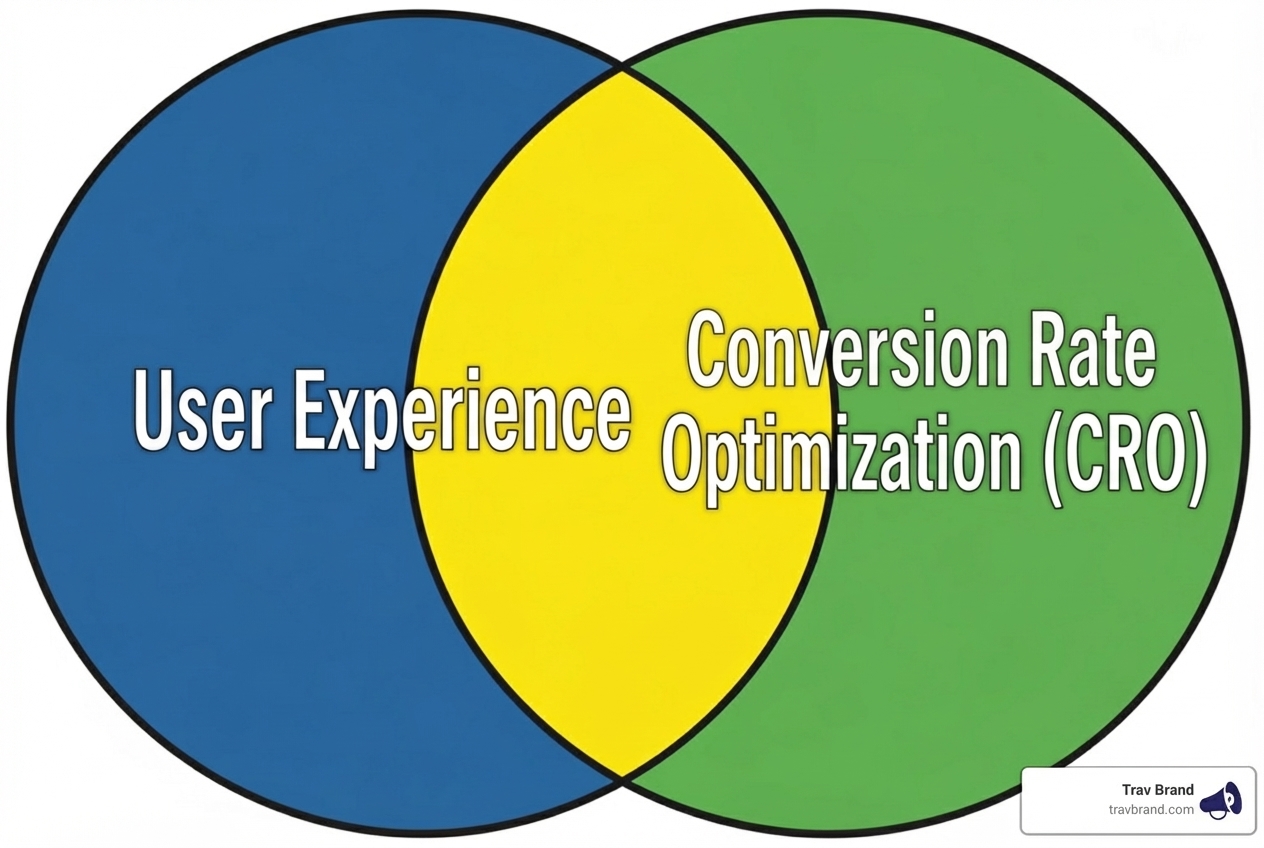
The connection between CRO and User Experience (UX) is profound. While UX design focuses broadly on creating an intuitive and enjoyable user journey, CRO zeroes in on specific business goals, like increasing sign-ups or sales. Think of it this way: UX ensures the path is pleasant, while CRO ensures more people reach the destination. A better user experience naturally leads to more conversions. When we understand how customers think and behave, we can design experiences that make it easier for them to convert. Good UX supports high conversions, and CRO helps measure and refine that UX to achieve business objectives.
Calculating and Measuring Your Conversion Rate
To optimize, you first need to measure. Calculating your conversion rate is straightforward once you define what a “conversion” means for your specific goal.
The basic formula is:
Conversion Rate = (Number of Conversions / Total Number of Visitors) x 100%
This can be adapted for unique users or sessions depending on your business model (e.g., one-time sign-ups vs. multiple purchases).
- Key Performance Indicators (KPIs): Beyond the overall rate, we track granular metrics like CTA clicks, revenue, checkout completion, and add-to-cart actions to understand the full picture.
- Average Conversion Rates: A “good” e-commerce conversion rate is typically 2-4%, but this varies widely by industry, traffic source, and product. SaaS trial signups often average 3-5%. Instead of obsessing over averages, focus on improving your own rate month-over-month.
- Mobile vs. Desktop: Mobile typically converts at about half the rate of desktop. With over 60% of traffic coming from mobile, optimizing product pages for small screens is critical.
- Tools for Tracking: We rely on robust analytics tools to gather this data. Google Analytics is fundamental for setting up conversion goals. For deeper behavioral insights, tools like Hotjar, CrazyEgg, and Lucky Orange provide heatmaps and session recordings to validate our efforts.
Core Principles: Enhancing User Experience and Trust
At the heart of successful conversion optimization best practices lies a deep understanding of users and a commitment to building their trust. We make the customer’s journey as smooth and reassuring as possible.
User journey mapping helps us visualize the paths users take and identify potential friction points where they might get confused or give up. Simplifying navigation is key, but equally important is building trust. In an online world, trust signals serve as crucial reassurances that our brand is legitimate, reliable, and secure. By focusing on UX and trust, we create an environment where visitors feel confident taking the desired action.

Optimize Website Speed and Mobile Responsiveness
Speed and mobile responsiveness are fundamental conversion optimization best practices. Even a one-second delay in page load time can significantly reduce conversions, as users are more likely to bounce.
To combat this, we constantly optimize:
- Image Compression: We use tools to compress images without sacrificing quality and leverage modern formats like WebP.
- Code Optimization: Minimizing CSS and JavaScript files streamlines loading.
- Lazy Loading: We implement lazy loading so content below the fold only loads when it becomes visible to the user.
- Caching and CDNs: Browser caching and a Content Delivery Network (CDN) speed up content delivery.
- Reliable Hosting: A robust hosting solution is the backbone of a fast website.
With mobile devices accounting for almost 60% of web page views, optimizing for mobile is non-negotiable. Mobile users are impatient; over half will abandon pages that take more than 3 seconds to load.
Our mobile-first design philosophy ensures:
- Seamless Responsive Design: Sites adapt flawlessly to any screen size.
- Thumb-Friendly Design: We prioritize large, easy-to-tap buttons and adequate spacing.
- Optimized Mobile Load Times: Speed on mobile is even more critical due to higher bounce rates.
- Simplified Mobile Navigation: We streamline menus to avoid clutter on smaller screens.
We use tools like Google PageSpeed Insights to analyze load times and ensure our sites provide an excellent user experience.
Simplify the Customer Journey and Navigation
The easier it is for a visitor to find what they need, the higher our conversion rates will be. Simplifying the customer journey is a cornerstone of effective conversion optimization best practices.
We focus on creating a frictionless experience:
- Intuitive Menu Structure: A clear, simplified menu with logical categories is paramount. We also include a search function and consider using breadcrumbs to show users their location.
- Reducing Form Fields: Long forms are a major source of friction. We minimize fields, only asking for essential information.
- Progressive Disclosure: We present complex information in stages to avoid overwhelming users.
- Guest Checkout Option: For e-commerce, offering a guest checkout option removes a significant barrier to purchase.
By streamlining navigation and minimizing unnecessary steps, we make it effortless for customers to move through their journey and convert.
Build Trust with Social Proof and Security Badges
In an online environment, trust is the currency of conversion. Leveraging social proof and security measures are non-negotiable conversion optimization best practices.
- Customer Reviews and Testimonials: These are incredibly powerful, capable of increasing conversion rates by over 200%. We display reviews and ratings prominently.
- Social Media Proof: Positive social media posts, media mentions, and influencer endorsements build credibility and can increase purchases.
- Trust Badges and Certifications: Displaying SSL certificates, secure payment icons, and other certifications builds immediate credibility, especially at checkout.
- Clear Policies: Easily accessible privacy policies, money-back guarantees, and clear contact information contribute to transparency and trustworthiness. Your shipping and returns policies are also crucial and should be highlighted, as they heavily influence purchase decisions.
Actionable Conversion Optimization Best Practices for Key Website Elements
Now that we’ve covered the foundational principles, let’s dive into actionable conversion optimization best practices for specific elements of your website. This section will focus on optimizing key areas like landing pages, calls-to-action, and the checkout process, alongside the crucial role of compelling copywriting and visuals.
Optimizing Landing Page Design and Content
Your landing page is often the first dedicated interaction a potential customer has with your offer. We adhere to these core principles:
- Single Goal Per Page: A landing page should focus exclusively on one conversion goal to eliminate distractions. The more links on a page, the lower the conversion rate tends to be.
- Message Matching Ad Copy: Aligning your landing page messaging with the ad copy that brought the visitor there is a critical conversion optimization best practice. It ensures a smooth, logical follow-through.
- Strong Value Proposition: Clearly highlight your unique value proposition above the fold, answering the visitor’s question, “What’s in it for me?”
- Benefit-Driven Headlines: Craft a strong headline that immediately grabs attention and communicates value.
- Clean Layout and Visual Hierarchy: Use a clean layout and visual hierarchy to guide the visitor’s eyes toward the most important elements: the headline, key benefits, and the CTA.
- Using High-Quality Visuals: Visuals capture attention and convey information quickly. Show your product, or for services, highlight them in action. Pictures of people help visitors identify with your brand, while even abstract visuals can be effective.
Engaging content that is concise, on-brand, and emphasizes benefits is paramount. Improving content often plays a larger part than design in motivating action.
Crafting Clear and Compelling Calls-to-Action (CTAs)
The Call-to-Action (CTA) is the direct instruction that tells your visitor what to do next. Crafting clear and compelling CTAs is a vital conversion optimization best practice.
- Action-Oriented Language: Use strong verbs that compel action. Instead of “Click here,” opt for specific, benefit-driven language like “Get Your Free Trial Now.”
- Creating Urgency and FOMO: Strategically introduce a sense of urgency with limited-time offers, countdown timers, or low stock warnings. However, ensure the urgency is genuine to avoid damaging trust.
- Contrasting Colors: Your CTA button needs to stand out. Use a contrasting color that works with your page’s design. Even subtle choices, like using rounded corners, can increase clicks.
- Button Size and Placement: Ensure your CTA is appropriately sized (at least 44×44 pixels for mobile) and prominently placed, such as above the fold.
- A/B Testing CTA Copy: Don’t guess what works. A/B test different CTA designs, placements, and copy to find what drives the highest conversion rates.
- Personalized CTAs: Personalized calls to action are significantly more likely to convert. Tailoring your CTA based on user data makes it far more relevant.
- One Primary CTA Per Page: To avoid decision paralysis, we generally recommend having one primary, prominent CTA per page.
By carefully crafting and testing our CTAs, we ensure every opportunity to convert is maximized.
Designing a High-Converting Checkout Process
The checkout process is the final hurdle, where nearly 70% of online shopping carts are abandoned. Optimizing this stage is one of the most impactful conversion optimization best practices.
We focus on making the checkout experience as smooth and reassuring as possible:
- Minimizing Form Fields: Reducing form fields can have a massive impact. We strive to only ask for essential information.
- Progress Indicators: Visual cues like progress bars reassure customers by showing them how many steps are left, reducing anxiety.
- Multiple Payment Options: Offering a variety of payment methods, including major credit cards and popular digital wallets like PayPal, Apple Pay, and Google Pay, caters to different preferences.
- Guest Checkout Option: Forcing account creation is a common reason for abandonment. A guest checkout option removes this barrier.
- Displaying Security Seals: Prominently displaying SSL certificates and other security badges reassures customers that their information is protected.
- Reducing Cart Abandonment: We employ strategies like exit-intent popups with compelling offers and automated cart abandonment emails to nudge users back. Hiding empty promotional code fields behind a link can also prevent users from leaving to “coupon hunt.”
By removing friction and building trust, we transform abandoned carts into completed purchases.
Driving Growth with Experimentation and Data
Successful businesses foster a culture of continuous experimentation. Our approach at Trav Brand is rooted in the belief that data, not intuition, should drive decisions. This section digs into advanced conversion optimization best practices that emphasize rigorous testing and a deep reliance on analytics.
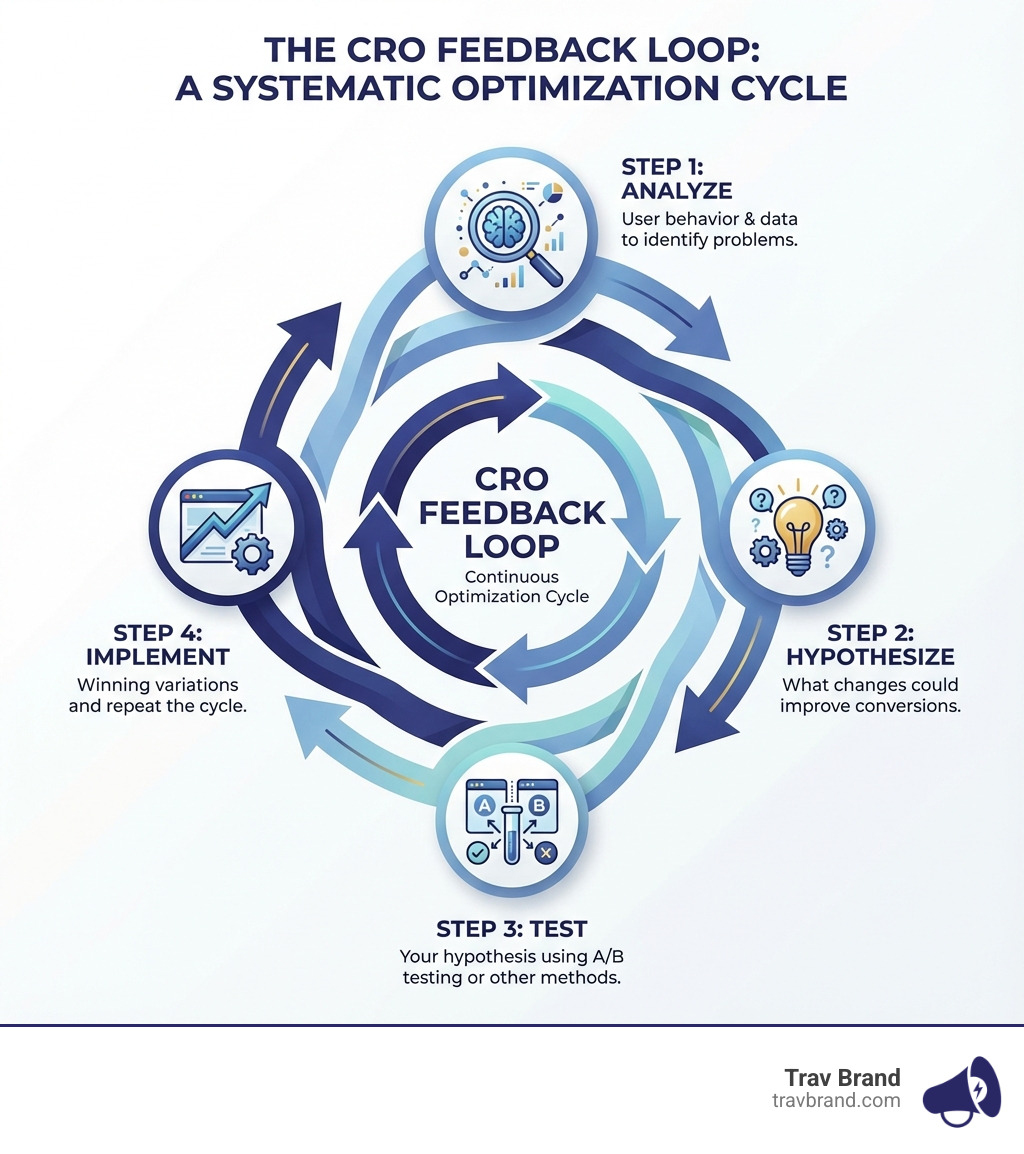
What matters is what the data tells us. While many ideas we test will fail to produce a statistically significant change, the real value lies in the process of research, development, and learning. The biggest challenge in CRO is that many businesses approach it half-heartedly. In 2025, businesses that continuously test and iterate are the ones that will stay competitive. We follow a professional, systematic process.
The Crucial Role of A/B Testing and Experimentation
A/B testing (or split testing) is a powerful tool in our CRO arsenal. It’s a controlled experiment that allows us to compare two or more variations of a web page element to see which performs best, using statistical inference to make data-driven decisions.
Here’s how we approach A/B testing as a core conversion optimization best practice:
- Formulating a Clear Hypothesis: Before any test, we define what we expect to happen, why, and how we’ll measure success (e.g., “Changing the CTA button to orange will increase clicks due to higher contrast.”).
- Testing One Variable at a Time: To accurately attribute changes, we test one significant variable at a time, such as a headline, image, or CTA.
- Reaching Statistical Significance: We determine a sample size in advance and run experiments long enough to account for variations in user behavior, waiting until the test is complete before drawing conclusions.
- Choosing an Overall Evaluation Criterion (OEC): We select a “north star metric” upfront to define success and prevent ambiguous results or “cherry-picked” data.
- Multivariate Testing: For more complex scenarios, multivariate tests allow us to test several variables simultaneously to understand their interaction effects.
- Learning from Failed Tests: A test that doesn’t produce a lift isn’t a failure; it’s a learning opportunity that provides valuable insights for future hypotheses.
Not all companies have the traffic volume for A/B testing, but for most, it is a crucial, ongoing process.
Leveraging Personalization and Dynamic Content
In a world of generic marketing, personalization is a powerful conversion optimization best practice. Personalized experiences can significantly increase conversion rates because they make your site more relevant to each visitor.
We leverage personalization in several ways:
- Audience Segmentation: We segment audiences based on criteria like demographics, location, past purchases, and browsing history to tailor content.
- Behavioral Data: We use a customer’s browsing history to inform personalized product recommendations.
- Dynamic Content: We adjust website elements in real-time based on user characteristics. This could include showing location-specific offers or customizing headlines for returning visitors.
- Personalized Landing Pages: We create dedicated landing pages that match the intent and context of the visitor, such as reflecting the specific ad they clicked.
By delivering highly relevant content, we reduce cognitive load and increase the likelihood of conversion.
Using Data and Analytics to Inform Strategy
Data and analytics are the lifeblood of effective CRO. We use a combination of quantitative and qualitative data to drive our strategies:
- Quantitative Data (The “What”): Google Analytics is our primary tool for tracking usage, traffic sources, and conversion funnels. We use it to identify pages with high traffic but low conversion rates and to spot drop-off points.
- Qualitative Data (The “Why”): Tools like Hotjar and CrazyEgg provide visual insights through heatmaps and session recordings, revealing points of user confusion or frustration. We also gather insights from on-site surveys, user testing, and customer interviews.
- Identifying Drop-Off Points: By analyzing conversion funnels, we can pinpoint where users are abandoning our site and prioritize our optimization efforts on high-impact pages.
- Measuring ROI: We set clear KPIs for every CRO initiative to track return on investment, including conversion rate, average order value, and customer lifetime value.
By continuously tracking, analyzing, and acting on data, we ensure our CRO strategies are always evolving and delivering measurable results.
Frequently Asked Questions about Conversion Optimization
We get a lot of questions about Conversion Rate Optimization, and we’re happy to clear up some common points.
What is a good conversion rate?
There isn’t a single “magic number.” A good conversion rate varies significantly based on your industry, traffic source, product, and the device being used. While a typical range across many industries is 2-4%, top performers can exceed 8%.
Instead of focusing on a universal benchmark, we advise focusing on continuous improvement. Your best goal is to achieve a better conversion rate than you had last month. We help you benchmark against your own historical data first, then work towards incremental improvements.
What are the most common CRO mistakes to avoid?
It’s easy to fall into common traps. Here are the most frequent mistakes to avoid:
- Making Decisions Based on Opinion, Not Data: Your opinion doesn’t matter as much as what your users actually do. Always use research and data to guide your strategy.
- Not Testing Changes: Implementing changes without A/B testing means you won’t know what actually worked or why.
- Copying Competitors Blindly: What works for a large brand might not work for you. Every audience and business context is unique.
- Stopping Tests Too Early: Don’t let impatience lead to false positives. Run tests long enough to gather sufficient data and achieve true statistical significance.
- Ignoring Qualitative Data: Analytics tell you what is happening, but qualitative data (surveys, user interviews) tells you why. Ignoring it means you’re missing the full picture.
- Going Half-Heartedly: CRO requires commitment. It’s a continuous process, not a one-time project.
- Not Setting a Clear Goal (OEC): Without a predefined “north star metric,” it’s easy to cherry-pick data. Establish your primary goal upfront.
By being mindful of these mistakes, we ensure our CRO efforts are strategic and effective.
How does CRO impact SEO?
The relationship between CRO and SEO is symbiotic. When done right, conversion optimization best practices can significantly boost your SEO performance because Google’s algorithms increasingly favor a good user experience.
Here’s how CRO positively impacts SEO:
- Improved Site Speed: A faster website is a key CRO goal and a positive ranking factor for SEO.
- Improved Mobile-Friendliness: Optimizing for mobile is crucial for both CRO and Google’s mobile-first indexing.
- Better User Engagement: CRO aims to reduce bounce rates and keep users on your site longer. These positive engagement signals are favored by Google’s algorithm.
- Relevant Content: CRO involves understanding user intent and delivering relevant content, which aligns perfectly with SEO goals.
However, aggressive CRO tactics like intrusive pop-ups can harm both user experience and SEO. Our approach ensures that CRO efforts improve both user experience and search visibility simultaneously.
Conclusion: Start Optimizing Your Conversions Today
We’ve covered the core principles of Conversion Rate Optimization, from enhancing the user experience to the necessity of data-driven experimentation. The key takeaways are:
- CRO is about efficiency: Make the most of your existing traffic.
- User experience is paramount: A smooth, trustworthy site is a high-converting site.
- Data drives decisions: Replace assumptions with rigorous testing and analytics.
- Trust is earned: Use social proof, security, and clear policies to build confidence.
- It’s a continuous process: CRO is an ongoing journey of testing, learning, and iterating.
The power of incremental improvements cannot be overstated. Even a small lift in your conversion rate can have a serious long-term impact on your bottom line, turning a low-performance campaign into a winner.
At Trav Brand, we focus on measurable results, building high-performing marketing ecosystems that convert visitors into loyal customers. We are data-driven, making decisions based on what our experiments tell us.
Don’t wait. Start optimizing your conversions today, and watch your business thrive.
Ready to transform your website into a high-converting machine? Let’s build a high-converting e-commerce experience together. Start building a high-converting e-commerce experience