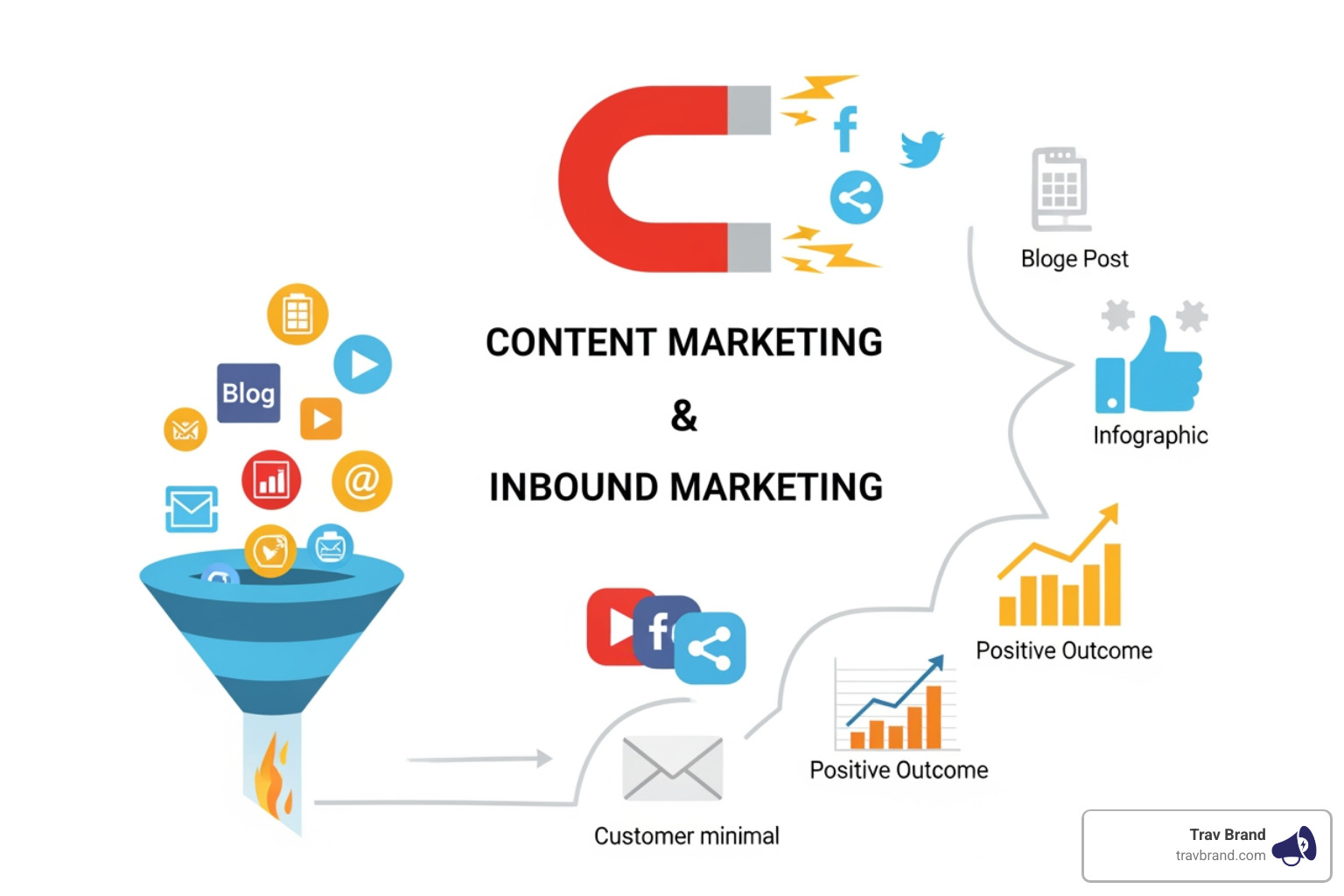
The Real Difference Between Content and Inbound Marketing
Why So Many Marketers Confuse Content Marketing and Inbound Marketing
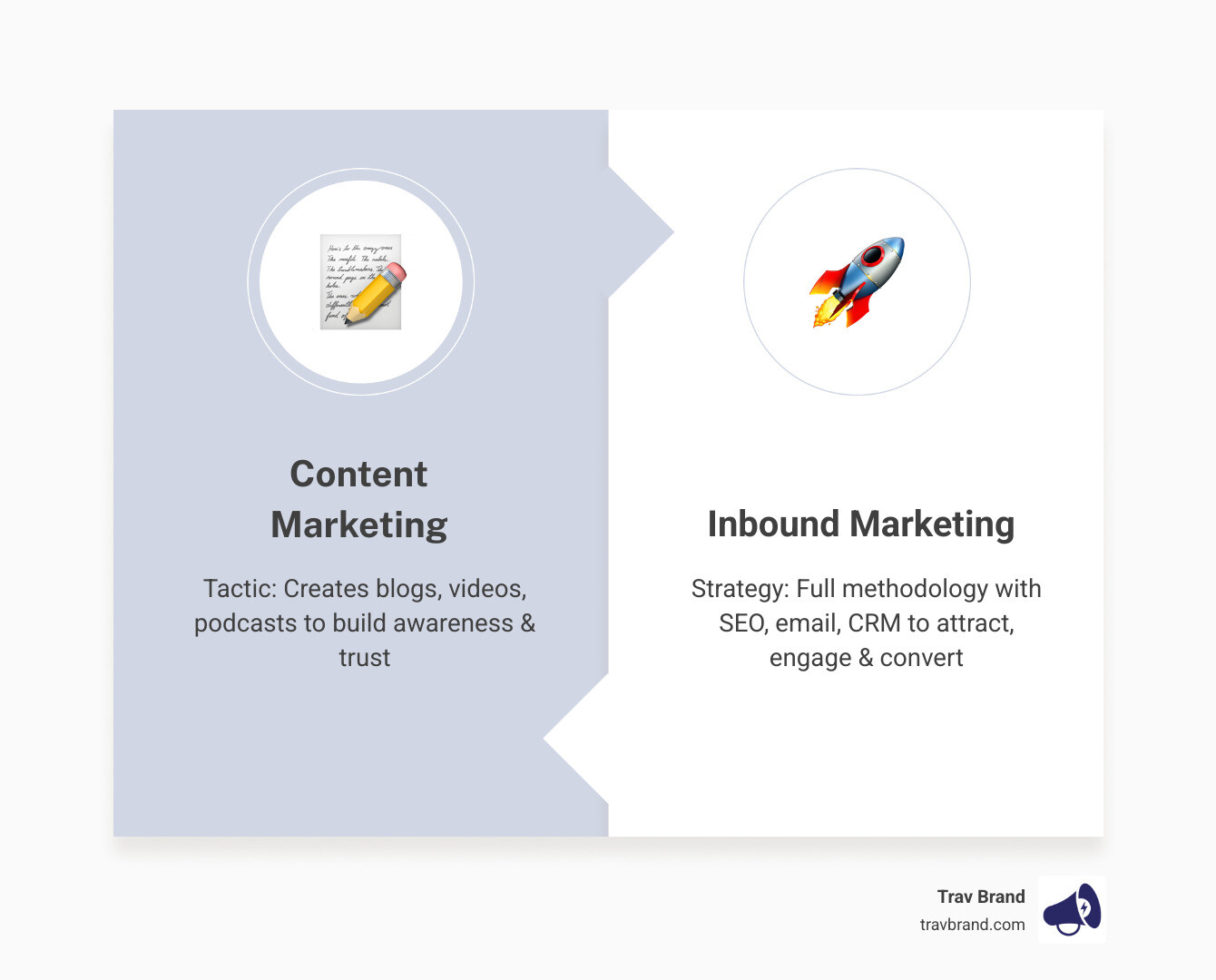
Content marketing and inbound marketing are related but not the same thing. Here’s the quick answer:
| Content Marketing | Inbound Marketing | |
|---|---|---|
| What it is | Creating and sharing valuable content to attract an audience | A full methodology to attract, engage, and convert customers |
| Scope | Tactic | Strategy/methodology |
| Goal | Build awareness, trust, and brand affinity | Generate leads, nurture them, and drive sales |
| Includes | Blogs, videos, podcasts, guides, social posts | Content marketing + SEO, email, CRM, lead nurturing, automation |
| Can stand alone? | Yes | Needs content to function |
The simplest way to think about it: content marketing is the fuel, inbound marketing is the engine.
You can run content marketing without a full inbound strategy — think brand storytelling, YouTube series, or industry guides that build awareness without capturing leads. But you can’t run a real inbound strategy without content. It powers every stage of the customer journey.
Both approaches share the same core philosophy: stop interrupting people, start helping them. Instead of pushing ads in front of strangers, you earn attention by being genuinely useful. That’s what makes these two strategies so powerful — and so easy to mix up.
I’m Trav Lubinsky, and across my work scaling brands like Flex Watches and advising companies including HexClad, Poppi, and FightCamp, content marketing and inbound marketing have been at the center of every growth strategy that actually moved the needle. In this guide, I’ll break down exactly how these two strategies differ, where they overlap, and how to use both to build a marketing system that compounds over time.
Content marketing and inbound marketing glossary:
Defining Content Marketing and Inbound Marketing
When we talk about content marketing and inbound marketing, we are talking about a fundamental shift in how businesses treat their customers. The old way of marketing was about buying attention—interrupting your favorite TV show with a commercial or cold-calling you during dinner. The new way is about earning attention.
At Trav Brand, we believe in a value-first approach. This means providing something useful to your audience before you ever ask them to open their wallets. By doing this, you build brand affinity and trust. However, while they share this “pull” philosophy, they operate on different scales.

HubSpot, which essentially pioneered the term “inbound,” offers their current definition: “Inbound marketing is a methodology to attract loyal customers to your business by aligning with your target audience’s needs and solving the problems they already have.”
In contrast, Strategic Marketing Content is the actual substance—the articles, videos, and guides—that fills that methodology. If inbound marketing is the map of the buyer journey, content marketing is the scenery and the signage that keeps the traveler moving toward the destination.
What is Content Marketing?
Content marketing is the art of educational storytelling. It is the process of creating and distributing valuable, relevant, and consistent information to attract and retain a clearly defined audience. The goal is to drive profitable customer action, but the primary focus is on the value provided to the reader or viewer.
It’s important to remember that content marketing can include social media, but it is much broader than just posting on Instagram. It includes:
- Blog posts and long-form articles.
- Videos (YouTube series, short-form reels).
- Podcasts and webinars.
- Infographics and original research.
- E-books and whitepapers.
For a deeper dive into how to structure these assets, check out our Web Content Marketing Services Complete Guide. The key takeaway is that content marketing focuses on the “what”—the message itself.
What is Inbound Marketing?
Inbound marketing is a holistic methodology. It isn’t just about the content; it’s about the systems that manage the content and the people who consume it. It is built on a three-stage flywheel: Attract, Engage, and Delight.
- Attract: Using content and SEO to bring people to your site.
- Engage: Using lead capture tools, email workflows, and inbound marketing tactics to turn visitors into leads.
- Delight: Providing exceptional service and continued value to turn customers into brand ambassadors.
If you are looking for a comprehensive look at how this fits into your overall business, our Your Ultimate Guide to E-Commerce Marketing Strategies explains how to build these systems from the ground up.
Key Differences: Scope, Goals, and Deliverables
Understanding the nuances between these two requires looking at them through the lens of a business operator. They are like the Baldwin brothers—closely related and often found in the same “movies” (campaigns), but they play very different roles.
| Feature | Content Marketing | Inbound Marketing |
|---|---|---|
| Primary Goal | Engagement and brand authority | Lead generation and revenue |
| Deliverables | Blog posts, videos, podcasts | Landing pages, CRM workflows, SEO audits |
| Ownership | Often a Content Manager or Editor | Often a Marketing Director or Operations Lead |
| Success Metric | Time on page, social shares | Conversion rate, ROI (return on investment) |
| Timeline | Long-term brand building | Full-funnel optimization |
Content marketing is often tactical. You might decide to write a series of blog posts to improve your search rankings. Inbound marketing is strategic. It asks: “Once they read that blog post, how do we get them to sign up for our newsletter, and how do we nurture that lead until they buy?” For help analyzing how your assets are performing, see our Content Performance Analysis.
Content Marketing and Inbound Marketing Metrics
Because the goals differ, the way we measure success differs too.
In content marketing, we look at content engagement. Are people reading the whole article? Are they sharing it? High engagement suggests your storytelling is resonating.
In inbound marketing, we look at the big picture, specifically customer lifetime value. and lead-to-customer conversion rates. We want to know if the content is actually moving the needle on revenue. We often work with brands to Optimize Content for Conversions to bridge this gap, ensuring that a “like” eventually turns into a “sale.”
Tools for Content Marketing and Inbound Marketing
The tools you use will also signal which strategy you are focusing on.
For content marketing, you need “creative” tools:
- CMS (Content Management Systems): Like WordPress or HubSpot’s Content Hub.
- Design Tools: Like Canva or Adobe Creative Suite.
- AI Assistants: Tools like Breeze are now helping teams accelerate production without losing quality.
For inbound marketing, you need “operational” tools:
- CRM (customer relationship management) system: To track every interaction with a prospect.
- Marketing Automation: To send the right email at the right time.
- SEO Software: To ensure your site is technically sound.
Our Internet Marketing Services Complete Guide provides an exhaustive list of the tech stack required to run a modern digital department.
How Content and Inbound Complement Each Other in 2025
As we move through 2025, the relationship between content marketing and inbound marketing is evolving rapidly. We are no longer in the era of “build it and they will come.” With the rise of AI-generated summaries and zero-click searches (where Google answers the question directly on the search page), just having a blog isn’t enough.
In 2025, we are seeing the rise of “Loop Marketing.” This is a model where content doesn’t just attract a visitor once; it creates a self-reinforcing cycle of engagement. Brands are using AI to hyper-personalize the experience. If you want to stay ahead, read our report on 10 Effective Digital Marketing Strategies for 2025 and Beyond.
According to HubSpot’s 2025 State of Marketing Report, 96% of marketers say personalized experiences have increased sales. This is where inbound systems shine—they take the great content you’ve made and ensure the right person sees it at the exact moment they need it.
The “Rented Land” Strategy
One of the most critical discussions in 2025 is the concept of “rented land.” My friend Jay Baer’s recent LinkedIn post got me thinking about this.
Rented land refers to platforms you don’t own—like TikTok, Instagram, or even Google Search. If the algorithm changes, your reach can disappear overnight.
- Content Marketing is often distributed on rented land (social media).
- Inbound Marketing focuses on moving people to “owned land” (your website and your email list).
In 2025, the winning strategy is to use rented land for reach but owned land for the payoff. You might use a viral TikTok to attract attention, but your inbound system must immediately work to get that person onto your email list or into your CRM. To see if your current strategy is too dependent on rented land, you can Audit Content Marketing efforts with our team.
Real-World Examples of Integrated Strategies
To see how these two work together, let’s look at some brands that are doing it right.
- The Entertainment Approach: Fintech provider Bilt pushes a “Roomies” series on TikTok and Instagram. This is pure content marketing—it’s funny, engaging, and builds a “vibe.” But behind the scenes, their inbound engine is capturing data and moving those viewers into their app ecosystem.
- The Educational Approach: Morehouse College built an admissions blog that used AI-powered assistants to answer student questions. This increased on-site time by 27% and saved thousands in agency hours. They used content to answer questions and inbound tools to manage the student journey.
- The B2B Powerhouse: Clearwing Productions, a live event production company, used HubSpot’s Marketing Hub to create deep-dive content and follow up with leads, driving $8M in revenue and a staggering 4,200% ROI.
Whether it’s a pizza chain creating a series on YouTube or a major retailer co-producing holiday films, the goal is the same: use great content to earn the right to start an inbound relationship. For e-commerce specifically, we’ve mastered How to Write E-Commerce Content Marketing That Converts, focusing on that critical transition from “viewer” to “buyer.”
Frequently Asked Questions about Content and Inbound
Is content marketing a part of inbound marketing, or are they the same thing?
They are not the same thing, but they are inseparable in a successful strategy. Think of it as an umbrella structure: Inbound Marketing is the umbrella. It covers everything from SEO and social media to email marketing and lead nurturing. Content marketing is the “foundational fuel” that sits under that umbrella.
You can technically do content marketing without inbound (e.g., publishing a magazine just for brand awareness), but you cannot do effective inbound marketing without content. Without content, your SEO has nothing to rank, your emails have nothing to say, and your social media has nothing to share.
Which strategy delivers better ROI for my business?
This is a trick question because they work together to produce ROI. However, the data is clear: content-driven inbound marketing is incredibly cost-effective. According to Neal Schaffer, content marketing is 62% less expensive than traditional “outbound” marketing, yet it generates three times as many leads.
Because content is an “asset,” it compounds. A blog post you write today can still generate leads three years from now. A TV ad or a Facebook ad stops working the second you stop paying for it.
Can you do inbound marketing without content marketing?
Technically, you could try to run an inbound strategy using only tools—like setting up a CRM and some automated emails—but what would those emails contain? What would people find when they search for you on Google?
The “Attract” phase of the inbound flywheel relies almost entirely on content. Without it, you have no value exchange. You are asking for a customer’s email address or time without giving them anything in return. In the modern era, consumers are too savvy for that. They want value first.
Conclusion
At Trav Brand, we don’t see content marketing and inbound marketing as competing ideas. We see them as the two halves of a powerful growth engine. Content provides the “why” for your audience to engage with you, while inbound provides the “how” for your business to turn that engagement into measurable results.
We focus on building and scaling purpose-driven brands through comprehensive strategies that don’t just look good on paper—they drive revenue. Whether you need help with Strategic Marketing Content or a full-scale Digital Marketing Strategy Guide, our team is here to move you from consulting to execution.
Ready to stop renting attention and start owning your audience? More info about Trav Brand services can be found here. Let’s build something that compounds.