
Supercharge Your Store Essential E-commerce Conversion Tips
Why E-commerce Conversion Best Practices Matter More Than Ever
E-commerce conversion best practices are the proven strategies that turn more of your website visitors into paying customers. Here’s what you need to know:
- Optimize site speed – Pages loading in 3+ seconds lose 32% of visitors
- Simplify checkout – Reduce form fields and offer guest checkout to combat 70% cart abandonment
- Add social proof – Reviews and testimonials can boost conversions by 34-270%
- Make it mobile – 59% of sales happen on mobile devices
- Use clear CTAs – Personalized calls-to-action convert 202% better
- Test everything – A/B testing helps you find what actually works for your audience
The real challenge for e-commerce businesses isn’t just driving traffic anymore. It’s converting that traffic into revenue.
Right now, the average e-commerce conversion rate hovers between 2-3%. That means for every 100 people who visit your store, only 2 or 3 actually buy. The other 97 leave empty-handed.
Here’s the good news: small improvements in conversion rate create massive revenue gains. If your store generates $10 million annually, a 1% conversion increase adds $100,000 to your bottom line instantly. No new traffic required.
But most store owners overcomplicate this. They chase expensive redesigns, bloated tech stacks, and flashy features that don’t move the needle. The highest-converting stores focus on fundamentals: reducing friction, answering customer questions, and making the path to purchase obvious.
I’m Trav Lubinsky, and I’ve spent my career building and scaling consumer brands across e-commerce, from launching Flex Watches to advising billion-dollar companies on growth strategy. Through my work implementing e-commerce conversion best practices for brands like HexClad, FightCamp, and Poppi, I’ve learned that conversion optimization is about understanding what persuades users to act and systematically removing what holds them back.
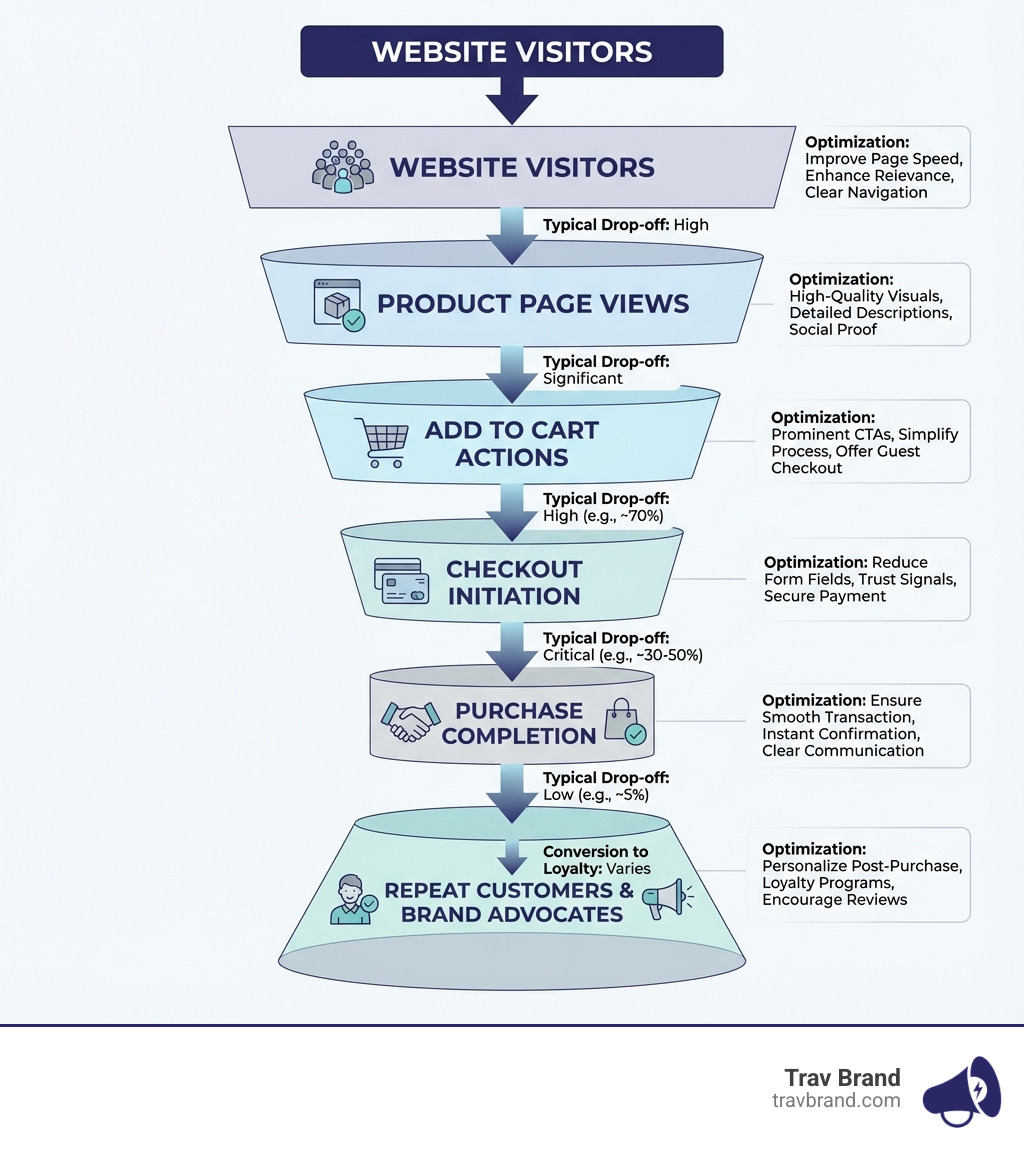
Mastering the Fundamentals: Key Ecommerce Conversion Best Practices
At Trav Brand, we believe that conversion rate optimization (CRO) is the heart of sustainable e-commerce growth. It’s the continuous process of identifying and testing opportunities to improve the percentage of visitors who take a desired action on your website. This could be anything from making a purchase, signing up for a newsletter, or even viewing a specific product.
Our approach to CRO is built on a solid foundation of data-driven decisions. We don’t guess; we gather insights, analyze patterns, and experiment to find what truly resonates with your audience. This process typically involves four key steps: analytics tracking, in-depth research and ideation, rigorous experimentation, and continuous iteration.
Understand Your Starting Point with Analytics
Before we can optimize anything, we need to know where we stand. This is where analytics tracking becomes our best friend. We implement robust tracking to monitor crucial metrics that paint a clear picture of user behavior on your site.
These key metrics include:
- Unique visitors: How many individual people are coming to your site?
- Page views: Which pages are most popular, and how often are they viewed?
- Bounce rate / Exit rate: Where are visitors leaving your site without interacting, or departing from a specific page?
- Add to carts: How many visitors are adding items to their shopping cart?
- Orders/purchases: The ultimate goal – how many actual sales are you making?
- Total revenue: What’s the monetary value of those sales?
- Average Order Value (AOV): How much are customers spending per order, on average?
By carefully tracking these numbers, we can perform a comprehensive conversion funnel analysis. This helps us pinpoint exactly where users are dropping off in their journey, from browsing to checkout. For instance, if many visitors view product pages but few add to cart, we know there’s a problem with the product page experience.
Most e-commerce platforms offer excellent tools for this. We leverage real-time analytics dashboards to keep a finger on the pulse of your store’s performance. These dashboards provide insights into everything from live visitor activity to product performance and marketing campaign effectiveness.
The average conversion rate as of March 2024 is around 1.95%, typically hovering between 2.5% and 3%. But this isn’t a one-size-fits-all number. It varies significantly based on your product type, pricing, and average order value. Our goal is always to exceed these benchmarks by understanding your unique business and customers.
To dive deeper into setting up your analytics, check out our guide on Setting Up Analytics for E-commerce Success.
Uncover “Why” with Qualitative Research
While analytics tell us what is happening, qualitative research helps us understand why. It’s about getting inside your customers’ heads and truly understanding their motivations, frustrations, and desires. This is a critical step in any successful CRO strategy.
Our favorite tools for this “detective work” include:
- User testing: We bring in real users to steer your site, perform tasks, and voice their thoughts out loud. It’s like having a personal tour guide pointing out every bump in the road. The best part? You don’t need a huge budget or an army of testers. Research shows that you only need 5 participants to find 85% of the usability problems on a website.
- Customer surveys: Simple on-site or post-purchase surveys can gather invaluable feedback directly from your audience. Asking “Why did you buy?” or “What almost stopped you?” can reveal hidden insights.
- Heatmaps: These visual tools show us where users click, move their mouse, and scroll on your pages. It’s like an X-ray of user engagement, highlighting hot spots and ignored areas.
- Session recordings: Imagine watching a video of a user’s entire journey on your site. That’s what session recordings offer. We can see exactly where they get confused, encounter bugs, or abandon a process.
By combining these methods, we can identify specific friction points that are holding back conversions. Is a button hard to find? Is a form field confusing? Is a crucial piece of information missing? Qualitative research answers these questions, providing actionable insights that pure numbers can’t.
Optimizing the On-Site Experience for Conversions
Once we understand the “what” and the “why,” it’s time to roll up our sleeves and optimize the actual on-site experience. This is where we implement e-commerce conversion best practices to make your website a smooth, enjoyable, and highly persuasive shopping destination.
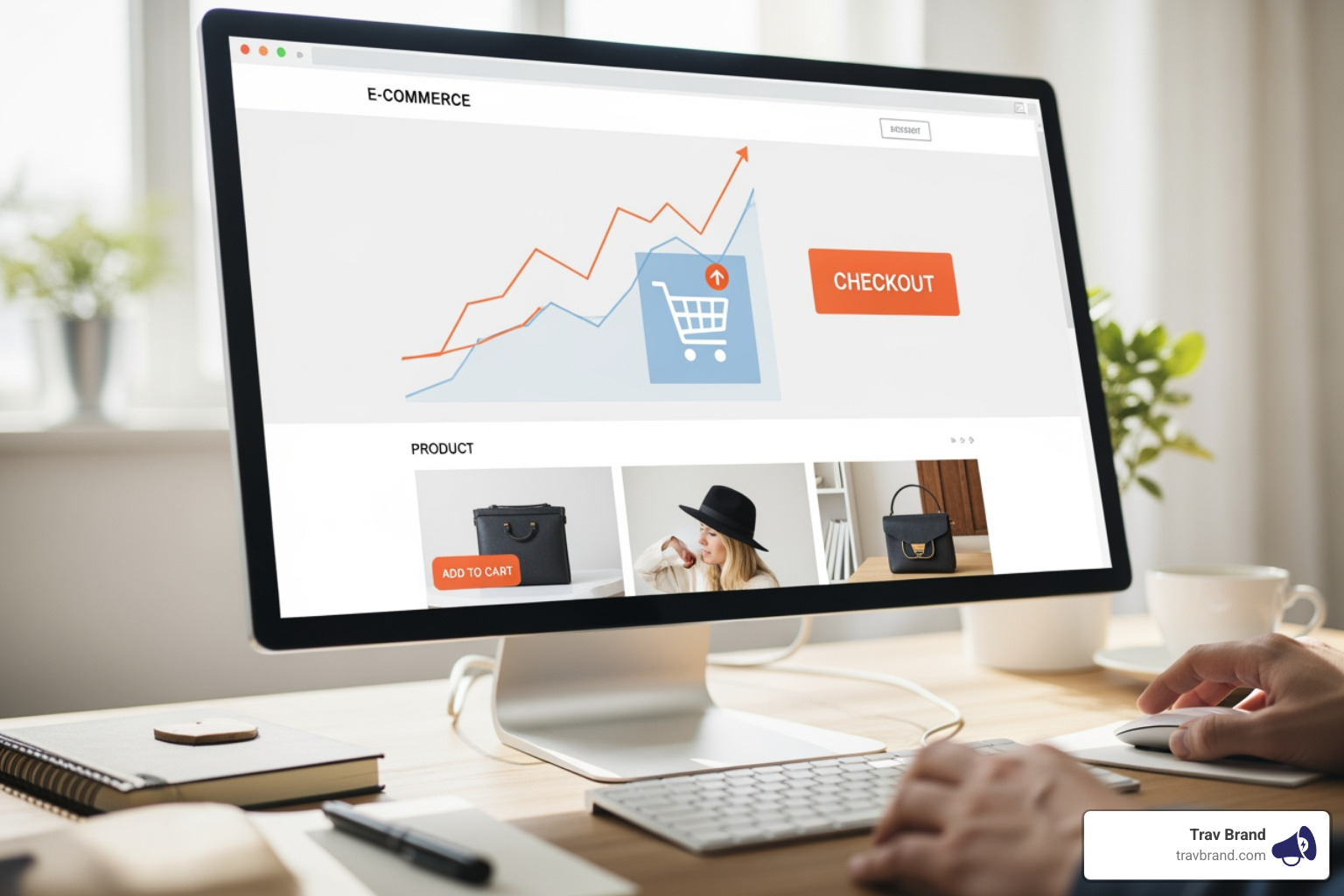
Every element, from how fast your pages load to the trust signals you display, plays a role in influencing a customer’s decision to buy.
Boost Performance with Superior Site Speed and Mobile Design
Patience is a virtue few online shoppers possess. Website speed isn’t just a nice-to-have; it’s a non-negotiable conversion factor.
Think about it:
- Users are 32% more likely to bounce from a page that takes three seconds to load.
- Double that to six seconds, and the probability of them leaving surges to 106%.
- This translates to a 12% drop in conversion rate for every second of load time.
Google research further emphasizes this, showing that as page load time increases from 1 to 5 seconds, the probability of a bounce increases by 90%. A one-second website speed improvement can increase mobile user conversions by up to 27%. Given that 70% of shoppers buy on mobile devices, site speed clearly has a huge impact on your revenue potential.
We implement best practices like:
- Compressing images without sacrificing quality.
- Minimizing code (CSS and JavaScript) to reduce file sizes.
- Utilizing a Content Delivery Network (CDN) to serve content faster globally.
- Enabling browser caching so repeat visitors load pages quicker.
- Choosing reliable hosting that can handle traffic spikes.
Beyond speed, mobile responsiveness and a mobile-first design approach are paramount. Mobile devices account for a significant 59% of ecommerce sales. If your site isn’t optimized for smaller screens, you’re essentially putting up a “closed for business” sign for more than half your potential customers.
Our strategy involves:
- Using responsive design that adapts seamlessly across all devices.
- Optimizing load times specifically for mobile.
- Ensuring tap targets (buttons, links) are finger-friendly.
- Simplifying mobile navigation to be intuitive and uncluttered.
- Thoroughly testing the mobile experience across various devices and browsers.
This is why faster page load times reduce bounce rates and increase conversions, especially on mobile.
Build Trust and Urgency with Social Proof and Strong CTAs
In an era of endless choices, online shoppers crave reassurance. This is where social proof comes in. It’s the psychological phenomenon where people assume the actions of others in an attempt to reflect correct behavior. In simpler terms, if others like it, I probably will too!
We harness social proof through:
- Customer reviews: Nearly 70% of online shoppers read between one and six customer reviews before making a purchasing decision. Authentic reviews can increase conversion rates by as much as 270%.
- Testimonials: Highlight positive experiences from satisfied customers. Testimonials alone can increase conversion rates by 34% when used properly.
- User-generated content (UGC): Showcase photos, videos, and social media posts from real customers using your products. Posting praise-filled social media posts about your product can earn you 34% more purchases.
- Trust badges: Display security seals (like SSL certificates), payment provider logos, and money-back guarantee badges to reassure customers about their data and purchase.
Equally important are compelling calls-to-action (CTAs). These are the guiding lights that tell users exactly what to do next. A great CTA isn’t just a button; it’s an invitation to convert.
To craft CTAs that convert, we focus on:
- Clarity and specificity: Instead of “Click Here,” try “Get Your Free Ebook Now” or “Add to Cart.”
- Action-oriented language: Use strong verbs that inspire immediate action.
- Urgency (genuine): Phrases like “Limited Stock” or “Offer Ends Soon” can encourage quicker decisions, but always be honest.
- Visual prominence: CTAs should stand out from the rest of the page. We use contrasting colors (check a color wheel for guidance!) and sufficient white space to make them pop.
- Personalization: Personalized calls to action are 202% more likely to convert. Tailoring the message to the user’s journey or interests makes a huge difference.
Small tweaks can lead to massive results. Expedia increased profits by $12 million simply by dropping one field from their checkout form. The travel company Going cut one word and added two new ones to their CTA, resulting in a 104% month-over-month increase in their homepage conversion rate. These aren’t just anecdotes; they’re proof that meticulous optimization pays off.
Simplify the User Journey: Ecommerce Conversion Best Practices for Navigation
Have you ever landed on a website and felt completely lost? That’s a conversion killer. Users expect your site to work the same way as all the other sites they already know (this is known as Jakob’s Law). An intuitive, frictionless user journey is fundamental to ecommerce conversion best practices.
We focus on:
- Intuitive navigation: Our goal is to make it effortless for users to find what they’re looking for. This means clear, logical menu structures, well-organized product categories, and minimal nesting. Improving your site navigation can increase conversion rates by 18.5%.
- Product categories: Divide categories and subcategories into manageable chunks. Avoid redundant or overlapping categories that confuse users. For larger catalogs, consider “Best Sellers” or “New Arrivals” categories as entry points.
- Site search functionality: A prominent and effective search bar is crucial. It should offer auto-complete suggestions, support synonyms, abbreviations, and even “symptom” searches (e.g., “dry skin relief”). Users often rely on search as a fallback when browsing fails.
- Product filtering and sorting: Empower users to quickly narrow down choices. Provide checkboxes for filter options and allow sorting by price, user rating, best-selling, and newest.
- Breadcrumbs: These helpful navigation aids show users their current location within your site’s hierarchy (e.g., Home > Category > Subcategory > Product). They prevent users from feeling lost and facilitate exploration.
We also ensure product pages themselves are actionable. This means:
- High-quality product imagery: Feature at least 3 to 5 images per product, including multiple angles, zoom functionality, and lifestyle shots. Videos and 360-degree views are even better.
- Detailed product descriptions: These should be persuasive, detailed, yet easy to skim. Focus on benefits, address pain points, and provide all necessary specifications. Baymard’s research indicates that 10% of e-commerce sites have insufficient product descriptions.
- Prominent CTAs: Ensure the “Add to Cart” button is visually distinct, above the fold, and easy to find.
Streamlining the Checkout to Reduce Cart Abandonment
Your customer has arrived at checkout; congratulations! But there’s still work to be done. The checkout process is the final, and often most fragile, stage of the conversion funnel. This is where over two-thirds of potential sales are lost.

Tackle the Top Reasons for Abandoned Carts
The statistics are stark: about 70% of consumers abandon their carts before completing a purchase. Why do so many shoppers get so close to buying, only to bail at the last minute?
The primary culprits often include:
- Unexpected costs: This is a huge one. 19.6% of consumers abandon shopping carts due to additional shipping costs alone. Hiding these costs until the very end is a sure-fire way to create frustration.
- High shipping fees: Even when transparent, excessively high shipping costs can be a deal-breaker.
- Lack of transparent pricing: Any hidden fees, taxes, or surcharges that pop up unexpectedly will cause users to second-guess their purchase.
- Account creation requirement: Forcing customers to create an account before buying is a major friction point. The Baymard Institute found that 18% of users will abandon their cart if the checkout process is perceived as being too long or complicated, often due to mandatory account creation.
Our strategy is to mitigate these issues by ensuring clear pricing, upfront communication about all costs, and a streamlined, user-friendly experience.
The Final Hurdle: Ecommerce Conversion Best Practices for Checkout
To combat cart abandonment and turn those hesitant shoppers into loyal customers, we implement these crucial ecommerce conversion best practices at checkout:
- Simplified forms: Long forms are a conversion killer. 27% of users will bail on a form if it’s too long. We ruthlessly cut unnecessary fields, pre-fill data where possible, and use dropdowns to simplify entry. Remember Expedia’s $12 million profit from removing just one field? It works!
- Progress indicators: For multi-step checkouts, a clear progress bar (e.g., “Step 1 of 3”) gives users a sense of where they are and how much is left, reducing perceived effort.
- Guest checkout option: This is a non-negotiable. While collecting customer data is valuable, forcing account creation is a huge barrier for first-time or infrequent buyers. Guest checkout enables customers to complete a purchase without creating an account, significantly reducing abandonment. Offer it clearly, and prompt for account creation after purchase.
- Multiple payment options: Align with customer expectations by offering a variety of trusted payment methods. This includes major credit/debit cards, digital wallets like PayPal, Apple Pay, and Google Pay, and increasingly popular “Buy Now, Pay Later” (BNPL) services like Klarna, AfterPay, and Affirm. Shopify’s accelerated checkout feature, Shop Pay, for example, increases conversions by up to 50% over guest checkout, outpacing other accelerated checkouts by at least 10%.
- Security seals (SSL): Visibly display trust badges and SSL certificates near payment fields. Robust security measures contribute significantly to customer confidence and conversion rates, assuring them their sensitive information is safe.
Use Personalization to Improve the Experience
Personalization isn’t just for product recommendations on the homepage; it can be a powerful tool at checkout too. By leveraging customer data and behavior, we can tailor the checkout experience to individual users, making them feel seen and valued.
- Personalized recommendations: Even if an item is already in the cart, relevant recommendations (e.g., “frequently bought together” or accessories) can increase average order value. The anecdote of Amazon engineers in 1998, who were initially dismissed for recommending products on the cart page, only to find it won by a wide margin in testing, highlights the power of this.
- Dynamic content: Adjust elements of the checkout page based on user segments or past behavior. For example, offering a specific discount to a returning customer who previously abandoned a similar cart.
- Custom offers: Imagine a customer buying a lipstick, and at checkout, they’re offered a free matching lip liner. Personalized experiences can increase conversion rates by over 200%. As mentioned before, this is because personalized calls to action are 202% more likely to convert.
Driving Continuous Improvement Through Testing and Iteration
The journey to a high-converting e-commerce store is never truly finished. It’s an ongoing process of learning, adapting, and refining. This is where the power of experimentation and iteration comes into play.
Leverage A/B Testing to Find What Works
A/B testing is our secret weapon for continuous improvement. It’s a scientific method for comparing two versions of a webpage or app element to determine which one performs better.
Here’s how we approach it:
- What is A/B testing: We create two (or more) versions of a page element (e.g., a button color, headline, image, or entire page layout). Half your audience sees version A, and the other half sees version B. We then monitor which version drives more conversions.
- Testing hypothesis: Every test starts with a clear hypothesis. For example, “We believe changing the ‘Add to Cart’ button to green will increase conversions because green is associated with ‘go’ and positive action.”
- Testing variables: We isolate and test one variable at a time to ensure reliable results. This could be headlines, calls-to-action, product images, page layouts, or pricing displays.
- Sample size and duration: It’s crucial to run tests long enough to gather sufficient data and reach statistical significance. We typically aim for at least two weeks of testing and ensure our results are statistically significant, meaning we can be confident the changes weren’t due to random chance. You can use various online calculators to check for statistical significance.
- A/B testing tools and methods: We use industry-leading tools like Optimizely, VWO, Adobe Target, and Google Optimize (for those who still have access) to set up, run, and analyze our tests.
A/B testing allows us to make data-backed decisions, ensuring that every change we implement is truly an improvement.
Extend the Journey with Post-Purchase Optimization
Conversion isn’t just about the first sale; it’s about building lasting customer relationships. The post-purchase experience is a critical opportunity to foster loyalty and encourage repeat business.
- Thank you pages: Don’t treat the “thank you” page as a dead end. We optimize it to offer additional value, such as:
- Suggesting complementary products or exclusive offers.
- Inviting customers to join your community or follow on social media.
- Providing helpful resources or guides related to their purchase.
- Welcome emails: A well-crafted welcome email campaign can significantly boost engagement. They have a particularly high open rate, around 50%, making them a prime opportunity for engagement. Use this opportunity to thank them, provide order details, and introduce them further to your brand.
- Review requests: Strategically ask for product reviews a few days after delivery. This feeds back into your social proof strategy, building trust for future shoppers.
- Customer loyalty: A positive post-purchase experience is key to customer retention. When customers feel valued, they’re more likely to return, become brand advocates, and contribute to a higher customer lifetime value.
Frequently Asked Questions about E-commerce Conversions
We often get asked similar questions about optimizing conversion rates. Here are some of the most common ones:
What is a good e-commerce conversion rate?
While the average conversion rate typically hovers between 2% and 3% (with March 2024 data showing 1.95%), what’s “good” really depends on several factors. These include your industry, product type, average order value, and traffic sources. For instance, luxury goods might have lower conversion rates but higher AOVs. Service-based e-commerce can see rates closer to 9%. It’s most important to benchmark against your own historical data and then against industry averages. Also, keep in mind that mobile typically converts at about half the rate of desktop.
What are some quick wins for increasing conversions?
Looking for immediate impact? Here are a few low-effort, high-impact ecommerce conversion best practices:
- Add trust signals: Display security badges, customer reviews, and clear return policies prominently.
- Offer free shipping: If feasible, meeting a free shipping threshold is a huge motivator and reduces cart abandonment.
- Simplify checkout forms: Remove any unnecessary fields.
- Improve CTA clarity: Make your calls-to-action specific and action-oriented.
- Implement live chat or FAQs: Provide instant answers to customer questions to prevent abandonment.
How does CRO affect SEO?
CRO and SEO are often seen as separate disciplines, but they’re deeply interconnected. When done right, CRO can significantly boost your SEO performance. How?
- Improved user experience signals: CRO focuses on making your site faster, easier to steer, and more engaging. These improvements lead to lower bounce rates, longer dwell times, and more pages visited per session – all positive signals for search engines like Google.
- Faster page speed: A key CRO tactic is optimizing site speed, which is a direct ranking factor for Google.
- Mobile-friendliness: Ensuring your site is responsive and optimized for mobile users (another CRO best practice) is crucial for mobile SEO and ranking.
A site that converts well is usually a site that ranks well because it prioritizes the user experience that search engines are increasingly rewarding.
Conclusion: Building a High-Converting E-commerce Machine
Implementing effective ecommerce conversion best practices is not a one-time project; it’s a continuous journey. It requires a data-driven culture, a keen understanding of your users, and a commitment to ongoing experimentation and iteration.
Our key takeaways are simple:
- Focus on the user: Understand their journey, pain points, and motivations.
- Measure everything: Analytics provide the “what,” qualitative research provides the “why.”
- Test relentlessly: A/B testing is your most powerful tool for informed decision-making.
- Iterate constantly: E-commerce is dynamic; your optimizations should be too.
Looking ahead, emerging technologies like AI and VR are set to revolutionize e-commerce conversion strategies even further. AI can power hyper-personalized experiences, dynamic pricing, and intelligent chatbots for instant customer support. Virtual and Augmented Reality (VR/AR) are already proving their worth: website visitors who interacted with a 3D model of a product were 27% more likely to place an order, and customers viewing a product in AR were over 6% more likely to make a purchase. These immersive experiences are the future of online shopping.
At Trav Brand, we specialize in helping businesses like yours steer this complex landscape. We don’t just offer advice; we partner with you to build and scale your brand through comprehensive digital marketing, e-commerce, and content strategies, focusing on measurable results.
Ready to open up your store’s full potential? Explore our e-commerce strategies and services to see how we can boost your conversions.