Your Blueprint for Video Marketing Analysis and Strategy
Why Video Marketing Analysis Is Your Most Powerful Growth Tool
Video marketing analysis is the systematic process of measuring, tracking, and interpreting the performance of your video content to optimize strategy and drive business results. Here’s what you need to know:
Key Components of Video Marketing Analysis:
- Goal Alignment – Match metrics to specific business objectives (awareness, leads, sales)
- Core KPIs – Track reach (views, impressions), engagement (watch time, retention), and conversions (CTR, sales)
- Audience Insights – Analyze demographics, behavior patterns, and viewing preferences
- ROI Measurement – Connect video performance to tangible business outcomes
- Continuous Optimization – Use A/B testing and data-driven insights to improve results
Video content now accounts for 82% of all consumer internet traffic, and 93% of marketers report positive ROI from their video efforts. But here’s the reality: creating videos is only half the battle.
The real competitive advantage comes from knowing what’s working and why.
Most founders and business owners pour resources into video production without a clear framework for measuring success. They track vanity metrics like view counts but struggle to connect video performance to revenue growth. They can’t answer critical questions: Which videos drive actual conversions? Where do viewers drop off? What content resonates with their highest-value customers?
This gap between creation and measurement is costing businesses real money.
The challenge isn’t just collecting data—platforms like YouTube, Instagram, and TikTok provide mountains of analytics. The challenge is knowing which metrics matter for your specific goals, how to interpret them correctly, and most importantly, how to translate insights into action.
A strategic approach to video marketing analysis transforms guesswork into a repeatable system for growth. It tells you exactly which video formats drive leads, which distribution channels deliver ROI, and how to optimize every piece of content for maximum impact. Instead of hoping your videos perform well, you’ll know precisely what works and how to replicate it.
I’m Trav Lubinsky, and over the past decade I’ve built and scaled multiple consumer brands using data-driven video marketing strategies—from launching Flex Watches to advising billion-dollar companies on their content approach. At Trav Brand, we help founders build comprehensive video marketing analysis systems that connect creative content to measurable business growth.
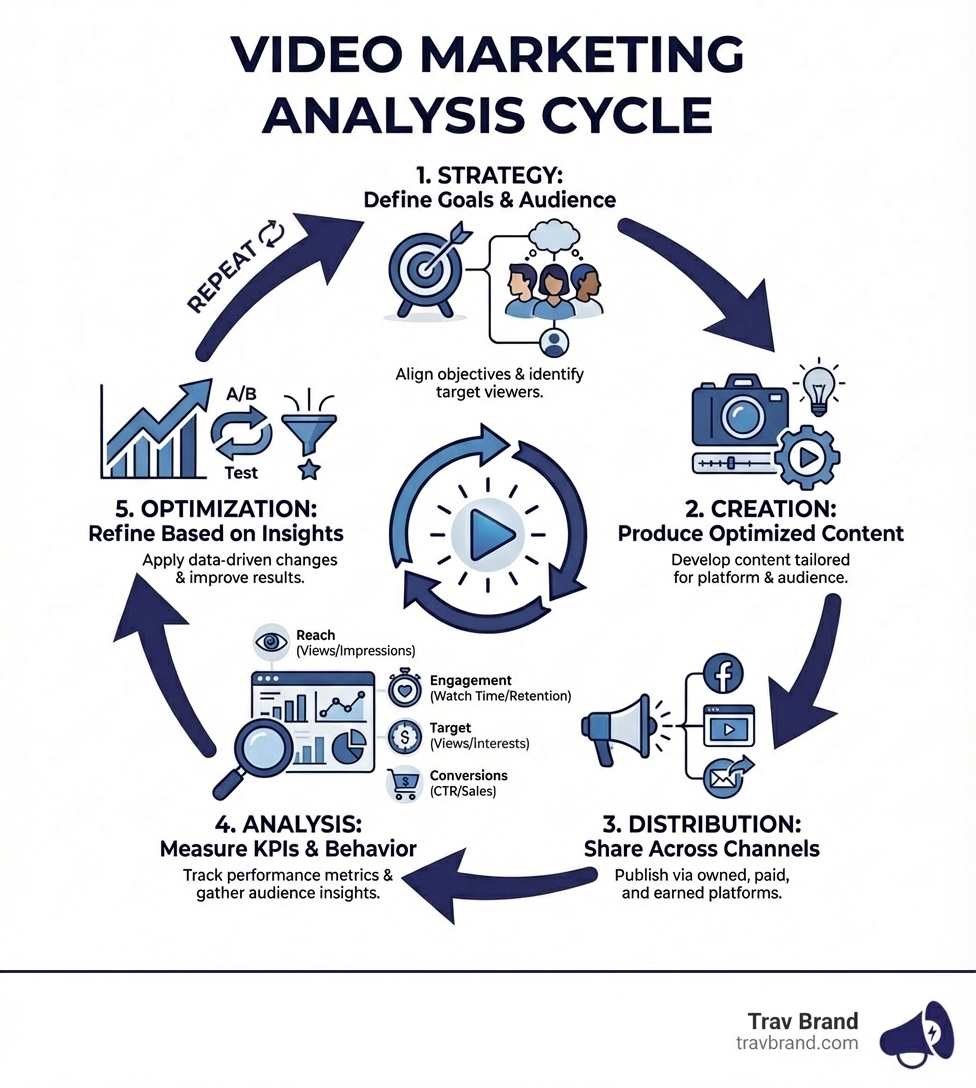
The video marketing analysis cycle: Strategy (define goals and target audience) -> Creation (produce optimized content) -> Distribution (share across owned, paid, and earned channels) -> Analysis (measure KPIs and audience behavior) -> Optimization (refine based on data insights) -> repeat.
Aligning Analysis with Your Video Marketing Goals
Before we even think about metrics, we need to understand why we’re making videos in the first place. Just like a chef doesn’t measure ingredients without knowing the recipe, we don’t analyze video performance without clear marketing goals. Our video marketing analysis should always start with a question: what are we trying to achieve?

The marketing funnel provides an excellent framework for defining our primary objectives. It helps us understand that different videos serve different purposes, from catching a prospect’s eye to sealing the deal or even turning a customer into a brand advocate. Metrics for success differ from goal to goal, and we classify them based on where our ideal viewer falls within this funnel.
Defining Your Primary Objectives
Each stage of the customer journey demands a unique approach to content and, consequently, a distinct set of metrics for video marketing analysis:
- Top-of-funnel (Attract): At this stage, our goal is to build brand awareness and attract new audiences. Think broad reach, engaging content that introduces our brand or solves a general problem. We’re casting a wide net, hoping to capture attention.
- Middle-of-funnel (Engage/Nurture): Here, we aim to educate potential customers, build trust, and address their specific needs. Our videos here deepen engagement, answering questions and demonstrating value.
- Bottom-of-funnel (Convert): This is where we drive direct action – purchases, sign-ups, or inquiries. Videos at this stage are designed to convince and convert, removing any final hesitations.
- Post-purchase (Delight): After a sale, videos can help onboard customers, provide support, and foster loyalty. Our goal is to keep them happy, reduce churn, and encourage repeat business and referrals.
Storytelling is paramount at every stage. It allows us to connect better with our target audience, helping us to build a brand voice and identity that resonates deeply.
Matching Video Formats to Funnel Stages
The type of video we create significantly impacts its effectiveness at different funnel stages. A quick glance at current trends shows that short-form content is a dominant force in the marketing landscape, but longer formats still hold immense value.
- Short-form video (Reels, Shorts): Perfect for top-of-funnel awareness and quick engagement. Short-form videos (under 1 minute) have an average engagement rate of 50%. These are snackable, shareable, and great for grabbing attention. As a fun fact, 73% of people believe videos between 30 seconds and 2 minutes are the most effective.
- Long-form content (Webinars, Tutorials): Ideal for middle-of-funnel education and nurturing. While they might have lower engagement rates, longer videos can yield more total watch time, providing in-depth information and showcasing expertise.
- Live streams: These foster real-time engagement and authenticity, making them suitable for both middle- and bottom-of-funnel interactions, like Q&A sessions or product launches. Live video content, such as live streams on social media, is used by 36% of marketers.
- Product demos & Explainer videos: Crucial for middle and bottom-of-funnel consideration and conversion. 78% of people prefer to learn about a product or service by watching a short video, making these formats highly effective for showcasing how our offerings solve problems.
- Customer testimonials: Powerful for bottom-of-funnel conversion. Honest personal feedback is gold; 90 percent of consumers say their buying decisions are influenced by online reviews. These videos build trust and social proof.
The Core KPIs of Video Marketing Analysis
Once our goals are set and our videos are out in the wild, it’s time for the real fun: diving into the data! For effective video marketing analysis, we classify key performance indicators (KPIs) into three main categories: Reach, Engagement, and Conversion. These give us a comprehensive picture of how our videos are performing.
Reach and Awareness Metrics
These KPIs tell us how many eyeballs our videos are attracting and how widely our message is spreading. They’re primarily top-of-funnel metrics:
- Views: The most basic metric, indicating how many times our video has been watched. While it’s a vanity metric if not tied to deeper goals, it helps us tailor our content. If a video on a particular topic generates more views than usual, we can gather that this topic is popular with our audience, and create more videos and other content on similar subjects.
- Impressions: The number of times our video thumbnail or player was displayed to users, regardless of whether they played it. This gives us insight into our content’s visibility.
- Play Rate: The percentage of people who saw our video and clicked play. This is a good indicator of how compelling our thumbnail, title, and initial context are.
- Unique Viewers: The estimated number of individual people who watched our video. This helps us understand our actual audience size, rather than just repeat views.
- Brand Awareness Lift: Often measured through brand lift studies (available on platforms like YouTube), this shows how our video impacts metrics like brand recall and recognition.
- Social Reach: How many people our video reached across social media platforms.
Engagement and Audience Retention Metrics
These metrics go beyond mere views to tell us how much our audience is connecting with our content. Engagement is one of our favorite metrics because it reveals the quality of views.
- Watch Time: The total accumulated time viewers spent watching our video. This is a crucial metric, as platforms often prioritize videos with higher watch times.
- Average View Duration: The average amount of time viewers spent watching our video. Video marketing analysis shows us how long viewers spend watching each of our videos, which can give us an indication of where their interest drops off. This is a top indicator of if our content is boring or not.
- Audience Retention Graphs: These graphs (often found in native analytics) visually show us exactly where viewers are dropping off or re-watching segments within our video. This is incredibly powerful for optimizing future content!
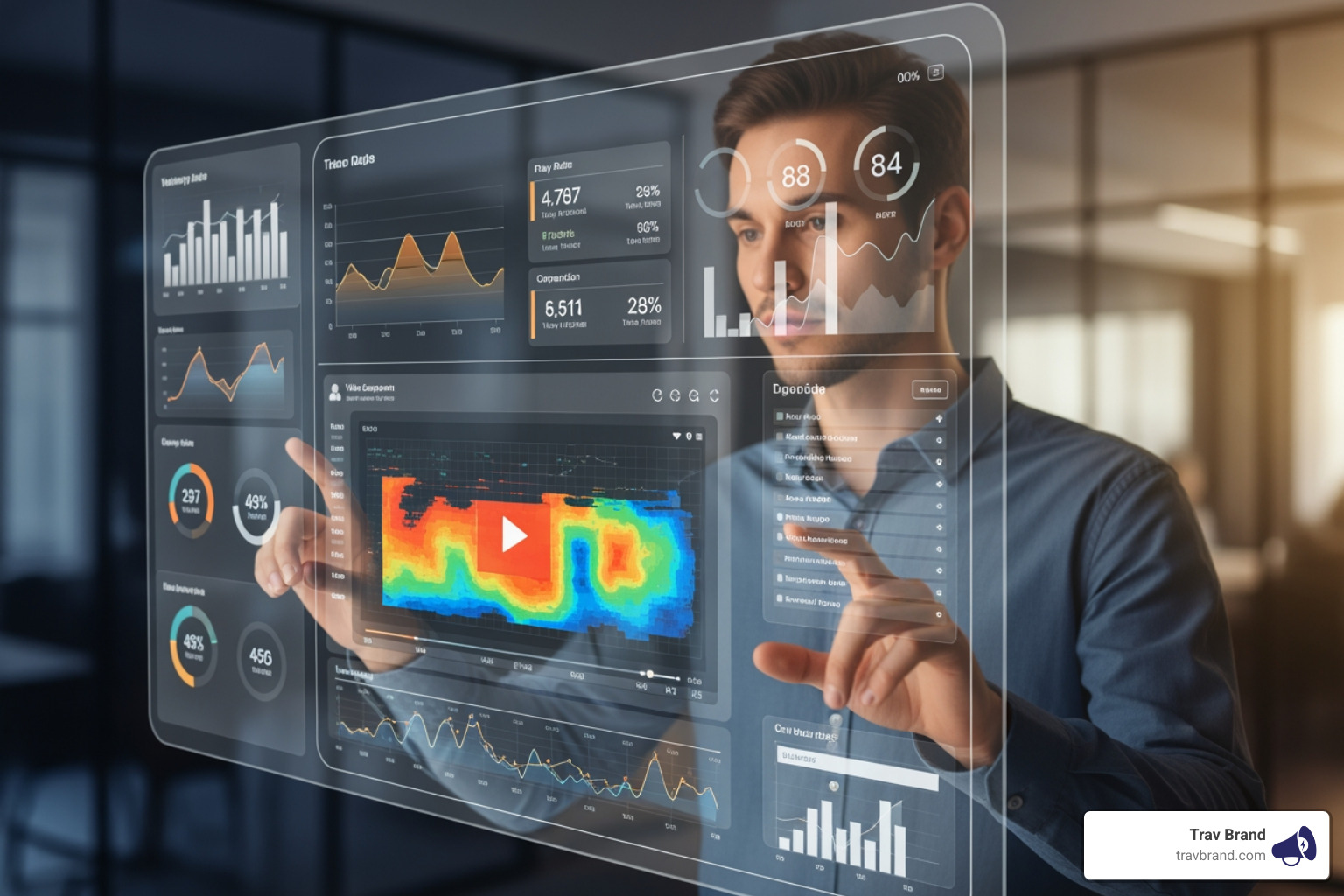
- Video Heatmaps: These offer granular insights into viewer behavior within a video, showing us the most and least watched parts.
- Likes, Comments, Shares: Direct indicators of audience interaction and sentiment. These social signals are invaluable. For example, short-form videos (under 1 minute) have an average engagement rate of 50%, showing their potential for virality.
Understanding Your Audience with Demographics
Beyond just how many people watch, video marketing analysis helps us understand who is watching. This demographic data is a goldmine for refining our content strategy and targeting.
- Age and Gender: Helps us confirm if we’re reaching our target demographic or uncover unexpected audiences.
- Geographic Location: Tells us where our viewers are, which can inform localized campaigns or content.
- Device Usage (Mobile vs. Desktop): With 3.5 billion users watching videos on mobile devices in 2023, understanding device preference is crucial for optimizing video format and delivery.
- How demographics inform content strategy and targeting: This data allows us to tailor future videos to specific audience segments. If our target audience is Gen Z, we might lean more into short-form, mobile-first content. If it’s B2B professionals, LinkedIn and webinar content might be more effective.
Measuring ROI and Business Impact
This is where the rubber meets the road. While vanity metrics are nice, the ultimate goal of video marketing analysis is to connect our video efforts to tangible business results. We need to answer the big question: are our videos generating revenue?
Connecting video to bottom-line results requires careful tracking and, sometimes, sophisticated attribution models. As with any marketing channel, it’s important to be able to measure and analyze our results with video.
Tracking Conversions and On-Site Actions
Our videos should ideally lead viewers to take a desired action, whether it’s clicking a link, signing up for a newsletter, or making a purchase.
- Click-Through Rate (CTR): The percentage of viewers who clicked on a call-to-action (CTA) within or after our video. A higher CTR indicates a compelling message and effective CTA placement.
- Conversion Rate: The percentage of viewers who completed a specific goal, like a purchase or form submission, after watching our video. This is a direct measure of our video’s effectiveness.
- Lead Generation Forms: If we embed forms directly into our videos (a feature offered by some specialized video platforms), we can track direct lead conversions.
- On-site behavior (time on page, bounce rate): When we embed videos on our website, we can use tools like Google Analytics to see how they impact user behavior. Pages with video are 53 times more likely to rank on Google’s first page, and people spend over twice as long on a page with video than without. This indicates our video is relevant and engaging.
Using Video Marketing Analysis to Measure Business Impact
Measuring the true Return on Investment (ROI) of video marketing can feel like trying to nail jelly to a wall. But it’s essential.
- ROI formula (Return – Investment / Investment): We apply this standard formula, but the trick is accurately defining “Return” and “Investment.”
- Calculating video production costs: This includes direct costs (equipment, talent, editing software) and indirect costs (our team’s time).
- Attributing sales and revenue: This is the most challenging part. We use unique UTM parameters in video links, track referral traffic from video platforms to our website, and analyze conversion paths. The good news is that 93% of marketers report a positive ROI from video, and 89% of people say watching a video has convinced them to buy a product or service. So, the results are there, we just need to find them!
Tools and Optimization Techniques
Measuring success is great, but what’s even better is using those insights to get more success! This is where optimization comes in. We believe in a continuous improvement cycle, where analysis informs our next steps, leading to better-performing videos.
Essential Tools for Video Marketing Analysis
Fortunately, we’re not flying blind. Many powerful tools help us track, analyze, and interpret our video data:
- Native Platform Analytics (YouTube, Vimeo, Social Media): Video sharing platforms like YouTube provide robust tools to analyze different aspects of our videos. These are our first stop for raw video performance data.
- Website Analytics (Google Analytics): Beyond in-platform analytics, we use Google Analytics to see the impact our videos have on our overall digital marketing strategy. This helps us monitor traffic from video sites, engagement metrics, and how on-page videos impact our site.
- Specialized Video Platforms: Platforms like Wistia offer advanced analytics, including heatmaps, engagement graphs, and the ability to embed CTAs directly into videos, providing deeper insights into viewer behavior.
And of course, for creation itself, professionals rely on a suite of tools. Here’s a list of top video creation and editing tools that can help bring our visions to life: Adobe, CapCut, Canva, Descript, and Frame.io.
Optimizing Performance with A/B Testing
A/B testing is our secret weapon for continuous improvement. It allows us to test different variables and see what resonates best with our audience.
- What to test (Thumbnails, Titles, CTAs, Video Length):
- Thumbnails: Does a smiling face or a product shot get more clicks?
- Titles: Which headline sparks more curiosity?
- CTAs: Does “Learn More” or “Shop Now” drive more conversions?
- Video Length: Is a 60-second explainer more effective than a 90-second one for a specific goal?
- How to structure a test: We create two versions of a video or its accompanying elements (A and B), expose them to similar audience segments, and measure which performs better against a specific KPI. AI tools can assist in A/B testing and performance tracking, providing real-time data on video performance metrics.
- Analyzing results for actionable insights: The winning version isn’t just a win; it’s a lesson. We learn what our audience prefers and apply those insights to future content.
The Future of Video Analytics: Trends for 2025 and Beyond
The world of video is constantly evolving, and so too must our approach to video marketing analysis. To stay ahead of the curve, we’re keeping a close eye on emerging trends that will shape how we create, distribute, and measure video content.
The Rise of AI in Video Creation and Analysis
Artificial intelligence is no longer science fiction; it’s a powerful partner in our video marketing efforts. Leveraging AI tools can significantly improve the effectiveness and efficiency of our campaigns.
- AI for content personalization: Imagine videos that dynamically adapt to individual viewer preferences, showing them products or information most relevant to them. 88% of international marketers reported that AI helped with personalizing the consumer journey across several channels.
- AI for predictive analytics: AI can analyze vast datasets to predict which video topics will perform best, identify potential viewer drop-off points, or even suggest optimal posting times.
- AI-powered editing and summarization: AI-powered video editing tools can automatically generate professional-looking videos by intelligently selecting impactful clips, adding transitions, captions, and music. This frees up our creative teams for higher-level strategy. Google AI has even been used to analyze over 8,000 top ads, revealing patterns and insights that traditional analysis might miss. We used AI to analyze over 8,000 top ads. Here’s what we learned about what truly ignites audiences’ emotions.
Interactive, Shoppable, and Personalized Video
Beyond passive viewing, the future of video is all about engagement and direct action.
- In-video quizzes and polls: These foster deeper engagement and gather valuable audience feedback directly within the video player.
- Branching narratives: Viewers can choose their own path through a video, creating a highly personalized and immersive experience.
- Shoppable video tags: This is a game-changer for e-commerce. Viewers can click on products featured in a video and purchase them directly, often without leaving the platform. 17% of social media users reported having bought a product in-app in the past three months, underscoring the power of this trend.
Frequently Asked Questions about Video Marketing Analysis
We get a lot of questions about how to best approach video marketing analysis. Here are some of the most common ones we encounter:
What is the most important video metric to track?
This is a trick question! The “most important” metric always depends on your primary goal. If your goal is brand awareness, reach metrics like views and unique viewers might be most important. If it’s engagement, then watch time and average view duration are key. For sales, conversion rate is king. As we’ve seen, metrics for success differ from goal to goal. For example, many experts consider engagement rate a crucial metric because it shows how well your audience is connecting with your content, while others emphasize view time as a top indicator of content quality. So, there’s no single “best” metric; it’s about aligning your analysis with your objectives.
How can I improve my video’s audience retention?
Audience retention is a critical indicator of video quality and engagement. To improve it:
- Strong hook: The opening moments of your video are crucial for capturing attention. Use an intriguing question, a surprising fact, or a visually appealing scene to grab viewers’ attention immediately.
- Clear and concise content: Get to the point. Viewers today have short attention spans.
- Good pacing: Keep the energy up, avoid long pauses, and maintain visual interest.
- Visual variety: Don’t just show a talking head for ten minutes. Mix in B-roll, graphics, text overlays, and different camera angles.
- Fulfilling the promise of the title: Make sure your video delivers on what your title and thumbnail promised. Viewers will drop off quickly if they feel misled.
How do I prove the ROI of my video marketing efforts?
Proving ROI is about connecting video views to your bottom line. Here’s how we do it:
- Track conversions with UTM parameters: Use unique UTM codes on all links from your videos to your website. This allows Google Analytics to attribute traffic and conversions directly to specific videos.
- Use dedicated landing pages: Direct video traffic to landing pages specifically designed for that campaign. This makes it easier to track conversions unique to your video efforts.
- Analyze referral traffic in Google Analytics: Beyond in-platform analytics, use Google Analytics to see how many visitors your videos attract to your site, how long they stay, and if they convert. This helps determine the effectiveness of calls to action and the quality of traffic.
- Connect video views to customer journey touchpoints: Integrate your video platform’s analytics with your CRM. This allows you to see if customers who watched certain videos are more likely to convert or have a higher lifetime value. We want to know whether our videos are generating the types of conversions that contribute to our bottom line, like sales and contact form submissions.
Conclusion
In today’s visually-driven digital landscape, video isn’t just an option; it’s a necessity. But the real power of video marketing isn’t in creation alone—it’s in the intelligent application of video marketing analysis. We’ve seen that analysis is not an afterthought; it’s the engine that drives continuous improvement and measurable results.
To truly succeed, we must align our metrics with our specific marketing goals, whether that’s building brand awareness, generating leads, driving sales, or fostering customer loyalty. By carefully tracking reach, engagement, and conversion KPIs, and understanding the demographics of our audience, we can transform raw data into actionable insights.
The future of video marketing analysis is exciting, with AI and interactive formats promising even deeper personalization and direct engagement. By embracing these trends and continuously optimizing our strategies through tools and A/B testing, we ensure that our video content doesn’t just entertain, but also drives significant business impact.
At Trav Brand, we specialize in building and scaling brands through comprehensive digital marketing, e-commerce, and content strategies. We focus on purpose-driven brands and measurable results, ensuring your video efforts contribute directly to your growth.
Ready to transform your video content into a powerful growth engine? Learn more about our comprehensive digital marketing services.