All About CRO
Why Conversion Rate Optimization Matters for Your Business
Conversion rate optimization is the systematic process of increasing the percentage of website visitors who complete a desired action—whether that’s making a purchase, signing up for a trial, or filling out a contact form. Instead of spending more to drive new traffic, CRO helps you get more value from the visitors you already have.
Quick Answer: What is Conversion Rate Optimization?
- Definition: The practice of improving your website to convert more visitors into customers or leads.
- Core Goal: Maximize the value of existing traffic rather than just attracting more visitors.
- Key Components: Data analysis, user research, hypothesis testing, and continuous iteration.
- Average Conversion Rate: 2.9% across industries (though this varies widely).
- Primary Benefit: More revenue from the same marketing spend.
Many businesses spend heavily on driving traffic, only to see most visitors leave without converting. This is a missed opportunity. Conversion rate optimization (CRO) addresses this by providing a structured approach to understand why visitors aren’t converting and what to do about it. It’s not about guesswork; it’s about data-driven improvements.
Even small improvements compound over time. A 1% increase in conversion rate can mean thousands in added revenue from the same traffic. Unlike paid ads that stop when you pause them, a well-optimized website keeps converting 24/7. The insights you gain also strengthen every other part of your marketing.
I’m Trav Lubinsky, and I’ve spent years scaling brands where CRO was the key to profitable growth. At Trav Brand, we implement systematic CRO processes that turn traffic into revenue and create better customer experiences.
Understanding the Core Principles of CRO
This section covers the fundamental concepts, calculations, and philosophies behind effective conversion rate optimization, setting the stage for strategic implementation.
How is Conversion Rate Calculated?
Before optimizing, you need to know what you’re measuring. Your conversion rate is the percentage of visitors who complete a desired action, such as a purchase or a form submission.
The formula is straightforward:
Conversion Rate = (Number of Conversions / Total Number of Visitors) x 100
For example, if your site gets 450 visitors and 18 make a purchase, your conversion rate is (18 / 450) x 100 = 4%.
So, what’s a “good” conversion rate? While a 2023 industry survey found an average of 2.9%, this figure varies wildly by industry, traffic source, and business goals. For e-commerce, 1%-3% is often considered strong. The best benchmark is your own past performance; the goal is continuous improvement. You can explore more benchmark data and methodology on sources like the conversion rate article on Wikipedia.
The Symbiotic Relationship Between CRO and SEO
While conversion rate optimization and SEO (Search Engine Optimization) seem different, they work together to drive growth. SEO gets people to your site, while CRO ensures those visits turn into valuable actions.
How they help each other:
- CRO helps SEO: Optimizing for conversions improves user experience (UX) with faster load times, clear navigation, and relevant content. These factors, which lead to lower bounce rates and longer time on site, are favored by search engine algorithms.
- SEO informs CRO: Keyword research reveals user intent, which helps tailor landing page content to match visitor expectations. SEO also brings in targeted, high-quality traffic that is more likely to convert, helping prioritize CRO efforts.
Integrating both strategies leads to a more robust and profitable digital presence.
Customer-Centric vs. Numerical Approach
It’s easy to get lost chasing numbers in conversion rate optimization. A purely numerical approach might test random changes to see what lifts a metric, but it fails to uncover the why behind user behavior. This can lead to short-term gains that don’t align with long-term customer satisfaction.
We champion a customer-centric approach, focusing on the people behind the data. To do this, we combine two types of data:
- Quantitative Data (The ‘What’): Analytics tells us what users are doing—where they come from, which pages they visit, and where they drop off. This identifies problem areas.
- Qualitative Data (The ‘Why’): User research tells us why they do it. We use tools like heatmaps, session recordings, surveys, and customer interviews to understand user motivations, frustrations, and needs.
By combining the ‘what’ and the ‘why’, we form hypotheses rooted in real user understanding, not guesswork. This leads to solutions that address genuine needs, creating happier customers and better conversion rates.

Building a Winning Conversion Rate Optimization Strategy
A successful CRO program is built on a structured, repeatable process. This section outlines the strategic framework for identifying opportunities and creating impactful tests.
The Key Components of a Successful CRO Strategy
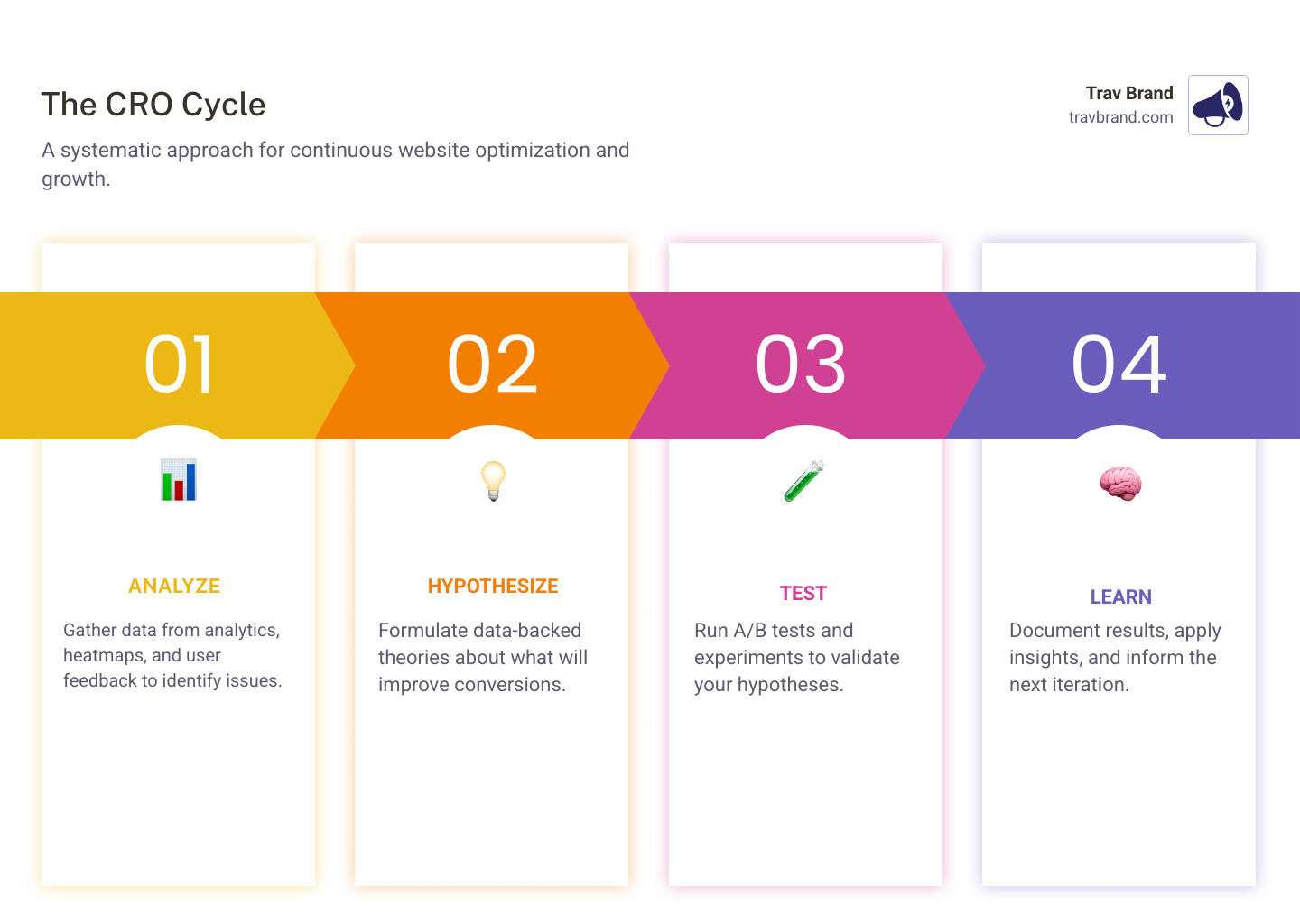
A robust conversion rate optimization strategy is a systematic approach with several interconnected components designed for continuous improvement:
- Data Analysis: We start by digging into website analytics to understand user behavior and identify what is happening on your site.
- User Research: To understand the why behind the data, we use qualitative methods like surveys, user interviews, and heatmaps to uncover user motivations and pain points.
- Hypothesis Generation: Based on data and research, we formulate educated, testable statements about a potential change and its expected impact.
- Prioritization: We use frameworks like PIE (Potential, Importance, Ease) to prioritize tests, ensuring we focus on changes that will yield the greatest returns.
- A/B Testing: We test our hypotheses by creating variations of page elements and showing them to different audience segments to see which performs better.
- Personalization: We tailor content and offers based on user segments, behavior, or demographics to make the experience more relevant.
- Iteration and Learning: CRO is an ongoing cycle. Every test provides valuable insights that inform the next round of hypotheses, continually refining the user experience.
Identifying and Analyzing Your Conversion Funnel
To optimize, we must first understand the user journey on your website—the conversion funnel. By mapping this path, from initial entry to a completed action, we can identify where users are dropping off.
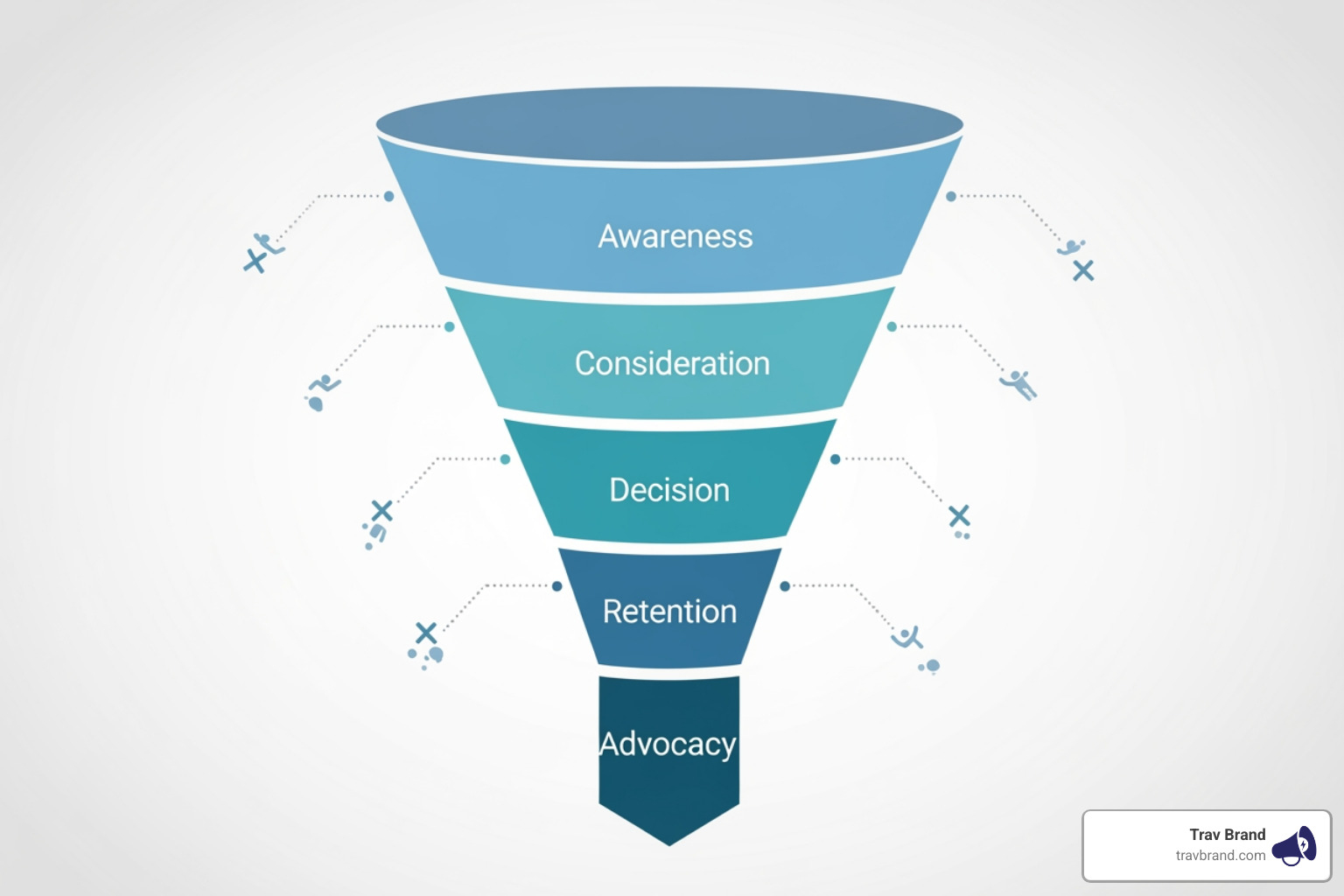
After defining the key stages (e.g., Homepage > Product Page > Add to Cart > Purchase), we use analytics to track user movement and pinpoint “friction points.” Common conversion barriers include:
- Slow Page Speed: Slow-loading sites deter visitors. A fast experience is critical, as first impressions are formed in milliseconds.
- Confusing Navigation: If users can’t find what they’re looking for, they’ll leave.
- Complex Forms: Long or unclear forms discourage completion. Only ask for essential information.
- Lack of Trust Signals: The absence of reviews, security badges, or clear policies can cause hesitation.
- Unclear Value Proposition: Visitors must immediately understand what you offer and why it’s beneficial.
- Poor Mobile Experience: With over half of web traffic coming from mobile, a clunky mobile site is a major conversion killer.
The Role of User Research and Data Analysis
Data analysis tells us what is happening, but user research tells us why. Combining these is key to uncovering genuine opportunities.
- Quantitative Data Analysis (The ‘What’): We analyze web analytics to look at metrics like traffic sources, bounce rates, and conversion rates. Segmenting this data helps us spot underperforming pages or user groups.
- User Behavior Analysis (The ‘How’): Tools like heatmaps and scroll maps show us how users interact with your site, revealing areas of interest or confusion. Session recordings allow us to watch anonymized user journeys to see where they get stuck.
- Qualitative User Research (The ‘Why’): To get into the minds of your users, we use surveys, feedback forms, and customer interviews. This provides rich data about their motivations and decision-making processes.
By combining the “what,” “how,” and “why,” we develop informed hypotheses for our CRO tests, ensuring our efforts are based on concrete evidence.
Actionable CRO Tactics and Implementation Areas
This section dives into the practical application of CRO, detailing specific tactics and the high-impact areas of your website where they can be implemented for maximum results.
Where to Implement CRO on Your Website
Conversion rate optimization should be strategically applied to pages with the most potential for impact, such as high-traffic or high-intent pages.
- Homepage: As the first impression, the homepage should clearly state your value proposition and guide visitors to key areas of your site.
- Landing Pages: Designed with a single goal, these pages are prime candidates for CRO. With an average conversion rate higher than other form types, they benefit from a focused design, minimal distractions, and a prominent call-to-action (CTA).
- Pricing Pages: Visitors here have high intent. Optimizing these pages by simplifying options, adding testimonials, and clarifying questions can significantly boost conversions.
- Blog Posts: Blogs are powerful conversion tools. Contextually relevant, text-based CTAs within posts and valuable content upgrades offered via pop-ups or slide-ins can generate a high volume of leads.
- Checkout Process: A frictionless checkout is crucial for e-commerce. We focus on simplifying forms, offering multiple payment options, and displaying trust signals to reduce cart abandonment.
Common CRO Strategies and Tactics
Once we’ve identified high-impact areas, we deploy a range of proven conversion rate optimization tactics:
- Compelling Calls-to-Action (CTAs): We ensure CTAs are visually distinct and use clear, action-oriented language. For example, apparel brand Bombas increased logins by 36% simply by changing its login CTA from an icon to text.
- Simplified Forms: Long forms are a barrier. We minimize fields, use clear labels, and break complex forms into multiple steps.
- Social Proof: People trust other people. We leverage customer testimonials, reviews, and case studies to build credibility.
- Urgency and Scarcity: Limited-time offers or low-stock indicators can create a sense of urgency, prompting users to act now.
- Pop-ups and Lead Capture Forms: When timed correctly, pop-ups offering valuable content (like a free guide) can be highly effective for lead generation.
- Abandoned Cart Emails: For e-commerce, these are essential. Automated emails reminding users of their cart have high open and click-through rates, leading to recovered sales.
- Live Chat and Chatbots: Offering real-time support can address questions and overcome objections instantly, significantly increasing conversion rates for users who engage with it.
- Retargeting: We re-engage visitors who didn’t convert by serving them targeted ads on other platforms, bringing them back to complete the desired action.
The Power of A/B Testing in conversion rate optimization
A/B testing is the backbone of effective conversion rate optimization, allowing us to make data-driven decisions instead of guessing.
What is A/B testing?
Also known as split testing, A/B testing involves comparing two versions of a webpage (a control and a variation) to see which one performs better. We show each version to a different segment of your audience and analyze which one leads to a higher conversion rate.
What to test?
Almost any element can be tested, including headlines, copy, images, CTA buttons, forms, and page layouts.
Statistical Significance
A crucial aspect of A/B testing is ensuring the results are statistically significant—meaning the difference in performance is not due to random chance. Ending tests too early is a common pitfall that leads to incorrect conclusions.
Learning from Failures
Not every test will be a “win”—in fact, most won’t. However, there are no “failed” tests, only learning opportunities. Every experiment provides valuable insights into user behavior that inform future hypotheses.
| Feature | A/B Testing | Multivariate Testing (MVT) |
|---|---|---|
| Number of Elements | 1 (e.g., headline or button color) | Multiple (e.g., headline and button color and image) |
| Number of Variations | 2 (A vs. B) | Many (all possible combinations of changes) |
| Complexity | Simpler to set up and analyze | More complex, requires advanced tools |
| Traffic Needed | Less traffic required for statistical significance | Significant traffic required for statistical significance |
| Insight Gained | Identifies the best-performing version of a single element | Identifies the best combination of multiple elements |
| Best Use Case | Quick tests, clear hypothesis about one change | Optimizing complex pages with many interacting elements |
Measuring Success and Avoiding Common Pitfalls
Conversion rate optimization is an ongoing journey. To ensure progress, we must accurately measure success, learn from experience, and sidestep common mistakes.
How to Measure the Success of Your CRO Efforts
Measuring success goes beyond just the conversion rate. We focus on key metrics tied to your business goals:
- Conversion Rate: The fundamental percentage of visitors completing a desired action.
- Revenue Per Visitor (RPV): The monetary value generated by each visitor, which accounts for changes in average order value.
- Lead Goal: For lead generation, we track the number of qualified leads to ensure quality.
- Customer Acquisition Cost (CAC): Effective CRO lowers your CAC by getting more customers from the same traffic.
- Return on Investment (ROI): We measure the financial impact of CRO by comparing the cost of initiatives against the revenue generated.
Common Pitfalls to Avoid in conversion rate optimization
Even experienced optimizers can fall into traps. Here are common pitfalls to avoid:
- Testing Without a Hypothesis: Randomly changing elements is just guessing. Every test needs a clear, data-backed hypothesis.
- Insufficient Traffic for Tests: A/B testing requires enough traffic to achieve statistical significance. Testing on low-traffic pages can lead to incorrect conclusions.
- Ending Tests Too Early: It’s tempting to stop a test when one variation pulls ahead, but without statistical significance, the results are unreliable.
- Ignoring Qualitative Data: Relying only on numbers tells you what is happening, but not why. Qualitative insights from user research are crucial for context.
- Copying Competitors Blindly: What works for a competitor might not work for your unique audience. Always test ideas for your own users.
- Treating CRO as a One-Time Project: CRO is a continuous cycle of analysis, testing, and learning, not a project with an end date.
Examples of Successful CRO Implementations
Strategic CRO drives tangible business results. Here are a few examples:
- Headline Optimization: One company increased its lead conversion rate by 79% simply by changing its headline from a generic description to one that highlighted a key benefit: “Save Up to 32% on Your Health Insurance.”
- Contextual Content Upgrades: Adding a relevant template offer to a blog post about that topic can dramatically increase conversions, sometimes by over 200% for that specific post.
- Retargeting Campaigns: An airline successfully re-engaged potential customers by promoting a short video ad to users who had previously viewed their site. This resulted in over half of the campaign’s conversions coming from direct click-throughs.
- Micro-Interaction Improvements: An apparel company saw a 36% increase in logins and a 4.1% increase in orders by updating its login CTA from a simple icon to clear text.
- Platform Improvements: Migrating to a modern e-commerce platform with seamless integrations and better usability can have a massive impact. One training equipment company saw its conversion rate increase by over 300% after such a move.
These examples show that effective conversion rate optimization is about a continuous series of data-informed improvements that lead to substantial growth.
Frequently Asked Questions about CRO
What is the difference between CRO and SEO?
SEO focuses on attracting more organic traffic by improving search engine visibility (getting people to your website). CRO focuses on converting the traffic you already have into customers or leads (getting people to do something on your website). They work together: SEO brings the visitors, and CRO ensures those visitors convert.
How long does it take to see results from CRO?
The timeframe varies. A single A/B test on a high-traffic site might show results in a few weeks. However, a mature CRO strategy is a long-term process of continuous improvement. It’s not about quick fixes but about building a sustainable system for growth, with results compounding over time.
What are the best tools for CRO?
The best tools for conversion rate optimization fall into a few categories:
- Web Analytics: Tools like Google Analytics are essential for understanding what users are doing (e.g., traffic sources, conversion funnels).
- User Behavior Analysis: These tools provide insights into how users interact with your pages through heatmaps, scroll maps, and session recordings.
- A/B Testing & Personalization: These platforms allow you to run experiments and deliver personalized experiences to different user segments.
The ideal tool stack depends on your specific needs and budget. A good starting point is combining a robust analytics platform with a user behavior tool to gather initial insights.
Conclusion: Start Optimizing for Growth
Conversion rate optimization is a powerful, data-driven discipline that turns your existing website traffic into tangible business results. By focusing on a continuous cycle of analysis, testing, and learning, you can create better user experiences and drive sustainable growth. At Trav Brand, we integrate these principles into a holistic digital strategy to build and scale purpose-driven brands. We don’t just consult; we execute, ensuring that every click, every visit, and every interaction on your website contributes directly to your bottom line.
Ready to stop guessing and start growing? Let’s work together to transform your website into a conversion powerhouse. Explore our comprehensive digital marketing services.