
From Clicks to Customers: Mastering Your SEO Conversion Rate
Beyond Traffic: Understanding Your SEO Conversion Rate
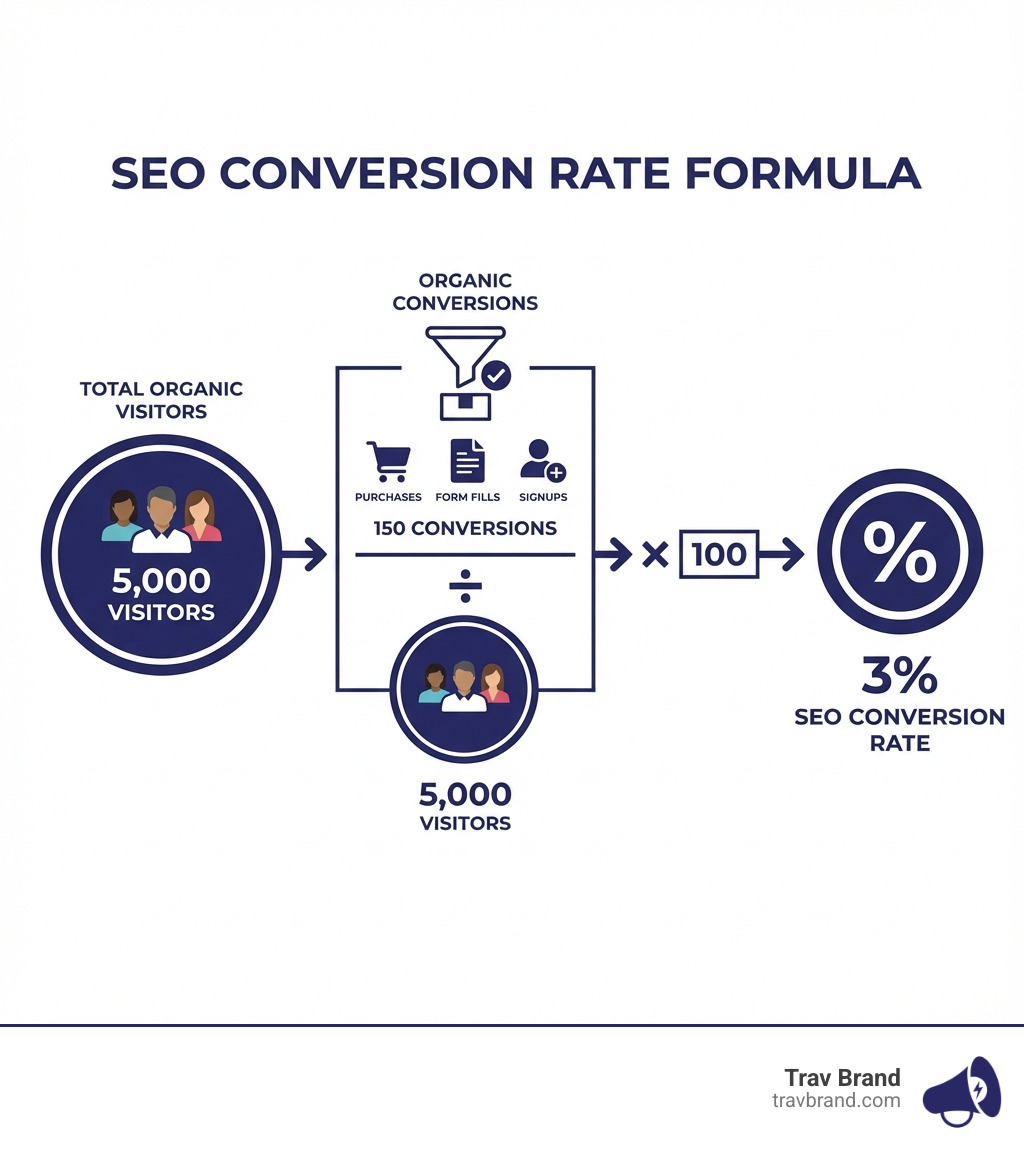
Your SEO conversion rate measures the percentage of organic search visitors who complete a desired action on your site—like making a purchase, filling out a form, or signing up for a newsletter. It’s calculated with this simple formula:
SEO Conversion Rate = (Organic Conversions / Total Organic Visitors) × 100
For example, if your site receives 5,000 organic visitors in a month and 150 of them make a purchase, your SEO conversion rate is 3%.
Imagine hosting a party where guests quickly leave without engaging—disappointing, right? The same goes for website visitors who don’t take desired actions. You can rank #1 for your target keywords and drive thousands of organic visitors to your site, but if those visitors don’t convert, you’re leaving money on the table.
Most businesses focus on driving more traffic. The smarter approach? Convert the traffic you already have.
Tracking your SEO conversion rate reveals whether your organic search strategy actually drives business results. It’s the bridge between visibility and revenue. A high conversion rate means you’re attracting the right audience with the right intent and delivering an experience that turns clicks into customers. A low rate signals a disconnect—wrong keywords, poor user experience, or weak calls-to-action.
The average SEO conversion rate across industries sits at 2.9%, but this varies dramatically by industry, page type, and keyword intent. Professional services companies average 5.0%, while B2C services hover around 1.0%. Understanding these benchmarks helps you set realistic goals and identify where you’re leaving opportunity on the table.
I’m Trav Lubinsky, and I’ve spent years helping brands like HexClad, FightCamp, and Poppi turn digital visibility into measurable growth through strategic brand development and performance marketing that optimizes for SEO conversion rate at every touchpoint. This guide will show you how to calculate, benchmark, and systematically improve your conversion rate so your organic traffic actually drives revenue.
Benchmarking Success: What’s a Good SEO Conversion Rate?
When we talk about a “good” SEO conversion rate, it’s a bit like asking “how long is a piece of string?” The answer is, it depends! What’s considered excellent for one business might be average for another, all due to differences in industry, the specific marketing channel, and even the type of page a visitor lands on. The average conversion rate across all fourteen industries we’ve examined is 2.9%. This serves as a general guideline, but our goal is always to help you exceed it.

SEO Conversion Rates by Industry
Different industries inherently have different sales cycles, product values, and customer behaviors, which directly impact conversion rates. For instance, a quick, low-cost purchase will naturally convert faster than a high-value B2B service requiring multiple touchpoints and approvals.
Let’s look at some industry averages for SEO conversion rate to put things in perspective:
| Industry | Average SEO Conversion Rate |
|---|---|
| Professional Services | 5.0% |
| Industrial | 4.4% |
| Automotive | 4.0% |
| Legal | 3.0% |
| Cosmetic & Dental | 2.7% |
| B2B Tech | 2.5% |
| Healthcare | 2.4% |
| B2B Services | 2.3% |
| Financial | 2.2% |
| Real Estate | 2.2% |
| Travel | 1.7% |
| Agency | 1.5% |
| B2B eCommerce | 1.5% |
| B2C Services | 1.0% |
Source: Industry marketing analytics data
As you can see, there’s quite a range! Professional Services, for example, often sees a higher conversion rate because the intent behind the search query might be closer to a decision-making stage, or the service involves a direct consultation. Conversely, B2C Services might require more nurturing before a conversion occurs. Comparing your rates with these benchmarks can help you identify areas where you’re thriving or where there’s room for significant improvement.
Conversion Rates by Marketing Channel
The source of your traffic also plays a crucial role in how well it converts. Different channels attract users with varying levels of intent and engagement.
Here’s how average conversion rates stack up across various marketing channels:
- Direct Traffic: 3.3%
- Paid Search Traffic: 3.2%
- Referral Traffic: 2.9%
- Organic Search Traffic: 2.7%
- Email Traffic: 2.6%
- Social Media Traffic: 1.5%
Organic search, our focus, often brings in high-quality, intent-driven traffic, but its average rate of 2.7% shows there’s always potential to optimize that journey. Paid search, with its immediate targeting capabilities, typically sees slightly higher rates. Social media, while excellent for brand awareness, often has lower direct conversion rates, as users are typically in a browsing rather than buying mindset. Understanding these differences helps us allocate resources effectively and tailor our conversion strategies to each channel.
Conversion Rates by Page Type
Not all pages on your website are created equal when it comes to conversions. A blog post, designed to inform, will naturally have a lower direct conversion rate than a product landing page, which is built for action. We need to set realistic expectations for each page type.
Here are some average SEO conversion rates by page type:
- White Paper: 4.6%
- Case Study: 3.5%
- Application Landing Page: 3.1%
- Product Landing Page: 2.9%
- Service Landing Page: 2.7%
- Problem & Solution / FAQ Page: 2.7%
- Industry Landing Page: 1.8%
- Thought Leadership Article or Blog Post: 2.0%
- Location Landing Page: 1.1%
- Hub Page: 0.5%
Source: SEO industry data
White papers often convert well because a user downloading one is highly engaged and interested in a deeper dive into a topic, signaling strong intent. Case studies also perform admirably, as they provide social proof and demonstrate real-world success. On the other end of the spectrum, hub pages, designed for navigation and content organization, typically have very low direct conversion rates. Blog posts, while crucial for attracting organic traffic, are generally mid-funnel and require careful CTA placement to guide users towards conversion actions.
Understanding these distinctions helps us optimize each page type for its specific purpose and conversion potential.
The Core Drivers: Key Strategies to Improve Your SEO Conversion Rate
Now that we understand what a good SEO conversion rate looks like across different contexts, let’s dive into the core factors that influence it and the strategies we can employ to boost our numbers. Improving your conversion rate isn’t about guesswork; it’s about making data-backed decisions that improve the user experience and align with their intent.

The Foundation: Keyword Intent and Audience Targeting
Attracting traffic is one thing, but attracting the right traffic is what truly drives conversions. This starts with meticulous keyword research and a deep understanding of user intent.
- Commercial Intent: These are the keywords people use when they’re ready to buy or engage with a service. Think “best project management software for agencies” or “buy organic coffee beans online.” When users search for these terms, they’re looking for solutions and are closer to making a decision. Our research shows that keywords with high buying intent often return a conversion rate of 5% or higher.
- Informational Intent: These keywords are used for learning or research, like “how to make cold brew coffee.” While important for attracting top-of-funnel traffic and building authority, they typically have lower direct conversion rates.
- Jobs To Be Done (JTBD) Keywords: These describe the problems your product or service solves. For example, “collect video testimonials” or “how to run standups in Slack.” Our data shows JTBD keywords have high conversion potential, averaging around 2.44%, especially when they clearly align with your solution. One client saw a 12.5% conversion rate for “how to run standups in Slack.”
- “Alternatives” Keywords: Users searching for “[Product X] alternatives” are actively evaluating options. These are incredibly high-intent keywords, boasting an average conversion rate of 8.43%. They present a direct opportunity to position your offering against competitors.
- “Vs.” Keywords: Similar to alternatives, “[Product X] vs. [Product Y]” indicates a user comparing specific solutions. These also convert exceptionally well, averaging 5.45%, as users are in the decision-making phase.
Message Matching: This is absolutely critical. Before someone lands on your website, an event often triggers their visit—a Google search, an ad click. That pre-visit context shapes what they expect to find on your site. Our job is to sync up with that backstory. If a user searches for “foldable camping chairs,” your landing page should immediately confirm they’ve found foldable camping chairs, ideally in the hero section. Disconnects between the search query and your page content can lead to immediate bounces and lost conversions. Using tools to identify the top keywords driving traffic to a page can help us tweak messaging to align with user expectations.
The Experience: How UX and Site Design Impact Conversions
Even with the perfect keyword targeting, a poor user experience will sink your conversion rates faster than you can say “bounce.” Google rewards websites that provide a positive user experience, making UX an indirect yet powerful factor in SEO performance.
- Site Speed: This is non-negotiable. A slow website frustrates users, leading to high bounce rates and abandoned carts. One study found that a B2B page loading in 1 second has a 3x higher conversion rate than one loading in 5 seconds. For e-commerce B2C sites, a 1-second load time makes them 2.5x more likely to convert than those taking 5 seconds. We aim for a 3-second load time as a general standard. Tools like Google’s PageSpeed Insights can help us identify and fix speed bottlenecks.
- Mobile Optimization: With mobile visits outpacing desktop traffic since 2017, a mobile-friendly site isn’t just a nicety—it’s a necessity. Mobile users often have higher bounce rates and spend less time on sites, so a seamless, responsive experience is paramount for conversions. Ensuring all clickable elements are at least 44×44 pixels is a small but impactful detail for mobile users.
- Trust Signals: Building trust is fundamental. Incorporate testimonials, customer reviews, and trust badges prominently on your pages. Research from Medill Spiegel Research Center indicates that displaying reviews can increase conversion rates by 190% for lower-priced products and a staggering 380% for higher-priced items. Clear privacy policies, contact information, and an ‘About Us’ section also contribute to legitimacy.
- Clear Navigation: An intuitive site architecture and navigation help users find what they’re looking for quickly, reducing frustration and guiding them towards conversion paths. Confusing menus or buried information are conversion killers.
- Page Layout: A clean, uncluttered layout with ample white space improves readability and highlights key information and CTAs. Visual hierarchy helps guide the user’s eye towards the most important elements on the page.
The Persuasion: On-Page Elements and CTA Optimization
Once users land on a fast, mobile-friendly, trustworthy page, the on-page elements need to seal the deal. This is where compelling content and strategic calls-to-action come into play.
- Compelling Headlines: Your headline is the first thing users read (after the meta title). It needs to grab attention, communicate value, and align with their search intent. A/B testing different headlines can reveal what resonates most with your audience.
- High-Quality Visuals: Humans are highly visual creatures. High-quality images, videos, and infographics make your content more engaging and help convey information quickly. Over one-third of marketers allocated at least 50% of their budget to visuals in 2024, a testament to their impact. Ensure product photography is professional, from multiple angles, and consistent.
- Call-to-Action (CTA) Best Practices: Your CTAs are the gateways to conversion. They must be:
- Clear and Concise: Use action-oriented language like “Get Your Free Quote,” “Download Now,” or “Shop Our Collection.”
- Prominent: Make them stand out with contrasting colors, sufficient size, and strategic placement, ideally above the fold, but also thoughtfully placed throughout the page.
- Benefit-Oriented: Emphasize what the user will gain by clicking.
- Limited Choices: Studies show that one well-defined CTA on a landing page routinely performs better than those with two or more. Don’t overwhelm users with too many options.
- Form Optimization: Forms are often the final hurdle to conversion, so we need to make them as frictionless as possible. Research shows that conversion rates drop as the number of form fields increases, and even more dramatically with multiple drop-down select boxes.
- Shorten Forms: Only ask for essential information. For initial inquiries, a name and email might be enough.
- Multi-Step Forms: For longer forms, break them into smaller, digestible steps using the “breadcrumb technique.” This makes the process feel less daunting and can increase completion rates.
- A/B Testing CTAs: Don’t just guess what works. Tools allow us to test multiple variants of CTAs—different wording, colors, placements, and sizes—to see what generates the maximum impact with your audience. For example, a health supplement brand saw a 6% increase in conversion rates after optimizing product descriptions and adding customer testimonials. PaintYourLife achieved a 28% increase in conversions with a visually appealing popup offering discounts. These are the kinds of gains we can open up through continuous testing.
Measurement and Analysis: Tracking Your Path to Higher Conversions
Understanding your SEO conversion rate is just the beginning. To truly master it, we need to continuously measure, analyze, and iterate. This means setting up robust analytics and tracking the right metrics to get a comprehensive view of performance.
Setting Up for Success: Using Analytics Tools to Track Your SEO Conversion Rate
Google Analytics 4 (GA4) is our go-to for understanding user behavior and tracking conversions.
- Analytics Setup: The first step is to ensure GA4 is correctly implemented on your website. This foundational setup allows us to collect all the necessary data.
- Conversion Events: In GA4, all user interactions are considered “events.” To track conversions, we need to mark specific events as “conversion events.” This could be a “purchase,” “formsubmit,” “newslettersignup,” or “file_download.” We can steer to Admin > Events > Create event in GA4 to define these.
- Custom Reports: GA4 allows us to create custom reports to specifically monitor our SEO conversion rate. We can add metrics like “Session conversion rate” or “User conversion rate” to our reports, segmenting by organic traffic to see how well our SEO efforts are performing.
- Segmenting Organic Traffic: It’s crucial to segment your data to isolate organic search traffic. This ensures that the conversion rates we’re analyzing are directly attributable to our SEO efforts, rather than being diluted by traffic from other channels.
- Analyzing User Flow: GA4’s “Path Exploration” and “Funnel Exploration” reports are invaluable for visualizing how users steer our site. We can see where users enter, what pages they visit, and, critically, where they drop off before converting. This helps identify bottlenecks in the conversion path. Integrating GA4 with specialized SEO platforms can provide an even more consolidated view of our conversion data.
The Bigger Picture: Key Metrics to Monitor Alongside Your SEO Conversion Rate
While the SEO conversion rate is central, it’s part of a larger ecosystem of metrics that give us a holistic view of performance. We like to think of these as leading and lagging indicators. Lagging indicators (like revenue or conversions) tell us what has happened, while leading indicators (like rankings or CTR) predict what will happen. Focusing on both helps us make proactive decisions.
- Click-Through Rate (CTR): This measures the percentage of users who click on your organic search listing after seeing it. A higher CTR indicates that your title tags and meta descriptions are compelling and relevant to the search query. We can monitor this in Google Search Console.
- Bounce Rate: The percentage of visitors who leave your site after viewing only one page. A high bounce rate often signals a mismatch between user intent and page content, or a poor user experience. However, a high bounce rate isn’t always bad if the user converted on that single page (e.g., a “thank you” page after a purchase).
- Time on Page: How long users spend on a specific page. Longer times generally suggest engagement, but we need to combine this with conversion data.
- Average Session Duration: The total time a user spends on your site during a single visit. This helps us understand overall engagement with our content.
- Exit Pages: These are the last pages users view before leaving your site. Identifying common exit pages in your conversion funnel can highlight problem areas that need optimization.
- Value Per Visit: This metric helps us understand the monetary worth of each visitor session. For example, if a shop page gets 100 visits, has a 2% conversion rate, and the average shopper spends $75, each visit is worth $1.50. This can be calculated by multiplying daily conversions by average shopper spend and dividing by total daily visits. Specialized SEO potential tools can help estimate this on a larger scale.
By tracking these metrics alongside your SEO conversion rate, we get a clearer picture of user behavior, identifying opportunities for improvement and ensuring our SEO efforts translate into tangible business growth. According to the Pareto Principle (the 80/20 rule), roughly 20% of your SEO efforts will generate 80% of your results. We want to focus our measurement on that high-impact 20%.
Frequently Asked Questions about SEO Conversion Rate
How is SEO conversion rate calculated?
The SEO conversion rate is calculated by taking the total number of conversions that originated from organic search traffic, dividing that by the total number of organic visitors to your website, and then multiplying the result by 100 to express it as a percentage. For example, if 100 people visit your site from Google and 3 of them make a purchase, your SEO conversion rate is (3 / 100) * 100 = 3%.
Does conversion rate directly affect SEO rankings?
While SEO conversion rate itself is not a direct ranking factor, user behavior signals associated with conversions indirectly impact SEO rankings. When users convert, it often means they spent more time on your page, visited multiple pages, and didn’t immediately bounce back to the search results (a signal known as “pogo-sticking”). These positive user engagement signals tell search engines that your page is valuable and relevant to the user’s query, which can positively influence your rankings over time. Google wants to serve the most useful results, and user action (conversion) is a strong indicator of usefulness.
What’s the fastest way to improve my SEO conversion rate?
The fastest way to improve your SEO conversion rate is to focus on pages that already receive significant organic traffic and have high commercial intent. Start by:
- Aligning Content with Intent: Ensure the page content perfectly matches the user’s search intent (e.g., if they search for “buy X,” make sure the page is transactional).
- Improving User Experience (UX): Boost page speed, ensure mobile responsiveness, and make the page layout clean and easy to steer.
- Optimizing Your Call-to-Action (CTA): Make your CTA clear, compelling, and strategically placed. Test different wordings and colors to see what performs best.
By optimizing these high-traffic, high-intent pages, you can often see a quicker impact on your overall conversion rate.
Conclusion: Turning Insights into Revenue
Mastering your SEO conversion rate is about more than just getting clicks; it’s about changing those clicks into customers and measurable revenue. We’ve explored how understanding industry benchmarks, optimizing for keyword intent, enhancing user experience, and refining on-page elements are all critical pieces of this puzzle.
The journey from traffic to revenue is a continuous one, demanding constant measurement, analysis, and adaptation. By leveraging analytics tools, tracking key metrics, and relentlessly testing your hypotheses, you can systematically improve how effectively your organic traffic drives business results. It’s about making every visitor count and ensuring your website isn’t just a destination, but a pathway to conversion.
Ready to turn your SEO insights into tangible revenue growth? Explore our e-commerce strategies to see how we can help your brand build and scale through comprehensive digital marketing and conversion-focused strategies.