
Why Market Research Services are Your New Best Friend
Why Market Research Services Are the Smartest Investment You Can Make
Market research services are structured solutions that help businesses collect, analyze, and act on data about their customers, competitors, and market conditions.
Here’s a quick breakdown of what they include:
- Consumer insights – Understanding what your customers want, need, and how they behave
- Brand tracking – Monitoring how your brand is perceived over time
- Competitive analysis – Identifying where you stand versus rivals
- Product testing – Validating ideas before you invest in them
- Survey research – Gathering direct feedback from your target audience
- Audience intelligence – Building detailed profiles of who actually buys from you
Most businesses guess. The ones that grow consistently don’t.
The difference between a brand that scales and one that stalls is almost always the same thing: clarity. Clarity about who your customers are, what they care about, and why they choose you (or don’t).
Yet most founders skip this step entirely. They build campaigns on gut instinct, launch products based on assumptions, and wonder why nothing converts the way it should.
Market research removes that guesswork. Whether you’re a startup trying to find product-market fit or an established brand optimizing ad spend, the data you gather shapes every smart decision that follows.
I’m Trav Lubinsky, and across my career launching and scaling brands like Flex Watches and working with companies from HexClad to Camping World, market research services have been the foundation I return to every time before making major strategic moves. The insights you’ll find in this guide reflect what I’ve seen work in the real world.
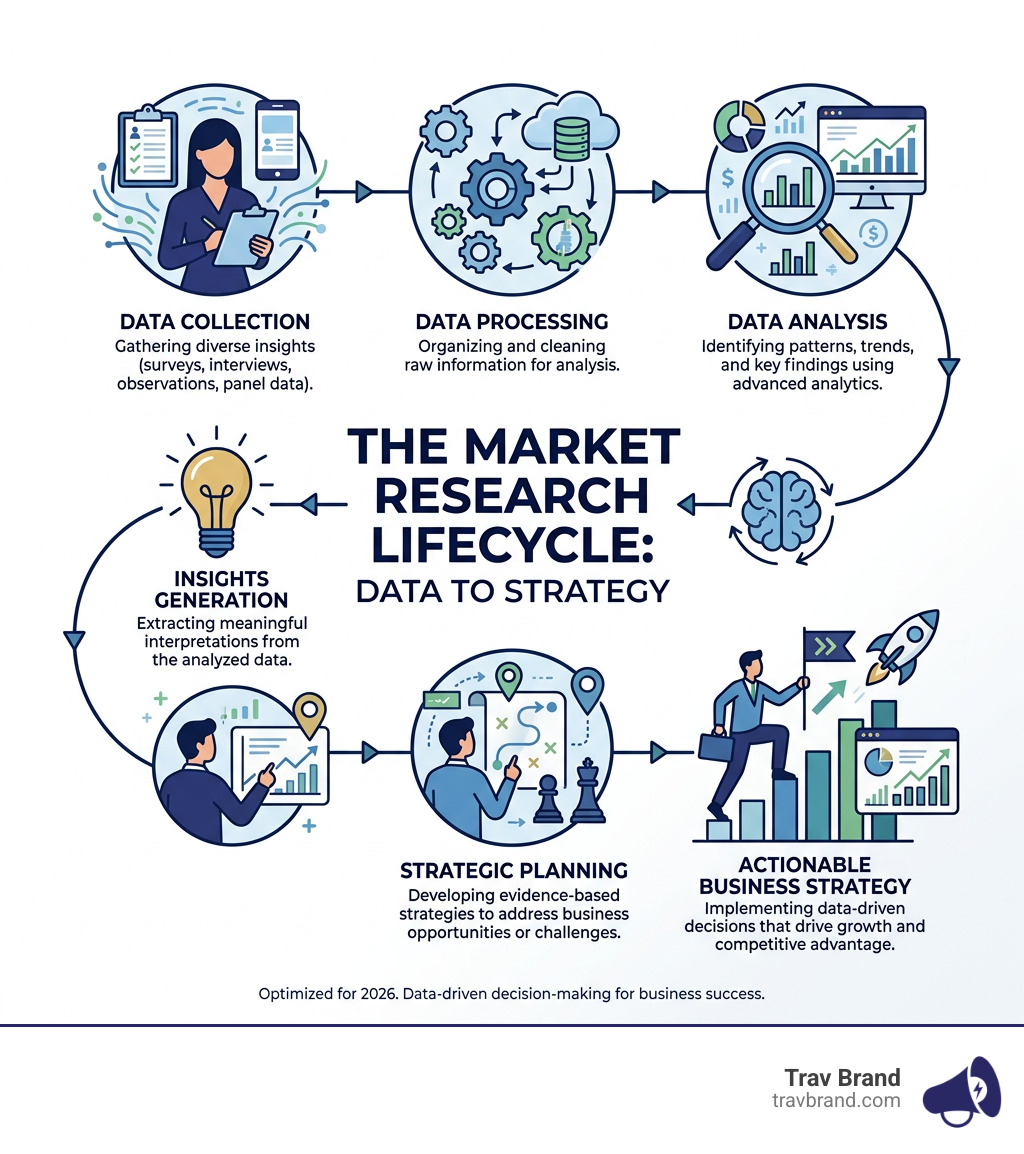
Market research services terms explained:
Defining the Landscape of Market Research Services
When we talk about market research services, we aren’t just talking about a single spreadsheet or a quick Google search. We are looking at a massive ecosystem designed to turn “I think” into “I know.” The landscape is generally divided into two main categories: primary and secondary research.
Primary research is data you collect yourself (or hire us to collect for you) specifically for your brand. This includes custom surveys, focus groups, and interviews. Secondary research involves analyzing data that already exists—think industry reports, census data, and academic studies. Both are essential for understanding consumer behavior.
In the commercial world, these services help us understand why a shopper picks one brand over another at the grocery store. In the public sector, market research services take on a different but equally vital role. For example, federal agencies use “Market Research As a Service” (MRAS) to navigate complex federal acquisitions. This ensures that taxpayer money is spent efficiently by identifying capable vendors before a contract is even written.
For any brand looking to scale, the first step is often a deep dive into your existing assets. Our Brand Audit Services serve as a primary research tool, helping you understand how your current identity stacks up against market expectations and where the gaps in your strategy lie.
Specialized Market Research Services for Every Industry
Different industries require different lenses. You wouldn’t use the same research methodology for a new brand of organic dog food as you would for a complex B2B software solution.
- Construction and Home Improvement: Specialized panels, such as those featuring over 5,000 home builders and remodelers, allow manufacturers to test new materials before they hit the shelves.
- Retail and D2C: This is where we thrive. Understanding the “path to purchase” is everything. Why did the customer click “buy” on your site but abandon their cart on a competitor’s?
- B2B Ecosystems: B2B marketing is a complex web of long buying cycles and multi-layered decision-makers. Research here focuses on identifying the specific pain points of C-suite executives versus the end-users.
- Healthcare and Legal: These sectors rely heavily on trust and sentiment. Research helps determine which messages establish that crucial bond of trust with a patient or client.
To truly master your niche, you need to know what the competition is saying. Our Audit Content Marketing service analyzes how your industry peers are communicating, ensuring your voice isn’t just louder, but smarter.
Public Sector vs. Private Sector Offerings
It might surprise you to learn that the government is one of the biggest users (and providers) of market research services.
In the public sector, market research is often a legal requirement under FAR Part 10 (Federal Acquisition Regulation). This ensures that federal, state, and local agencies conduct thorough research before purchasing. A prominent example is the MRAS program, which provides free research to agencies. This process often involves Requests for Information (RFIs) and “sources sought” notices to see which businesses can meet the government’s needs. This system has successfully pushed billions of dollars in business toward GSA Schedules, supporting small businesses and diverse vendors.
In the private sector, the focus shifts from regulatory compliance to competitive advantage. While the government wants to ensure “fair and open competition,” a private business wants to find the “unfair advantage.” We use the same rigorous methodologies—like RFIs and capability statements—but we apply them to help you win more market share and increase your ROI.
Core Methodologies: How Data is Gathered
How do we actually get inside the heads of your customers? It’s not magic; it’s a mix of proven market research methodologies.

Quantitative vs. Qualitative Research
To get a full picture, we use two types of data:
- Quantitative (The “What”): This is all about numbers. Surveys, polls, and data analytics that tell us what is happening. (e.g., “70% of users prefer the blue packaging.”)
- Qualitative (The “Why”): This involves focus groups and interviews. It tells us why people feel the way they do. (e.g., “The blue packaging makes me feel like the product is eco-friendly.”)
| Feature | Quantitative Research | Qualitative Research |
|---|---|---|
| Goal | Test hypotheses, look at patterns | Explore ideas, understand motivations |
| Sample Size | Large (hundreds or thousands) | Small (8-12 people) |
| Data Format | Numerical, statistical | Text, video, audio |
| Common Tools | Surveys, Brand Tracking | Focus Groups, Ethnography |
Leveraging Modern Market Research Services for Rapid Insights
The days of waiting six months for a thick binder of paper reports are over. Modern market research services are agile and tech-driven.
Self-serve platforms now allow brands to launch surveys to a general population or granular audience in as little as 10 minutes. With access to panels of over 30 million registered members worldwide, you can get answers to burning questions in under an hour.
These platforms use automated cleaning to remove poor-quality responses (like bots or “speeders”), ensuring your data is reliable. For digital-first brands, integrating this with Keyword Analysis and Content Marketing allows us to see not just what people say they want in a survey, but what they are actually searching for in real-time.
Advanced Testing and Observational Studies
Sometimes, asking people what they think isn’t enough because people aren’t always honest with themselves. That’s where observational research comes in.
- Product Testing: Giving a prototype to a consumer and watching them use it.
- Time & Motion Studies: Used frequently in construction and manufacturing to see if a new tool actually saves time on a job site.
- Ethnographic Research: Observing consumers in their natural environment (like their home or a retail store) to see how they interact with products.
- Brand Tracking: This is a “world-class” necessity for any scaling brand. It’s an always-on measurement of your brand’s health, tracking awareness, consideration, and loyalty daily.
For brands using video to tell their story, we employ Video Marketing Analysis to see exactly where viewers drop off, allowing us to optimize the creative for better engagement.
Strategic Benefits: Driving Growth and ROI
Why spend the money? Because the ROI on good data is astronomical. Organizations that utilize professional market research services often see a 15-40% lift in their custom KPIs, such as web form fills, memberships, and new customer acquisitions.
Competitive Advantage and Risk Mitigation
Market research is your shield and your sword. It protects you from making expensive mistakes (like launching a product no one wants) and gives you the tools to attack your competitors’ weaknesses. By identifying market gaps, you can position your brand as the only solution to a specific problem.
Informed Decision-Making
When we work with brands, we use research to create a S.W.O.T. analysis (Strengths, Weaknesses, Opportunities, Threats). This leads to an action plan that isn’t based on a “hunch” but on hard data. This clarity allows for confident leadership and decisive action in a rapidly evolving market.
To ensure your efforts are actually paying off, we recommend a Content Performance Analysis to tie your research-backed strategy directly to your bottom-line results.
Optimizing Campaigns with Market Research Services
A great marketing campaign is just a conversation with a customer. If you don’t know who you’re talking to, the conversation will be awkward.
- Ad Testing: Before you drop $50k on a social media ad spend, we test the creative on a small, targeted panel to see which version resonates most.
- Persona Creation: We move beyond basic demographics (age/location) to psychographics (values, habits, and tastes). We want to know what your customer eats for breakfast and what keeps them up at night.
- Sentiment Tracking: In the age of “cancel culture” and rapid PR shifts, real-time sentiment tracking allows you to respond to market changes before they become crises.
By performing a Content Marketing Competitive Analysis, we can identify exactly which topics your competitors are winning on and where you can swoop in to take the lead.
The Roadmap: From Initial Request to Actionable Insights
Engaging with market research services is a structured journey. Here is what the typical process looks like when you partner with a professional provider:
- Initial Request & Scoping: We start by asking: “What is the one question you need answered to grow your business?” We define the goals, target audience, and budget.
- Methodology Selection: Based on the goals, we choose the right tools—be it a nationwide survey, focus groups at an industry trade show, or a deep-dive brand audit.
- Data Collection (The “Fielding” Phase): This is where the work happens. Surveys are sent, interviews are conducted, and data starts flowing in.
- Analysis & Automated Cleaning: We filter out the noise. Experienced analysts review the data to find the “story” behind the numbers.
- Strategic Recommendations: You don’t just get a data dump. You get a roadmap. This includes specific, actionable steps for your marketing, product development, and sales teams.
- Ongoing Support: The best research isn’t a one-and-done. Many providers offer 90 days of implementation support to ensure the findings are actually integrated into your business operations.
Frequently Asked Questions about Market Research
How much do market research services typically cost?
The cost of market research services varies wildly based on scope.
- Self-serve surveys can start as low as $1.00 per completed response, making it accessible for small tests.
- Full-service custom studies in major cities typically start around $30,000. This usually includes custom question authoring, data collection, professional analysis, and a strategic action plan.
- Government services like MRAS are provided at no cost to federal, state, and local agencies, as they are funded through GSA’s value-added service model.
How long does the research process take?
Speed is the new currency.
- Rapid Insights: You can get basic pulse-checks from global panels in as little as one hour.
- Standard RFIs/Surveys: A typical government RFI or a standard private-sector survey takes about one to two weeks from start to finish.
- Longitudinal Studies: Brand tracking and “deep-dive” ethnographic studies can be ongoing, providing data over months or years to track long-term trends.
How is data accuracy and reliability ensured?
Quality is the most common concern. Top-tier market research services ensure accuracy through:
- Vetted Panels: Using registered members who have been strictly screened (e.g., verifying that a “home builder” actually holds a license).
- Automated Cleaning: Software that identifies and removes “straight-lining” (checking the same box for every question) or bot-like behavior.
- Bias Removal: Using multiple incentive structures and neutral question phrasing to ensure respondents aren’t just saying what they think the researcher wants to hear.
- Scale: Leveraging massive global panels (some with over 300 million people) to ensure a statistically significant sample size.
Conclusion
At the end of the day, market research services are about one thing: reducing the distance between you and your customer.
When market uncertainty is the only constant, having a data-backed strategy isn’t just a “nice to have”—it’s a competitive necessity. Whether you are a federal agency looking to streamline acquisitions or a D2C brand trying to scale to eight figures, the insights gained from professional research provide the blueprint for measurable growth.
At Trav Brand, we don’t just hand you a report and wish you luck. We build and scale brands through a complete ecosystem of strategy and execution. We use these very insights to fuel purpose-driven brands and deliver results that you can actually see in your bank account.
Ready to stop guessing and start growing? Welcome to Trav Brand—your comprehensive partner in brand marketing and strategic growth. Let’s build something great together.