How to Choose the Best Online Marketing Agency for Your Store
Why Choosing the Right E-Commerce Digital Marketing Services Can Make or Break Your Store
E-commerce digital marketing services are the tools, strategies, and agency partnerships that help online stores attract customers, convert traffic, and grow revenue.
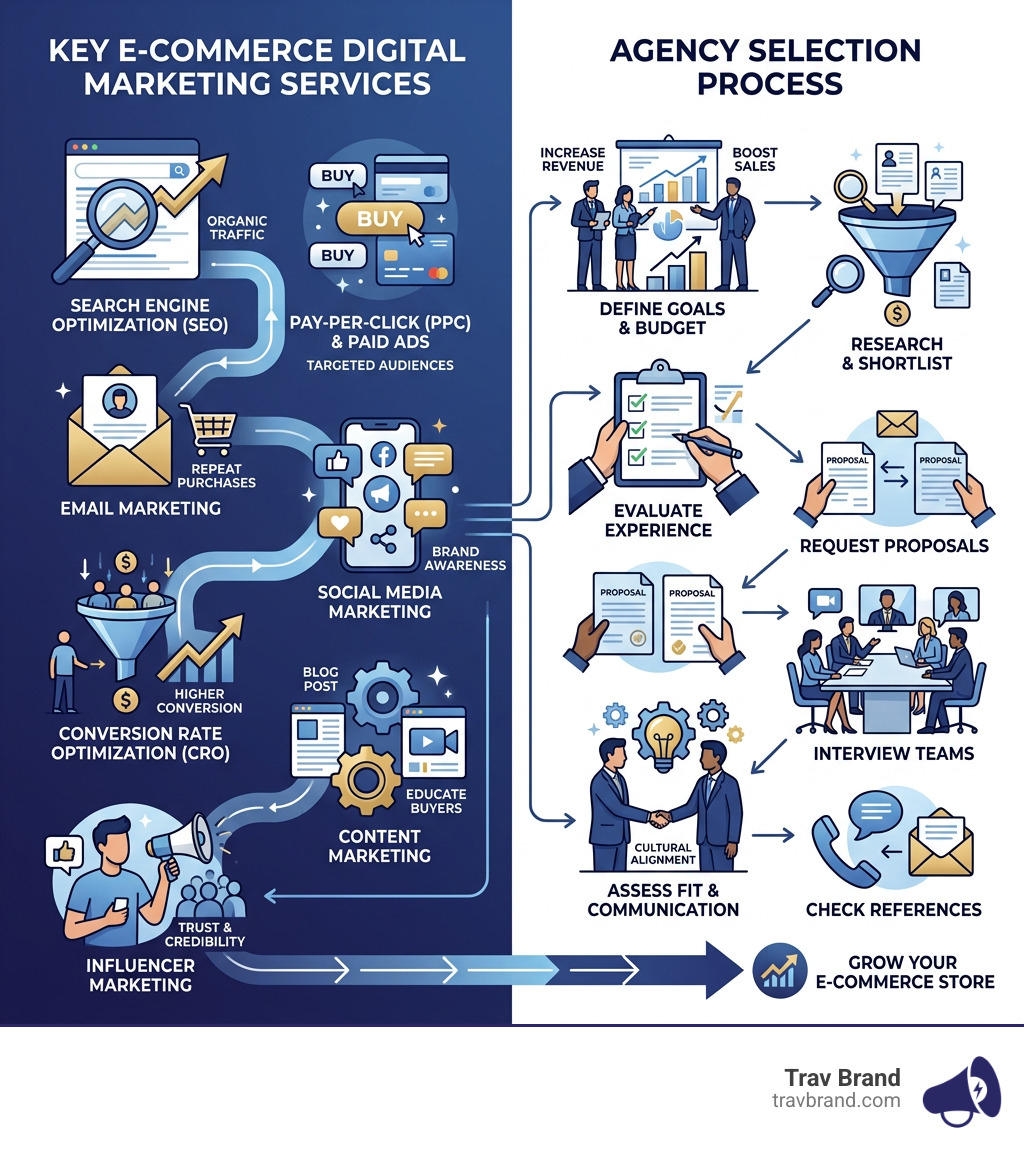
Here’s a quick overview of what these services typically include:
| Service | What It Does |
|---|---|
| SEO | Drives organic traffic through search rankings |
| PPC / Paid Ads | Captures high-intent buyers through paid search and social |
| Email Marketing | Recovers abandoned carts and builds repeat purchases |
| Social Media Marketing | Builds brand awareness and drives sales via social platforms |
| Conversion Rate Optimization (CRO) | Turns more visitors into paying customers |
| Content Marketing | Attracts and educates buyers throughout the funnel |
| Influencer Marketing | Leverages trusted creators to build brand credibility |
Digital marketing is one of the fastest-growing industries today. But with dozens of agencies competing for your budget, finding the right partner is harder than it looks.
Most store owners don’t struggle because they lack a great product. They struggle because they’re running disconnected campaigns, working with vendors who chase clicks instead of long-term growth, and wasting ad spend without a clear strategy tying everything together.
This guide helps you cut through the noise.
*I’m Trav Lubinsky — entrepreneur, investor, and founder of Trav Brand — and I’ve spent my career scaling consumer brands like Flex Watches and advising companies on e-commerce digital marketing services across retail, consumer products, and beyond. The principles in this guide come directly from what I’ve seen work at scale.
Relevant articles related to E-commerce digital marketing services:
- Content marketing for e-commerce
- Online store marketing strategy
- E-commerce conversion rate optimization
The Role of E-commerce Digital Marketing Services in Brand Growth
When we talk about growing an online store, we aren’t just talking about “getting more clicks.” True growth comes from a unified performance engine where every piece of your digital ecosystem works together. E-commerce digital marketing services act as the fuel for this engine, but only if they are executed with a focus on strategy over simple task completion.
For purpose-driven brands, this means moving beyond generic consulting. You need partners who act as strategic agents for your success—teams that don’t just suggest ideas but actually “ship” results. Whether it’s achieving a 119% increase in conversions (like some top-tier logistics campaigns have seen) or driving an 8% year-over-year increase in ad-spend ROI, the goal is always measurable impact.
We believe that a comprehensive approach is the only way to survive in a market where attention is scarce. By integrating content, paid media, and analytics, you create a seamless journey for the shopper. If you want to dive deeper into the full spectrum of what’s available, check out our Internet Marketing Services Complete Guide.
Customizing E-commerce Digital Marketing Services for D2C
Direct-to-Consumer (D2C) brands face a unique set of challenges. Unlike traditional retail, you own the entire customer journey, from the first Instagram ad to the unboxing experience. This means your e-commerce digital marketing services must be highly tailored to your specific brand identity.
Success in D2C requires more than just a website; it requires a memorable brand that resonates with your audience’s values. We focus on mapping the e-commerce experience to unlock customer insights that lead to higher lifetime value. When your marketing aligns with a strong brand voice, you don’t just find customers—you build a community. You can learn more about this in our guide on The Power of Branding: How to Create a Memorable Ecommerce Brand.
Future-Proofing with AI-Powered E-commerce Digital Marketing Services
The digital landscape changes faster than a viral TikTok trend. To stay ahead, we must leverage AI-powered tools for predictive analytics and audience targeting. Modern e-commerce digital marketing services now include AI-driven bidding strategies for PPC and sentiment analysis for social media.
By using AI to analyze search terms and forecast demand, we can make smarter decisions about where to allocate your budget. This isn’t about replacing humans; it’s about giving our strategists better data to work with. For a look at what’s coming next, see our insights on 10 Effective Digital Marketing Strategies for 2025 and Beyond.
Key Criteria for Selecting a Marketing Partner
Selecting an agency is a bit like dating—everyone looks great on the first day, but you need to know if they’ll still be there when things get tough. We recommend looking for agencies with high transparency and a history of verified success.

One of the best ways to vet a partner is through third-party platforms like Clutch. They verify business registrations, legal histories, and—most importantly—client feedback. When you see an agency with a “Premier Verified” status or a high ranking in the Leaders Matrix, it indicates a strong ability to deliver results.
| Verification Level | What It Means | Market Presence |
|---|---|---|
| Premier Verified | Rigorous check of legal/credit background and client reviews | High trust, established presence |
| Verified | Confirmed business registration and legitimate feedback | Reliable for mid-market projects |
| Unverified | Basic listing without deep background checks | Higher risk, requires manual vetting |
Responsiveness and Communication
We’ve all heard the horror stories: you hire an agency, and suddenly they go “ghost.” In the fast-moving world of e-commerce, a delay of a few days can mean thousands in lost revenue. Top-tier e-commerce digital marketing services are built on a foundation of professional project management and open communication.
You want a team that acts as a sounding board for your ideas while providing regular, transparent updates. Approximately 90% of highly-rated agencies receive praise specifically for their professionalism and communication. If you’re ready to start your search, take a look at our article on Finding Your Digital Dream Team: Top E-Commerce Agencies Reviewed.
Industry Experience and Case Studies
Don’t hire a generalist if you’re trying to scale a specialized store. If you sell luxury watches, you need someone who understands high-ticket sales, not just someone who has run ads for a local pizza shop. Look for niche expertise and proven results.
For instance, some agencies have achieved a 300% increase in conversion rates specifically for e-commerce clients through a mix of web development and digital strategy. We always suggest asking for case studies that show a deep understanding of the customer journey. You can learn how to analyze these journeys in our post on Unlocking Customer Insights: Mapping the E-Commerce Experience.
Essential Service Pillars: SEO, PPC, and Retention
To build a sustainable store, you need a balanced approach. We call this the “Growth Trifecta”: Search Engine Optimization (SEO) for long-term organic health, Pay-Per-Click (PPC) for immediate sales, and Email/Retention to keep customers coming back.
Without these three pillars working in harmony, you’re essentially pouring water into a leaky bucket. You might get traffic, but if you aren’t retaining those visitors, your acquisition costs will eventually eat your margins. For a deep dive into building this framework, see our Digital Marketing Strategy Guide.
Strategic SEO and Content Commerce
E-commerce SEO is a different beast than traditional blog SEO. It focuses on transactional keywords—the terms people use when they are ready to buy. This includes optimizing product pages, fixing technical site speed issues, and ensuring your Core Web Vitals are in top shape.
Content commerce is the art of using valuable content to drive sales. Instead of just “blogging,” we create content that guides a user from a question (e.g., “how to choose a waterproof watch”) directly to a product solution. Master this by reading Content Commerce: How to Master E-Commerce Content Marketing.
Performance-Driven PPC and Paid Social
Paid advertising is the fastest way to scale, but it’s also the fastest way to lose money if you don’t know what you’re doing. High-performing e-commerce digital marketing services use smart bidding and precision audience segmentation to ensure your ads appear in front of the right people at the right time.
Whether it’s Google Ads, Meta (Facebook/Instagram), or TikTok, the goal is to drive “opportune” users—people who have a high likelihood of converting. Understanding how these paid channels feed into your overall funnel is crucial. Check out our guide on Understanding Ecommerce and Funnels for more.
Email Marketing and Customer Retention
Did you know that most online stores lose 80% of their visitors without ever capturing their information? That is a massive amount of “lost” revenue. Email marketing and SMS automation are your best tools for recovering abandoned carts and delivering personalized product recommendations.
We focus on building lifecycle flows that nurture a customer long after their first purchase. This increases your Customer Lifetime Value (CLV) and reduces your reliance on expensive paid ads. Learn the best tactics in our Your Ultimate Guide to E-Commerce Marketing Strategies.
Data-Driven Metrics to Evaluate Agency Performance
If an agency can’t show you the numbers, they aren’t doing their job. We live and breathe data because it’s the only way to know if your e-commerce digital marketing services are actually working.
You should be looking at more than just “vanity metrics” like likes or impressions. We focus on:
- Conversion Rate: The percentage of visitors who actually buy.
- ROAS (Return on Ad Spend): How many dollars you get back for every dollar spent on ads.
- Organic Traffic Growth: Steady improvements in search rankings.
- Average Order Value (AOV): How much the average customer spends per transaction.
For more on what to look for, check out our Ecommerce Conversion Best Practices.
Understanding the Leaders Matrix Score
When researching agencies on platforms like Clutch, you’ll encounter the “Leaders Matrix.” This is a visual representation of how agencies stack up against each other based on two main factors:
- Ability to Deliver: This includes client reviews, past work, and the results they’ve achieved (like a 35% increase in organic traffic for a client).
- Market Presence: This looks at their industry reputation, social presence, and the size of their team.
An agency in the “Leaders” quadrant typically has a high score in both, meaning they have the experience and the resources to handle complex e-commerce projects.
Key Performance Indicators (KPIs) for Growth
To keep your agency accountable, you need to agree on specific KPIs from day one. Here are the essentials we recommend tracking:
- Customer Acquisition Cost (CAC): How much it costs to get one new customer.
- Customer Lifetime Value (CLV): The total revenue you expect from a single customer over time.
- Cart Abandonment Rate: Identifying where people drop off in the checkout process.
- Repeat Purchase Rate: A key indicator of brand loyalty.
Improving these metrics is the core of Conversion Rate Optimization (CRO). If your traffic is high but sales are low, you might need our Conversion Rate Optimization Ultimate Guide.
Frequently Asked Questions about E-commerce Marketing
How does Clutch verify agency reviews and trustworthiness?
Clutch uses a rigorous verification process that includes confirming business registration, checking legal and credit backgrounds, and conducting direct interviews with past clients. This ensures that the reviews you read are from real businesses that actually paid for the services.
What are the typical hourly rates and budgets for top agencies?
Budgets vary wildly depending on your needs. Smaller, specialized agencies might charge $25–$49 per hour with project minimums around $1,000. Larger, world-class agencies often have hourly rates between $100 and $300, with minimum monthly retainers starting at $5,000 to $25,000. It’s important to find a partner that matches your current scale and growth goals.
How do I know if my brand is a good fit for a full-service agency?
If you are generating between $1M and $10M in annual revenue and find that your current marketing is “disjointed” or “stagnant,” you are likely a perfect fit. Full-service agencies are best for brands that want to stop managing multiple freelancers and instead want a unified team to take over the entire performance engine.
Conclusion
Choosing the right e-commerce digital marketing services is one of the most important decisions you’ll make for your store. It’s the difference between a brand that just “exists” and one that scales sustainably.
At Trav Brand, we don’t believe in one-size-fits-all solutions. We build and scale brands through a complete ecosystem of strategy, execution, and content. We focus on purpose-driven growth and measurable results because we know that at the end of the day, your store’s success is our success.
Ready to take your store to the next level? Scale your brand with expert development services and let’s build something great together.