
The Secret Sauce of Startup Storytelling
Why Clear Startup Brand Messaging is Your Survival Lever
If you’re a founder, you’re likely juggling product development, fundraising, and hiring. It’s easy to think, “We’ll fix the messaging once we have more users.” But waiting is a dangerous game. Startup brand messaging isn’t just “marketing fluff”—it is a survival lever.
As we mentioned, 20% of startups fail in the first two years, and a staggering amount of capital is wasted due to poor communication. When your messaging is murky, your Customer Acquisition Cost (CAC) skyrockets because you have to spend more to explain a concept that should be intuitive.
Clear messaging acts as a force multiplier for your entire organization. It ensures that when an investor asks what you do, they get a punchy, exciting answer. It ensures that when a new hire joins, they understand the mission immediately. Without it, you face the “Founder’s Blindspot”—the assumption that because you understand the value of your innovation, everyone else does too.

The Core Components of Startup Brand Messaging
To build a narrative that sticks, you need more than a catchy tagline. You need a cohesive ecosystem of elements that work together. At Trav Brand, we look at purpose-driven branding as the foundation. Here are the “ingredients” of your secret sauce:
- Value Proposition: A clear statement of the functional and emotional benefits you provide.
- Mission Statement: Your “Why.” Why did you start this company in the first place?
- Vision Statement: The future state you are trying to create.
- Brand Promise: The consistent experience you guarantee to every customer.
- Target Audience: Detailed personas that go beyond demographics into psychological pain points.
- Founding Story: The narrative of how and why the company was born, which builds human connection.
- Company Culture & Social Responsibility: The values that guide how you treat people and the planet.
Overcoming the Four Hurdles of Early-Stage Growth
Every startup faces four primary hurdles when trying to reach a customer. Effective startup brand messaging is the only way to clear them:
- Awareness: Does the customer even know you exist?
- Comprehension: Do they actually understand what you do? (This is where most tech startups fail by using too much jargon).
- Trust: Do they believe you can actually deliver on your promise?
- Differentiation: Why should they pick you over the “safe” incumbent?
To stand out, you must move away from feature-first traps. Your customers don’t care about your API’s latency as much as they care about the 22 hours of manual work they’ll save every week. By adding an emotional layer to your claims, you transform a commodity into a brand.
The Architecture of a High-Conversion Messaging Framework
Building your messaging is a structural exercise. You can’t just “wing it” on a whiteboard and hope for the best. We recommend starting with Simon Sinek’s “Golden Circle”: Why, How, and What. Most startups start with what they do. Great brands start with why they exist.
| Internal Jargon (The “What”) | Customer-Centric Language (The “Why”) |
|---|---|
| “Our AI-driven heuristic engine optimizes data silos.” | “Stop losing hours to manual data entry.” |
| “We offer a cross-platform interoperable SDK.” | “Your tools finally talk to each other.” |
| “Proprietary cloud-native architecture.” | “Access your business from anywhere, safely.” |
Once you have your “Why,” you need to map it to detailed audience personas. You aren’t just selling to “Marketing Managers.” You’re selling to “Sarah,” who is stressed because her team is missing deadlines and she fears she won’t get her bonus. When you speak to Sarah’s pain points, your messaging becomes a magnet.
Defining Your Mission and Aligning the Narrative
Your mission is your North Star. It provides strategic clarity and acts as a “gut check” for every decision you make. When a “shiny object” appears—like a new feature request that doesn’t fit your core—your mission allows you to say no.
Aligning your narrative means ensuring your brand-building strategies reflect the founder’s original passion. If you started the company to democratize healthcare, but your website sounds like a cold insurance manual, there is a misalignment. We help founders translate that raw passion into a professional, scalable narrative.
Discovering and Using Customer Language
The biggest mistake in startup brand messaging is using the language you use in the office. To find the “Secret Sauce,” you have to go to the source.
- Review Mining: Read reviews of your competitors. What words do customers use to complain? What do they praise?
- Sales Call Analysis: Listen to recordings. What specific phrases make a prospect “lean in”?
- Support Ticket Audits: Where are people confused? That confusion is a messaging gap.
- Search Query Analysis: What are people actually typing into Google?
By performing a “language translation exercise,” you take your internal technical terms and swap them for the emotive storytelling your customers use. If your beta customers say your tool “saved their Friday afternoon,” use that! It’s more powerful than saying you “increased efficiency by 15%.”

Mastering the Startup Brand Messaging Hierarchy
Messaging should be organized like a pyramid. At the top is your Value Proposition—the one thing you want people to remember. Beneath that are your 3-5 Messaging Pillars. These are the core themes that prove your value proposition is true.
Cognitive research shows that humans can only hold about 3 to 5 pieces of information in their working memory at once. If you try to tell a customer ten great things about your startup, they will remember zero. If you tell them three, they might just buy.
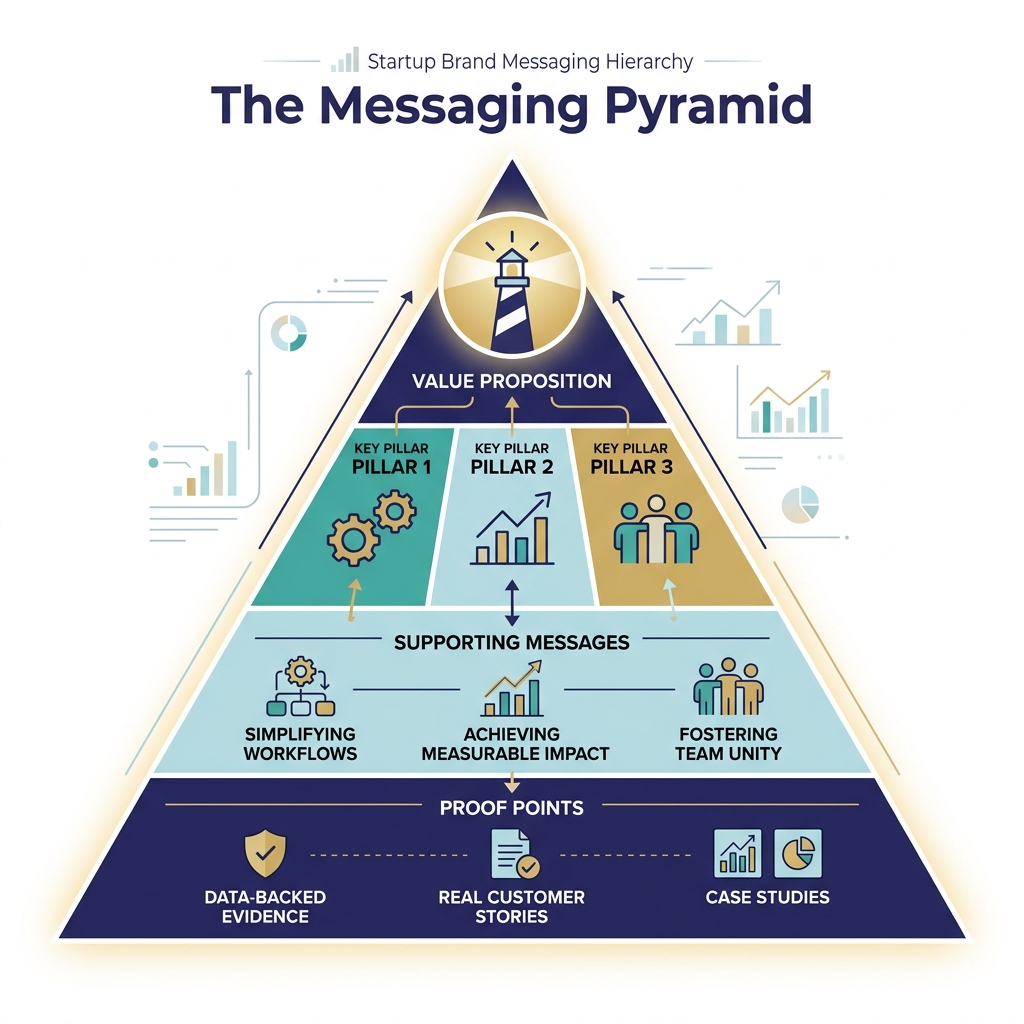
Each pillar needs supporting messages and proof points. For example, if your pillar is “Unmatched Speed,” your proof point might be: “Our AI automation reduces manual data processing by 87%.” Data and case studies are the “teeth” that make your brand promise bite.
Crafting the Brand Messaging 1-Pager
Every startup needs a Brand Messaging 1-Pager. This is a “living document” that serves as the single source of truth for your team. It should include:
- The Elevator Pitch: Can you explain your business in the time it takes to go up 10 floors?
- Positioning Statement: For [target], who has [problem], our [product] is a [category] that [benefit].
- The “Goldilocks” Version: Not too long, not too short. Just enough to keep everyone aligned.
This document is essential for onboarding new employees or briefing external contractors. It even helps with AI; you can feed your 1-pager into LLMs to ensure the content they generate stays perfectly on-brand.
Documenting Tone of Voice for Consistency
Your tone of voice is how you say what you say. Are you the “Expert Guide” (authoritative but helpful) or the “Irreverent Disruptor” (bold and funny)? Documenting this prevents your brand from sounding like it has a split personality across different channels.
We recommend defining creative strategies that include “Do’s and Don’ts.”
- Do: Use active verbs and simple sentences.
- Don’t: Use “corporate speak” or passive voice.
Your tone should be flexible but consistent. You might be slightly more playful on social media than in an investor deck, but the core personality should remain recognizable.
Testing, Validating, and Scaling Your Narrative
Messaging is never “done.” It is a series of hypotheses that need to be tested. We use a 30/60/90-day playbook to improve brand awareness and validate messaging.
- 30 Days: A/B test your landing page headlines. Which one has a higher click-through rate?
- 60 Days: Run “Win/Loss” analysis. Ask customers who didn’t buy: “What about our explanation confused you?”
- 90 Days: Audit your sales deck. Is the sales team actually using the messaging pillars, or are they making up their own?
By using collaboration in brand building, you can gather feedback from sales, customer success, and the customers themselves to iterate until you find the language that converts.
Common Pitfalls in Startup Brand Messaging
Avoid the “Branding Theater”—spending months on a logo while your messaging remains vague. Other common traps include:
- Over-explaining the Innovation: You don’t need to explain how the engine works to sell a fast car.
- Sounding “Corporate”: Startups win by being human and agile. Don’t hide behind “synergy” and “best-in-class.”
- Missing the Hero: Your startup is not the hero of the story; your customer is the hero. Your brand is the guide (the “Yoda”) that helps them win.
- Vague UVPs: “We make the world better” is not a value proposition. “We reduce financial reporting errors by 94%” is.
Frequently Asked Questions about Startup Brand Messaging
What is the difference between positioning and messaging?
Positioning is your internal strategy—it’s the mental space you want to occupy in the market relative to competitors. Messaging is the external expression of that strategy—the actual words and stories you use to communicate that position to the world. Think of positioning as the blueprint and messaging as the house. You can find more in our brand positioning guide.
How many key messages should a startup have?
Stick to 3-5 core pillars. Any more than that and you exceed the “cognitive load” of your audience. Each pillar should be distinct, provable, and directly tied to a major customer pain point. This focus is what helps you create a memorable brand.
When is the right time to document brand messaging?
The best time was yesterday; the second best time is now. Ideally, you should document your core messaging during the Seed stage, once you have some initial customer feedback. Documenting early prevents “messaging drift” and ensures that strategic partnerships and marketing efforts are aligned from day one.
Conclusion
At Trav Brand, we believe that your story is your most valuable asset. We don’t just provide “advice”; we offer a complete ecosystem that takes you from strategy to execution. Whether you need brand transformation services to fix a narrative that isn’t working, or a brand audit to identify where your messaging is leaking revenue, we are here to help.
Don’t let your innovation get lost in translation. Let’s build a brand that people don’t just use, but one they actually care about.
Partner with Trav Brand for comprehensive brand marketing and let’s start telling your story the right way.