
How to Boost Your E-commerce Conversion Rates (and Keep Them High!)
Why E-commerce Conversion Rate Optimization Transforms Your Bottom Line

E-commerce conversion rate optimization is the practice of increasing the percentage of website visitors who complete a desired action—like making a purchase, signing up for a newsletter, or adding items to their cart. Here’s what you need to know:
- What it is: Systematic improvements to your website that turn more visitors into customers
- Why it matters: Increases revenue from your existing traffic without spending more on ads
- Average benchmark: Global e-commerce conversion rates average 3.68%, with new businesses typically starting at 1-2%
- Key focus areas: Product pages, checkout process, mobile experience, site speed, and trust signals
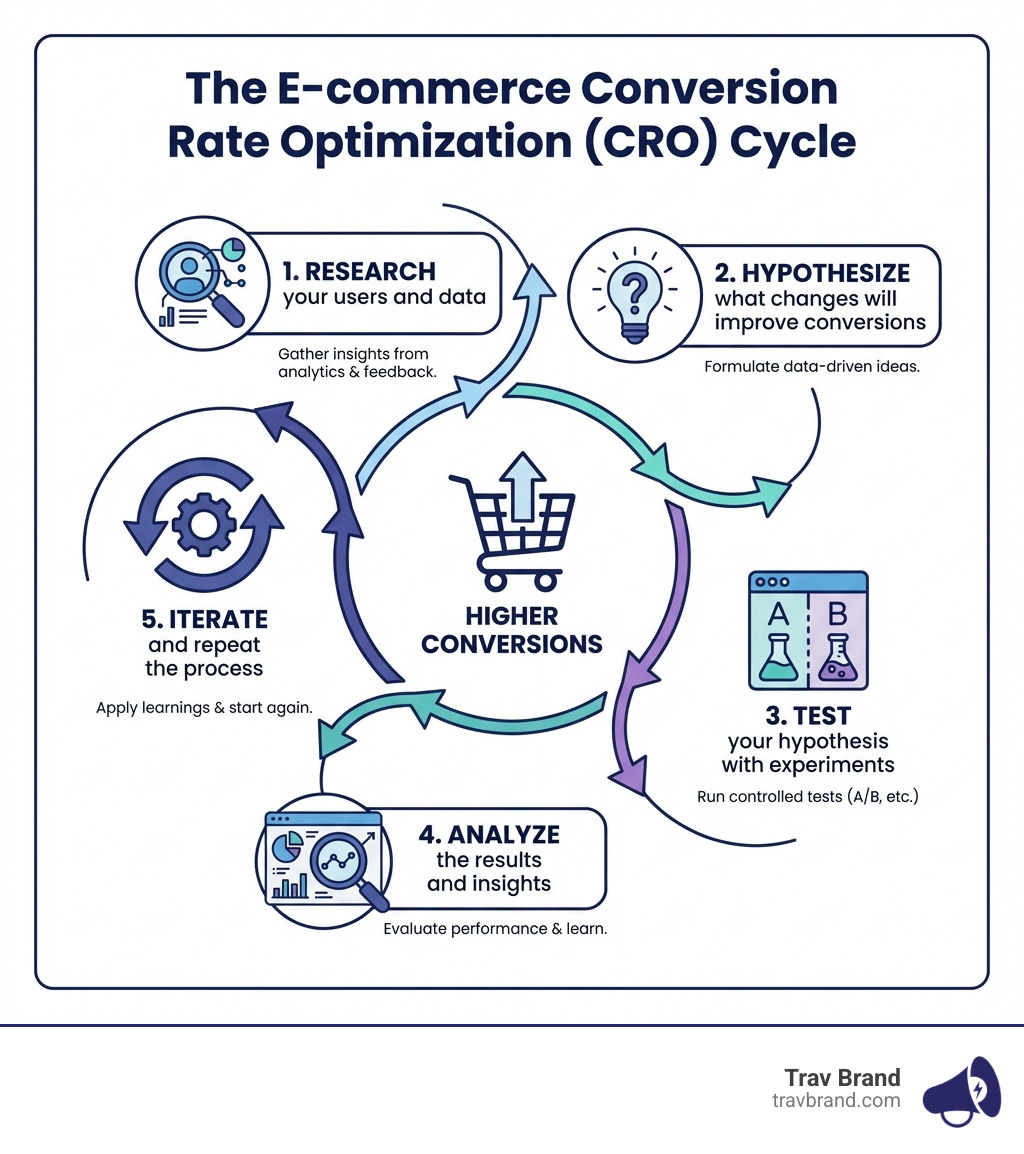
- Core process: Research → Hypothesize → Test → Analyze → Iterate
For leaders of e-commerce businesses, understanding and improving conversion rates is critical to long-term success. The math is simple: if you’re getting 10,000 visitors per month and converting at 2%, you’re making 200 sales. Boost that to 3%, and you’re at 300 sales—a 50% revenue increase without spending a dollar more on traffic.
Most businesses focus heavily on driving more traffic through ads, SEO, and social media. That’s important, but it’s only half the equation. If your site isn’t converting those visitors effectively, you’re essentially pouring water into a leaky bucket.
CRO addresses this by making your website work harder for you. It’s about working smarter, not harder. Small tweaks—like simplifying your checkout process, improving product images, or adding customer reviews—can produce significant results.
The beauty of CRO is that it compounds. Better conversion rates mean better return on ad spend (ROAS), which means you can afford to invest more in growth while maintaining profitability. It also improves user experience (UX), which builds customer loyalty and increases lifetime value.
I’m Trav Lubinsky, and over the past decade I’ve helped brands from Star Wars to Poppi optimize their e-commerce experiences through strategic E-commerce conversion rate optimization. At Trav Brand, we’ve seen how the right CRO strategies can transform struggling online stores into conversion powerhouses.
Understanding the Foundations: Metrics and Benchmarks
Before we dive into the nitty-gritty of optimizing, we need a solid understanding of what we’re optimizing for. This means getting to grips with conversion rate metrics and benchmarks. What exactly is a conversion? How do we measure it? And what’s considered a “good” rate in the vast ocean of e-commerce?
At its core, e-commerce conversion rate optimization is about influencing user behavior to achieve specific goals. These goals, or “conversion actions,” can vary, but for e-commerce, the most meaningful action to measure is undoubtedly a web order. Other common e-commerce conversion actions include:
- Adding items to a cart: A crucial micro-conversion indicating strong purchase intent.
- Initiating checkout: The final hurdle before a sale.
- Signing up for an email newsletter: Building your audience for future marketing.
- Creating an account: Fostering customer loyalty and simplifying future purchases.
- Downloading a report or guide: Capturing leads for higher-value products.
- Engaging with live chat: Indicating a user needs more information or assistance.
Each of these actions contributes to the overall customer journey and plays a role in the broader Understanding E-commerce and Funnels process.
How to Calculate Your E-commerce Conversion Rate
Calculating your e-commerce conversion rate is straightforward. It’s a simple formula that gives you a clear percentage:
Conversion Rate = (Total Number of Conversions / Total Number of Visitors) * 100
Let’s put this into practice. Imagine your online store had 50 completed orders last month, and during that same period, you welcomed 1,000 unique visitors to your site. Your conversion rate would be:
(50 Orders / 1,000 Visitors) * 100 = 5%
It’s essential to define a set period for your calculation (e.g., daily, weekly, monthly) and to be consistent. Also, consider whether you’re tracking unique visitors or total sessions. While unique visitors give you a sense of individual customer engagement, total sessions can highlight repeat visits and their impact on conversion. For more in-depth analysis of your data, you can dive into Content Performance Analysis to see how different elements contribute to your overall performance.
What is a Good E-commerce Conversion Rate?
This is the million-dollar question, and the answer is, perhaps unsatisfyingly, “it depends!” In 2023, the average global e-commerce conversion rate was 3.68%. For new e-commerce businesses, aiming for a conversion rate of 1–2% is a realistic starting point, with the goal to increase it from there.
However, what constitutes a “good” e-commerce conversion rate can vary significantly based on several factors:
- Industry: Some industries naturally have higher or lower conversion rates. For instance, the average conversion rate across e-commerce as a whole is a median of 4.2%, but it can fluctuate wildly. The automotive repair, service, and parts industry might see averages around 12.96%, while furniture might be closer to 2.53%.
- Product Type and Cost: High-value or niche products often have longer sales cycles and lower conversion rates, while everyday essentials might convert faster.
- Seasonality: Holiday seasons or promotional periods can temporarily inflate conversion rates.
- Device Type: Mobile devices account for 59% of e-commerce sales, but mobile conversion rates are often lower than desktop rates, partly because many shopping journeys start on mobile but purchases are completed on desktop.
- Traffic Source: Conversion rates can differ depending on where your visitors come from. For example, direct traffic (visitors typing your URL directly) often converts higher than social media traffic, which typically hovers around 0.8%. Facebook ads, however, can see a higher average of 9.21% across industries.
- Your Internal Optimization Efforts: Your definition of “good” should be tied to your own performance and continuous improvement. As we’ve learned, small, consistent improvements are key.
Rather than fixating on an arbitrary benchmark, we advise focusing on consistent improvement. A 3% conversion rate is often considered normal, with industry standards ranging from 2% to 5%. If your site consistently converts above 3%, you’re already doing exceptionally well! You can explore more on conversion benchmarks to gain deeper insights into specific industries.
Key Strategies for E-commerce Conversion Rate Optimization
Now that we understand the fundamentals, let’s explore the actionable strategies we use to boost e-commerce conversion rates. It’s about optimizing the entire customer journey, because even small design tweaks can drive big changes in engagement and revenue. For a holistic view, consider our Ultimate Website Conversion Best Practices.

Optimize Product Pages and Site Navigation
Your product pages are where the magic happens – where interest turns into intent. And clear navigation is the map that guides your customers there.
- High-Quality Product Photography: People can’t touch or feel products online, so visuals are paramount. Studies show 56% of users immediately explore product images. Yet, only 25% of e-commerce sites provide sufficient images. We recommend high-resolution images, multiple angles, zoom functionality, and even 360-degree views or videos.
- Detailed Product Descriptions: Ten percent of e-commerce sites have insufficient product descriptions. Your descriptions should be persuasive, detailed, and easy to skim, highlighting benefits as much as features. Address customer pain points and provide precise information like composition, dimensions, and compatibility.
- Harness Social Proof: Nearly 70% of online shoppers read between one and six customer reviews before buying. User-generated content (UGC) is incredibly powerful; when visitors actively engage with UGC, conversions can increase by over 102%. Display customer reviews, star ratings, and even influencer mentions prominently. Tools like Yotpo, Okendo, and Loox can help embed these.
- Clear Calls-to-Action (CTAs): Your “Add to Cart” or “Buy Now” buttons should be unmissable. Use contrasting colors, compelling copy, and strategic placement (often above the fold). Regularly A/B test different designs and wording.
- Intuitive Navigation: A well-organized site reduces friction. Improving site navigation can increase conversion rates by 18.5%. Ensure your categories are logical, labels are clear, and the overall flow makes sense to your users.
- Powerful Site Search: Users expect an intelligent search bar. Implement features like predictive results, typo tolerance, and filtering options (by brand, price, color, etc.). Apps like Searchanise can add this functionality, helping customers find what they need faster. For more on how compelling copy and visuals drive sales, explore how we Optimize Content for Conversions.
Streamline the Checkout and Payment Process
The checkout is often the most critical stage for e-commerce conversion rate optimization. This is where commitment turns into a completed sale, but it’s also where many businesses falter. The average cart abandonment rate is around 70%, with 18% of users abandoning due to a long or complicated process.
- Reduce Form Fields: This is huge. The average checkout displays 11.8 form fields, but most only need eight. Reducing fields can increase conversions by up to 160%! We recommend asking only for essential information.
- Offer Guest Checkout: Forced account creation is a major conversion killer. Forty-three percent of consumers prefer to check out as guests. Always give users the option to proceed without creating an account first.
- Provide Clear Progress Indicators: Let customers know where they are in the checkout process. A simple progress bar can reduce anxiety and keep them moving forward.
- Offer a Variety of Payment Methods: Card payments drive just 40% of global e-commerce. To maximize conversions, we must cater to diverse customer preferences. This includes popular digital wallets like Google Pay and Apple Pay, and the increasingly popular Buy Now, Pay Later (BNPL) options such as Klarna, AfterPay, and Affirm. Digital wallet payments are projected to take over 53% of online POS transactions, making them a must-have. BNPL allows customers to finance purchases, making larger items more accessible and boosting conversion rates and average order value.
- Balance Fraud Prevention with False Declines: While preventing fraud is crucial (more than 70% of business leaders diverted resources to combat it in 2022), overcompensating can lead to “false declines”—blocking legitimate charges. This frustrates customers and can drive them away for good. We need smart, machine-learning-based solutions that protect against fraud without penalizing good customers. Our comprehensive guide, Trav Shares His Top 10 Reasons Why People Check Out of Checkout, digs deeper into these critical points.
Build Trust and Improve User Experience
Trust is the bedrock of any successful e-commerce business. Without it, even the best products and prices won’t convert. A bad user experience can be costly; studies show 88% of online shoppers wouldn’t return after one, and 44% would tell their friends. The e-commerce industry loses over a trillion dollars due to bad UX!
- Prominently Display Trust Signals: Security badges, SSL certificates, and clear contact information reassure customers. Visual cues, like padlock icons and microcopy indicating secure transactions, contribute to a user’s “gut feeling” of security.
- Transparent Policies: Buyers care a lot about return policies. Eleven percent of buyers abandon orders because they’re unhappy with it. Ensure your shipping information and return policy are easily accessible, perhaps in the footer, so customers can find them without hassle. For more on legal considerations, see our Checkout Legal Policy guide.
- Simple, Authentic Messaging: Keep your website copy short, simple, and authentic. Aim for a Grade 6 reading level in your website copy to ensure broad comprehension. Tools like Hemingway Editor can help you achieve this. Avoid jargon and speak directly to your customer’s needs and desires.
- Leverage User Familiarity (Jakob’s Law): Users spend most of their time on other sites. This means they expect your site to work in a familiar way. Deviating too much from established e-commerce conventions can create friction. For instance, putting the shopping cart icon somewhere unexpected might seem innovative but can confuse users. Understanding Jakob’s Law helps us design intuitive experiences.
- Strong Brand Presence: A memorable brand builds trust and recognition. Your brand’s story, values, and visual identity all contribute to the overall user experience and can significantly influence conversion. Explore The Power of Branding: How to Create a Memorable E-commerce Brand to understand its impact.
Master Mobile-First Design and Site Performance
Mobile is no longer just “important” for e-commerce; it’s dominant. Nearly 60% of all global web traffic is done on mobile devices, and more than 90% of web users access the internet from a mobile phone at least some of the time. While mobile devices account for 59% of ecommerce sales, mobile conversion rates are often lower. This gap presents a massive e-commerce conversion rate optimization opportunity.
- Responsive Design is Non-Negotiable: Your website must adapt seamlessly to any screen size. This isn’t just about looking good; it’s about functionality.
- Optimize for Touch: Mobile users interact differently. Ensure buttons and CTAs are easy to tap (aim for clickable elements to be at least 44×44 pixels). Text should be legible without pinching and zooming. Sixty-seven percent of consumers find it difficult to click on different elements on mobile due to small screens.
- Blazing Fast Page Speed: Mobile users are notoriously impatient. Google recommends an average load time of 2 seconds for e-commerce sites. Websites that load in 1 second have 2.5 times higher conversion rates than those taking 5 seconds. A one-second delay can even lead to a $2.5 million loss in sales for a store generating $100,000 per day! Optimize images (compress them with tools like ImageOptim), leverage browser caching, and use a reliable hosting provider.
- Prioritize Core Web Vitals: These Google metrics (Loading, Interactivity, Visual Stability) directly impact user experience and search rankings. Optimizing them improves both SEO and CRO. You can analyze your site with Google PageSpeed Insights to identify areas for improvement.
Building a Continuous CRO Program
E-commerce conversion rate optimization isn’t a one-time fix; it’s an ongoing journey. The digital landscape constantly evolves, and so do customer behaviors. To stay ahead, we must adopt a continuous program of testing, learning, and iteration. This dedication to improvement is one of our core Conversion Optimization Best Practices.
A successful CRO strategy involves four essential steps: analytics tracking, research & ideas, experimentation, and iteration. We like to think of it as maintaining a steady “experiment velocity”—consistently launching, completing, and implementing tests. We learn from both our wins and our losses, continuously refining our approach.
Step 1: Research and Data Analysis
You can’t optimize what you don’t understand. The first step in any successful CRO program is deep research and data analysis. This helps us identify where users are dropping off, why they might be struggling, and where the biggest opportunities for improvement lie.
- Analytics Tracking: This is your foundation. Tools like Google Analytics allow us to track everything about website traffic and user behavior, including conversions. Most e-commerce platforms have easy ways to set this up. If you’re on BigCommerce, for example, they have documentation on Setting Up Google Analytics 4. We use this data to understand customer journeys and pinpoint bottlenecks in the Optimize Conversion Funnel.
- User Behavior Tools: Beyond raw numbers, we need to see how users interact with your site. Tools like Hotjar and Microsoft Clarity offer heatmaps (showing where users click and scroll), session recordings (replaying user journeys), and conversion funnels. These visual insights are invaluable for identifying friction points. Lucky Orange and CrazyEgg are other popular options.
- Qualitative Research: Numbers tell us what is happening, but qualitative research tells us why.
- User Testing: This is a hands-on approach where real users walk through your site, sharing their thoughts aloud. Research suggests you only need 5 participants to find 85% of usability problems.
- Surveys and Polls: On-site surveys or post-purchase questionnaires can gather direct feedback on pain points and motivations.
- Customer Interviews: Speaking directly to 5-10 customers can uncover profound insights that data alone might miss.
Step 2: A/B Testing and Experimentation
Once we have hypotheses based on our research, it’s time to put them to the test. A/B testing is the cornerstone of e-commerce conversion rate optimization experimentation.
- What is A/B Testing? It’s an experimentation technique where we display two or more versions of a website element (e.g., a button, headline, or entire page layout) to different segments of your audience. We then monitor which version performs better against a defined conversion goal.
- Forming a Hypothesis: Every test starts with a clear hypothesis, such as: “We believe changing the CTA button color to green will increase ‘add to cart’ clicks by 10% because green signifies progress and action.”
- Creating Variations: Design your ‘B’ version based on your hypothesis, ensuring only one significant variable is changed per test to isolate its impact.
- Running Tests: Launch your A/B test and let it run for a sufficient period, typically at least two weeks, to account for daily and weekly traffic fluctuations. It’s crucial not to “peek” at metrics before the test concludes, as this can lead to misleading results.
- Sample Size and Statistical Significance: For reliable results, your test needs enough traffic (sample size) to achieve statistical significance. This ensures the observed difference isn’t just due to random chance. There are calculators available to check your statistical significance.
- A/B Testing Tools: Platforms like Google Optimize, Optimizely, VWO, AB Tasty, and Amplitude make it easy to set up, run, and analyze A/B tests without extensive coding knowledge. For a broader perspective on improving your conversion rates, explore our guide on How to Optimize Conversion Rate.
Frequently Asked Questions about E-commerce CRO
We often encounter similar questions from businesses looking to optimize their e-commerce conversion rates. Here are some of the most common ones:
What are the most common mistakes in e-commerce CRO?
Even with the best intentions, businesses can fall into common CRO traps:
- Ignoring mobile users: With nearly 60% of web traffic on mobile, neglecting optimization for smaller screens is a huge misstep. Many stores still aren’t responsive or optimized for mobile devices.
- Having a slow website: Online shoppers have zero patience. If your site takes too long to load, they’ll leave. A one-second delay can cost millions in lost sales.
- Overcomplicating the user journey: This often happens at checkout. Too many form fields, forced account creation, or confusing navigation can lead to high abandonment rates. Eighteen percent of users abandon orders due to checkout UX issues.
- Testing without a data-backed hypothesis: Relying on guesswork rather than research is a recipe for wasted time and resources. “65% of the decisions that business leaders make are getting more complex. Relying on guesswork is like playing a high-stakes game.”
- Not running tests long enough: Ending an A/B test prematurely can lead to false positives and implementing changes that don’t actually improve conversions in the long run. We recommend running tests for at least two weeks.
What are some essential tools for CRO?
A robust CRO toolkit is crucial for implementation and management:
- Analytics: Google Analytics is indispensable for tracking traffic, user behavior, and conversions. Shopify’s built-in analytics, including live view, product insights, marketing reports, and customer reports, also provide valuable data.
- User Behavior: Tools like Hotjar and Microsoft Clarity provide visual insights through heatmaps and session recordings, showing exactly how users interact with your site. LuckyOrange offers similar functionalities and integrates with Shopify.
- A/B Testing: Google Optimize (while being phased out, its principles remain relevant for alternatives), Optimizely, and VWO are popular platforms for creating and managing experiments.
- Page Speed: Google PageSpeed Insights helps analyze your website’s performance and offers recommendations for improvement.
How long does it take to see results from CRO?
The timeline for seeing results from e-commerce conversion rate optimization can vary. Small, impactful changes, such as optimizing a CTA button or simplifying a form, can sometimes show immediate improvements. However, significant and sustained increases in conversion rates typically require a consistent, iterative process over several weeks or even months.
For A/B tests, we generally recommend running them for at least two weeks to gather sufficient data and account for variations in user behavior throughout the week. The volume of traffic your site receives also plays a big role; high-traffic sites can reach statistical significance faster. CRO is a marathon, not a sprint, and the biggest gains come from continuous refinement.
Conclusion: Turn Visitors into Loyal Customers
We’ve covered a lot of ground, from understanding what e-commerce conversion rate optimization is and why it’s vital, to calculating your conversion rate, identifying benchmarks, and implementing key strategies. We’ve explored how optimizing product pages, streamlining checkout, building trust, and mastering mobile performance are non-negotiable for success in today’s digital marketplace.
CRO is a continuous journey, not a destination. It’s about constant measurement, testing, learning, and adapting. By focusing on understanding your customers better, delivering exceptional user experiences, and making data-driven decisions, you can transform your website into a finely-tuned conversion machine.
A strong brand is also a powerful conversion tool. It builds trust, communicates value, and creates a memorable experience that keeps customers coming back. At Trav Brand, we believe in building and scaling brands through comprehensive digital marketing, e-commerce, and content strategies, focusing on measurable results.
Ready to stop leaving money on the table and start seeing your e-commerce conversion rates soar? Let us help you open up your brand’s full potential. Develop your brand and boost conversions with our expert services.