
Your Brand’s North Star: Writing an Unforgettable Positioning Statement
Why Every Successful Brand Starts With a Positioning Statement
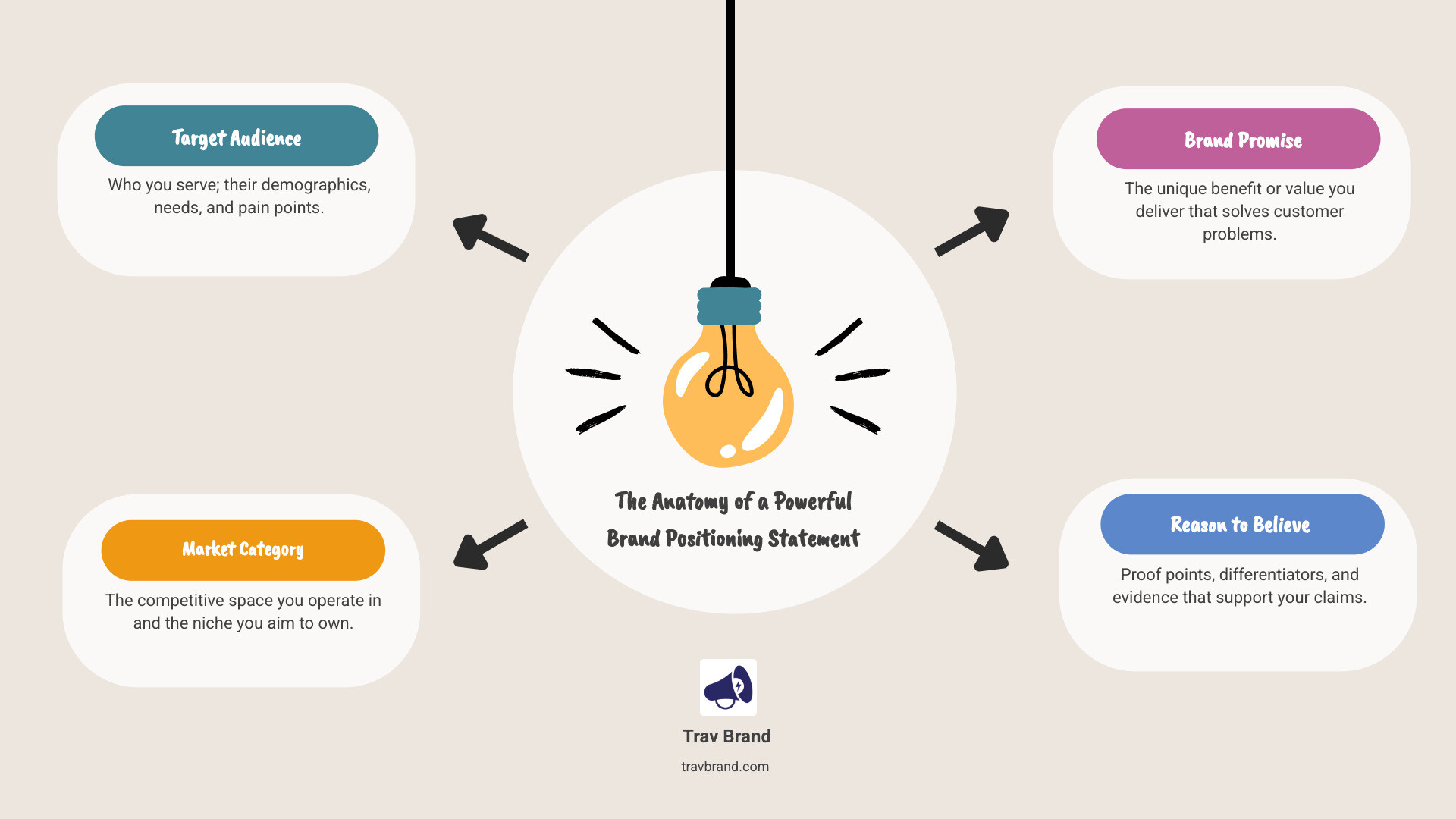
A brand positioning statement is a concise internal declaration that defines how your brand stands apart in your market—who you serve, what you offer, and why customers should believe you. Here’s what makes a strong positioning statement:
- Target Audience: Who your product or service is specifically for
- Market Category: The competitive space you operate within
- Brand Promise: The unique benefit or value you deliver
- Reason to Believe: Proof points that support your promise
Picture this scenario: You’ve spent months building a product. You’ve perfected the features. You’ve assembled a team. Then you launch—and it falls flat. Why? Because no one understood what made you different or why they should care. Without a positioning statement, your sales team pitches one thing, your marketing team says another, and customers walk away confused.
This happens more often than you’d think. A positioning statement acts as your brand’s North Star—the internal guide that keeps every message, every campaign, and every customer touchpoint aligned. It’s not a tagline customers see. It’s the strategic foundation that ensures everyone in your organization tells the same story about who you are and what you stand for.
The concept dates back to 1969, when Jack Trout first introduced positioning. Since then, it’s become the critical first step in building brands that actually connect with customers and win in crowded markets.
I’m Trav Lubinsky, and I’ve spent my career building and scaling brands—from launching Flex Watches to helping billion-dollar companies craft their brand positioning statements and growth strategies. Let me show you exactly how to create yours.
What Is a Brand Positioning Statement and Why Is It Your North Star?
A brand positioning statement is a focused description that articulates how your product, service, or brand stands out in the market. It explains who you’re for, what specific need you fulfill, and how you differ from your competitors. Think of it as the strategic compass for your entire brand.
The fundamental concept of positioning was first introduced by Jack Trout in 1969, and later popularized by Al Ries and Jack Trout in their classic 1981 book, Positioning: The Battle for Your Mind. They recognized that in an increasingly cluttered marketplace, success wasn’t just about having a great product, but about owning a unique space in the consumer’s mind.
For us, the brand positioning statement is primarily an internal strategic tool. It’s the guiding principle that informs every decision we make about our brand, from product development to marketing campaigns. It helps us achieve market differentiation by clearly articulating our unique value proposition. This internal clarity ensures consistent messaging across all touchpoints, which is crucial for building trust and recognition with our audience. It serves as a powerful decision-making filter, ensuring that all our efforts align with our core brand identity and strategic objectives.
As Harvard Division of Continuing Education emphasizes, the most effective positioning statements focus on the customer’s problem, not just the product. Before customers can engage with what we offer, they need to understand what problem we can help them solve. Positioning our brand around the customer’s problem makes it clear who our customer is and what critical challenge our solution addresses. This approach is far more impactful than merely describing product features, as it creates an immediate connection and relevance. If we’re unsure about the core problem we solve, we need to go out and ask our customers directly. To learn more about this problem-centric approach, check out this insightful piece: Creating a Positioning Statement? Position the Problem, Not The Product.
Positioning Statement vs. Mission Statement vs. Value Proposition
While often confused, a brand positioning statement, a mission statement, and a value proposition serve distinct purposes within our brand strategy. Understanding these differences is key to effective brand building.
| Feature | Brand Positioning Statement | Mission Statement | Value Proposition |
|---|---|---|---|
| Purpose | Defines our unique place in the market relative to competitors; guides internal strategy. | States our company’s fundamental purpose and overall goal. | Explains why a customer should buy from us; summarizes the benefits. |
| Audience | Primarily internal (employees, stakeholders). | Internal and external (public-facing). | Primarily external (customers, prospects). |
| Focus | “What we are” and “How we uniquely serve.” | “Why we exist” and “What we aspire to achieve.” | “What benefits customers receive” and “Why we’re better.” |
| Use Case | Informs marketing, product development, messaging, and strategic decisions. | Inspires and provides direction; communicates company culture and ethics. | Convinces customers to choose our product/service over alternatives. |
| Specificity | Highly specific to our competitive differentiation. | Broad and inspirational. | Specific to customer needs and product benefits. |
Our brand positioning statement acts as the blueprint for our brand’s identity and market differentiation, while our mission statement articulates our overarching purpose. Our value proposition then translates our unique benefits into customer-centric language, directly addressing their needs and why they should choose us.
The Importance of Customer Empathy
In today’s market, connecting with customers goes beyond just offering a great product; it requires genuine customer empathy. This means deeply understanding their pain points, aspirations, and emotional drivers. Our research shows that nearly half of customers want the brands they interact with to be empathetic. This isn’t just a feel-good statistic; it’s a strategic imperative. Nearly half of customers want the brands they interact with to be empathetic.
When crafting our brand positioning statement, we must embed this customer-centric approach. It’s about identifying the specific problems our target audience faces and positioning our brand as the most effective, understanding, and relevant solution. By doing so, we don’t just sell a product; we offer a solution that resonates on an emotional level. This focus on solving problems and fostering an emotional connection is what builds lasting customer loyalty and differentiates us in a crowded market.
The Anatomy of a Powerful Positioning Statement
A powerful brand positioning statement isn’t just a catchy phrase; it’s a carefully constructed declaration built upon several core components. These elements form a strategic framework that ensures clarity, relevance, and differentiation for our brand. When we get this right, our statement becomes a foundational element that guides every aspect of our brand’s interaction with the market.
The Core Elements of a Strategic Brand Positioning Statement
Let’s break down the essential components that make up an effective brand positioning statement:
-
Target Audience: This defines who we are serving. We need to be incredibly specific here, going beyond broad demographics. We consider their buyer personas—their needs, pain points, behaviors, and what drives their decisions. Understanding our target audience is the first step in creating a message that truly resonates.
-
Market Category: This is the competitive space we operate within. It clearly states what our product or service is. This helps customers understand where we fit in the marketplace. We also consider our niche identification within this category, pinpointing the specific segment where we can truly excel and differentiate ourselves from the competitive set.
-
Brand Promise: This articulates the unique benefit or value we deliver to our target audience. It answers the question, what problem do we solve? Our brand promise should be compelling and focus on the outcome or positive experience our customers will gain from choosing us. It’s not just about features, but the change we offer.
-
Reason to Believe: This provides the credible evidence and differentiators that support our brand promise. It answers why our target audience should trust us to deliver on our promise. This can include unique technologies, proprietary processes, exceptional customer service, ethical sourcing, or a proven track record. These proof points make our claims believable and reinforce our competitive advantage.
By carefully defining each of these elements, we build a brand positioning statement that is robust, clear, and actionable, serving as a solid foundation for all our branding and marketing efforts.
How to Write Your Brand Positioning Statement in 5 Steps
Crafting an effective brand positioning statement is a systematic process, not a shot in the dark. It requires thoughtful research, collaborative effort, and precise language. Here’s our recommended methodology, designed to move from initial research to a finalized, impactful statement.

Step 1: Research Your Landscape (Audience & Market)
Before we can position our brand, we must understand the terrain. This involves a deep dive into both our audience and the broader market.
-
Identify Our Target Audience: This is where we define who our product or service is for. We gather insights through customer surveys, direct feedback sessions, and in-depth market research to understand their demographics, needs, habits, and purchasing behaviors. Social listening offers a powerful advantage here; it combines the scale of quantitative research with the depth of qualitative insights. By analyzing online conversations, we can understand not just what people think, but the exact language they use when discussing their needs and our industry.
-
Understand Our Market and Competition: We need to perform thorough market research to identify industry trends, market size, growth potential, and customer demographics. Equally important is identifying and analyzing our competitors. We look at their strengths, weaknesses, pricing strategies, and how they communicate their value. A useful tool for this is a perceptual map, which visually plots our brand against competitors based on key attributes like price, quality, innovation, or customer service. This helps us to identify market gaps or opportunities to differentiate our brand further, allowing us to carve out a unique spot.
Step 2: Define Your Unique Differentiators
Once we understand our landscape, we pinpoint what makes us special. This involves articulating our Unique Value Proposition (UVP) and aligning it with our core brand values.
-
Articulate Our Unique Value Proposition (UVP): This is the heart of our competitive positioning—what truly sets our brand apart and gives customers a compelling reason to choose us. Our UVP should be clear, concise, and focused on the specific benefits we offer that competitors don’t, or don’t offer as well. We identify our brand’s strengths and unique features, services, or benefits, then align these with what our customers value most.
-
Incorporate Brand Values: Today’s consumers are increasingly discerning. Our research indicates that 54% of customers want to buy from companies that prioritize diversity, equity, and inclusion in their communities and workplaces, and 63% want to buy from companies that are socially responsible. 54% of customers want to buy from companies that prioritize diversity, equity, and inclusion. These values can be powerful differentiators. Our brand positioning statement should reflect our core values, making it authentic and appealing to customers who share those values. Authenticity builds trust and credibility, ensuring our statement reflects our true strengths and beliefs.
Step 3: Draft Your Statement Using a Template
Now, we bring all our research and insights together into a cohesive statement. Using a template can simplify this process and ensure we include all the necessary components. We’ve found this structure to be highly effective:
For [our target market] who [their specific need or pain point], [our brand name] is the [market category] that [main benefit that differentiates our offering from competitors] because [reason why our target market should believe our differentiation statement].
This template ensures we cover all the critical elements: who we serve, their problem, what we are, our unique solution, and the proof behind our claims.
Step 4: Refine for Clarity, Simplicity, and Impact
A great brand positioning statement is concise, clear, and memorable. This step is about polishing our draft until it shines.
-
Keep it Concise and Simple: The goal is to convey a lot of information clearly in a few words. A helpful technique is to repeatedly ask “so what?” until you get to the root of your answers. This “so what” exercise helps us strip away fluff and unnecessary details, ensuring every word earns its place. The more complicated our statement becomes, the less convincing or engaging it will be.
-
Ensure Uniqueness and Authenticity: Our statement should highlight what makes us truly distinctive. Shelley Grieshop, Creative Writer at Totally Promotional, suggests exploiting personal history or unique demographics as a way to make a statement unique and memorable. Furthermore, authenticity is paramount. Our brand positioning statement must accurately reflect our core values and strengths, making promises we can reliably keep.
-
Focus on the Customer’s Perspective: As Sai Sathish, B2B Marketing Leader, wisely points out, “It’s easy to get carried away with what you think the best thing is about your brand when it should really be about what the best thing is for your audience.” Our statement needs to resonate with their desires and address their pain points directly.
Step 5: Pressure-Test and Finalize
The final step involves rigorous review and validation to ensure our brand positioning statement is robust and actionable across our organization.
-
Internal Feedback and Alignment: We share our drafted statement with key internal stakeholders across different departments—marketing, sales, product development, customer service, and even HR. Their diverse perspectives are invaluable. Consulting a colleague not directly involved in the writing process can provide fresh, objective feedback on clarity, consistency, relevance, and impact. This cross-departmental review ensures everyone understands and buys into the positioning.
-
Ensure Actionability: Our brand positioning statement isn’t just a document; it’s a guide for action. It should be clear enough that all teams can align their key business decisions with it. If it doesn’t guide our choices about product features, marketing messages, or customer interactions, it needs further refinement. We test it by asking: Does this statement help us make better decisions? Does it clarify our unique value? Does it inspire confidence in our team?
Deconstructing Winning Positioning Statement Examples
Examining successful brand positioning statements from well-known companies can provide invaluable inspiration and illustrate how these principles are applied in the real world. While we won’t name any direct competitors, we can learn from the strategies of leading brands across various industries.

B2C Example: Athletic Apparel Brand
Consider a leading athletic apparel brand. Their brand positioning statement might focus on inspiring athletes to reach their full potential.
- Target Audience: Athletes of all levels, from professionals to everyday enthusiasts, who seek peak performance and self-improvement.
- Benefit: Provides innovative, high-performance athletic wear that improves comfort, durability, and style, enabling athletes to break barriers and achieve greatness.
- Reason to Believe: Driven by continuous research and development in sports science, sustainable practices, and partnerships with top athletes who embody the spirit of perseverance.
This type of statement emphasizes purpose, innovation, and commitment to both athletic achievement and societal impact, resonating deeply with its target market.
B2C Example: Beverage Brand
Now, let’s look at a globally recognized beverage brand. Their brand positioning statement often transcends the product itself, focusing on emotional connection.
- Target Audience: A broad global audience seeking moments of refreshment, connection, and simple happiness.
- Benefit: Offers a refreshing and uplifting experience that brings joy and fosters shared moments, making a positive difference in daily life.
- Reason to Believe: Built on a rich heritage of iconic taste, global accessibility, and a consistent promise of happiness and optimism through its products and marketing.
This approach highlights the brand’s ability to evoke positive emotions and create memorable experiences, positioning it as more than just a drink.
B2B Example: Team Collaboration Platform
For a prominent team collaboration platform, their brand positioning statement would emphasize efficiency and connectivity for businesses.
- Target Audience: Businesses of all sizes, from small teams to large enterprises, seeking to streamline communication and improve productivity.
- Benefit: Provides a seamless and intuitive platform that unifies team communication, information, and tools, driving work forward efficiently.
- Reason to Believe: Offers robust integrations with essential business applications, flexible features adaptable to diverse workflows, and a proven track record of connecting millions of users worldwide.
This statement showcases scope, flexibility, and the core benefit of seamless connectivity, clearly defining its value for a wide range of business users.
Bringing Your Positioning to Life: Communication and Evolution
A brand positioning statement is a living document. Once crafted, it must be actively communicated internally and externally, and continuously adapted to remain relevant in an ever-changing market.
Internal and External Communication
Our brand positioning statement acts as the blueprint for our entire brand. It’s crucial that everyone within our organization understands and embodies it.
-
Internal Alignment: We use our brand positioning statement as a compass to align all our teams—from product development and sales to marketing and customer service. It serves as an internal tool that aligns marketing efforts with our brand and value proposition. This ensures that every employee, regardless of their role, understands who we are, what we offer, and why we are different. Consistent internal messaging fosters a unified brand experience for the customer.
-
External Communication: While the brand positioning statement itself isn’t public-facing, it directly informs all our external communications. This includes our marketing campaigns, website copy, sales enablement materials, and even press releases. It guides our brand voice and tone, ensuring consistency across all customer touchpoints. Research highlights that consistency in branding can boost revenue by 10-20%, emphasizing the importance of a cohesive brand identity driven by a strong positioning statement. By clearly communicating our unique value, we articulate the need we serve, why customers should believe in us, and why they should choose us over competitors.
Adapting Your Positioning Over Time
The market is a dynamic place, and what’s effective today might not be tomorrow. Our brand positioning statement isn’t set in stone; it needs to evolve.
-
Responding to Market Changes: We continuously monitor industry trends, technological advancements, and shifts in customer behavior. As SurveyMonkey notes, “Continuous market analysis is key to ensuring your positioning remains relevant and effective.” This vigilance allows us to anticipate changes and adapt our positioning proactively.
-
Evaluating Business Performance: Regular analysis of our business performance metrics—sales, customer feedback, market share—provides valuable insights. If our performance indicates a disconnect between our intended positioning and market perception, it’s a sign that our statement may need adjustment.
-
Evolving Customer Needs: Customer needs are not static. Through ongoing customer surveys and social listening, we stay attuned to their evolving pain points and desires. A brand audit can be particularly useful here, revealing where we stand in the consumer’s mind and highlighting any gaps between our intended positioning and actual perception.
-
Repositioning Strategy: When significant changes are needed, we start on a repositioning strategy. This is a strategic undertaking that requires extensive research and, crucially, buy-in from leaders and all departments. A clear vision, backed by data, is essential to guide these efforts. The goal isn’t to abandon our core identity but to refine how we communicate our value to remain relevant and competitive.
Frequently Asked Questions about Brand Positioning Statements
How is a brand positioning statement different from a tagline?
A brand positioning statement is an internal, strategic document that clearly defines our unique market position, our target audience, and our competitive advantages. It’s the foundation upon which all our branding and marketing strategies are built. A tagline, on the other hand, is a short, memorable, external-facing marketing slogan. It’s a creative expression derived from our core positioning, designed to capture attention and communicate a key benefit to customers. The positioning statement guides the creation of the tagline, but they serve different purposes and audiences.
How long should a positioning statement be?
A brand positioning statement should be a concise declaration, typically one to three sentences. The goal is clarity and focus, not a lengthy paragraph. As Qualtrics advises, we want to “keep it short, simple, and tight.” It must be sharp enough to guide internal decisions, ensuring that it’s easy for every team member to understand and remember. Its brevity is its strength, allowing it to serve as a quick, effective reference point.
Can a company have more than one positioning statement?
A company typically has one overarching brand positioning statement that defines its core identity and market position. This master statement guides the entire enterprise. However, for companies with diverse product lines or distinct sub-brands, it’s common for specific products or sub-brands to have their own nuanced positioning statements. These individual statements must always align with and ladder up to the master brand’s position, ensuring overall brand coherence while allowing for custom messaging to specific market segments.
Build a Brand That Resonates
We’ve explored the profound importance of a brand positioning statement—not just as a marketing tool, but as the very North Star guiding our entire brand strategy. From its historical roots with Jack Trout and Al Ries to its modern-day application, a clear, empathetic, and differentiated statement is non-negotiable for success.
We’ve walked through the anatomy of a powerful statement, dissected its core elements, and outlined a practical, five-step process to craft your own. We’ve seen how internal alignment and external communication are vital, and how continuous adaptation keeps our brand relevant in an changing market.
Building a brand that resonates, connects, and converts is a journey—a strategic journey that begins with a crystal-clear understanding of who you are, who you serve, and why you matter. This clarity is what allows us to stand out, build trust, and drive growth.
Are you ready to define your brand’s unique place in the market and ensure every message you send hits its mark? Let us help you illuminate your brand’s North Star.
Your Comprehensive Brand & Marketing Partner