CRO Unlocked: 8 Ways to Skyrocket Your Website’s Conversion Power
What is CRO and Why It’s Your Biggest Growth Lever
How to optimize conversion rate is the single most powerful way to grow your business without spending more on ads. Here’s the quick answer:
To optimize conversion rate, you need to:
- Improve page speed and mobile experience – Every second counts, and 60% of traffic is mobile
- Build trust with social proof – Reviews, testimonials, and trust badges increase conversions by up to 270%
- Simplify your CTAs and forms – Clear calls-to-action and shorter forms reduce friction
- Personalize the customer journey – 81% of customers prefer personalized experiences
- Use psychological triggers ethically – Urgency, scarcity, and social proof drive action
- Test and measure everything – A/B testing validates what actually works for your audience
Conversion Rate Optimization (CRO) is the strategic process of increasing the percentage of website visitors who take your desired action—whether that’s making a purchase, signing up for a newsletter, or requesting a demo.
Here’s why it matters: A small bump in your conversion rate creates massive financial impact. If you have a 3% conversion rate generating $100k per month and you boost it to 3.5%, that yields an additional $16.7k—a revenue boost of nearly 17% on an ongoing basis. No additional ad spend required.
Most businesses obsess over driving more traffic. But what if your website is bleeding money because visitors leave without converting? CRO fixes that leak. It’s about getting more value from the traffic you already have.
The best part? CRO improvements compound over time. Unlike paid ads that stop working when you stop paying, a better-converting website keeps delivering results 24/7.
I’m Trav Lubinsky, and over the past decade I’ve helped brands like HexClad, FightCamp, and Poppi build high-performing marketing ecosystems that convert. Learning how to optimize conversion rate has been central to scaling these brands from early stage to eight figures and beyond.
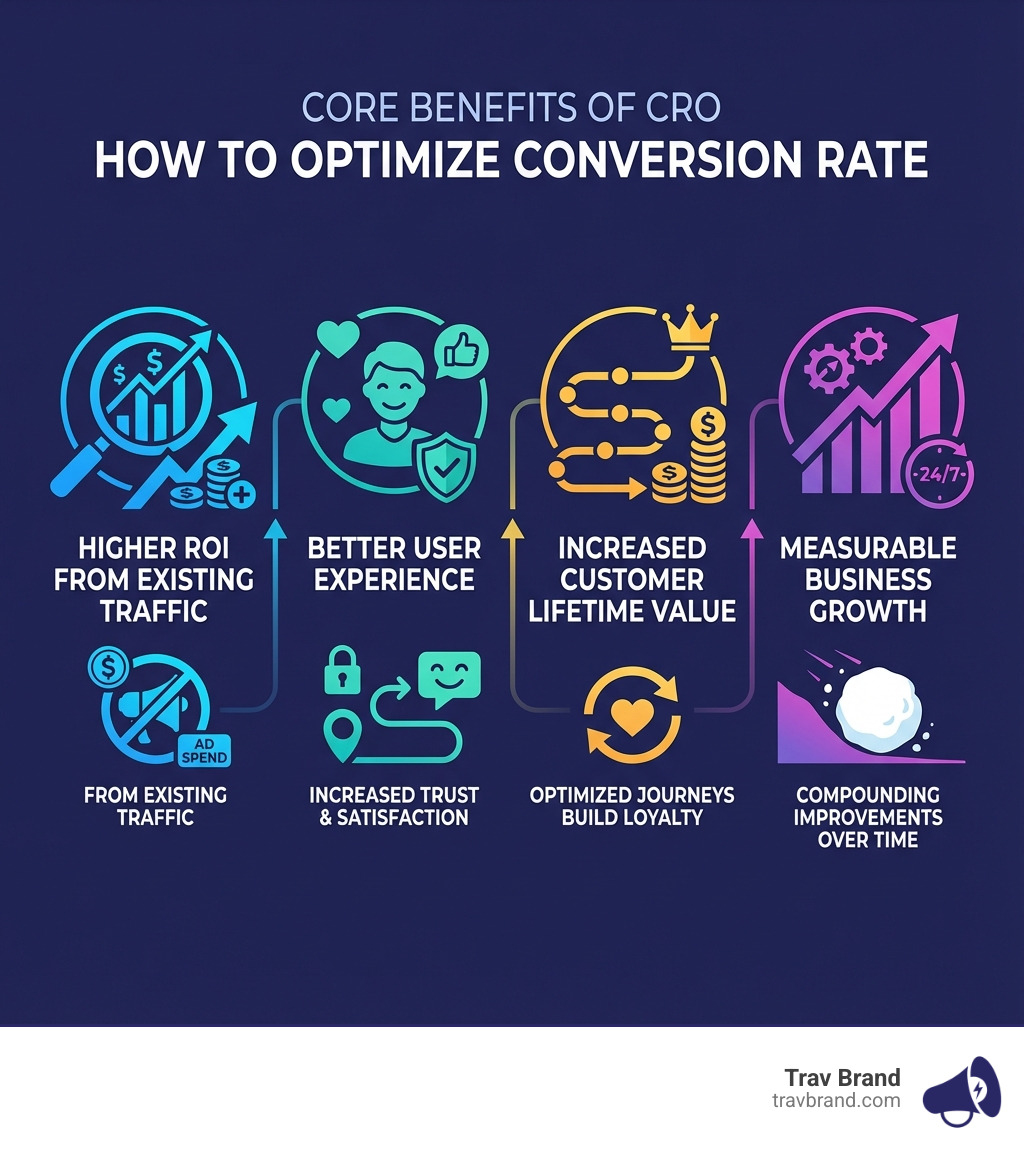
8 High-Impact Strategies on How to Optimize Conversion Rate
We believe that how to optimize conversion rate isn’t just about tweaking buttons; it’s about understanding human behavior and systematically removing obstacles between your customers and their goals. These eight strategies are designed to do just that, creating a seamless and persuasive journey for every visitor.
1. Master Your Website’s First Impression: Speed and Navigation
First impressions matter, especially online. Your website’s speed and ease of navigation are often the first things visitors notice, consciously or subconsciously.
Slow-to-load pages frustrate visitors and can lead to high bounce rates. According to Bidnamic, conversion rate improves by 17% for every second a website loads faster. Think about it: users are 32% more likely to bounce if a page takes three seconds to load. Double that to six seconds, and that probability surges to 106%! This translates to a 12% drop in conversion rate for every second of load time. We optimize page load speed by implementing simple yet effective techniques like lazy loading for images and videos below the fold, reducing image file sizes, enabling caching, and cutting down on redirects.
A smooth mobile experience is no longer optional; it’s essential. In January 2024, mobile devices accounted for almost 60% of web page views worldwide. If your site isn’t responsive and thumb-friendly with large, easy-to-tap buttons, you’re alienating a huge portion of your audience. We ensure our websites are mobile-optimized to provide a consistent and enjoyable experience across all devices.
Intuitive navigation keeps visitors engaged and helps them find what they’re looking for quickly. We advocate for simple navigation menus with clear labels and logically grouped items. For example, apparel brand FRAME uses a straightforward top menu highlighting key categories. In addition to an easy-to-steer menu, we always include a search function and often use breadcrumbs to show users their current location within the site structure, making exploration a breeze.

2. Build Unshakable Trust with Social Proof and Guarantees
In the digital world, trust is the currency of conversion. We work to build this trust through transparent policies and the power of social proof.
Social proof is the positive influence created when people see others using and approving of your products and services. It’s incredibly powerful: Nearly 90% of consumers trust word-of-mouth recommendations, and 80% of consumers will typically read five or more reviews before committing to a purchase. Testimonials alone can increase conversion rates by 34% when used properly, and customer reviews can boost them by as much as 270%. We leverage various types of social proof:
- Reviews and Testimonials: Displaying customer reviews prominently, as a travel backpack brand does with over 3,000 five-star reviews on its homepage.
- User-Generated Content (UGC): Showcasing real customers using your products.
- Media Mentions: Highlighting features in reputable publications.
- Trust Badges: Certifications, security seals, and awards.
- Influencer Marketing: 49% of all consumers make daily, weekly, or monthly purchases thanks to influencers.
Beyond social proof, clear trust signals are vital. These include visible SSL certificates, secure payment icons, easily accessible privacy policies, and money-back guarantees. We also ensure clear contact information is available, offering accessible customer support through help centers, contact forms, live chat, and even AI chatbots.
Your shipping and returns policies play a crucial role in a customer’s purchase decision. Customers want to know all associated costs and feel secure about returns. We make these policies transparent, especially on cart and checkout pages.
Finally, offer multiple payment options. We cater to diverse preferences by including major credit cards, digital wallets (PayPal, Apple Pay, Google Pay), and Buy Now, Pay Later (BNPL) services like Klarna, AfterPay, Affirm, or Shop Pay Installments. This flexibility removes friction and accommodates more buyers.
3. Craft Irresistible Calls-to-Action (CTAs) and Frictionless Forms
The Call-to-Action (CTA) is where the magic happens—it’s the gateway to conversions. We ensure CTAs are prominently placed, visually distinct, and clearly communicate the action you want the user to take. Fun fact: Rounded CTA buttons receive anywhere from 17 to 55% more clicks than buttons with sharp angles! We use contrasting colors (using a color wheel), appropriate sizing, and action-oriented language. Don’t be afraid to A/B test different designs, placements, and copy. For example, the travel company Going cut one word and added two new ones from their CTA, resulting in a 104% month-over-month increase in their homepage conversion rate. Personalized calls to action are also 202% more likely to convert.
Forms are often the final hurdle before conversion, and we know that long forms can be a major blocker. 27% of users will bail on a form if it’s too long. We prioritize user experience by reducing the number of required fields to the absolute minimum and allowing guest checkout options. Remember the story of the 300 million dollar button? Expedia increased profits by $12 million by simply dropping a single field from their checkout form. We always aim to simplify the experience as much as possible.
4. How to optimize conversion rate with a personalized customer journey
Personalization is about showing your customers you understand them. According to recent data, 81% of customers prefer companies that offer a personalized experience. This boosts conversion rates by making your site more relevant to each visitor. We implement personalization using data like browsing history, past purchases, geographic location, and referral sources. This can include:
- Displaying product recommendations based on browsing or purchase history.
- Showing location-specific content or offers.
- Customizing content for returning visitors.
- Adapting messaging based on the referral source (e.g., a specific social media influencer).
- Using dynamic pricing or promotions based on user behavior.
Nearly 90% of marketers claimed they saw positive ROI when they used personalization in their marketing campaigns.
Dedicated landing pages are crucial for targeted ads. As leading marketing experts explain, you wouldn’t show up to a first date and immediately ask to skip to the end. Similarly, you shouldn’t send ad traffic to a generic product page. Instead, a dedicated landing page allows us to curate information, remove distractions, and maintain narrative consistency between the ad and the page. This “message matching” ensures visitors find exactly what they expect.
Interactive quizzes can also significantly improve conversion rates by guiding shoppers to the right product or service. Brands like Haus Labs use shade finder quizzes to help customers confidently identify their perfect match. This reduces choice paralysis and builds confidence.
5. Leverage Customer Psychology to Encourage Action
Understanding human psychology is a secret weapon in how to optimize conversion rate. We use these principles ethically to motivate action.
Urgency and scarcity play on the fear of missing out (FOMO). We use limited-time offers, countdown timers, and low stock warnings to encourage immediate action. Remember the Beanie Babies craze in the 1990s? The toys were marketed as limited editions, driving demand through perceived scarcity. Every year, Starbucks leverages this with its buy-one-get-one-free offer on holiday drinks, making sure customers don’t miss out.
Loss aversion is the bias where the thought of losing something feels worse than the potential gain. We tap into this by highlighting what customers stand to lose if they don’t convert – perhaps missing out on a limited-time discount or the benefits of a product.
Anchoring is when people rely too heavily on the first piece of information they receive. We can apply this by strategically presenting a higher-priced option first, making subsequent, more affordable options seem like a better deal.
The decoy effect involves introducing a third, less attractive option to make one of the other options look more appealing. For example, a medium-sized popcorn might seem more appealing if there’s a small and a slightly more expensive, much larger option available.
Finally, simplicity and clarity are paramount. Our brains instinctively prefer ease and efficiency. The Paradox of Choice suggests that too many options can paralyze users. A famous jam study showed that consumers with fewer choices were ten times more likely to purchase those with many options. A Google study found that website visitors determine aesthetics within 1/50th to 1/20th of a second and often perceive cluttered or complex designs as less beautiful. We strive for clean designs and straightforward messaging to reduce cognitive load and guide users effortlessly.
6. Use High-Quality Visuals and Crystal-Clear Messaging
In online commerce, your visuals are your storefront. We ensure products and services are showcased with high-quality imagery, multiple angles, and zoom functionality. If you’re selling basketball shoes like Nike, throw a pair of ’em on your landing page so users can see what they’re getting. For services, we highlight them in action. We also incorporate 360-degree views or videos to provide a comprehensive understanding. Pictures of people also help visitors identify with your products and services, letting them see themselves in what you offer, making them much more likely to convert. Oyster (an HR tool) does exactly that above the fold on their homepage, using a real photo of a seemingly happy individual.
Your value proposition must be crystal clear and jargon-free. We cut through the noise, answering the fundamental question: “What’s in it for me?” We make sure this core message, along with primary CTAs and key features, is visible above the fold so visitors immediately understand your offering without scrolling.
7. Recapture and Re-engage Potentially Lost Customers
Not every visitor converts on their first visit, and that’s okay! We implement strategies to win back those who showed interest but didn’t complete a purchase.
Abandonment popups (especially exit-intent popups) are powerful tools. These appear when a user is about to leave your site, offering a last-chance incentive like a discount code or free shipping. We use them strategically with compelling offers, clear value propositions, and a sense of urgency.
Retargeting ad campaigns are highly effective because they target users who have already engaged with your brand. United’s retargeting campaign is a great example: they focused on users who had viewed ads and were considering booking a vacation, showing them a short video with a clear call-to-action.
Abandoned cart emails are another must-have. According to research from Moosend, these emails have a high open rate of 45%. Of those opened, 21% are clicked, and half of the people who click go on to make a purchase! We craft these emails with reminders, incentives, and clear paths back to their cart.
Finally, we offer attractive incentives for first-time customers. This could be a special discount, free shipping, a gift with purchase, an extended trial, or bonus points. The goal is to lower the barrier to that initial purchase and turn a browser into a buyer.
8. Optimize Beyond the Buy Button: Post-Conversion Strategies
The customer journey doesn’t end after a purchase; it just begins a new phase. We optimize beyond the initial conversion to foster loyalty and maximize customer lifetime value.
Optimizing thank you pages is often overlooked. Instead of a generic “Thank You,” we use these pages to provide next steps, invite customers to connect on social media, or even offer relevant upsells or cross-sells. For example, you might offer a complementary product at a small discount.
Lead nurturing is critical for prospects who converted into leads but haven’t yet purchased. We implement email marketing automation sequences that provide value, address common questions, and gently guide them towards a purchase or deeper engagement.
Upsells and cross-sells can significantly boost average order value (AOV) by suggesting related or upgraded products at opportune moments, like on product pages or during checkout.
Finally, building a customer community can transform buyers into advocates. This involves encouraging reviews, fostering engagement on social media, and creating exclusive content or events for loyal customers. This cultivates social proof and strengthens brand affinity.
Getting Started: Your 5-Step CRO Implementation Framework
So, you’re ready to dive in and learn how to optimize conversion rate for your business? Great! We use a systematic, data-driven framework to ensure our efforts are impactful and measurable.
Step 1: Gather Quantitative and Qualitative Data
This is where we become detectives. We start by collecting both “what” and “why” data.
-
Quantitative Data (the “what”): We use analytics tools like Google Analytics to track key metrics such as:
- Overall conversion rate
- Bounce rate (where users leave)
- Average session duration
- Cart abandonment rate
- Traffic sources and device usage
- Conversion funnels (where users drop off)
-
Qualitative Data (the “why”): To understand the motivations behind user behavior, we employ behavioral analysis tools like heatmaps and session recordings (Hotjar, Lucky Orange, CrazyEgg, Microsoft Clarity). Heatmaps show where users click, scroll, and spend time, while session recordings let us literally watch how individual users steer the site. We also gather direct feedback through customer surveys (like Hubspot’s NPS surveys), user testing, and interviews.
Step 2: Analyze Data to Form a Hypothesis on how to optimize conversion rate
With our data in hand, we identify patterns and pinpoint areas of friction. We look for pages with high traffic but low conversion rates, or specific steps in a funnel where many users drop off. This analysis helps us understand why users aren’t converting.
Based on these insights, we form a testable hypothesis. A good hypothesis follows a structure like: “If I change X (e.g., shorten the form fields), then Y will happen (e.g., conversion rate will increase) because Z (e.g., it reduces user friction and perceived effort).”
Step 3: Prioritize Your Test Ideas
Not all tests are created equal. We prioritize our hypotheses to focus our efforts on changes that will yield the biggest impact with reasonable effort. We often use prioritization frameworks like:
- ICE model: Impact, Confidence, Ease. We rank each hypothesis on a scale (e.g., 1-10) for how much impact we think it will have, how confident we are in that impact, and how easy it will be to implement.
- PIE model: Potential, Importance, Ease. Similar to ICE, this framework helps us evaluate the overall value of a test by scoring its potential for improvement, its importance to the business, and how easy it is to implement.
We focus our initial optimization efforts on high-impact pages, such as checkout pages, pricing pages, and dedicated landing pages, as these often have the most direct influence on the bottom line.
Step 4: Test Your Hypothesis with A/B Testing
Once prioritized, it’s time to put our hypotheses to the test! A/B testing (or split testing) involves creating two versions of a webpage element (A and B) and showing them to different segments of your audience simultaneously. This allows us to compare their performance directly.
For more complex scenarios, we might use multivariate testing, which tests multiple variables at once. We use powerful split testing tools like Optimizely, VWO, AB Tasty, or Google Optimize to run these experiments. A crucial rule we follow: always run one significant test at a time to accurately measure the impact of each change. We also ensure our tests run long enough to achieve statistical significance, so we can be confident in our results.
Step 5: Analyze Results and Implement Winning Changes
After a test concludes, we carefully analyze the data. Did our hypothesis hold true? Did the new variation outperform the original? Once we have a statistically significant winner, we implement that successful variation across the site. Crucially, we document everything—both wins and losses. This builds a valuable knowledge base that informs future tests and helps us continually refine our understanding of what drives conversions for our clients.
Frequently Asked Questions about How to Optimize Conversion Rate
What is a good conversion rate?
This is the million-dollar question, and the answer is… it depends! A “good” conversion rate varies significantly by industry, business model, traffic source, and even the specific conversion goal. For example, general ecommerce conversion rates often hover between 2-4%, though top performers can reach 5-8% or higher. Overall, the average conversion rate across fourteen different industries was 2.9% in 2023.
We advise our clients not to obsess over industry averages but to focus on continuous improvement. Your “good” conversion rate is simply better than what you had last month. It’s also important to note that mobile conversion rates are typically about half that of desktop, so segmenting your data is key.
How long does it take to see results from CRO?
The timeline for seeing results from CRO depends heavily on your website’s traffic volume. For sites with high traffic, we can achieve statistical significance for tests in a matter of weeks. For lower-traffic sites, it might take longer, sometimes months.
However, the most important thing to understand is that CRO is not a one-time project; it’s an ongoing process. Customer needs, market trends, and competitive landscapes are constantly evolving. Successful CRO is about establishing a continuous cycle of research, hypothesis, testing, and learning.
What’s the difference between CRO and SEO?
Think of it this way:
- SEO (Search Engine Optimization) is all about attracting visitors to your website. It focuses on increasing your visibility in search engine results to bring more qualified organic traffic to your site.
- CRO (Conversion Rate Optimization) is about converting those visitors once they arrive. It focuses on optimizing your website and user experience to maximize the percentage of visitors who take a desired action.
They are two sides of the same coin and share a symbiotic relationship. Great SEO brings people to the door, and great CRO gets them inside and makes them feel at home. You can have all the traffic in the world, but if your site doesn’t convert, that traffic is just expensive window shopping. Conversely, a perfectly optimized site won’t help if no one can find it. For true digital marketing success, both are essential.
Conclusion: Turn Your Insights into Lasting Growth
Learning how to optimize conversion rate is a journey, not a destination. It’s a continuous cycle of understanding your users, experimenting with solutions, and refining your approach. The beauty of CRO lies in its ability to transform small, data-driven changes into significant, compounding impacts on your bottom line. It’s about creating a better, more intuitive, and more persuasive experience for your customers.
At Trav Brand, we specialize in helping purpose-driven brands scale by building comprehensive digital marketing ecosystems that not only attract but also convert. Our focus is on measurable results and lasting growth, ensuring your digital presence performs as hard as it looks.
Ready to open up your website’s full potential? Explore our e-commerce strategies and find how we can help your brand thrive.