10 Effective Digital Marketing Strategies for 2025 and Beyond
Why Digital Marketing Strategy Matters More Than Ever
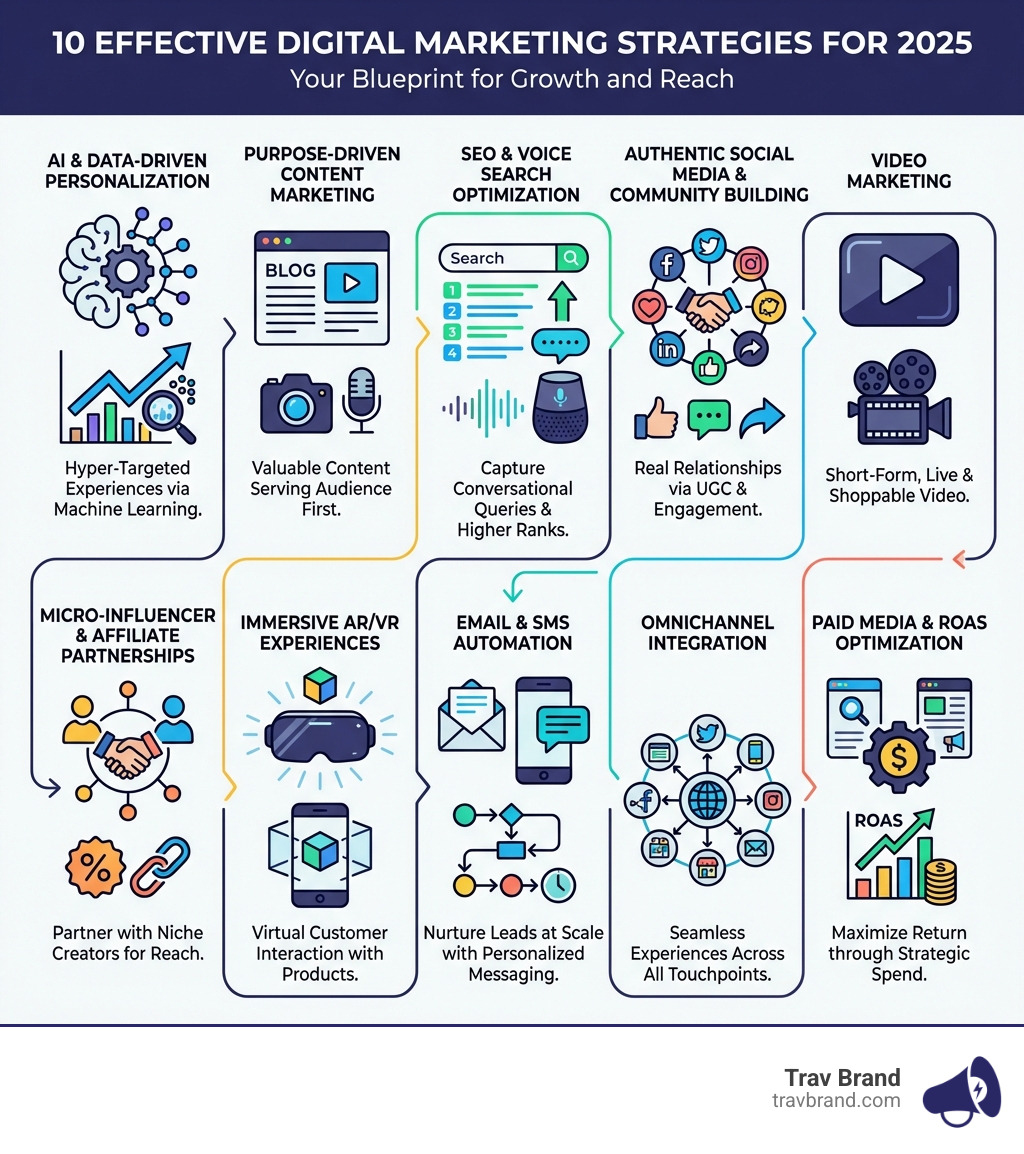
Effective digital marketing strategies are your blueprint for reaching customers online, driving conversions, and growing your business in 2025 and beyond. Here are the 10 most impactful approaches:
- AI and Data-Driven Personalization – Use machine learning to deliver hyper-targeted experiences
- Purpose-Driven Content Marketing – Create valuable content that serves your audience first
- SEO and Voice Search Optimization – Rank higher and capture conversational queries
- Authentic Social Media & Community Building – Build real relationships through UGC and engagement
- Video Marketing – Leverage short-form, live, and shoppable video content
- Micro-Influencer & Affiliate Partnerships – Partner with niche creators for authentic reach
- Immersive AR/VR Experiences – Let customers interact with products virtually
- Email & SMS Automation – Nurture leads with personalized messaging at scale
- Omnichannel Integration – Create seamless experiences across all touchpoints
- Paid Media & ROAS Optimization – Maximize return through strategic ad spend
The digital marketing landscape is changing faster than ever. Almost half of companies still don’t have a defined digital marketing strategy, which means there’s a massive opportunity for businesses that get it right.
But here’s the truth: throwing money at random tactics won’t work. You need a cohesive strategy that connects your brand identity, customer experience, and measurable growth goals.
The businesses winning in 2025 are building integrated marketing ecosystems. They use AI to better understand customers, create content that matters, and measure what works to double down on success.
This isn’t about following every trend. It’s about understanding which strategies will move the needle for your business, then executing them with precision.
I’m Trav Lubinsky, and I’ve spent my career building and scaling consumer brands across e-commerce, hospitality, and consumer products–working with everyone from billion-dollar enterprises to high-growth startups. At Trav Brand, my team and I help founders cut through the noise and build marketing systems that convert.
Strategy vs. Campaign: Setting the Foundation for Success
Before we dive into the nitty-gritty of individual approaches, let’s clarify a common point of confusion: the difference between a marketing strategy and a marketing campaign. Understanding this distinction is fundamental to crafting effective digital marketing strategies.
A marketing strategy is a comprehensive plan outlining how a business will promote its products or services. It’s the “what” and the “why”–the long-term vision and framework for achieving goals like brand visibility, customer engagement, and revenue growth. It’s your company’s blueprint for success, an approach we emphasize in our Digital Marketing Strategy Guide.
A marketing campaign, however, is a set of specific actions to achieve focused goals within that strategy. Campaigns are the “how” and “what” you do. They have a defined timeline and support specific objectives like a product launch, seasonal promotion, or driving webinar sign-ups.
To put it simply: strategy is planning, and tactics (which make up campaigns) are doing. Having a strategy without ways to act on it is just daydreaming. Taking actions without a clear plan or goal is a recipe for wasting time and resources.
Here’s a quick comparison:
| Feature | Marketing Strategy | Marketing Campaign |
|---|---|---|
| Purpose | Long-term vision; overarching goals; “why” | Short-term; specific objectives; “how” and “what” |
| Scope | Comprehensive plan for overall business growth | Focused initiative within the broader strategy |
| Duration | Ongoing; evolves over years | Defined start and end dates |
| Example | Increase market share by 20% in two years | Launch a social media contest to boost engagement for a new product for six weeks |
| Flexibility | Guides decisions, adaptable to market shifts | Specific actions, may be tweaked based on performance |
| Relationship | The blueprint; the big picture | The actionable projects that bring the blueprint to life |
Our goal is to help you develop a robust strategy first, then design impactful campaigns that consistently move you toward your long-term objectives.
The 10 Most Effective Digital Marketing Strategies for 2025
The 2025 marketing landscape is shaped by technology, changing consumer behaviors, and personalization. In this dynamic environment, we’re not chasing fads but focusing on strategies for sustainable growth and genuine brand connections. It’s about more than visibility; it’s about creating Innovative Brand Building Strategies to Stand Out in a Competitive Market.
1. AI and Data-Driven Personalization
AI is no longer a buzzword; it’s a cornerstone of effective digital marketing strategies. It automates processes, improves personalization, and analyzes data to predict customer behavior. Over 71% of marketers report AI has significantly impacted their roles, with many expecting it to become an assistant in their daily duties.
This power is leveraged through data. Analytics help measure campaign performance (conversion rates, ROI, customer acquisition costs) and enable hyper-personalization. For example, on an e-commerce site, AI can analyze a customer’s browsing history and past purchases to recommend products they’re genuinely interested in, often before they know it themselves.
At Trav Brand, we’ve helped e-commerce clients implement AI-driven personalization engines that adjust website content and product recommendations based on user behavior. This improves customer experience and boosts conversion rates and average order value. It’s about using technology to understand and serve your audience, as we discuss in How Brands Are Leveraging AI to Scale Smarter.
2. Purpose-Driven Content Marketing
Content is still king, but the focus has shifted from quantity to quality and purpose. Modern content marketing creates valuable, relevant, and consistent content to attract and engage a defined audience, establishing your brand as a trusted expert.
Instead of pushing products, focus on storytelling that captures interest, encourages engagement, and drives conversions. For example, Adilo’s Senior SEO and Content Strategist, Felix Johnson, noted that content marketing drove over 95% of their new signups from Google Search.
The evolution of content marketing means focusing on user needs and questions rather than solely on the product. This includes a variety of formats:
- Blogs: Publishing articles on a company blog demonstrates expertise and generates organic search traffic.
- Videos: Engaging and dynamic, perfect for explaining complex topics or showcasing products.
- Podcasts: Offer an authentic way to engage audiences and build long-term affinity.
- Infographics: Visually appealing and easily shareable, great for conveying data.
- Case Studies: Showcase your expertise and success stories, building credibility.
Buyers typically view three to five pieces of content before engaging with a sales representative. This means your content ecosystem needs to provide continuous value throughout their journey. Our Content Marketing Services are designed to help you create this kind of impactful content.
3. SEO and Voice Search Optimization
Search Engine Optimization (SEO) continues to be a non-negotiable component of effective digital marketing strategies. It’s the practice of optimizing your web content, structure, and technical aspects to improve visibility and ranking on search engine results pages (SERPs). The ultimate goal is to increase organic, non-paid traffic to your website.
But SEO isn’t static. With the rise of voice assistants like Alexa, Siri, and Google Assistant, voice search optimization has become increasingly crucial. Users are now asking questions conversationally, making long-tail keywords and natural language paramount. Optimizing for voice search means structuring your content to answer common questions directly, aiming for featured snippets or “position zero” in search results.
For local businesses, optimizing your Google My Business profile for local SEO is vital. Local bookstores, for instance, can optimize their profiles to appear in queries for “bookstore near me” or location-specific searches.
Effective SEO provides sustainable long-term visibility without the ongoing costs of paid advertising. It’s about making sure your brand is easily findable when your target audience is actively looking for solutions you provide. We dig deeper into this in our guide on Keyword Analysis and Content Marketing.
4. Authentic Social Media & Community Building
Social media marketing has evolved beyond just posting updates; it’s about building genuine communities and fostering authentic engagement. In 2025, visually rich storytelling, short-form video, and micro-influencer collaborations are key.

Consumers crave authenticity. Brands that succeed on platforms like TikTok leverage behind-the-scenes content, recipes, and culturally relevant posts, humanizing their brand by showcasing ingredient sourcing and values. The key is creating playful and humorous content that engages younger audiences.
User-Generated Content (UGC) is another powerhouse. Photo challenges encouraging users to share their best product photos not only generate buzz but also build immense trust and social proof.
At Trav Brand, we recently partnered with a sustainable fashion brand to amplify their message through a UGC campaign. We encouraged customers to share photos of themselves wearing the brand’s eco-friendly apparel in natural settings, using a unique hashtag. This not only generated a wealth of authentic content but also fostered a vibrant community around shared values, significantly boosting brand awareness and engagement, as we explore in Use Facebook to Grow Your Brand.
5. Dominating with Video Marketing
Video marketing continues its meteoric rise, becoming an indispensable part of effective digital marketing strategies. It offers a dynamic and engaging way to convey messages, connect with audiences, and showcase brand creativity. Its shareable nature also improves SEO, improves retention, and expands reach.
Short-form video platforms like TikTok and Instagram Reels are dominating, but longer formats for tutorials, product demos, and behind-the-scenes content on YouTube are equally powerful. Live video offers real-time interaction, while shoppable videos are increasingly blurring the lines between content and commerce.
Successful video campaigns creatively use humor, relatability, and celebrity features in their ads, connecting with a broad audience. Brands are finding that video allows for a more personal connection, communicating complex ideas quickly and effectively. We analyze the impact of video in our Web Marketing Video guide.
6. Micro-Influencer & Affiliate Partnerships
While celebrity endorsements still exist, the landscape of influence has shifted. Micro-influencers (those with 10,000-99,999 followers) are proving to be incredibly effective. In 2024, 44.88% of marketers reported the most success with micro-influencers. Why? They offer authenticity, trust, access to highly engaged niche communities, and often come at a lower cost. Katerina Andreeva of HypeFactory notes their content is “perfectly imperfect and sincere,” resonating deeply with modern audiences.
Affiliate marketing, a performance-based strategy, is another robust approach. It involves partnering with individuals or entities who promote your products or services in exchange for a commission on each sale they drive. The affiliate marketing industry was estimated to be worth $12 billion in 2022. This taps into the affiliate’s audience, expanding your reach while leveraging their trust. Estheticians and other professionals effectively use affiliate marketing by sharing referral codes and discounts via their Linktree pages, demonstrating how individuals can drive sales for brands. Dive deeper into this lucrative channel with Unleash Your Earnings: A Deep Dive into Affiliate Marketing.
7. Immersive Experiences with AR/VR
Augmented Reality (AR) and Virtual Reality (VR) are moving from novelty to mainstream in effective digital marketing strategies, offering truly immersive experiences. These technologies allow customers to interact with products and brands in innovative ways, enhancing engagement and driving purchase decisions.
Think virtual product try-ons for clothing or makeup, interactive showrooms for furniture, or AR-powered games that integrate brand messaging. Major brands are exploring the metaverse, cleverly integrating their products into virtual worlds with millions of monthly active users. This creates a playful, interactive experience that resonates with a younger demographic.
At Trav Brand, we recently conceptualized an AR campaign for a home decor brand, allowing customers to virtually place furniture and decorative items in their homes using their smartphone cameras before making a purchase. This not only reduced return rates but also significantly boosted customer confidence and conversion. This kind of Creative Strategy in Advertising is where we excel.
8. Strategic Email & SMS Automation
Despite the rise of new channels, email marketing remains a cornerstone of effective digital marketing strategies, offering the second-highest ROI for B2C brands. It’s a direct, personal channel for promoting products, nurturing leads, and building strong customer relationships. The key is automation and personalization. Segmented and personalized emails drive 30% more opens and 50% more click-throughs.
SMS marketing complements email by offering immediate, direct communication, especially for time-sensitive offers or transactional updates.
Automation allows us to send the right message to the right person at the right time, whether it’s a welcome series for new subscribers, abandoned cart reminders, or personalized product recommendations. Skincare companies effectively use email marketing to advertise discounts, using bold letters and clear CTAs to drive action. This targeted approach builds relationships and drives traffic. We explore this further in Maximizing Your Growth: The Power of Email and SMS Automation.
9. Omnichannel Marketing Integration
In a fragmented digital world, customers interact with brands across numerous touchpoints. An omnichannel strategy ensures a seamless, consistent, and integrated customer experience, regardless of how they engage with your brand. This builds brand loyalty and improves customer satisfaction.
Omnichannel isn’t just about being on every channel; it’s about making those channels work together harmoniously. This means aligning messages, coordinating media types (owned, earned, paid), and ensuring brand consistency across all online and offline interactions. For example, successful brands excel at this with seasonal marketing strategies, creating buzz through multi-platform campaigns that integrate in-store promotions with digital engagement.
By tracking the customer journey from social media ads to newsletter sign-ups and website purchases, businesses can make adjustments to optimize the experience. This unified approach is crucial for optimizing your Optimize Conversion Funnel and ensuring every customer interaction is a positive one.
10. Paid Media & ROAS Optimization
Paid media, including Pay-Per-Click (PPC) advertising and social media ads, offers unparalleled opportunities for targeted reach and immediate results. While organic strategies build long-term equity, paid campaigns can quickly drive brand awareness, generate leads, and boost sales. The key is Return on Ad Spend (ROAS) optimization.
This involves strategically allocating your budget, continuously A/B testing ad creatives and targeting, and focusing on high-intent keywords and audiences with proven conversion rates. Luggage brands, for instance, use search engine marketing to feature their products prominently in search results, capturing users with direct purchase intent.
For us, it’s about ensuring every dollar spent on advertising works as hard as possible. We analyze campaign performance daily, optimizing bids, creatives, and landing pages to maximize ROAS and ensure our clients achieve their financial goals. Our insights into The Conversion Value Playbook: Smart Bidding Strategies for Ad Platforms help us fine-tune these efforts.
How to Build and Measure Your Digital Marketing Plan
Developing effective digital marketing strategies isn’t a one-time event; it’s a continuous process of planning, execution, measurement, and adaptation. We need an an actionable digital marketing plan that bridges the gap from theory to practice and allows for continuous improvement.
Step 1: Define Your SMART Business Goals
The first step in building any successful digital marketing strategy is to clearly define your goals. We advocate for the SMART framework: goals that are Specific, Measurable, Attainable, Relevant, and Time-bound. This provides a robust framework for tracking progress and making necessary adjustments.
For example, instead of saying “we want more sales,” a SMART goal would be: “Increase online sales by 15% within the next 12 months.” This aligns with your overall business vision and gives us a clear target. Other examples might include increasing website traffic by 20% or boosting social media engagement by 30%. Without these clear objectives, it’s impossible to measure success effectively, as we’ll discuss when we talk about key performance indicators (KPIs).
Step 2: Understand Your Audience & Competitors
To truly connect with your audience, you must understand them deeply. This involves creating detailed buyer personas – fictional representations of your ideal customers based on demographic data, psychographic insights, behaviors, goals, and challenges. Tools like Google Surveys, Typeform, Facebook Audience Insights, and even exploring Reddit communities can provide invaluable information about who your customers are and what they care about.
Equally important is analyzing your competitive landscape. Who are your direct and indirect competitors? What are their digital marketing strategies? Tools like SimilarWeb and SEMrush’s Traffic Analytics can reveal how competitors acquire visitors, what channels they use, and what content performs well for them. This competitive intelligence helps us identify opportunities they might be overlooking or potential threats to address. A SWOT analysis (Strengths, Weaknesses, Opportunities, Threats) is a cornerstone of this process, including both internal (strengths/weaknesses) and external (opportunities/threats) components. Our Content Marketing Competitive Analysis further guides this process.
Step 3: Choose Your Channels & Allocate Budget
With clear goals and a deep understanding of your audience and competitors, we can now choose the most appropriate digital channels and allocate your budget effectively. We typically categorize channels into three main types:
- Owned Media: These are digital assets your brand controls, like your website, blog, and social media profiles. The goal here is to create valuable content and build direct relationships.
- Earned Media: This refers to exposure gained through word-of-mouth, PR mentions, organic social shares, and user-generated content. It’s “earned” because you don’t pay for it directly, but it’s a result of valuable owned media and strong brand reputation.
- Paid Media: This involves any channel where you pay for visibility, such as Google Ads, social media advertising, and native advertising. Paid media is excellent for targeted reach and accelerating results.
Budget allocation is critical. There’s no one-size-fits-all answer, but we generally recommend allocating 60-70% of your budget to proven channels that generate positive ROI and 20-30% to testing new channels and tactics. For small businesses, a basic digital presence might start at $500-$1,000 monthly, while e-commerce companies often need $3,000-$10,000 monthly to profitably acquire customers. Companies under $500,000 annual revenue might allocate 7-12% of revenue to marketing, while larger businesses typically allocate 5-10%. The goal is always to maximize your Return on Ad Spend (R.O.A.S.): The Content Marketing Advantage.
Step 4: Implement, Measure KPIs, and Adapt
Once the strategy is planned, it’s time for execution. But the work doesn’t stop there. Continuous measurement and adaptation are what make effective digital marketing strategies truly successful. We need to track performance rigorously using key performance indicators (KPIs) that directly align with our SMART goals.
Tools like Google Analytics, HubSpot Marketing Analytics & Dashboard Software, and others provide invaluable data. We monitor metrics such as website traffic, conversion rates, engagement rates, cost per lead, and customer lifetime value. This data allows us to see what’s working, what’s not, and where optimizations are needed.
The digital landscape is constantly evolving, with new trends, algorithm changes, and shifts in consumer behavior (e.g., 88% of marketers reported data privacy changes impacted their strategy in 2024). An agile approach is essential. We don’t just “set it and forget it” – that’s the worst possible mindset for digital marketing! Instead, we review performance data regularly, often weekly or monthly, and are ready to pivot quickly. This continuous cycle of implementation, measurement, and adaptation, which we detail in our Content Performance Analysis process, ensures your digital marketing efforts remain effective and deliver consistent results.
Frequently Asked Questions about Digital Marketing Strategies
What are the core components of effective digital marketing strategies?
At its heart, an effective digital marketing strategy is built on five core components:
- Goals: Clearly defined, SMART (Specific, Measurable, Attainable, Relevant, Time-bound) objectives that align with your overall business vision.
- Audience: A deep understanding of your target customers, typically articulated through detailed buyer personas and market segmentation.
- Channels: A strategic selection of owned, earned, and paid media channels where your audience spends their time and where your message will resonate most effectively.
- Measurement: A robust system for tracking Key Performance Indicators (KPIs) and analyzing data to evaluate performance and inform future optimizations.
- Budget: A realistic allocation of financial resources across chosen channels and tactics, with a focus on maximizing Return on Investment (ROI).
How much should a business budget for digital marketing?
There is no single “right” number, because your ideal budget depends on your industry, business size, goals, and competitive landscape. That said, there are useful benchmarks you can use as a starting point:
- As a percentage of revenue: Companies generating under $500,000 in annual revenue often allocate 7-12% of their revenue to marketing. Larger businesses typically allocate 5-10%.
- Minimums for channels: As a rough guide, Google Ads often requires $1,000-$2,000 monthly for sufficient data and optimization, while Facebook and Instagram ads can start at $500-$1,000 monthly. LinkedIn ads, which are popular for B2B targeting, might need $3,000-$5,000 monthly.
- Small businesses: For a basic digital presence, $500-$1,000 monthly might be enough. To include paid advertising alongside organic efforts, many small brands invest $2,000-$5,000 monthly.
- E-commerce: To profitably acquire customers through paid channels, e-commerce companies commonly allocate $3,000-$10,000 monthly.
The most important thing is to treat your budget as an investment, not just an expense. Start with a realistic number, track performance closely, and scale spend into the channels that deliver the strongest, most reliable ROI.
How often should I update my digital marketing strategy?
Your digital marketing strategy should be considered a living document, not something set in stone. The digital landscape changes too rapidly for a static plan.
- Regular reviews: Conduct monthly or quarterly reviews of your performance data and market trends. This allows for continuous tweaking and minor adjustments to campaigns and tactics.
- Annual overhaul: A comprehensive review and potential overhaul of your entire strategy should happen at least once a year. This is your chance to assess major shifts in consumer behavior, emerging technologies, competitive movements, and your business’s evolving goals.
- Adaptation: Be prepared to adapt quickly to significant market changes, algorithm updates, or unexpected events. Continuous engagement and agility are key to keeping your strategy effective over time.
Conclusion: Future-Proofing Your Brand’s Growth
In the dynamic world of 2025 and beyond, building effective digital marketing strategies is about more than just staying current – it’s about future-proofing your brand’s growth. We’ve explored ten impactful approaches, from leveraging AI and data-driven personalization to fostering authentic communities and optimizing paid media. Each strategy, when integrated thoughtfully, contributes to a cohesive digital ecosystem that can drive remarkable results.
The key takeaway is agility. The digital landscape is constantly evolving, and consumer behaviors are shifting at lightning speed. Businesses that thrive are those that accept continuous learning, adapt their strategies based on real-time data, and prioritize genuine connection with their audience.
At Trav Brand, we specialize in helping purpose-driven brands steer this complexity. We don’t just offer consulting; we provide a complete ecosystem from strategy to execution, ensuring measurable results that genuinely scale your business. If you’re ready to transform your digital presence and build a resilient brand that stands the test of time, we’re here to help you craft your next winning strategy.
Get a complete guide to our branding services and find how we can help your brand not just survive, but truly thrive.