
Is a Marketing Copywriter Career Right for You?
Why Marketing Copywriters Are Essential in Today’s Digital Economy
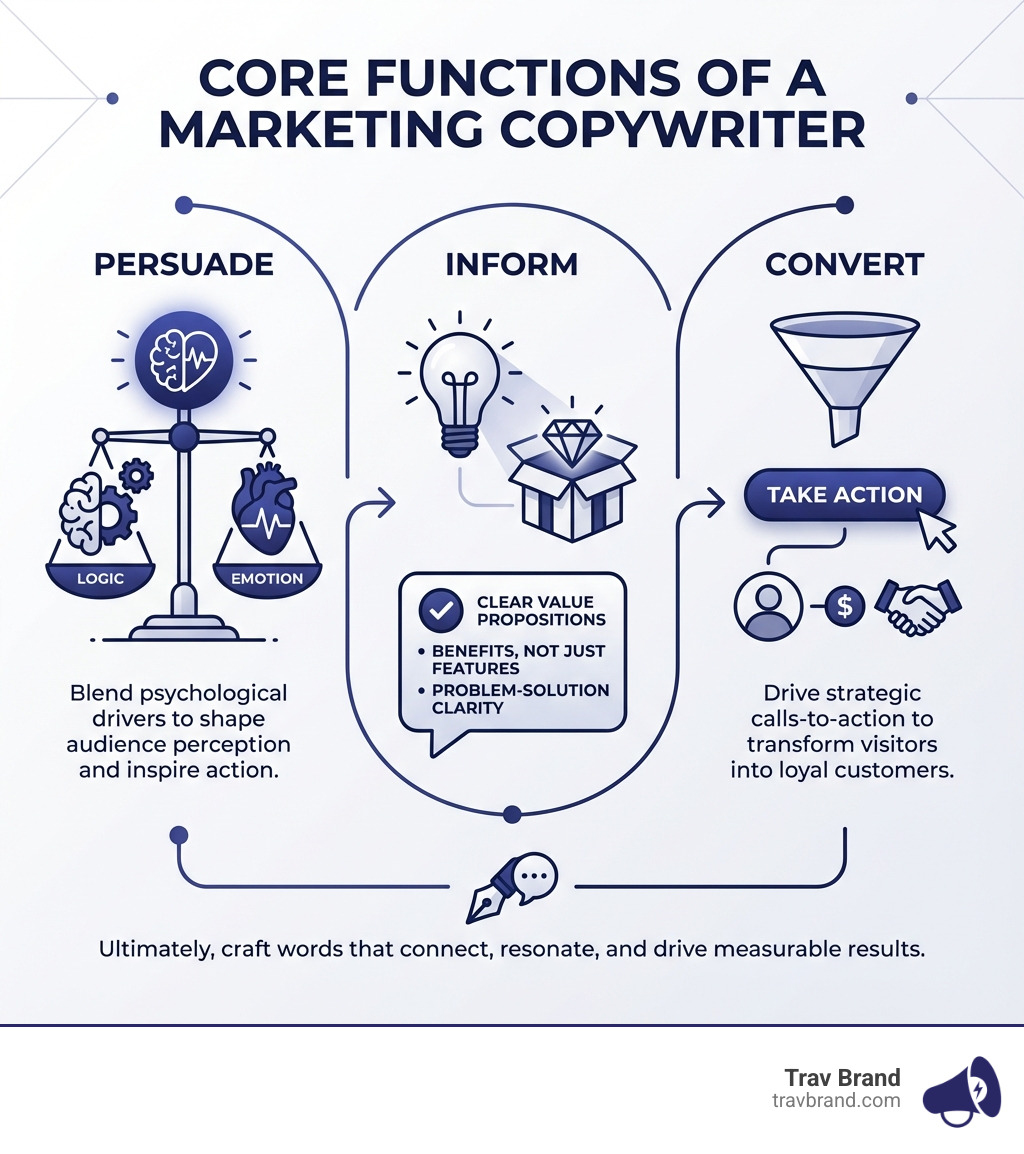
A marketing copy writer creates persuasive text to drive specific actions—making a purchase, signing up for a newsletter, or booking a consultation. The role blends psychology, sales strategy, and creative writing to turn readers into customers.
What a Marketing Copywriter Does:
- Writes conversion-focused copy for ads, landing pages, emails, and social media
- Researches target audiences and their pain points
- Optimizes content for search engines and marketing platforms
- Tests and refines messaging to improve ROI
- Collaborates with designers, marketers, and brand strategists
Key Difference: Copywriting drives action (bottom of funnel), while content writing builds trust (top of funnel).
The stakes are high. With the average human attention span around 8.25 seconds, copywriters must grab attention immediately. They are the voice of a brand, translating business goals into words that resonate emotionally and persuade rationally. Effective copywriting is what separates thriving businesses from those that blend into the noise.
I’m Trav Lubinsky, and I’ve spent years building brands like HexClad, FightCamp, and Poppi, where strong marketing copy was the difference between modest growth and explosive success. I’ve seen how skilled marketing copywriters drive measurable results and become invaluable assets to any growth-focused team.
What is a Marketing Copywriter and Why Are They Crucial?
At its core, a marketing copy writer is a wordsmith with a mission: to persuade. They are the voice of a brand, translating its essence into compelling language that molds audience perceptions and drives marketing objectives. It’s about strategically crafting messages that resonate, evoke emotion, and lead to a desired action. We see them as the intersection of growth, creativity, and community, guiding users through the conversion funnel and building long-term relationships.
The impact of a skilled marketing copy writer on a business is immense. They are vital for increasing return on investment (ROI) by converting prospects into customers. By creating an emotional bond, addressing pain points, and showcasing a product’s value, they foster loyalty. In fact, Harvard Business Review research shows that customers with an emotional connection to a brand are more valuable to a company. This connection, paired with clear messaging, helps businesses stand out and strengthen audience relationships.
What does a marketing copywriter do?
A marketing copy writer‘s day is a dynamic blend of research, writing, and strategy. Their primary responsibility is creating compelling copy for various marketing materials, from ad headlines and landing pages to engaging emails and social media posts.
Key responsibilities often include:
- Creating persuasive copy: This is the core of the role, covering everything from punchy ad headlines to detailed product descriptions.
- Conducting thorough research: Understanding the target audience, market trends, and competitor messaging is foundational. This means diving into customer surveys, interviews, and online forums to speak their language.
- SEO optimization: Ensuring web content is optimized for search engines is crucial for visibility. This involves strategic keyword placement while keeping the copy natural and readable.
- Collaborating with teams: Copywriters work closely with marketing, creative, and sales teams to ensure brand messaging is consistent across all touchpoints.
- Measuring and refining: Using data and analytics is key to understanding what works. Metrics like conversion rates and email open rates are used to measure effectiveness and make data-driven adjustments.
A marketing copy writer is responsible for telling a company’s story in a way that compels potential leads to take immediate action and contributes to business growth.
The difference between copywriting and content writing
While both involve writing, copywriting and content writing have different goals. Understanding this distinction is crucial.
| Feature | Copywriting | Content Writing |
|---|---|---|
| Primary Goal | To persuade and drive a specific action (e.g., buy, sign up, click) | To inform, educate, entertain, and build trust/awareness |
| Sales Funnel Stage | Bottom-of-Funnel (BoFu) and Middle-of-Funnel (MoFu) | Top-of-Funnel (ToFu) and Middle-of-Funnel (MoFu) |
| Emphasis | Persuasion, direct response, conversion | Information, engagement, thought leadership |
| Examples | Ad copy, sales pages, email sequences, landing page headlines, CTA buttons | Blog posts, articles, white papers, e-books, social media captions (informational) |
| Tone | Often urgent, direct, benefit-driven, emotional | Informative, educational, conversational, authoritative |
| Metrics | Conversion rates, click-through rates, sales | Page views, time on page, shares, comments, SEO rankings |
Copywriting is about the “hard sell” or guiding a reader to an immediate decision. It leverages psychology and sales principles. Content writing, on the other hand, nurtures a relationship by providing value and establishing credibility. Both are vital components of a comprehensive digital marketing strategy.
The Essential Toolkit: Key Skills and Proven Techniques
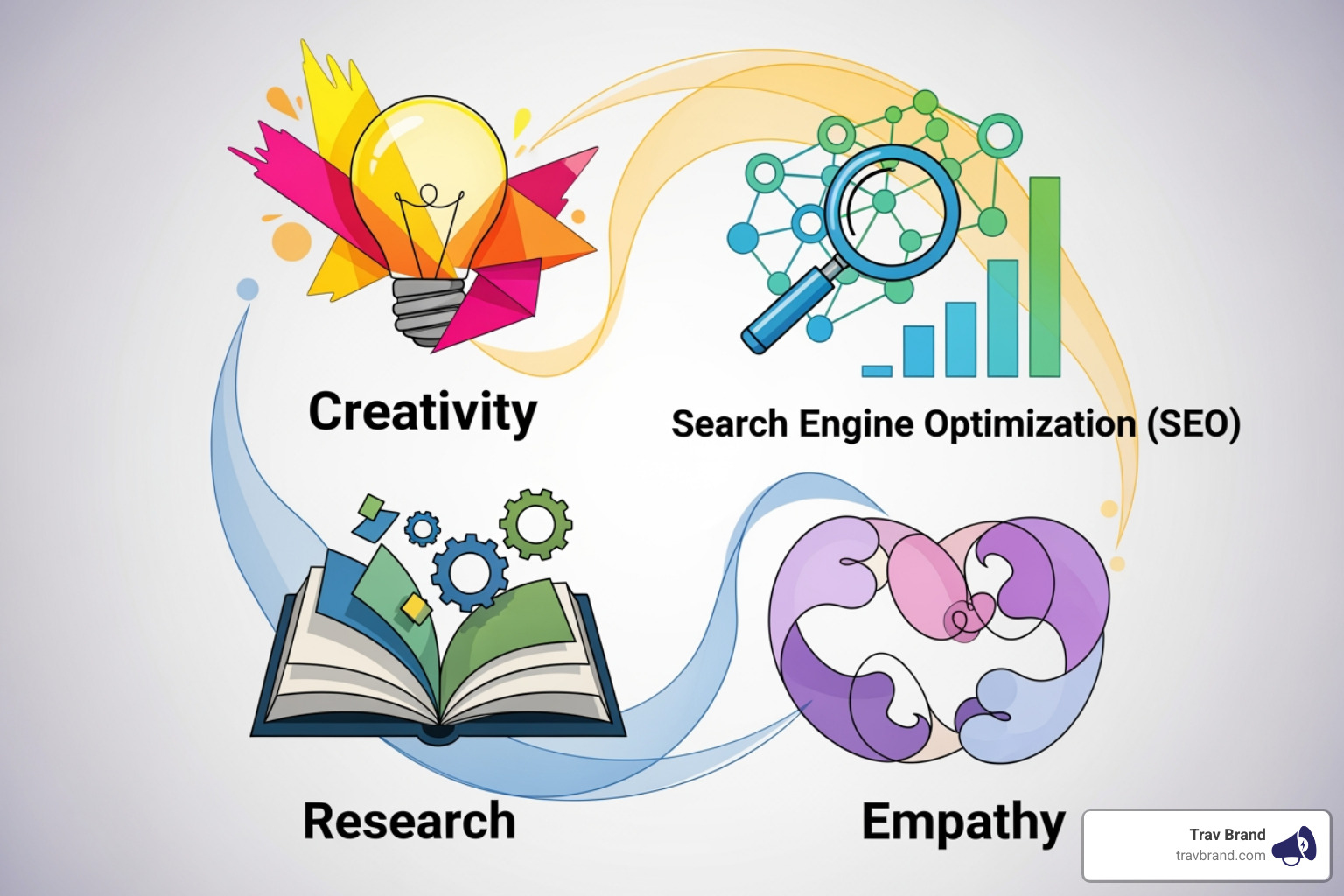
Becoming a successful marketing copy writer requires a diverse set of skills and a strategic approach, blending creativity with analytical rigor to deliver measurable results.
A strong writing foundation—clear, concise writing with impeccable grammar—is non-negotiable. As a Tidio survey found, over 50% of respondents feel grammar mistakes ruin a company’s professional image.
Beyond the basics, key skills include:
- Research Abilities: Deep-diving into market trends, customer pain points, and competitor strategies is paramount.
- Empathy: Grasping an audience’s motivations, fears, and aspirations is essential for developing data-driven big ideas.
- Creative Thinking: Creativity allows us to craft unique, memorable copy that cuts through the noise.
- SEO Principles: Understanding search engines and integrating keywords naturally is critical for online visibility.
- Adaptability: The ability to alter tone and voice based on the client, platform, and audience is invaluable.
- Analytical Reasoning: Copywriting is about solving marketing challenges and optimizing for performance using data.
Establishing a consistent brand voice is another cornerstone. Imagine your brand as a person: what’s their personality and vocabulary? This is your brand voice. We often develop brand voice guidelines that include the brand’s personality (sometimes expressed as archetypes), mission, and specific word choices. Consistency across all marketing materials builds recognition and trust.
Effective copywriting frameworks
While creativity is key, we rely on proven frameworks to structure persuasive messages. They provide a roadmap for guiding the reader from attention to action.
Here are some popular frameworks:
- AIDA (Attention, Interest, Desire, Action): This classic guides the reader through four stages: grab attention with a hook, build interest by highlighting a problem, create desire by showcasing benefits, and prompt action with a clear call to action.
- PAS (Problem, Agitate, Solve): This framework taps into pain points. Identify a problem, agitate that pain to make the reader feel its impact, and present your product as the solution.
- BAB (Before-After-Bridge): This framework paints a picture of change. Describe the reader’s current before state, envision a better after state, and show how your product is the bridge to get them there.
- Problem-Solution: This direct framework presents a problem and immediately offers a solution, effective for audiences seeking quick answers.
Persuasive writing techniques
Beyond frameworks, a marketing copy writer employs various techniques to make copy irresistible:
- Benefit-Driven Copy: Focus on what’s in it for the customer. Instead of “Our software has X feature,” we say “Save X hours a week with our software.”
- Social Proof: People trust others. Incorporating testimonials, reviews, and case studies builds credibility.
- Urgency & Scarcity: Phrases like “Limited time offer” or “Only X left” motivate immediate action by leveraging the fear of missing out (FOMO).
- Specificity: Use specific numbers and details to make claims believable. “Increase sales by 41.9%” is more compelling than “Increase sales.”
- Storytelling: Crafting relatable mini-stories that highlight challenges and showcase change makes copy memorable.
- Clarity and Conciseness: Every word counts. We strive for simple language, short sentences, and active voice.
- Emotional Appeal: As Harvard Business Review research suggests, emotions drive decisions. We tap into aspirations, fears, and joys to create a deeper connection.
- Clear Calls to Action (CTAs): Always tell the reader what to do next with a clear, action-oriented CTA like “Shop Now.”
- Address Objections: Proactively addressing potential customer hesitations builds trust and removes barriers to conversion.
Copywriting in Action: From Funnels to Platforms
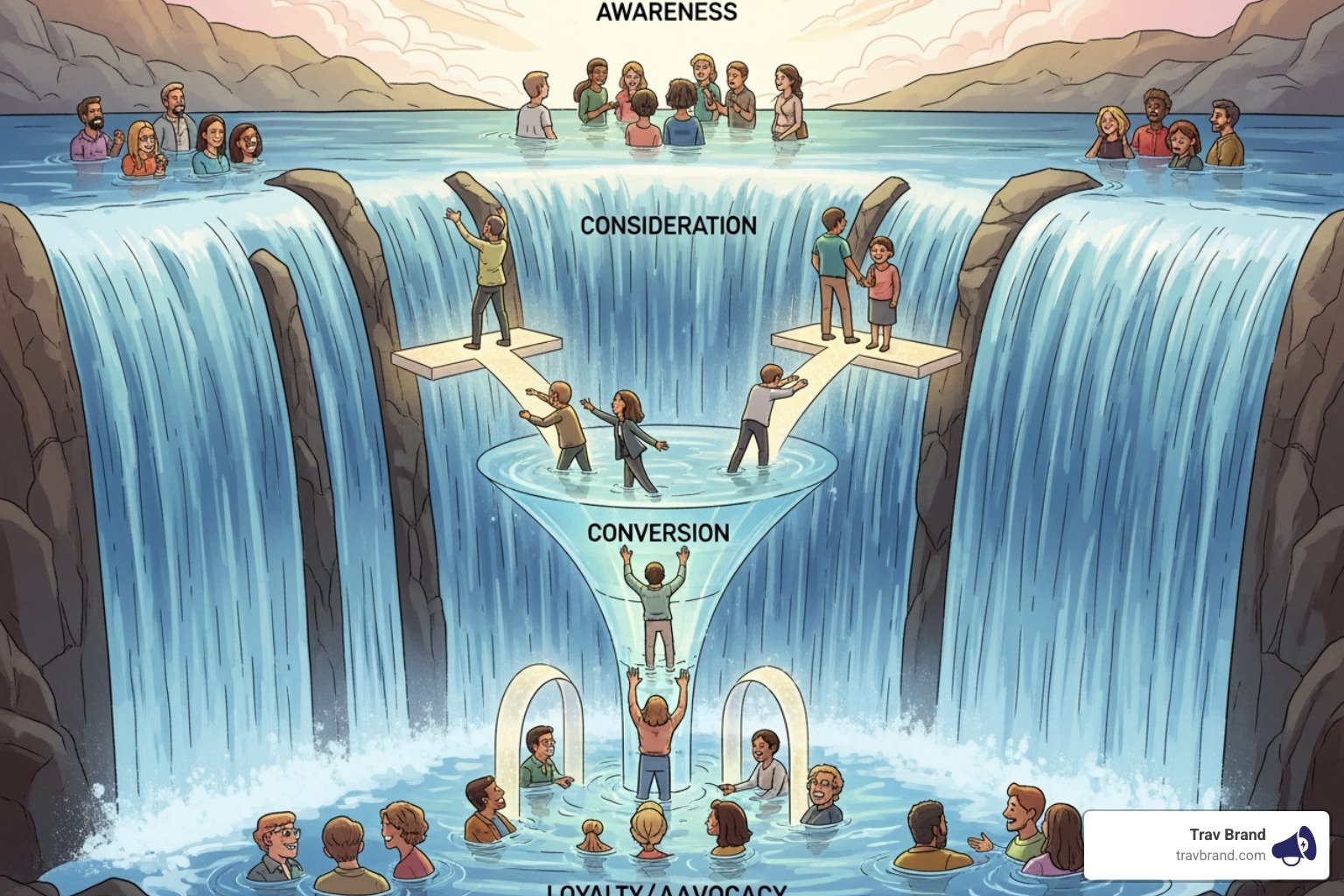
A marketing copy writer understands that copy must be custom to where a potential customer is in their journey. This is where the marketing funnel guides our approach.
The marketing funnel typically consists of several stages:
- Top-of-Funnel (ToFu): Awareness. Attract a broad audience and introduce the brand.
- Middle-of-Funnel (MoFu): Consideration. Individuals are researching solutions and comparing options.
- Bottom-of-Funnel (BoFu): Conversion. The final decision is made, and the customer takes action.
- Loyalty/Advocacy: Post-Purchase. The focus shifts to retaining customers and turning them into advocates.
Our work involves tailoring messages for each stage and adapting them for specific platforms, where character limits and user intent vary. We also pay close attention to mobile optimization, knowing that mobile devices make up over 64% of internet usage and users spend most of their time on the top half of the page on mobile.
How a marketing copywriter contributes to the marketing funnel
The marketing copy writer is integral to steering customers through the funnel:
- Awareness Stage (ToFu): Copy here grabs attention without being overly promotional, using engaging blog titles or social media captions to provide value.
- Consideration Stage (MoFu): Copy becomes more specific, highlighting unique value propositions and product benefits through detailed product pages or comparison guides.
- Conversion Stage (BoFu): This is the “hard sell.” Copy is direct and action-oriented, using urgency and social proof on sales pages and promotional emails.
- Loyalty Stage: Post-purchase copy focuses on building relationships through welcome emails, onboarding guides, and exclusive offers.
Writing for different marketing platforms
Each platform demands a unique approach:
- Landing Pages: Designed for a single purpose: conversion. Copy must be clear and benefit-driven with a strong headline and a prominent CTA.
- Social Media Copy: Needs to be concise, engaging, and conversational, respecting character limits on platforms like X (formerly Twitter).
- Email Subject Lines: Crucial for open rates. They must be short, clear, and intriguing. Personalization and urgency can boost performance.
- Ad Copy (Search & Social): Search ad copy must be incredibly concise and match user intent. Social ads need to stop the scroll with compelling hooks.
- SMS & Push Notifications: These are the most constrained formats, requiring an ultra-concise message and a direct call to action.
- Website Copy: This includes homepages and about pages. It needs to tell the brand’s story, establish authority, and guide visitors.
Launching Your Career as a Marketing Copy Writer
So, you’re intrigued by the idea of being a marketing copy writer? It’s a rewarding path that blends creativity with strategic thinking. But how do you get started, especially if you’re fresh out of the gate with no experience? The key is building a compelling portfolio and then actively seeking out opportunities.
A strong portfolio is your calling card. It demonstrates your ability to write persuasive copy for various formats and industries. Think of it as your proof of concept. But how do you build one if you haven’t had clients yet?
How to build a portfolio with no experience
Here’s how we advise aspiring marketing copy writers to build a portfolio from scratch:
- Choose a Niche: Specializing in a niche (e.g., SaaS, e-commerce) helps you focus your learning and makes you appear as an expert to potential clients.
- Rewrite Existing Ads/Pages: Find copy you think could be improved and rewrite it. This “spec work” demonstrates your analytical and creative skills.
- Create a Personal Brand Website: Your website is your own marketing platform. Write compelling copy for your “About Me” and “Services” pages to show you can practice what you preach.
- Offer to Write for Non-Profits (Pro Bono): Reach out to non-profits or small businesses and offer to write a few pieces for free in exchange for a testimonial and a portfolio piece.
- Guest Posts & Personal Projects: Write guest posts for relevant blogs or create your own hypothetical marketing campaigns for products you love to show what you can do.
- Case Studies: Turn your early work, even if pro bono, into a mini case study. Explain the objective, your approach, the copy you wrote, and any results.
The key is to proactively create samples that demonstrate your ability to write conversion-focused copy.
How to find your first clients
Once you have a portfolio, it’s time to find clients:
- Leverage Your Network: Let friends, family, and former colleagues know you’re offering copywriting services. Referrals are a powerful starting point.
- LinkedIn Power: Optimize your LinkedIn profile to highlight your skills. Connect with marketing managers and business owners, and share relevant insights to build your presence.
- Cold Pitching (Strategically): Identify businesses that could benefit from better copy. Craft a personalized email that highlights a specific area where you can add value.
- Inbound Marketing for Yourself: Create content (blog posts, social media updates) that showcases your expertise as a marketing copy writer to attract clients who are already looking for your services.
- Online Platforms: While direct strategies are often best, professional online platforms can also provide opportunities if you present yourself well.
Finding your first clients is often the hardest step, but persistence and a strong portfolio will pave the way to a thriving career.
The Future: AI, Career Paths, and Earning Potential
The landscape for marketing copy writers is evolving, with artificial intelligence (AI) emerging as a powerful force. This has raised questions about the future, but the outlook remains bright for those who adapt.
AI writing assistants can generate text quickly, helping with brainstorming and drafting. However, AI is a tool, not a replacement. The human touch—empathy, strategic thinking, and storytelling—remains irreplaceable. AI lacks the intuitive understanding of human psychology and brand voice needed for truly persuasive copy. The future involves a collaborative approach, where copywriters leverage AI for speed and then apply their unique human skills for refinement and emotional depth.
Will AI replace marketing copywriters?
The short answer is no. AI will not replace marketing copywriters, but it will change the role. We view AI as a powerful assistant that amplifies a copywriter’s capabilities.
Here’s why:
- Enhancing Efficiency: AI can handle repetitive tasks, freeing up copywriters to focus on high-level strategy and creativity.
- Idea Generation: AI can provide a burst of initial ideas or different angles for a campaign, overcoming writer’s block.
- The Need for Strategy: AI doesn’t understand overall marketing strategy, brand objectives, or audience nuances. These require human insight.
- The Human Touch: Persuasion is rooted in emotion. AI struggles with true empathy, humor, and the ability to inspire genuine feeling.
- Human Oversight: AI-generated content requires significant editing, fact-checking, and refinement to ensure it aligns with brand voice and accuracy.
The role will evolve. Those who integrate AI tools into their workflows will be the most successful, shifting focus from pure text generation to strategy and emotional storytelling.
Typical career paths and salaries
A career as a marketing copy writer offers diverse paths and significant earning potential.
- Entry-Level: Many start as Junior Copywriters in agencies or marketing departments, supporting senior team members.
- Mid-Level: With a few years of experience, copywriters take on more project leadership and may begin to specialize.
- Senior and Leadership: Experienced copywriters can become Senior Copywriters, Content Strategists, or Creative Directors, setting strategy and managing teams.
- Freelance: Many work independently, offering flexibility and high earning potential, especially with value-based pricing.
Regarding earning potential, there’s a wide spectrum. While salary tracking sites like Payscale.com show average salaries around $50,000 in Canada, skilled copywriters can earn significantly more. The U.S. Bureau of Labor Statistics reported a median salary of $62,170 for writers in 2018. Highly skilled copywriters who deliver tangible results can achieve six-figure incomes, especially when their fee is tied to the value they create.
Conclusion
The role of a marketing copy writer is more vital than ever. In a world of fleeting attention spans, the ability to craft clear, compelling, and conversion-focused messages is a superpower. We’ve explored how copywriters act as the voice of a brand, driving action across the marketing funnel by blending research, empathy, and strategic thinking.
For those considering this career, it’s a rewarding journey that demands continuous learning and a passion for understanding people. While AI tools are changing the landscape, they serve as collaborators, freeing up humans to focus on the strategic and emotional aspects of the craft. The future belongs to those who can master both the art of words and the science of data.
At Trav Brand, we understand the power of purpose-driven brands and the crucial role that exceptional copywriting plays in their success. We build and scale brands through comprehensive digital marketing, e-commerce, and content strategies focused on measurable results. If you’re passionate about the blend of creativity and strategy, a career as a marketing copy writer might be the perfect fit.
To learn more about how we harness the power of words to build and scale brands, explore our content marketing services.