
Digital Marketing Strategy 101
Why Your Business Needs a Digital Marketing Strategy
A digital marketing & strategy is a long-term plan using digital channels like websites, search engines, and social media to achieve business goals. A complete strategy includes:
- Goals: Clear targets aligned with business objectives (e.g., revenue, leads).
- Audience: A deep understanding of who you’re trying to reach.
- Budget: Resource allocation across the right channels.
- Metrics: KPIs to track performance and refine your approach.
- Channels: The platforms you’ll use (SEO, content, ads, email, social).
Why It Matters:
- 93% of global traffic flows through Google.
- Nearly half the world’s population uses Meta’s platforms.
- Many businesses struggle with low website traffic and waste budgets on disconnected tactics without a clear strategy.
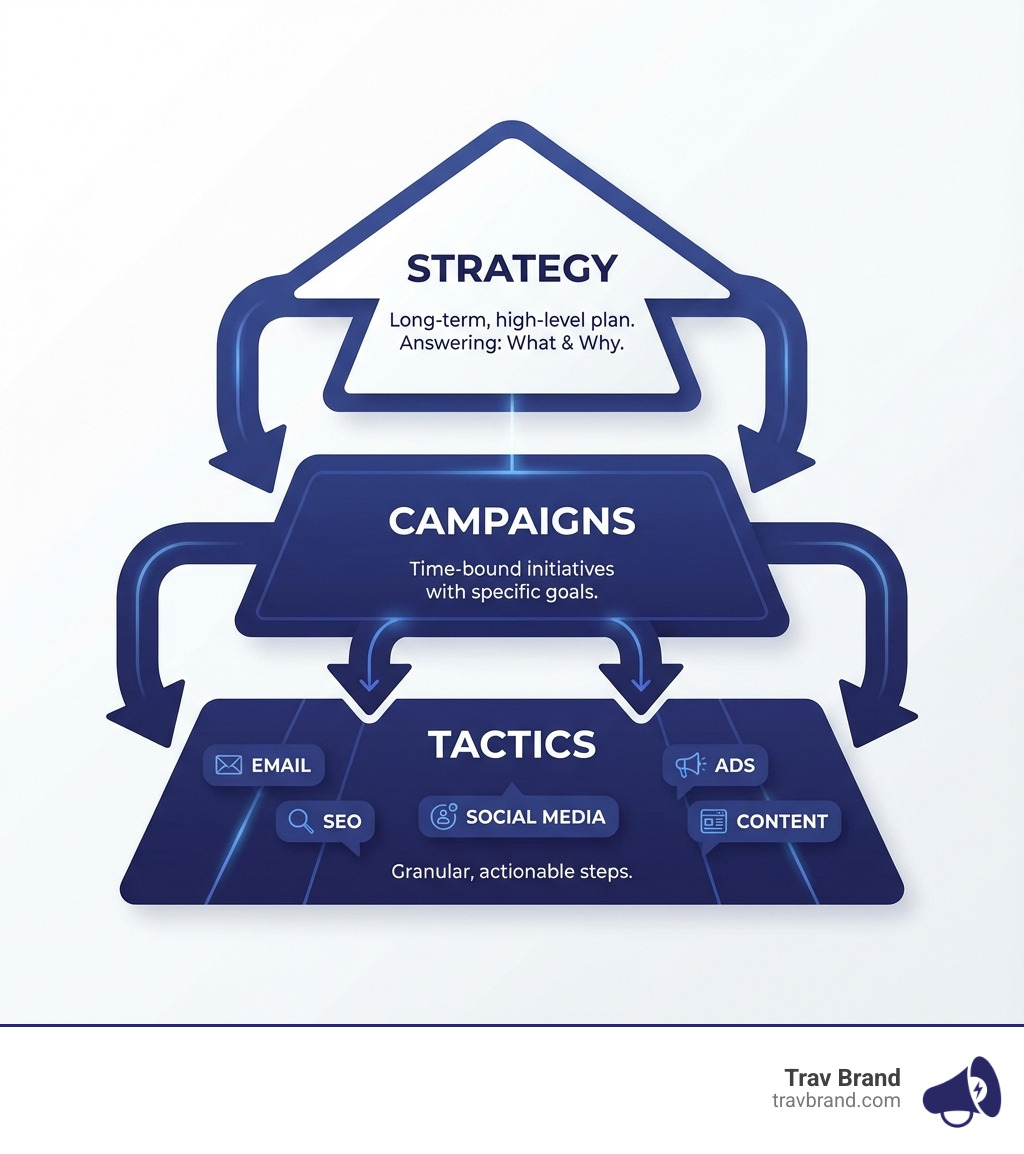
A strategy is the master plan defining what you’re trying to achieve and why. It’s different from campaigns (time-bound initiatives) and tactics (specific actions within campaigns).
Without a strategy, you’re hoping something works. With one, you build a system that turns strangers into loyal customers.
I’m Trav Lubinsky, and I’ve spent over a decade scaling companies through integrated digital marketing & strategy. My agency, Trav Brand, helps purpose-driven companies create marketing ecosystems that drive measurable growth.
The Core Components of a Winning Strategy
A winning digital marketing & strategy is the blueprint for your online success, guiding all your efforts toward your business goals. It’s built on four key components:
- SMART Goals: Goals must be Specific, Measurable, Achievable, Relevant, and Time-bound. For example, “increase online sales by 20% in the next six months.”
- Buyer Personas: We create detailed profiles of your ideal customers based on data to tailor messaging and choose the right channels.
- Budget: Resources are carefully allocated to high-impact channels to generate the best return on investment.
- KPIs (Key Performance Indicators): We track measurable values like conversion rates and customer acquisition cost to demonstrate effectiveness and refine our approach.
At Trav Brand, we integrate these components into a comprehensive framework, ensuring every part of your digital marketing & strategy is aligned for success. Learn more about Trav Brand’s strategic framework.
What is a Digital Marketing Strategy?
At its heart, a digital marketing & strategy is the high-level plan that aligns all your digital activities—from your website and social media to email and search—with your core business objectives. It ensures your efforts are cohesive and impactful, building brand value and driving tangible growth, a concept we explore in The Founders Blindspot: Why Brand Building is the Real Growth Lever.
The Customer Value Journey Explained
One of the most powerful frameworks we use is the Customer Value Journey (CVJ). It outlines the eight critical stages every prospect goes through to become a loyal customer and brand advocate. The job of marketing is to move people seamlessly through each phase:
- Awareness: A prospect finds your brand through a social media ad, a Google search, or an online video.
- Engagement: They interact with your content, such as a blog post, email newsletter, or social media community.
- Subscribe: They provide their contact information for a valuable offer, like a webinar, free sample, or software demo.
- Convert: The prospect makes an initial, small purchase, such as an introductory product or a discounted service.
- Excite: The new customer has a great first experience with their purchase, thanks to a quick start guide or helpful walkthrough.
- Ascend: The customer makes more frequent or higher-value purchases, like adding accessories or upgrading to a premium package.
- Advocate: A happy customer leaves a positive review or shares their experience when asked.
- Promote: The customer actively promotes your brand, perhaps through an affiliate link or by referring colleagues.
The biggest mistake marketers make is trying to move people from stranger to promoter in one step. Instead, we design specific campaigns for each stage transition to nurture relationships and maximize long-term value. You can dive deeper into this process with our Downloadable Value Journey Worksheet and learn how it integrates with Understanding E-commerce and Funnels.

How to Build Your Digital Marketing & Strategy From Scratch
Building a robust digital marketing & strategy from the ground up is about breaking it down into actionable steps, starting with a thorough understanding of where you stand and where you want to go.

Step 1: Analyze Your Position with SWOT and Market Analysis
Before plotting a course, we analyze your starting point with a SWOT Analysis, evaluating your internal Strengths and Weaknesses and external Opportunities and Threats. Alongside this, we conduct a thorough Market Analysis to understand industry trends and customer behavior. Using tools like Google Surveys, Facebook Audience Insights, and exploring online communities, we gather data to identify market gaps where your brand can stand out. We analyze how successful brands communicate, not to copy, but to inform our unique approach.
Step 2: Define Your Audience, Goals, and KPIs
Next, we define who you’re speaking to, what you want to achieve, and how you’ll measure it.
First, we create detailed buyer personas, data-driven representations of your ideal customers. Knowing their demographics, values, and pain points allows us to tailor messaging for maximum impact. Learn more with our insights on Brand Creation Strategy.
Then, we set SMART goals (Specific, Measurable, Achievable, Relevant, Time-bound) that align with your broader business objectives. An example is: “Increase email subscribers by 50% in the next six months to nurture leads for our new product line.”
Finally, we establish high-level KPIs like lead conversion rates and customer acquisition cost to measure progress and confirm the strategy is working.
Step 3: Balance Your Owned, Earned, and Paid Media
An effective digital marketing & strategy balances owned, earned, and paid media, each playing a distinct role.
| Media Type | Definition | Examples | Advantages | Disadvantages |
|---|---|---|---|---|
| Owned Media | Channels you control entirely. | Website, Blog, Email List, Social Media Profiles, Mobile Apps | Full control, cost-effective long-term, builds brand equity, direct customer relationships. | Requires effort to build audience, can be slow to scale, reliance on our own content. |
| Earned Media | Publicity gained through promotional efforts other than paid advertising. | PR mentions, Customer Reviews, Social Shares, Word-of-Mouth, Influencer Endorsements | High credibility, organic reach, cost-effective (once earned), builds trust. | Less control over messaging, hard to scale, requires excellent product/service. |
| Paid Media | Marketing efforts for which you pay. | Digital Ads (PPC, display, social), Sponsored Content, Influencer Marketing, Traditional Ads | Immediate reach, highly targeted, scalable, precise control over messaging. | Can be expensive, lower trust than earned, ad fatigue, declining ROI over time. |
Owned media (your website, blog) is your digital foundation. Earned media (reviews, social shares) provides credibility and trust. Paid media (digital ads) accelerates reach and targets specific audiences. The key is an integrated approach: use paid media to amplify your owned content, which in turn generates valuable earned media.
Key Levers: Choosing Your Digital Marketing Channels
Once our strategic foundation is in place, we choose the specific “levers” or channels to execute our digital marketing & strategy. These are the platforms we use to reach our audience and drive action.
Our primary levers often include:
- Inbound Marketing: Creating valuable experiences custom to your audience.
- SEO (Search Engine Optimization): Ensuring your content is findable in search results.
- Digital Advertising: Using paid promotions to reach specific audiences quickly.
- Social Media Marketing: Building communities and driving brand awareness.
- Email Marketing: Nurturing leads through direct communication.
- Video Marketing: Engaging audiences with dynamic content.
Content Marketing & SEO
Content marketing is the art of creating and distributing valuable content (blog posts, videos, guides) to attract and engage your audience, a core part of any digital marketing & strategy. Explore our Strategic Marketing Content and Content Marketing Services.
SEO ensures that when customers search for solutions you provide, they find you. It includes:
- On-page SEO: Optimizing content and elements on your website.
- Technical SEO: Improving backend elements like site speed and mobile-friendliness.
- Link building: Acquiring backlinks from reputable sites to build authority.
For a deeper dive, check out Trav Brand’s Guide to SEO.
Digital Advertising & Social Media
Digital Ad Campaigns (PPC, social media ads) allow for precise, rapid audience targeting, ideal for driving immediate results. We focus on maximizing your Return on Ad Spend (ROAS), as detailed in Maximizing Your Return On Ad Spend (ROAS): The Content Marketing Advantage.
Social Media Promotion is about building a community. With billions of users on platforms like Facebook and Instagram, social media is a powerful tool for brand awareness, customer interaction, and driving traffic to your owned channels.
Email Marketing & Automation
Email marketing remains a top channel for forging personalized connections and driving conversions. It’s vital for SMBs and ranked as a top-three most effective channel by most marketers.
We use email for lead nurturing, personalization, and audience segmentation. Marketing automation workflows improve this by sending timely, automated messages (e.g., welcome series, abandoned cart reminders), scaling your efforts while maintaining a personal touch. For more insights into crafting compelling email campaigns, explore Trav Brand’s Email Marketing Insights.
Measuring Success and Staying Ahead of the Curve
A brilliant digital marketing & strategy is only as good as its results. We believe in continuous improvement by tracking performance, adapting to trends, and future-proofing our strategy, as we explore in How Brands Are Leveraging AI to Scale Smarter.
Key Metrics for Measuring Your Digital Marketing & Strategy
We prioritize metrics that directly impact business goals, not just vanity metrics like likes or page views. Key metrics include:
- Customer Acquisition Cost (CAC): The cost to acquire a new customer, measuring marketing efficiency. Learn more about CAC here.
- Lifetime Value (LTV): The total revenue expected from a customer, indicating loyalty and long-term profitability. Understanding LTV is crucial.
- Return on Ad Spend (ROAS): Revenue generated per dollar of ad spend. We balance this with LTV and CAC for a holistic view of profitability, as discussed in Maximizing Your Return On Ad Spend (ROAS): The Content Marketing Advantage.
- Conversion Rate: The percentage of visitors who complete a desired action (e.g., a purchase). Learn more in our Conversion Increase Complete Guide.
Focusing on these metrics ensures your digital marketing & strategy is truly profitable.
Essential Tools for Your Digital Marketing & Strategy
To execute and measure our strategy, we use a suite of essential tools:
- Analytics Platforms (e.g., Google Analytics): To track website traffic, user behavior, and conversions.
- SEO Tools: For keyword research, site audits, and rank tracking.
- CRM Systems: To manage customer interactions and sales leads.
- Email Marketing Platforms: For creating, sending, and automating email campaigns.
- Social Media Management Tools: To schedule posts, monitor engagement, and analyze performance.
Modern Tactics: AI, Voice, and Video
The digital world evolves, and so should your digital marketing & strategy. We keep clients ahead by exploring modern tactics:
- AI-powered personalization: Delivering unique user experiences based on behavior.
- Voice search optimization: Targeting conversational queries for smart speakers.
- Short-form video: Using platforms like TikTok and Reels for engaging, bite-sized content.
- Privacy-first marketing: Building trust through transparent and ethical data practices.
- Social commerce: Integrating shopping directly into social media for a seamless experience.
For those curious about the cutting edge, check out Embracing the Power of AI Avatars: Revolutionize Your Digital Presence.
Frequently Asked Questions about Digital Marketing Strategy
We often encounter common questions from businesses looking to refine their digital marketing & strategy. Here are some of the most frequent ones:
What are common mistakes to avoid when creating a digital marketing strategy?
Common pitfalls we help clients avoid include:
- Ignoring audience research: Without deep buyer personas, your messaging will miss the mark.
- Setting vague goals: You can’t measure success without SMART goals.
- Not tracking metrics: Failing to track KPIs means you’re just guessing about what works.
- Focusing on tactics over strategy: A tactic like “using TikTok” is useless without a strategic why.
- Inconsistent brand messaging: A fragmented message across channels confuses your audience. A Brand Guide is crucial for consistency.
How can small businesses effectively compete with larger brands using a well-defined digital marketing strategy?
Small businesses can leverage a smart digital marketing & strategy to compete with larger brands by:
- Niche targeting: Dominating a specific market segment with custom messaging.
- Hyper-local focus: Using local SEO to capture nearby customers. 80% of customers rely on the web for searching local businesses.
- Agility: Adapting to market changes much faster than large corporations.
- Superior customer service: Creating loyalty through personalized attention.
- Building community: Fostering authentic relationships on social media to turn customers into advocates.
For more strategies on standing out, see Innovative Brand Building Strategies to Stand Out in a Competitive Market.
How often should I update my digital marketing strategy?
Your digital marketing & strategy is a living document that needs regular updates.
- Review quarterly: To assess performance and make tactical adjustments.
- Major review annually: To re-evaluate long-term goals, personas, and the competitive landscape.
- Adapt continuously: A flexible strategy is key to keeping up with new platforms, algorithm changes, and shifting consumer behavior.
Conclusion: Build a Strategy That Drives Real Growth
A well-defined digital marketing & strategy is the blueprint for sustainable growth. It provides the “what” and “why” behind every marketing action, ensuring all efforts are aligned.
A successful strategy is built on analysis, clear goals, defined audiences, and a balanced media mix. By optimizing channels like content, SEO, social media, and email, you create a cohesive ecosystem that turns prospects into passionate promoters, guided by frameworks like the Customer Value Journey.
The digital landscape demands continuous measurement and adaptation to modern tactics like AI, voice search, and short-form video. By avoiding common mistakes, you can compete effectively and achieve remarkable results.
At Trav Brand, we build and execute comprehensive strategies that create cohesive marketing ecosystems for purpose-driven companies, ensuring every effort drives measurable growth. Ready to build a strategy that delivers? Explore our strategic services.