From Browsers to Buyers: 13 Proven Ways to Increase Your Conversion Rate Today
Introduction: What is a Conversion Rate and Why Does It Matter?
Ways to increase conversion are essential for any business looking to turn more website visitors into paying customers. Here are the 13 most impactful strategies:
- Craft a compelling value proposition that speaks directly to customer needs
- Optimize page speed and mobile experience (17% boost per second faster)
- Simplify navigation to help visitors find what they need
- Build trust with social proof like reviews and testimonials
- Create authentic urgency with limited-time offers and low-stock alerts
- Streamline checkout with guest options and multiple payment methods
- Personalize the customer journey based on behavior and preferences
- Use high-quality visuals including videos and 360-degree product views
- A/B test your CTAs to find what resonates with your audience
- Offer incentives like free shipping and money-back guarantees
- Implement loyalty programs to encourage repeat purchases
- Recapture lost sales with abandoned cart emails and SMS
- Leverage data and analytics to identify and fix conversion bottlenecks
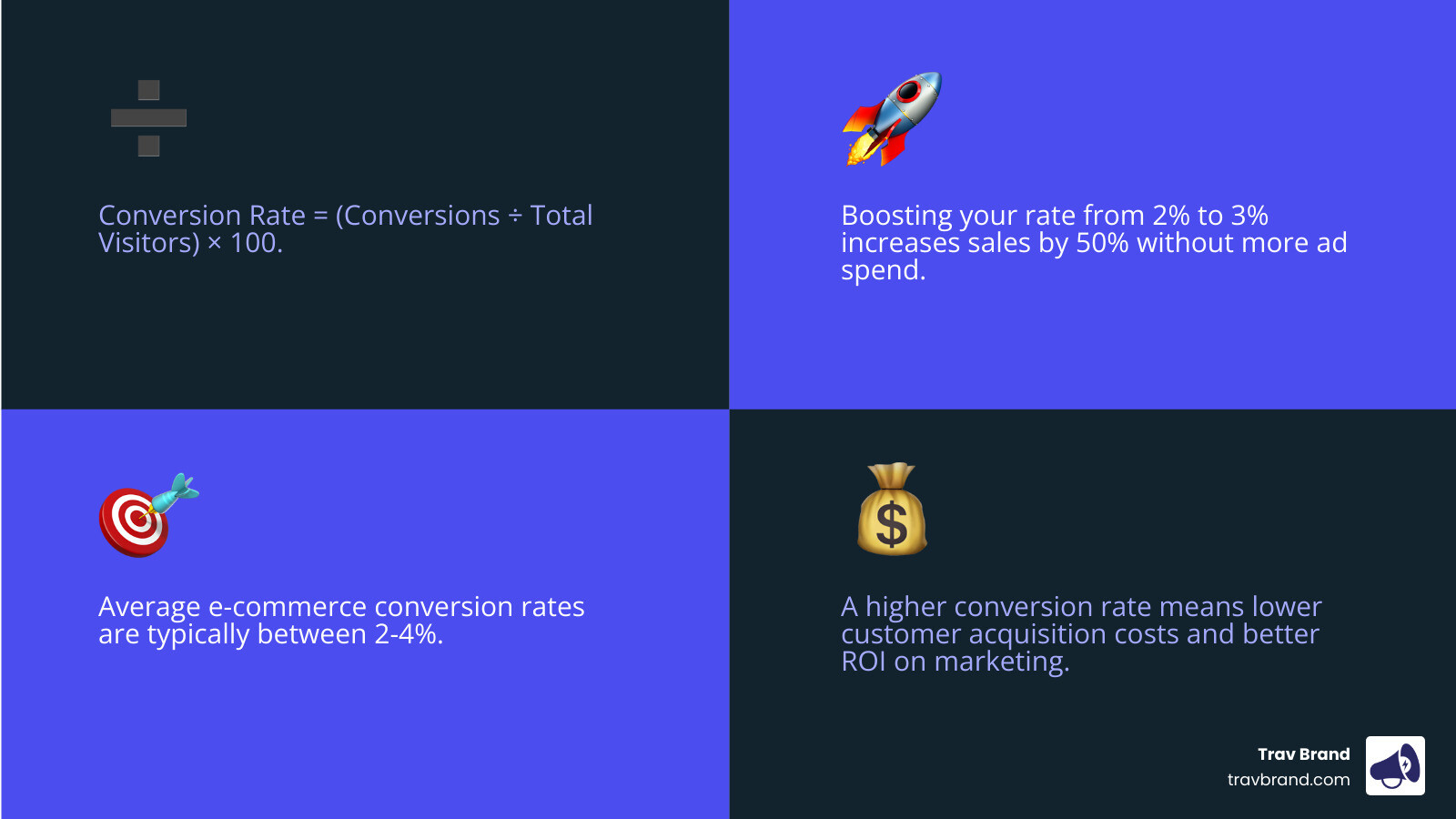
Your conversion rate is the percentage of website visitors who complete a desired action—usually making a purchase. The formula is simple: divide conversions by total visitors, then multiply by 100.
This metric directly impacts your bottom line and return on investment (ROI). When you increase your conversion rate, you generate more revenue from the same amount of traffic, which means lower customer acquisition costs and better ROI on your marketing spend.
Most e-commerce sites see conversion rates between 2-4%. That means for every 100 visitors, only 2-4 actually buy. But even small improvements compound quickly. Boost your rate from 2% to 3%, and you’ve increased sales by 50%—without spending a dollar more on ads.
The challenge? Most founders and business owners lack a clear strategy to systematically improve conversions. They’re stuck guessing what works instead of building a proven, repeatable system.
I’m Trav Lubinsky, and I’ve spent over a decade helping brands like HexClad, Poppi, and FightCamp implement ways to increase conversion that drive measurable growth through integrated branding, e-commerce optimization, and performance marketing. At Trav Brand, we’ve built a proven framework that turns browsers into buyers by combining strategic positioning with data-driven tactics.
Foundational Strategies: Building a High-Converting Website
This section covers the essential elements every website needs to turn visitors into customers, focusing on clarity, trust, and user experience.
1. Craft a Compelling and Clear Value Proposition
Imagine a visitor lands on your site. What’s the very first thing they should understand? Your value proposition! This isn’t just marketing jargon; it’s the concise explanation of why a user should choose your products or services over a competitor’s. It’s your Unique Selling Point (USP) distilled into its purest form.
We’ve seen countless websites with headlines that sound impressive but say absolutely nothing. Think “Revenue-focused marketing automation & sales effectiveness solutions release collaboration throughout the revenue cycle.” What does that even mean to a potential customer? As Paul Graham said, clarity is key. We believe clarity always trumps persuasion. Your value proposition should be so clear that it can be summarized in 10 words or less, and it should immediately address a core customer need.
Your headline is paramount here. Statistics show that on average, five times as many people read the headline as read the body copy. If your headline doesn’t sell your product or concept, you’ve essentially wasted 80% of your effort. It needs to be punchy, instantly credible, and featured prominently “above the fold” – the part of your webpage visible without scrolling. At Trav Brand, we help businesses define and communicate their core message effectively through our Brand Creation Strategy workshops, ensuring your unique value shines through.
2. Optimize for Speed and Mobile Experience
In today’s digital world, patience is a virtue few online shoppers possess. We’re talking about microseconds here! Slow loading times are conversion killers. Research indicates that you should aim for page load times of no longer than four seconds. Even within that range, the shorter the time, the better for your conversions. Why? Because users are 32% more likely to bounce if your site takes three seconds to load. Double that to six seconds, and the probability of them leaving surges to 106%. We’ve seen that conversion rates can improve by an astonishing 17% for every second a website loads faster.

And let’s not forget the dominance of mobile. In January 2024, mobile devices accounted for almost 60% of web page views worldwide. This isn’t just a trend; it’s the new normal. If your site isn’t optimized for mobile, you’re essentially turning away more than half your potential customers. Google reports that 53% of mobile visits abandon pages that take over 3 seconds to load. This means a seamless mobile experience isn’t optional; it’s critical.
To boost your site speed and mobile experience, consider implementing strategies like lazy loading for images and videos, reducing image file sizes, enabling caching, and minimizing redirects. These technical optimizations are fundamental ways to increase conversion and ensure a smooth, frustration-free journey for every visitor. For more insights into common pitfalls and fixes, check out our guide on Why Most Shopify Stores Underperform (and How to Fix Them).
3. Simplify Navigation and Site Layout
Have you ever landed on a website and felt immediately lost, overwhelmed by too many options or a cluttered design? We certainly have! The “Paradox of Choice” teaches us that too many options can paralyze users, making them choose nothing at all. Our goal is to make it incredibly easy for visitors to find exactly what they’re looking for, reducing friction at every turn.
Intuitive navigation is key. This means clear, logical menus with simple labels and a hierarchical structure. Integrating breadcrumbs helps users understand their location within your site’s structure, preventing that “lost in space” feeling. A robust on-site search functionality is also non-negotiable; 69% of shoppers go straight to the search bar when they know what they want, and 80% will leave a site if they have a bad search experience. Enhancing your search with rich features like image-based results or recommendations can make a huge difference.
Finally, declutter your pages. Every element on your page should serve a purpose, guiding the user towards the desired action. Remove unnecessary distractions, sidebars, or competing calls-to-action that pull focus. Employ visual hierarchy to subtly direct the visitor’s eyes to the most important information. We often encourage our clients to Go Ahead, Be Your Own Online Customer – steer your own site as if you’re a first-time visitor. This simple exercise can reveal glaring usability issues that are silently sabotaging your conversion rates.
Psychological Triggers: Influencing Purchase Decisions
Leverage proven psychological principles to build confidence and encourage visitors to take action.
4. Build Unshakeable Trust with Social Proof
We all seek reassurance, especially when making a purchase. That’s where social proof comes in – it’s the positive influence created when people use and approve of your products or services. It’s one of the most powerful ways to increase conversion because it taps into our innate tendency to follow the crowd.
The numbers don’t lie: nearly 90% of consumers trust word-of-mouth recommendations, and almost half trust online customer reviews as much as a personal recommendation from a friend. Before committing to a purchase, 80% of consumers will typically read five or more reviews. Testimonials alone can increase conversion rates by 34% when used properly, and research from Northwestern University suggests that highlighting customer reviews and quotes can boost conversion rates by as much as 270%! Beyond reviews, consider showcasing user-generated content (UGC), displaying trust badges (especially security-focused ones, which make sites appear twice as trustworthy), and even featuring logos of reputable brands you’ve worked with. This collective validation builds immense credibility and persuades on-the-fence shoppers. Building a strong foundation of trust is crucial, much like building your own Building a Strong Personal Brand: The Key to Long-Term Success.
5. Create Urgency and Scarcity (Authentically)
Humans are wired to react to urgency and scarcity. The fear of missing out (FOMO) is a powerful motivator. When something is perceived as limited, its value increases in our minds. This psychological tactic is a highly effective way to encourage immediate action and is one of the oldest ways to increase conversion.
There are two main types of scarcity: quantity-related (e.g., “Only 3 left in stock!”) and time-related (e.g., “Offer ends in 24 hours!”). We’ve all seen brands like Starbucks leverage this masterfully with their specific holiday drink offers, creating a buzz and prompting customers not to miss out. Implementing countdown timers, flash sales, or limited-time promotions can create that sense of urgency.
However, a crucial caveat: this must be authentic. If your scarcity tactics are fake, customers will see right through them, and your trustworthiness will plummet. It’s not worth jeopardizing your brand’s reputation for a quick, dishonest win. The goal is to highlight genuine opportunities for customers to benefit from a limited offering, not to trick them. Just as in The Secret of Licensing, authenticity is key to long-term success.
6. Reduce Friction with a Seamless Checkout
You’ve done all the hard work: attracted a visitor, shown them your value, and built their trust. Now they’re ready to buy! Don’t let a clunky checkout process undo all that effort. More than two-thirds of shoppers abandon their carts before completing a purchase. This is a massive opportunity to recover lost sales.
The number one rule of checkout optimization is: make it easy. First, always offer a guest checkout option. Forcing users to create an account before buying is a significant barrier; we’ve seen how a company like Expedia increased profits by $12 million simply by removing a single, non-essential field from their checkout form. Second, simplify your forms. Every extra form field can result in a 5-10% drop in conversion rates, and 27% of users will bail if a form is too long. Collect only the absolutely essential information.
Finally, offer flexible payment options. This includes major credit cards, popular digital wallets like PayPal and Apple Pay, and increasingly, Buy Now, Pay Later (BNPL) services like Klarna or Afterpay. Providing these choices accommodates customer preferences and removes payment-related friction. A clear progress indicator during checkout can also reassure customers by showing them exactly where they are in the process. We’ve compiled our insights on common checkout pitfalls in Trav Shares His Top 10 Reasons Why People Check Out of Checkout – it’s a must-read!
Advanced Ways to Increase Conversion and Drive Sales
Go beyond the basics with these high-impact tactics designed to significantly boost your sales and grow your business.
7. Personalize the Customer Journey: A Key Way to Increase Conversion
Imagine walking into your favorite store, and the assistant immediately knows your size, your past purchases, and your preferred style, offering custom recommendations. That’s the online equivalent of personalization, and it’s a powerful tool among ways to increase conversion. Eighty-one percent of customers prefer companies that offer a personalized experience, and personalized calls to action are an astounding 202% more likely to convert!
Personalization isn’t just about addressing someone by their first name. It’s about tailoring the entire site experience based on their browsing history, past purchases, geographic location, and even how they arrived at your site. This could mean dynamic content that changes based on their interests, location-specific offers, or product recommendations that genuinely resonate. When visitors feel understood and catered to, their engagement skyrockets, and they’re much more likely to convert. Leveraging AI and data to understand and predict customer preferences is now a cornerstone of effective personalization, as we discuss in How Brands Are Leveraging AI to Scale Smarter.
8. Use High-Quality Visuals and Product Demos
In the online world, customers can’t touch, feel, or try on your products. So, your visuals need to do all the heavy lifting. High-quality imagery and compelling product demonstrations are among the most impactful ways to increase conversion.
This means professional, high-resolution product photography from multiple angles, close-ups of important details, and in-context shots that show the product being used by real people. If you’re selling basketball shoes like Nike, don’t just show a static image – show them in action on the court! For more complex products, consider 360-degree views or short video clips. Data shows that incorporating video into product description pages can improve conversion by up to 85% and even reduce return rates by as much as 25%. Visuals tell a story, evoke emotion, and build confidence in the product. They are fundamental to The Power of Branding: How to Create a Memorable E-commerce Brand.
9. A/B Test Your Calls-to-Action (CTAs)
Your Call-to-Action (CTA) is the moment of truth – it’s where you ask the visitor to take the plunge. But what makes a CTA truly effective? It’s not always obvious, which is why A/B testing is your best friend here. A/B testing involves creating two versions of a page element (like a CTA button) and showing each version to different segments of your audience to see which performs better.
Small changes can lead to massive results. For example, the travel company Going famously cut one word and added two new ones to their CTA, resulting in a 104% month-over-month increase in their homepage conversion rate. When designing your CTAs, experiment with placement (above the fold, sticky buttons), button color (use contrasting colors that pop!), shape (fun fact: rounded CTA buttons receive anywhere from 17 to 55% more clicks than sharp-angled ones!), and especially the copy. Use action-oriented language that clearly states the benefit the user will receive. Personalized calls to action are 202% more likely to convert, so tailor your message to the user’s intent. This iterative process of testing and refining is a core part of creating effective Strategic Marketing Content.
10. Offer Incentives and Reduce Risk
Online shopping still carries a degree of perceived risk. Customers worry about whether the product will meet expectations, fit correctly, or if they’ll be stuck with it if it doesn’t. Offering incentives and clearly reducing this risk are powerful ways to increase conversion.
Free shipping is a massive motivator: more than 60% of shoppers won’t even consider buying from a retailer that doesn’t offer it. In fact, free shipping was the most popular motivation for 82% of UK and 80% of US consumers in one study. While you might not be able to offer it on every single order, consider free shipping thresholds or promotions.
Bundled deals are another fantastic incentive, encouraging customers to purchase more by offering complementary products at a slightly reduced price compared to buying them individually. Think of it as a convenient upgrade that adds value.
To reduce risk, offer a robust money-back guarantee (a 30-day guarantee is often considered the industry standard, but we encourage you to do better!) and a clear, reassuring returns policy. Display these prominently, especially on product pages and during checkout. These reassurances can be the final nudge a hesitant customer needs to complete their purchase and are vital when bringing Products Into Retail.
Post-Click and Retention Strategies
Converting a customer is just the beginning. Use these strategies to encourage repeat business and maximize customer lifetime value.
11. Implement Loyalty Programs and Customer Rewards
Securing a new customer is great, but nurturing that relationship into repeat business is where true long-term value lies. Loyalty programs and customer rewards are fantastic ways to increase conversion over time by fostering deeper relationships with your audience. The longer and deeper your relationship with a prospect, the more likely they are to buy from you repeatedly.
These programs can take many forms: points systems where customers earn rewards for every purchase, tiered programs that open up exclusive benefits as spending increases, or special access to new products, sales, or members-only content. Not only do they incentivize repeat purchases, but they also make customers feel valued and appreciated. This sense of belonging and reward strengthens their connection to your brand, ultimately increasing their customer lifetime value (CLV) and turning them into brand advocates. This strategy aligns perfectly with the collaborative growth mindset we champion at Unlocking Growth: The Power of Collaboration in Brand Building.
12. Recapture Lost Sales with Email and SMS Automation
The bad news: more than two-thirds of shoppers abandon their carts before checkout. The good news: this doesn’t mean those sales are lost forever! These shoppers have shown clear intent, making them prime candidates for recapture through automated email and SMS campaigns.
Abandoned cart emails are remarkably effective. We recommend sending a series of emails that gently remind the customer of their abandoned items, perhaps highlighting benefits, social proof, or even offering a small incentive (like free shipping) to encourage them to complete the purchase. Similarly, win-back campaigns can target customers who haven’t purchased in a while, rekindling their interest with personalized offers. Post-purchase follow-ups are also crucial for building loyalty, gathering feedback, and encouraging repeat business. These automated sequences are powerful ways to increase conversion and maximize customer lifetime value by staying top-of-mind and addressing potential hesitations. Learn more about effective automated strategies in Maximizing Growth: The Power of Email and SMS Automation.
13. Leverage Data and Analytics: Data-Driven Ways to Increase Conversion
At Trav Brand, we believe that data is not just numbers; it’s the voice of your customer. Leveraging analytics is arguably the most crucial of all ways to increase conversion. Without understanding what is happening on your site and why, you’re simply guessing.
Start by tracking key metrics using tools like Google Analytics. Dive deeper with behavioral analytics tools like heatmaps and scroll maps, which visually show you where users click, where they linger, and where they drop off on a page. Funnel analysis allows you to map the customer journey and identify specific drop-off points – perhaps a particular product page, the “add to cart” step, or the payment information page.
Once you identify these friction points, you can form hypotheses and conduct A/B tests to implement solutions. Customer feedback surveys (on-site or post-purchase) provide invaluable qualitative data, telling you the “why” behind user behavior. This continuous cycle of data collection, analysis, hypothesis formation, testing, and implementation is the engine of conversion rate optimization. It ensures you’re always making informed decisions that drive real results and maximize your Maximizing Your Return on Ad Spend (R.O.A.S.): The Content Marketing Advantage.
Frequently Asked Questions about Ways to Increase Conversion
What is a good conversion rate for e-commerce?
This is a question we hear all the time! The truth is, there’s no single “magic” number, as a good conversion rate can vary significantly. Most e-commerce sites typically see conversion rates between 2-4%. However, top performers in certain niches can reach 5-8% or even higher. Factors like your industry, product price point, traffic source, and even device (mobile typically converts at about half the rate of desktop) all play a role. The best approach is to first benchmark against your own historical data and then compare against industry averages. The goal isn’t just to hit an average, but to continuously improve your own performance.
How do I get started with conversion rate optimization (CRO)?
Getting started with CRO doesn’t have to be overwhelming. We recommend a structured, data-driven approach. First, define clear, measurable goals for your website (e.g., “increase purchases by 15%”). Second, dive into your analytics (Google Analytics, heatmaps, etc.) to collect visitor data. Identify your high-traffic, low-conversion pages – these are your biggest opportunities. Third, form a hypothesis about why a particular page isn’t converting well (e.g., “the CTA isn’t clear enough”). Fourth, design an A/B test to test that hypothesis, making only one change at a time. Finally, measure the results, learn from them, and repeat the process. CRO is an ongoing journey of continuous improvement.
What are some common CRO mistakes to avoid?
While the pursuit of higher conversion rates is noble, there are common pitfalls we see businesses fall into. One of the biggest mistakes is making changes without data – relying on gut feelings instead of evidence. Another is testing too many things at once, which makes it impossible to know which change caused the impact. Ignoring qualitative feedback, like customer reviews or surveys, means you’re missing crucial “why” insights. Not running tests long enough to achieve statistical significance is also a common error. Lastly, focusing solely on your homepage and neglecting optimization for product pages, cart pages, or the checkout process is a missed opportunity, as these are often where the most significant drop-offs occur.
Conclusion: Turn Your Insights into Action
Increasing your conversion rate isn’t a one-time fix; it’s a continuous journey of understanding your customers, optimizing their experience, and refining your offers. By implementing these 13 proven ways to increase conversion, you can transform passive browsers into enthusiastic buyers, driving significant growth for your business. From crafting compelling value propositions and streamlining your site’s technical performance to leveraging powerful psychological triggers and data-driven insights, each strategy plays a vital role in building a high-converting digital storefront.
At Trav Brand, we specialize in helping businesses like yours steer this complex landscape. We don’t just offer advice; we partner with you to implement comprehensive digital marketing, e-commerce, and content strategies that drive measurable results. By integrating these ways to increase conversion into a holistic brand strategy, we help you build purpose-driven brands that thrive. Ready to stop guessing and start growing? Explore our e-commerce strategies to start growing your brand today and let’s turn your insights into action.