


What is Conversion Optimization SEO? Your Blueprint for Digital Success
Why Conversion Optimization SEO is Your Secret Weapon for Digital Growth
Conversion optimization SEO is the strategic integration of Search Engine Optimization (SEO) and Conversion Rate Optimization (CRO) to both attract qualified traffic and convert visitors into customers. Here’s what you need to know:
Key Components:
- SEO drives qualified organic traffic to your website by improving search engine rankings
- CRO maximizes the percentage of visitors who take desired actions (purchases, sign-ups, leads)
- Integration creates a feedback loop where better user experience improves both conversions and search rankings
- Result is 30-50% higher conversion rates from organic traffic compared to siloed approaches
Most businesses treat SEO and CRO as separate strategies. SEO teams chase traffic. CRO teams chase conversions. The result? High traffic with poor lead quality, or perfectly optimized pages that nobody finds.
Here’s the reality: Your SEO is working if traffic is up 40% year over year, but if pipeline isn’t growing proportionally, you’re leaving money on the table. This disconnect shows up when SEO drives traffic to pages with no conversion optimization, or when CRO perfects pages that rank on page seven of Google.
The solution isn’t choosing between visibility and conversion. It’s building a unified strategy where both disciplines amplify each other. When aligned properly, SEO and CRO create a compounding growth engine that increases revenue without increasing ad spend.
Companies that integrate conversion optimization SEO see measurable results: traffic from AI-powered search is already 4.4 times more valuable in terms of conversions than regular organic traffic. Even a small jump from 2% to 3% conversion rate represents a 50% increase in conversions—achieved without needing more traffic.
I’m Trav Lubinsky, and I’ve spent over a decade helping brands like HexClad, FightCamp, and Poppi scale through integrated marketing strategies that connect conversion optimization SEO with measurable business outcomes. At Trav Brand, we’ve seen how aligning these disciplines transforms digital performance from a cost center into a revenue driver.
Why SEO and CRO Are a Power Couple for Business Growth
Imagine trying to build a thriving garden. SEO is like planting the seeds in fertile ground (getting found in search engines) and ensuring they get sunlight and water (attracting traffic). CRO, on the other hand, is nurturing those plants so they bear fruit (converting visitors into customers). You wouldn’t just plant seeds and walk away, would you? We certainly wouldn’t!

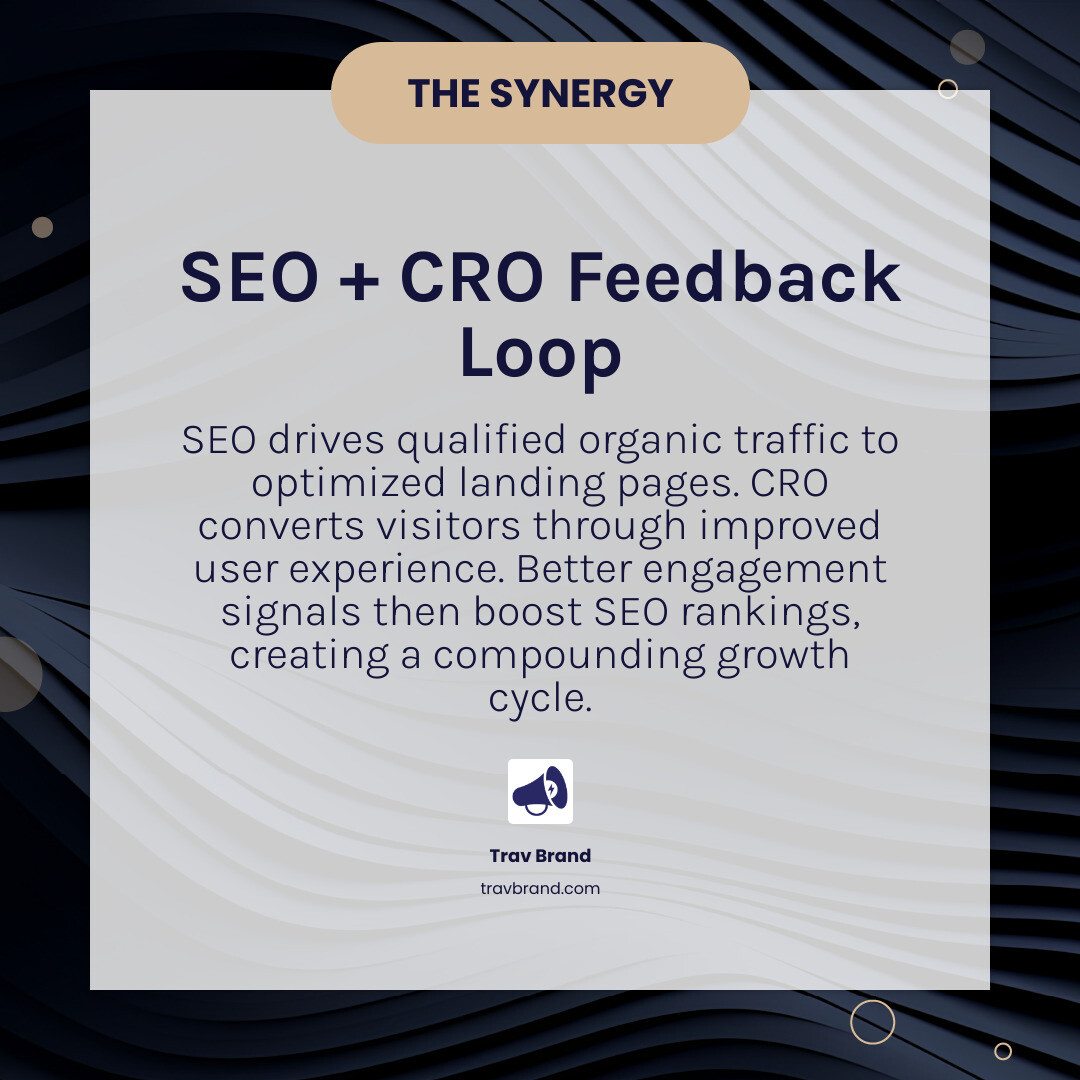
The synergy between SEO and CRO is not just beneficial; it’s crucial for sustainable business growth. It creates a powerful feedback loop: SEO brings in qualified visitors, CRO optimizes their experience to encourage desired actions, and the positive user signals generated by a great experience (like lower bounce rates and longer time on site) tell search engines that your site is valuable, which, in turn, boosts your SEO rankings. This virtuous cycle leads to more qualified traffic, lower Customer Acquisition Cost (CAC), and higher ROI. In fact, companies that align these disciplines see 30-50% higher conversion rates from organic traffic.
SEO Gets You Found, CRO Gets You Customers
At its core, SEO’s purpose is to increase your visibility in search engine results, attracting visitors who are actively searching for what you offer. It’s about getting found. CRO’s purpose is to maximize the percentage of those visitors who take a desired action once they land on your site – whether that’s making a purchase, signing up for a newsletter, or requesting a demo. It’s about getting customers.
While their primary functions differ, their shared goal is ultimately user satisfaction and, by extension, business growth. If your content isn’t relevant to what a user searched for, or if your page is frustrating to steer, neither SEO nor CRO will succeed.
Here’s how we compare traditional SEO metrics with an integrated conversion optimization SEO approach:
| Traditional SEO Metrics | Integrated SEO+CRO Metrics |
|---|---|
| Keyword Rankings | Conversion Rate from Organic Traffic |
| Organic Traffic Volume | Leads/Revenue from Organic Search |
| Impressions | Qualified Leads from Organic |
| Click-Through Rate (CTR) | Customer Lifetime Value (CLV) of Organic Customers |
| Backlinks | Return on Ad Spend (ROAS) for Organic Acquisition |
How Good CRO Positively Impacts Your SEO
It might seem counterintuitive, but optimizing for conversions can significantly boost your SEO. When we improve the user experience (UX) through CRO, we’re making the site more engaging and easier to use. This leads to:
- Increased Dwell Time: Visitors spend more time on your pages because they’re finding what they need and enjoying the experience.
- Reduced Pogo-sticking: Users are less likely to click back to the search results page to find a better answer.
- Positive Ranking Signals: Search engines interpret these behaviors as indicators of high-quality, relevant content, which translates to better rankings.
- Content Relevance: CRO encourages us to ensure our content truly matches user intent, making it more valuable to visitors and, by extension, to search engines.
- E-E-A-T (Experience, Expertise, Authoritativeness, Trustworthiness): A site that provides an excellent user experience, clearly answers questions, and builds trust naturally demonstrates E-E-A-T, a critical factor for Google’s evaluation of content quality.
Essentially, by making your website a joy to use, we’re not just delighting customers; we’re also making Google happy.
A Strategic Framework for Integrated Conversion Optimization SEO
To truly harness the power of conversion optimization SEO, we need a structured approach. We can’t just throw things at the wall and see what sticks. Our framework involves a systematic, data-driven methodology that ensures every effort contributes to both visibility and conversions.

Step 1: Audit Your Current Performance to Find Gaps
Before we can optimize, we need to know where we stand. This step is about identifying the pages that are underperforming and pinpointing the reasons why. We look for two main scenarios:
- High-traffic, low-conversion pages: These pages attract a lot of organic visitors but fail to convert them. This signals a CRO opportunity – perhaps the messaging is off, the call-to-action is unclear, or the user experience is frustrating.
- Low-traffic, high-conversion pages: These pages convert well when people find them, but they aren’t ranking high enough to get significant traffic. This points to an SEO opportunity – we need to boost their visibility.
To effectively audit our current SEO and CRO performance, we dive deep into analytics. Tools like Google Analytics 4 and Google Search Console are indispensable. We analyze organic traffic by landing page, conversion rates segmented by page and keyword cluster, bounce rates correlated with specific search queries, and assisted conversions.
Beyond quantitative data, we use user behavior analysis tools like heatmaps and session recordings (e.g., Microsoft Clarity) to visually understand how users interact with our pages. Where do they click? How far do they scroll? Where do they get stuck? These insights help us identify friction points and hypothesize solutions.
Step 2: Map Keywords to the Buyer’s Journey and Intent
Understanding user intent is paramount for improving both SEO rankings and conversion rates. We can’t optimize effectively if we don’t know what our audience is truly looking for. Keywords aren’t just search terms; they’re expressions of a user’s needs and stage in their purchase journey.
We categorize keywords based on their intent:
- Informational Keywords (Top-of-Funnel – TOFU): Users are researching a problem or topic. Examples: “why is our website bounce rate so high” or “what is CRO.” Our goal here isn’t a direct sale, but to provide valuable information. Conversions might be newsletter sign-ups or guide downloads.
- Navigational/Investigational Keywords (Middle-of-Funnel – MOFU): Users are looking for solutions and comparing options. Examples: “best CRM software” or “HubSpot vs. Salesforce.” Our content should offer comparisons, case studies, or detailed product information.
- Transactional Keywords (Bottom-of-Funnel – BOFU): Users are ready to buy or commit. Examples: “buy CRM software” or “CRM software demo.” These pages need clear calls to action for purchases, sign-ups, or demos.
We map our content strategy to these stages, ensuring that for every keyword cluster, we have relevant content and appropriate Call-to-Action (CTA) alignment. For instance, a blog post targeting a TOFU keyword would lead to a newsletter signup, while a product page targeting a BOFU keyword would feature a “Request a Demo” button. B2B SaaS visitor-to-lead conversion rates average around 1.9%, but this varies significantly by funnel stage, so we set realistic benchmarks for each.
Step 3: Optimize Landing Pages for Search Engines and Users
This is where the rubber meets the road for conversion optimization SEO: designing landing pages that serve both search engines and human visitors. We call this dual-intent optimization.
For search engines, we ensure a solid technical SEO foundation:
- On-page SEO elements: Optimized title tags, meta descriptions, and H1s that incorporate target keywords and compel clicks.
- Content structure: Clear, logical content that satisfies search intent first, then expands with depth. 43% of people skim blog posts, so scannable formatting is critical.
- Technical elements: Clean HTML, descriptive alt text for images, and effective internal linking. We also use schema markup for rich results, helping search engines understand our content better.
For conversions, we focus on user experience and persuasion:
- Clear Value Proposition: What problem does our product or service solve? Why should the user choose us? This must be immediately clear.
- Compelling CTAs: Strong, action-oriented calls to action that stand out visually and are strategically placed.
- Social Proof: Testimonials, reviews, case studies, and client logos build trust.
- Form Optimization: Streamlined forms that ask only for essential information. Reducing form fields can lead to significant conversion increases.
Every element on the page, from the headline to the form fields, is crafted to guide the user towards the desired conversion while simultaneously signaling relevance and quality to search engines.
Key Pillars of a Unified SEO and CRO Strategy
Beyond optimizing individual pages, a successful conversion optimization SEO strategy relies on foundational elements that impact both user experience and search engine performance. These are the non-negotiables.
The Need for Speed: How Page Load Time Affects Everything
In our digital world, patience is a virtue few online users possess. Page load speed isn’t just a technical detail; it’s a critical factor for both SEO and CRO. Google openly states that website speed is one of the key factors impacting website ranking.
A slow-loading page frustrates users, leading to higher bounce rates and reduced engagement. We know that a one-second delay in page load time can reduce conversions by 7%. This isn’t just about losing a potential customer; it’s also about sending negative signals to search engines. Core Web Vitals, a set of metrics measuring real-world user experience for loading performance, interactivity, and visual stability, directly impact SEO rankings. Our conversion optimization SEO strategy must ensure that changes to the website have minimal impact on loading speed.
Mobile-First is a Mandate, Not a Suggestion
Mobile optimization isn’t an afterthought; it’s the starting point. Google uses mobile-first indexing, meaning your mobile site is your actual site in Google’s eyes. This is especially critical for B2B, where 80% of B2B buyers use mobile devices during working hours for research and buying.
A poor mobile user experience creates a double penalty: it hurts your SEO rankings and significantly reduces conversion rates. Our approach ensures:
- Responsive Design: Your site adapts seamlessly to any screen size.
- Thumb-Friendly Navigation: Buttons and links are large enough to be easily tapped.
- Simplified Forms: Minimal fields and easy-to-use input methods.
- Scannable Content: Short paragraphs, bullet points, and clear headings.
We focus on creating an experience that is not just functional but delightful on mobile devices, knowing that mobile visits have been outpacing desktop traffic since 2017.
Building Credibility with Trust Signals and Social Proof
Trust is the foundation of conversions. Users won’t convert if they don’t trust your brand. This is where trust signals and social proof become invaluable for both SEO and CRO.
- Testimonials and Reviews: Authentic feedback from customers directly addresses potential user objections and builds confidence. We encourage and display reviews prominently. Third-party platforms like G2 and Capterra add significant credibility for B2B SaaS companies.
- Case Studies: Detailed accounts of how your product or service solved a customer’s problem provide concrete evidence of value.
- Security Badges: SSL certificates and payment gateway logos reassure users, especially during checkout.
- Client Logos: Displaying recognizable brands you’ve worked with instantly boosts credibility.
By strategically placing these trust indicators throughout your site, we build user confidence, reduce perceived risk, and foster an environment where conversions are more likely to happen. This also helps with E-E-A-T, as showcasing positive experiences and expert endorsements signals authority to search engines.
Measuring Success and Avoiding Common Pitfalls
The beauty of conversion optimization SEO lies in its data-driven nature. We don’t guess; we measure, analyze, and iterate. This requires a shift from vanity metrics to those that directly impact your bottom line.
How to Measure Your Integrated Strategy’s Success
Measuring success goes beyond just traffic numbers or keyword rankings. We focus on integrated KPIs that reflect true business impact:
- Conversion Rate by Channel: We segment conversion rates by organic search to understand the effectiveness of our SEO efforts. The average website conversion rate across industries is 2.35%, but this varies widely. For example, white papers have an average SEO conversion rate of 4.6% compared to 2.0% for blog posts.
- Lead Quality (MQLs to SQLs): For B2B, we track how many Marketing Qualified Leads (MQLs) from organic search become Sales Qualified Leads (SQLs) and eventually closed-won deals.
- Customer Lifetime Value (CLV): We analyze the long-term value of customers acquired through organic channels.
- Assisted Conversions: Using tools like Google Analytics 4, we understand how organic search contributes to conversions, even if it wasn’t the last touchpoint.
- ROI from Organic Search: We connect our efforts to revenue, ensuring a clear Return on Investment.
Common Mistakes in Conversion Optimization SEO
Even with the best intentions, it’s easy to stumble. Our experience has shown us several common pitfalls to avoid when aligning SEO and CRO:
- Optimizing for Vanity Keywords: Chasing high-volume keywords that bring unqualified traffic. This might boost rankings, but if users aren’t ready to convert, it’s wasted effort. We qualify keywords based on historical SQL and customer data, prioritizing commercial intent.
- Ignoring Mobile Experience: As we’ve discussed, a poor mobile UX penalizes both SEO and conversions. Neglecting this is a critical error.
- Sacrificing UX for SEO: Keyword stuffing, hidden text, or overly complex internal linking might seem like SEO tactics, but they harm user experience and ultimately lead to penalties. Google rewards user-friendly pages.
- A/B Testing Without Statistical Significance: Making decisions based on insufficient data can lead to implementing changes that don’t actually improve performance. We ensure tests run long enough to gather reliable data.
- Failing to Connect Metrics to Revenue: If you can’t link your SEO and CRO efforts to actual sales and pipeline, you can’t prove their value. We use CRM integration and attribution platforms to track true ROAS.
Frequently Asked Questions about Conversion Optimization and SEO
We often encounter similar questions from businesses starting on their conversion optimization SEO journey. Here are some of the most common, along with our insights:
What are the key differences between A/B testing for CRO and SEO testing?
While both involve testing variations, the core difference lies in the audience and the goal:
- CRO A/B Testing: Primarily user-based. We test different versions of a page or element (e.g., CTA button color, headline) to see which performs better for human visitors, leading to higher conversion rates.
- SEO Testing: Often bot-based. We test changes that might impact how search engine crawlers (like evergreen Googlebot) perceive and rank our pages. This could involve title tags, meta descriptions, or content structure.
Key considerations for SEO testing:
- Cloaking Risks: Never show different content to humans and bots. This is considered deceptive and can lead to penalties.
- Temporary Redirects: For temporary URL changes during a test, always use a 302 redirect, not a 301.
- Canonical Tags: When running A/B tests with multiple URLs, it’s crucial to use the rel=”canonical” tag to tell Google which version is the preferred one, preventing duplicate content issues.
How does content strategy fit into conversion optimization SEO?
Content is the bridge between SEO visibility and CRO conversions. Our content strategy is designed to:
- Satisfy Search Intent First: Every piece of content, whether a blog post or a product page, must first answer the user’s query.
- Content for Every Funnel Stage: We create content custom for Top-of-Funnel (TOFU) awareness, Middle-of-Funnel (MOFU) consideration, and Bottom-of-Funnel (BOFU) decision-making.
- Guide Users Toward Conversion: Once search intent is satisfied, we subtly guide users towards the next logical step in their journey with relevant CTAs. For example, a thought leadership article might convert at 2.0% on average, but a white paper can convert at 4.6%.
- Scannable Formats and Natural Keywords: We structure content for readability, using headings, subheadings, and bullet points, and integrate natural keywords without stuffing. As we noted earlier, 43% of people skim blog posts, so readable structure is critical.
- Optimizing Blog Posts for Lead Capture: Blog posts aren’t just for traffic; they can be optimized with inline CTAs, content upgrades (e.g., downloadable guides), and lead forms to capture interested readers.
How do user behavior analytics and feedback contribute to optimizing SEO and CRO?
User behavior analytics and feedback are the eyes and ears of our conversion optimization SEO efforts. They help us understand the “why” behind the “what” that quantitative data reveals:
- Understanding the ‘Why’: While Google Analytics tells us what users do (e.g., bounce rate on a page), tools like Microsoft Clarity provide heatmaps and user recordings to show us how they interact and why they might be leaving.
- Identifying Friction Points: Heatmaps can reveal areas where users get stuck, don’t click on expected elements, or simply ignore critical content. Session recordings allow us to literally watch user journeys, spotting usability issues we might have missed.
- Uncovering User Objections: Feedback tools (like exit-intent surveys from Qualaroo) can directly ask users why they’re leaving or what they couldn’t find, surfacing objections or missing information.
- Informing Test Hypotheses: These qualitative insights are invaluable for developing hypotheses for A/B tests. Instead of guessing, we’re testing solutions to actual user problems.
By combining the “what” from analytics with the “why” from user behavior tools and feedback, we gain a comprehensive understanding that fuels continuous optimization, benefiting both SEO (through improved engagement) and CRO (through increased conversions).
Conclusion: Stop Choosing Between Traffic and Conversions
In the dynamic world of digital marketing, the days of treating SEO and CRO as separate entities are long gone. At Trav Brand, we believe that true digital success comes from a seamless integration of these two powerful disciplines. This conversion optimization SEO approach isn’t just about getting more traffic or higher conversion rates in isolation; it’s about creating a compounding growth engine that drives qualified leads, increases revenue, and builds a loyal customer base.
By adopting a holistic, user-centric approach, we ensure that every visitor who lands on your site has the best possible experience, leading to higher engagement, better conversions, and stronger signals to search engines. This continuous cycle of optimization is what truly scales brands.
To scale your brand with a comprehensive digital strategy that connects visibility with measurable results, explore our e-commerce solutions. We’re here to help you stop choosing between traffic and conversions, and start achieving both.


