Your Ultimate Guide to E-commerce Marketing Strategies
The E-commerce Boom and Your Blueprint for Success
Online store marketing strategy is a comprehensive plan that combines foundational elements (target audience definition, unique value proposition, goals), key digital channels (SEO, social media, email, paid ads), amplification tactics (influencer partnerships, brand collaborations), and optimization methods (personalization, loyalty programs, analytics) to attract visitors, convert them into customers, and retain them for long-term growth.
Core Components of a Winning Strategy:
- Foundation – Define your target audience, set SMART goals, and establish your unique value proposition
- Digital Channels – Leverage SEO, content marketing, social media, email, and paid advertising
- Amplification – Partner with influencers and complementary brands to expand reach
- Optimization – Use personalization, loyalty programs, and data analytics to improve performance
- Measurement – Track key metrics like conversion rate, customer lifetime value, and ROI
By 2026, approximately a quarter of all purchases will take place online. The e-commerce market continues to see massive growth, with global sales projected to reach trillions of dollars. This expansion is largely driven by mobile commerce, which is expected to account for the majority of online sales growth, and social commerce, which is also seeing explosive growth.
The challenge? Standing out in this crowded digital marketplace requires more than just having great products. You need a cohesive marketing strategy that connects every touchpoint in your customer’s journey.
Most online store owners struggle because they approach marketing as a collection of disconnected tactics rather than an integrated system. They run some Facebook ads here, post on Instagram there, maybe send a few emails, but nothing works together. The result is wasted budget, inconsistent messaging, and frustrated customers who bounce before buying.
The solution is treating your online store marketing strategy as an ecosystem where each component supports and amplifies the others. Your SEO efforts feed your email list. Your social media builds trust that your paid ads convert. Your loyalty program turns one-time buyers into brand advocates who do your marketing for you.
This guide breaks down exactly how to build that ecosystem, from laying a solid foundation to scaling through partnerships to optimizing for long-term growth. You’ll learn which channels to prioritize, how to measure what matters, and how to adapt as the market evolves.
I’m Trav Lubinsky, and I’ve spent over a decade building, scaling, and exiting e-commerce brands while working with companies like HexClad, FightCamp, and Poppi to develop winning online store marketing strategies. At Trav Brand, I help founders transform disconnected marketing efforts into cohesive systems that drive measurable growth.
Building Your Foundational Online Store Marketing Strategy
The first step in crafting a successful online store marketing strategy is laying a solid foundation. This involves understanding the core components that will guide all your efforts: clear marketing objectives, a strong unique value proposition, and realistic budgeting and timelines. Without these, your marketing efforts will be like shooting arrows in the dark – expensive and ineffective.
A well-defined marketing plan outlines how and when we use different tactics to attract and keep customers. It helps us make informed decisions about who we’re trying to reach, what we want to say, and how to get the word out. This strategic approach ensures long-term company health and stability, provides a foundation for scalability and growth, helps us edge out the competition, and drives operational and cost efficiency. Building a powerful brand identity is also crucial here, as it differentiates you in the marketplace and resonates with your target audience. Learn more about The Power of Branding to understand how to build a memorable e-commerce brand.

Effectively Identifying and Understanding Your Target Audience
How can businesses effectively identify and understand their target audience for online marketing? This is arguably the most critical question. We can’t market effectively if we don’t know who we’re talking to. Our goal is to create detailed buyer personas that reflect our ideal customer’s demographics (age, gender, location, economic status), psychographics (interests, values, lifestyle), pain points, and triggering events that lead them to seek a solution like ours.
To understand our customers deeply, we need to go beyond surface-level data. We imagine our ideal customer and consider their challenges and personality traits. What problems are they trying to solve? What motivates their purchasing decisions? What makes them tick? We can use powerful analytics tools to glean insights into their purchase behavior and interactions. Platforms like Facebook Audience Insights and TikTok Audience Insights can provide valuable data on demographics and interests, helping us tailor our messaging.
For example, the underwear brand Pepper found success by deeply understanding the specific pain point of small-chested women – finding flattering and comfortable bras. By focusing on this niche and offering a custom solution, they resonated strongly with their target audience, regardless of age or other interests. This deep understanding allows us to craft messages and products that truly connect.
Setting SMART Goals for Your E-commerce Business
Once we know our audience, we need to define what success looks like. Setting clear, measurable, actionable, relevant, and time-bound (SMART) goals is essential for any online store marketing strategy. These goals help us know if our marketing tactics are successful and allow us to adjust them as needed. It’s easier to analyze the impact of marketing on small, short-term goals, which can then build towards larger objectives.
Key Performance Indicators (KPIs) are our compass. These might include:
- Sales targets: e.g., $5,000 in product sales during a promotion.
- Customer acquisition cost (CAC): How much it costs to acquire a new customer.
- Conversion rate: The percentage of website visitors who make a purchase. For a deeper dive into optimizing this, check out our Conversion Rate Optimization Ultimate Guide.
- Email subscriptions: e.g., 75 new email sign-ups per month.
- Average Order Value (AOV): The average amount spent per transaction.
By setting specific, quantifiable goals, we can track our progress, identify what’s working, and make data-driven decisions to optimize our efforts.
The Engine: Key Digital Marketing Channels for E-commerce
With a solid foundation in place, it’s time to fire up the engine of your online store marketing strategy: digital marketing channels. The digital landscape offers a plethora of options, and understanding which ones to prioritize is crucial. We must recognize that “online” isn’t a single channel but a collection of touchpoints, requiring a cross-channel or omnichannel approach to create a seamless customer experience.

The most impactful digital marketing channels for online stores often include Search Engine Optimization (SEO), content marketing, social media marketing, email marketing, and paid advertising. Prioritization depends heavily on our target audience, budget, and specific SMART goals. For instance, if our goal is immediate sales, paid ads might be prioritized. If it’s long-term brand building and organic traffic, SEO and content marketing take precedence. A well-rounded Digital Marketing Strategy Guide can help steer this complex terrain.
Driving Organic Growth with SEO and Content Marketing
How can Search Engine Optimization (SEO) be implemented to improve an online store’s visibility and attract organic traffic? And what types of content are most effective for promoting an online store, and where should they be distributed?
SEO is a long-term investment that focuses on improving your store’s visibility in search engine results. It’s vital because 41% of global consumers start their shopping journey through search engines. Our SEO efforts should include:
- Keyword Research: Identifying the terms our target audience uses to find products like ours. We need to understand how customers talk about products to use the most relevant keywords. Tools like Google Keyword Planner can help.
- On-Page SEO: Optimizing product titles, descriptions, images, and other content on our pages with relevant keywords. This includes crafting unique title tags and meta descriptions for every page. For example, skincare brand Biossance knows the power of a search-optimized product page, often ranking organically for terms like “vitamin c rose oil.”
- Technical SEO: Ensuring our site is fast, mobile-friendly, and easy for search engines to crawl.
Content marketing complements SEO beautifully. Effective content educates, entertains, and solves problems for our audience, positioning our brand as an authority. Types of content that work well include:
- Blog Posts: Educational articles, buying guides, how-to’s, and trend reports.
- Videos: Product demonstrations, unboxings, lifestyle content, and tutorials.
- Infographics: Visually appealing summaries of complex information.
- Customer Stories/Case Studies: Showcasing how our products have helped others.
This content can be distributed on our blog, YouTube channel, social media, and through email newsletters. For a comprehensive look, explore our Web Content Marketing Services Complete Guide.
Engaging Customers with Social Media and Email
What role does social media play in an online store’s marketing strategy, and which platforms are most effective? And how can email marketing be leveraged to drive traffic and sales for an online store?
Social media is no longer just for sharing cat videos; it’s a powerful sales channel. Social shopping is particularly popular among younger customers, with recent surveys finding that a majority of Gen Z consumers have purchased through a social media platform. Globally, social commerce sales are on a rapid rise and are expected to more than double by 2028, becoming a multi-billion dollar market.
The most effective platforms depend on our target audience and products:
- Instagram: Excellent for visually appealing products. Brands like Dippin’ Dots use their Instagram channel to showcase beautiful product photos.
- TikTok: Ideal for reaching younger demographics with short, engaging, and often viral video content. Take it from Pashion Footwear, a brand that sells convertible heels. Its TikTok has more than 200,000 followers, and its videos reach 20,000 to two million people by focusing on the problem these shoes solve and using trending audios and video concepts.
- Pinterest: Great for lifestyle products, DIY, and inspiration. Its pins have a longer shelf-life than posts on other platforms.
Email marketing remains a powerhouse, with revenue projected to pass 9.5 billion dollars in 2024. It’s a direct line to our customers and can be leveraged to drive traffic and sales through:
- List Building: Encouraging sign-ups via pop-ups, checkout options, and exclusive discounts.
- Segmentation: Sending targeted emails based on customer behavior (e.g., past purchases, browsing history).
- Automation: Setting up automated sequences for welcome series, abandoned cart reminders (69% of all online shopping carts are abandoned), post-purchase follow-ups, and replenishment reminders. For example, Braxley Bands uses bold, personal abandoned cart reminders. Curlsmith makes it easy for customers to reorder their favorite products with personalized emails.
- Promotions: Announcing sales, new products, and exclusive offers.
For a deeper dive into optimizing your email campaigns, check out Maximizing Growth: The Power of Email and SMS Automation.
Accelerating Sales with Paid Advertising
How can paid advertising, such as Google Ads and social media ads, be used to drive traffic and conversions for an online store? Paid advertising offers a powerful way to get our products in front of highly targeted audiences quickly.
- Search Engine Marketing (SEM) with Google Ads: We can bid on keywords to appear at the top of search results. This is highly effective because we’re reaching users actively searching for what we sell. Google estimates a 2:1 return on investment when using Google Ads, meaning we can expect two dollars back for every dollar spent.
- Social Media Ads: Platforms like Facebook Ads, Instagram Ads, and Pinterest Promoted Pins allow for incredibly precise targeting based on demographics, interests, and behaviors. We can create compelling visual and video ads to capture attention within users’ feeds.
- Retargeting/Remarketing: This is a crucial strategy where we show ads to people who have previously interacted with our store (e.g., visited a product page but didn’t buy, added to cart but abandoned). Dynamic retargeting can tailor ads based on the specific products a user was interested in, significantly increasing conversion rates.
Paid advertising requires careful budgeting and continuous optimization. We start with a manageable daily budget and adjust our approach based on results. Understanding conversion value is key to making the most of our ad spend; explore The Conversion Value Playbook for smart bidding strategies.
The Amplifier: Scaling Through Partnerships and Community
Beyond our direct marketing channels, we can significantly amplify our reach and credibility through strategic partnerships and by nurturing our existing customer base. This approach leverages trust and community to scale our brand.
How can existing offline or online customer bases be leveraged to promote a new online store? And what are the benefits of partnering with complementary brands or participating in online events for an online store’s marketing?
Our existing customers are our best advocates. We can encourage word-of-mouth marketing by providing exceptional service and products, making them feel heard, and empowering them to share their experiences. User-generated content (UGC), such as customer reviews, photos, and videos featuring our products, is incredibly powerful because consumer faith often leans towards peer opinions over traditional advertising. We can incentivize customers to share their experiences or even feature their content on our own channels. If we have a physical presence, we can leverage our offline store(s) by asking customers to sign up for our email list at checkout or using QR codes to link to online promotions.
Participating in online events and discussions, such as webinars, virtual conferences, or active engagement in relevant online communities (like Reddit or Quora), allows us to establish thought leadership and connect directly with potential customers in a non-salesy way.
Integrating Influencer Marketing into Your Strategy
How can influencer marketing be integrated into an online store’s strategy to reach new customers? Influencer marketing has grown into an estimated $21.1 billion market size in 2023 for a reason – it works. It allows us to tap into established communities and leverage the trust influencers have built with their followers.
- Finding the Right Influencers: It’s not just about follower count. We look for creators whose audience aligns with our target market and whose values resonate with our brand. Nano-influencers (1,000-10,000 followers) and micro-influencers (10,000-100,000 followers) often have highly engaged communities and can be incredibly effective for niche markets.
- Campaign Types: This can range from sponsored posts and product reviews to affiliate partnerships and brand ambassadorships. For example, fitness and activewear brand AYBL partners with fitness creators like Madison Hoover, who organically mentions the brand as part of her workout routine videos.
- Measuring ROI: We track metrics like reach, engagement rate, website traffic from influencer links, and direct sales generated to assess the effectiveness of our campaigns.
Partnering with Complementary Brands
Partnering with complementary brands is a fantastic way to expand our reach and introduce our products to new, relevant audiences. The key is to find companies that target a similar audience but offer non-competing products or services.
- Cross-Promotion Benefits: When we partner with a brand, we essentially get access to their audience, and they get access to ours. This is a win-win.
- Finding Partners: Look for businesses that share our target demographic, offer products that naturally complement ours, and have mutual marketing aims. For instance, if we sell gourmet coffee, we might partner with a brand that sells artisanal mugs or specialty coffee makers.
- Co-Marketing Campaigns: This could involve co-hosting webinars, running co-branded giveaways, creating joint content (e.g., gift guides), or offering exclusive bundles. A classic example is the partnership between Starbucks and Spotify, which improved customer loyalty and engagement for both brands.
We can also explore affiliate marketing programs, where partners earn a commission for driving sales to our store. Our 8 Reasons Why Your E-commerce Business Needs a Great Affiliate Network guide provides more insights.
The Flywheel: Optimization, Retention, and Future-Proofing
The final stage of our online store marketing strategy is about creating a continuous loop of improvement, retention, and adaptation. This is where we ensure our efforts build momentum, turning satisfied customers into loyal advocates and future-proofing our business against evolving trends. This focus on optimization and retention significantly boosts Customer Lifetime Value (CLV), a critical metric for sustainable growth.
Measuring and Optimizing Your Online Store Marketing Strategy
What are the key metrics for measuring the success of an online store’s marketing strategy, and how should they be tracked? Continuous measurement and optimization are non-negotiable for success. We need to track a range of metrics beyond just sales:
- Website Traffic: Number of visitors, unique visitors, traffic sources.
- Conversion Rate: Percentage of visitors who complete a desired action (e.g., purchase). We continuously strive for E-commerce Conversion Best Practices to improve this.
- Average Order Value (AOV): The average amount spent per order.
- Customer Lifetime Value (CLV): The total revenue we expect from a customer throughout their relationship with our brand.
- Customer Acquisition Cost (CAC): The cost to acquire a new customer.
- Return on Investment (ROI): The profitability of our marketing campaigns.
We use analytics tools like Google Analytics and our e-commerce platform’s built-in reports to track these KPIs. A/B testing different elements (e.g., product page layouts, call-to-action buttons, email subject lines) allows us to make data-driven improvements. Regular audits and data analysis help us understand what’s working, what’s not, and where to allocate our resources more effectively. Sometimes, even seemingly successful stores can underperform, and understanding Why Most Shopify Stores Underperform can provide valuable insights for optimization.
Using Personalization and Loyalty Programs to Boost Sales
How can personalization be used in online store marketing to improve customer engagement and drive sales? And what is the role of customer loyalty programs in an online store’s marketing strategy?
Personalization is no longer a luxury; it’s an expectation. Companies that do personalization well see 40% more revenue than companies that are only average at it. By leveraging first-party data (from purchases, loyalty programs, email sign-ups), we can deliver highly relevant and engaging experiences:
- Personalized Product Recommendations: Showing products based on browsing history, past purchases, or complementary items.
- Targeted Promotions: Offering discounts on items a customer has shown interest in.
- Customized Content: Tailoring website content or email messages to individual preferences.
- Interactive Quizzes: Skin care brand Skin Inc, for example, offers a “skin identity check” survey to recommend personalized regimens, which has quadrupled their revenue and doubled conversion rates.
Customer loyalty programs are powerful tools for retention. A five-percent increase in customer retention can boost profits up to 95 percent, according to a study by Bain & Company. These programs incentivize repeat purchases and foster a sense of belonging:
- Points Systems: Customers earn points for purchases, which can be redeemed for discounts or exclusive products. A report by Bond Brand Loyalty found that a majority of consumers (66%) will change when or where they shop to earn more points, and many (58%) will adjust how much they spend to maximize loyalty benefits.
- Tiered Rewards: Offering increasing benefits as customers reach higher spending tiers (e.g., VIP status with early access to sales or free shipping).
- Exclusive Benefits: Special access to new products, members-only sales, or birthday gifts.
- Subscription Models: For replenishable products, offering a subscription service with a discount (e.g., Stay Flexy offers 15% off subscription orders) provides convenience for customers and predictable revenue for us.
Loyalty programs turn customers into advocates, creating a powerful flywheel effect for our online store marketing strategy.
Conclusion: Building a Resilient E-commerce Brand
The world of e-commerce is dynamic, with constant shifts in consumer behavior and technology. As we’ve explored, building a successful online store marketing strategy isn’t a one-time task but an ongoing, iterative process. We must continuously adapt our strategies to evolving digital trends and technologies, whether it’s the rise of m-commerce (which will account for two-thirds of net online sales growth by 2028, with 94% occurring on smartphones) or emerging media like augmented reality (AR) and virtual reality (VR), which Millennials and Gen Zers are two to three times more likely to use for product exploration.
We’ve covered the core components of a successful strategy:
- Laying the Foundation: Understanding your audience, setting SMART goals, and defining your unique value proposition.
- Mastering Digital Channels: Leveraging SEO and content for organic growth, engaging customers through social media and email, and accelerating sales with targeted paid advertising.
- Amplifying Your Reach: Integrating influencer marketing and forming strategic partnerships with complementary brands.
- Fueling the Flywheel: Continuously measuring performance, personalizing the customer journey, and fostering loyalty through programs.
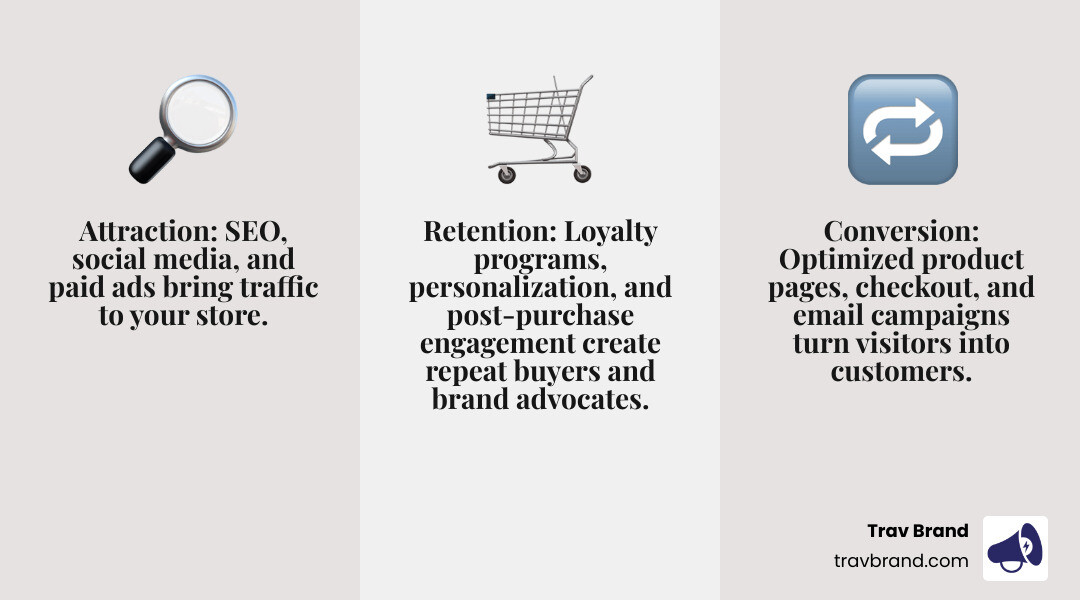
Each of these elements works in concert, creating a powerful ecosystem that drives attraction, conversion, and retention. At Trav Brand, we believe in building and scaling brands through comprehensive digital marketing, e-commerce, and content strategies. We offer a complete ecosystem from strategy to execution, focusing on purpose-driven brands and measurable results. If you’re ready to transform your marketing efforts into a cohesive system that drives measurable growth, let us help you.
Develop your brand with our expert services