Precision Placement: How Brand Positioning Elevates Your Market Presence
Why Strategic Brand Positioning Is Your Path to Market Dominance
Brand positioning services help businesses carve out a unique space in their customers’ minds—defining how you’re perceived, what you stand for, and why someone should choose you over the competition. At their core, these services deliver:
- Strategic Clarity: A positioning statement that defines your target audience, competitive frame, unique value, and reasons to believe
- Market Differentiation: Clear articulation of what makes you different (not just better) than competitors
- Customer Relevance: Messaging aligned with your ideal customer’s needs, motivations, and pain points
- Implementation Roadmap: Guidelines for expressing your position across visual identity, messaging, and all marketing channels
- Internal Alignment: A north star that guides business decisions, product development, and team communication
As positioning pioneers Al and Laura Ries put it: “Positioning is finding the right parking space inside the consumer’s mind and going for it before someone else takes it.” That conceptual space you own becomes your strategic backbone. A strong strategy leads to long-term success by differentiating your business, while a weak one risks commoditization, customer confusion, and becoming just another voice in a crowded marketplace.
I’m Trav Lubinsky, and I’ve spent years building and scaling brands—from launching Flex Watches to advising billion-dollar consumer companies on growth marketing and brand positioning services. Through my agency Trav Brand and work with partners like Marcus Lemonis, Daymond John, and top global brands including Star Wars, HexClad, and Poppi, I’ve seen how precision positioning transforms market presence into market leadership.
The Foundation: What is Brand Positioning and Why It Matters
At its heart, brand positioning is the strategic process of setting your business apart from competitors to build preference among your target audience. It’s about creating a specific, desirable image in their minds—your identity in the eyes of the consumer.
An effective brand positioning strategy maximizes customer relevancy and competitive distinctiveness, directly boosting brand value. When your unique value propositions (UVPs) are clearly communicated, customers are more willing to purchase from you. In a world brimming with choices, positioning is key to creating a unique identity that resonates deeply with your audience.

The Core Objectives of a Strong Position
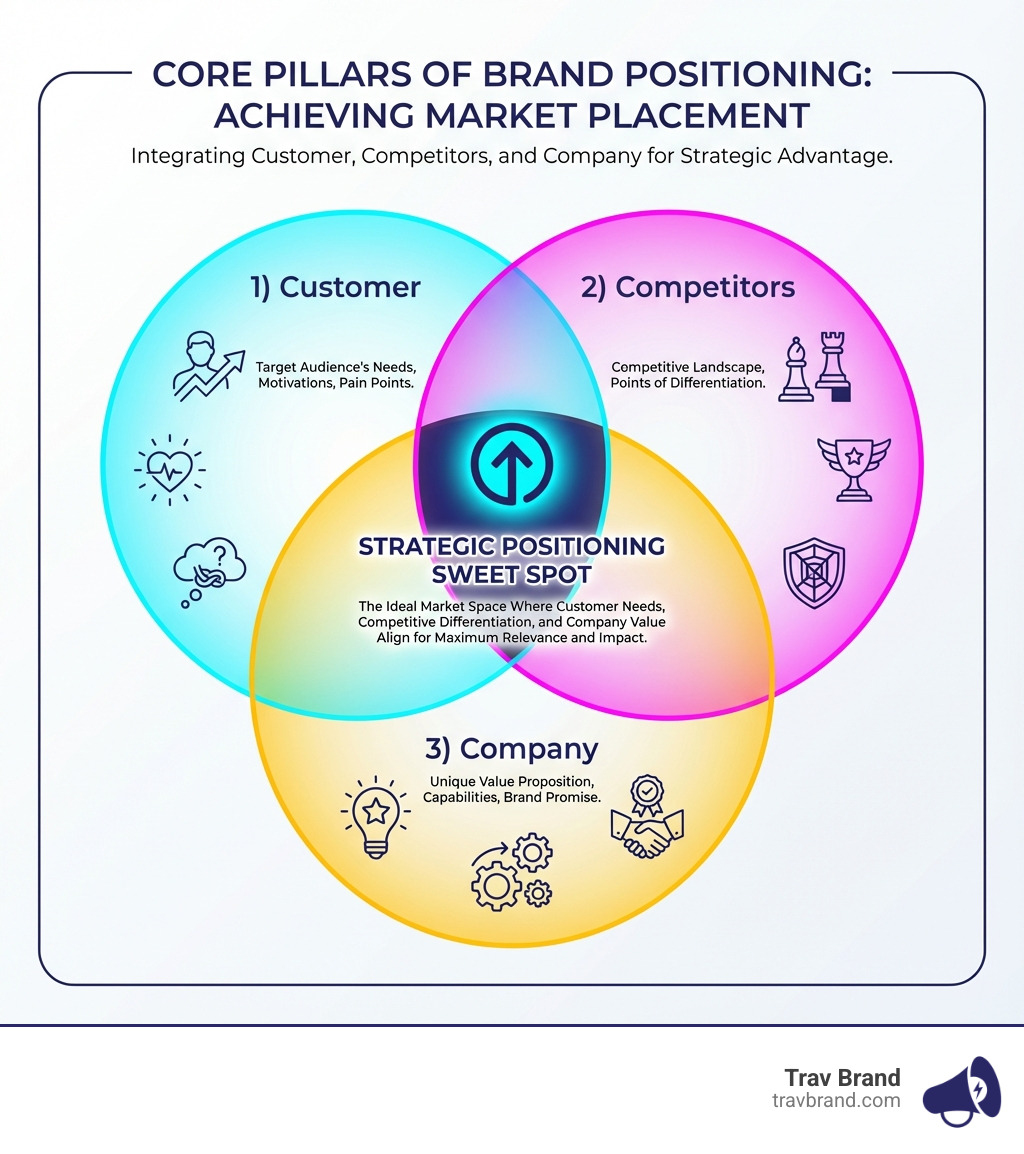
A strong position aims for three critical objectives:
- Relevance: Your brand must appeal to customers by understanding and addressing their needs, desires, and pain points.
- Differentiation: You must be distinct from competitors, offering something unique that sets you apart.
- Credibility/Attainability: Your brand must be able to deliver on its promises, making your position trustworthy.
The magic happens when you deliver on all three simultaneously. This balanced approach ensures your brand not only stands out but also genuinely connects with and is trusted by its audience.
The Dangers of Poor Positioning
Conversely, poor positioning leads to significant risks:
- Commoditization: Without differentiation, your product becomes interchangeable with competitors’, leading to price wars and diminished value.
- Niche Provider Trap: Focusing too much on differentiation without relevance can result in a product that appeals to too few people.
- Customer Confusion: An unclear or inconsistent message confuses customers about what you offer and why they should choose you.
- Inconsistent Messaging: Without a guiding position, marketing messages can become scattered, undermining trust and brand recognition.
Real-World Impact: From Awareness to Loyalty
The impact of strong positioning extends far beyond initial impressions, moving customers from awareness to loyalty and driving leads and sales.
Consider the Dove’s Real Beauty sketch campaign. By taking a bold stand on an issue important to its audience, Dove differentiated itself in the crowded beauty market and fostered deep emotional connections. The campaign was so successful that Dove’s sales jumped from $2.5 billion to over $4 billion in the following decade, according to AdAge. This kind of impact—from increased awareness to sustained sales growth—is what we aim for with our brand positioning services.
Crafting Your Strategic Blueprint: The Core Components
Crafting your brand position is a mix of research, creativity, and strategy. The process involves a deep dive to understand what makes a brand unique and how to communicate its purpose compellingly.
The core of effective positioning lies in articulating your Unique Value Proposition (UVP). This UVP is the heart of your brand, establishing your unique identity and communicating your differentiators to consumers.

Step 1: Deep Dive into Market & Audience Analysis
This foundational step involves a comprehensive analysis of your market, competitors, and target audience.
- Target Audience Identification: We dive into understanding your target audience’s demographics, psychographics, needs, and purchasing habits to create detailed customer personas.
- Competitive Analysis: We analyze the competition to identify their advantages, assess their messages, and spot opportunities for you to stand out. A perceptual map is a useful tool to visualize how consumers perceive your brand versus competitors.
- Market Trends & Consumer Behavior: We research broader market trends and consumer behaviors to identify potential positioning strategies and underlying industry currents.
- SWOT Analysis: We conduct an internal and external business analysis (Strengths, Weaknesses, Opportunities, Threats) to understand your capabilities relative to the market.
This deep dive lays the groundwork for a position that is not just creative but strategically sound.
Step 2: Defining Your Differentiators and UVP
Next, we pinpoint your brand’s unique value—what makes you special and why customers should choose you. This is your Unique Value Proposition (UVP).
To articulate your UVP, we identify your unique differentiators and the reasons to believe your claims. This involves:
- Unique Selling Points: What specific features or benefits do you offer that competitors don’t?
- Product/Service Quality: How does the inherent quality of your offering set you apart?
- Identifying a Strategic Contrast: Clarifying your position can mean defining what you stand against to highlight what you stand for. This isn’t about negativity; it’s a powerful way to rally customers to your cause. For example, a brand might position itself against complexity, inefficiency, or outdated industry practices.
- Reasons to Believe: What facts and evidence can you offer to support your claims and build trust?
The customer value proposition should clearly state who your product is for, what need it meets, and how your brand meets that need uniquely. For a deeper dive, we recommend exploring resources like Crafting the Perfect Brand Positioning Statement.
Step 3: How to Write a Brand Positioning Statement
A brand positioning statement is an internal declaration that defines your brand’s unique value, target audience, and market. It’s a North Star that guides all marketing efforts and ensures everyone in your organization is aligned.
Here are the key components:
- Target Audience: For [our specific target market]…
- Market Category: …our brand is the only one among all [competitive set/frame of reference]…
- Brand Promise (Benefit): …that [unique value claim or primary point of difference]…
- Reason to Believe (Proof): …because [reasons to believe or supporting facts].
A common template looks like this:
“To (target audience), (Product X) is the only (frame of reference) that (benefits delivered) because (reasons to believe).”
This framework helps articulate precisely how your brand establishes competitive advantages.
Step 4: Choosing Your Brand Positioning Strategy
With your differentiators and positioning statement defined, you can choose a strategy that best highlights your unique advantages. Common types include:
- Price-Based Positioning: Offering the most competitive price for value-conscious consumers.
- Quality-Based Positioning: Focusing on superior craftsmanship, performance, or premium ingredients to justify a higher price.
- Convenience-Based Positioning: Differentiating through ease of use, speed of service, or accessibility.
- Customer Service Positioning: Building loyalty through exceptional support and personalized interactions.
- Differentiation Strategy (Feature/Benefit-Based): Highlighting a unique feature or innovative technology that sets your product apart.
- Experiential Positioning: Creating memorable, interactive experiences for consumers, like the M&M’s flavor room experience.
- User-Based Positioning: Focusing on a specific user type or lifestyle, making your brand synonymous with that group.
- Prestige/Luxury Positioning: Emphasizing exclusivity, status, and premium offerings.
Our team evaluates potential positions to find what aligns best with your UVP and resonates most with your target audience.
Activating Your Position: From Internal Guide to External Reality
A brand position is only as powerful as its execution. It must become a living reality that shapes every interaction with your brand. This requires internal alignment and employee buy-in, ensuring your positioning statement acts as a north star for the entire company and creates a cohesive customer experience.
How Positioning Shapes Your Entire Brand Strategy
Your brand positioning is the DNA that influences your entire brand strategy:
- Influence on Marketing Messages: Your positioning statement directly informs your brand narrative. We craft compelling messages that showcase your unique value consistently across all marketing channels.
- Guiding Visual Identity: Your visual identity—logo, color palette, imagery—is a direct manifestation of your brand position. We help you create an aesthetic that evokes the desired experience or emotion.
- Defining Brand Voice and Tone: Your positioning dictates how you communicate. We define a consistent tone of voice (e.g., authoritative, playful, empathetic) that lets your brand personality shine through.
- Informing Product Development: A strong position guides future product development, ensuring new offerings align with your brand promise and reinforce your market standing.
By aligning messaging, visuals, and marketing strategy with your positioning, you build a powerful, unified brand presence.
Maintaining Consistency Across All Channels
Consistency across all channels is critical for building a recognizable brand identity that builds trust. A unified message and experience—from your website to customer service—solidifies your position in the consumer’s mind.
To achieve this, we implement several best practices:
- Brand Style Guides: We create comprehensive guides that document your brand’s visual and verbal identity to ensure everyone adheres to the established guidelines.
- Omnichannel Marketing: We ensure your brand’s message and experience are seamless across all customer touchpoints—website, social media, email, and more.
- Consistent Messaging: We share your core message consistently across all marketing channels, reiterating your unique value.
- Regular Brand Audits: We conduct regular audits to ensure all communications and touchpoints are aligned with your brand positioning.
Adapting to Evolving Markets and Repositioning
The market is rarely static. A strong brand position must be dynamic enough to evolve without losing its core identity.
- Monitoring Market Shifts: We continuously monitor market trends, customer feedback, and competitive activities to spot opportunities or threats.
- Responding to Consumer Behavior Changes: If your audience’s needs change, your positioning may need to adapt to remain relevant. We help you stay agile and refine your message.
- The Process of Repositioning: Sometimes, a full repositioning is necessary. This strategic recalibration, informed by deep research, can breathe new life into a brand. The “Jaguar Rebrand Disaster” serves as a cautionary tale of the risks of misjudging market perception.
- The Power of Iconic Brand Events: Successful brands often use impactful events to reinforce their positioning. Think of Apple Events, which consistently showcase innovation and cement Apple’s position as a leader in technology and design.
The Professional Edge: Why Businesses Use Brand Positioning Services
While the concept of brand positioning seems straightforward, execution requires a blend of art and science that is challenging to manage internally. This is where professional brand positioning services from agencies like ours become invaluable.
We bring objectivity, specialized expertise, and comprehensive research methodologies that internal teams often lack. Expert agencies help entrepreneurs use positioning to build dominant brands and create new categories. Our approach at Trav Brand, for instance, focuses on a complete ecosystem from strategy to execution, delivering measurable results rather than just consulting. We offer expertise in market research, brand analysis, differentiation strategy, and more, all aimed at helping you achieve long-term success.
| Feature | Brand Positioning | Brand Identity | Brand Strategy |
|---|---|---|---|
| What it is | The “why” and “for whom” – your unique mental space. | The “how it looks and feels” – visual and sensory cues. | The “what and how to achieve” – your long-term plan for perception. |
| Primary Goal | To differentiate and own a distinct space in the consumer’s mind. | To create recognizable and consistent recognition. | To achieve specific business objectives through brand perception. |
| Focus | Unique value, competitive differentiation, target audience relevance. | Logo, colors, typography, imagery, voice, tone. | Long-term vision, values, purpose, target audience, competitive landscape, brand architecture, messaging. |
| Internal/External | Primarily internal guide, but informs external perception. | Both, how the brand visually and verbally presents itself. | Primarily internal blueprint, guiding all brand activities. |
| Relationship | The core idea within the Brand Strategy, expressed through the Brand Identity. | The visual/verbal manifestation of the Brand Strategy and Positioning. | The overarching plan that encompasses Brand Positioning and guides Brand Identity. |
The Process of Working with a brand positioning services firm
When partnering with a brand positioning services firm, we follow a structured process for effectiveness:
- Findy & Analysis: We start with a deep dive into your business, market, and audience through stakeholder interviews, market research, and competitive audits to uncover your brand’s essence.
- Audience Profiling & Gap Analysis: We define your ideal customer with detailed personas and perform a gap analysis to map a course from your current to your desired position.
- Strategy & Narrative Development: We craft the core brand strategy, positioning framework, and a compelling narrative that articulates your unique value.
- Identity Creation & Visual System Design: We translate the strategy into tangible brand elements, including visual identity (logo, colors) and brand voice and tone.
- Implementation & Rollout: We help you activate your position across all channels with actionable, scalable deliverables, ensuring your new positioning is consistently applied.
How to Choose the Right Partner for your brand positioning services
Selecting the right partner is a crucial decision. We recommend looking for firms that offer:
- Industry-Specific Expertise: A partner who understands the nuances of your industry can provide more relevant insights.
- Proven Track Record: Look for evidence of successful projects and measurable results.
- Collaborative Approach: The best outcomes stem from a true partnership where your team is involved throughout the process.
- Focus on a Complete Ecosystem: At Trav Brand, we offer a complete ecosystem from strategy to execution, focusing on measurable results rather than just consulting.
The Difference Between DIY and Professional brand positioning services
Engaging professional brand positioning services offers distinct advantages over a DIY approach:
- Depth of Research: Agencies have dedicated resources to conduct exhaustive research and distill it into focused recommendations.
- Strategic Frameworks: We bring proven methodologies that ensure a robust approach and help avoid common pitfalls.
- Objectivity: An external partner offers an unbiased perspective, free from internal assumptions.
- Execution Capabilities: Many firms, including ours, offer execution support to ensure the strategy is effectively implemented.
- Long-Term Vision: We help you develop a position that is both effective today and adaptable for the future, providing clear alignment between your brand and your long-term goals.
Frequently Asked Questions about Brand Positioning
How long does it take to see results from a brand positioning strategy?
The timeline varies based on your industry, competition, and project scope.
- Short-term impacts (weeks to months): Expect increased internal clarity, consistent messaging, and better marketing campaign engagement.
- Long-term results (months to years): Look for measurable growth in market share, brand equity, and customer loyalty.
Is brand positioning only for new businesses?
No. While critical for new businesses to establish an identity, it’s equally vital for established ones.
- For new businesses: It provides a clear roadmap for market entry and differentiation.
- For established businesses: It allows for strategic repositioning to reignite relevance, foster growth, and maintain a competitive edge, even in global markets.
How do you measure the success of brand positioning?
Success is measured by tracking several Key Performance Indicators (KPIs) over time:
- Brand Awareness Metrics: Monitoring brand recognition, recall, and mentions.
- Customer Perception Surveys: Understanding how audiences perceive your brand relative to competitors.
- Market Share Analysis: An increase often indicates successful differentiation.
- Lead Quality and Conversion Rates: Better positioning attracts the right customers, improving marketing ROI.
- Customer Loyalty and Retention: Strong positioning fosters deeper connections, increasing customer lifetime value.
- Website and Social Media Analytics: Tracking engagement to see how your message resonates.
Conclusion: Secure Your Market Position for Lasting Success
In today’s marketplace, strategic brand positioning isn’t a luxury—it’s a necessity. It’s the tool that carves out a unique space in your audience’s mind, driving preference, loyalty, and growth. A clear strategy built on relevance, differentiation, and credibility can transform a business into a market leader.
The journey—from analysis and strategy to consistent activation—influences every facet of your brand. It creates an undeniable presence that resonates with customers and builds a foundation for lasting success.
At Trav Brand, we understand that scaling brands requires a complete ecosystem from strategy to execution. We focus on purpose-driven brands and measurable results, ensuring our brand positioning services provide a clear pathway to market leadership.
Ready to define your unique space and lift your market presence? Take the first step towards market leadership with our brand strategy solutions and let us help you achieve lasting success.