
The Ultimate Content Audit: Uncover Your Digital Goldmine
Why Your Content Might Be Costing You More Than It’s Making

Audit content marketing is the process of systematically evaluating all your website’s content to measure performance, identify gaps, and uncover opportunities for improvement. Here’s what you need to know:
Quick Answer: How to Conduct a Content Audit
- Create an inventory – Compile all URLs using tools like Screaming Frog or your CMS
- Collect performance data – Pull metrics from Google Analytics, Search Console, and SEO tools
- Analyze content quality – Evaluate relevance, SEO optimization, engagement, and conversions
- Make strategic decisions – Keep, update, repurpose, or delete each piece based on performance
- Implement changes – Execute your action plan and measure results over 3-4 months
You’ve invested time and money creating content. Blog posts, landing pages, product descriptions—maybe hundreds of pieces sitting on your website right now.
But here’s the uncomfortable truth: 37% of marketers have never audited their content. They’re essentially flying blind, guessing which content works and which doesn’t.
Without an audit content marketing strategy, you’re likely wasting resources on content that doesn’t serve your business goals. Worse, you might have digital goldmines buried in your archives—high-performing content that could drive significantly more traffic and conversions with just a few strategic updates.
The data backs this up: 57% of B2B marketers cite creating the “right” content as a top challenge, and 54% struggle to stand out from competitors. These aren’t minor issues—they’re missed revenue opportunities.
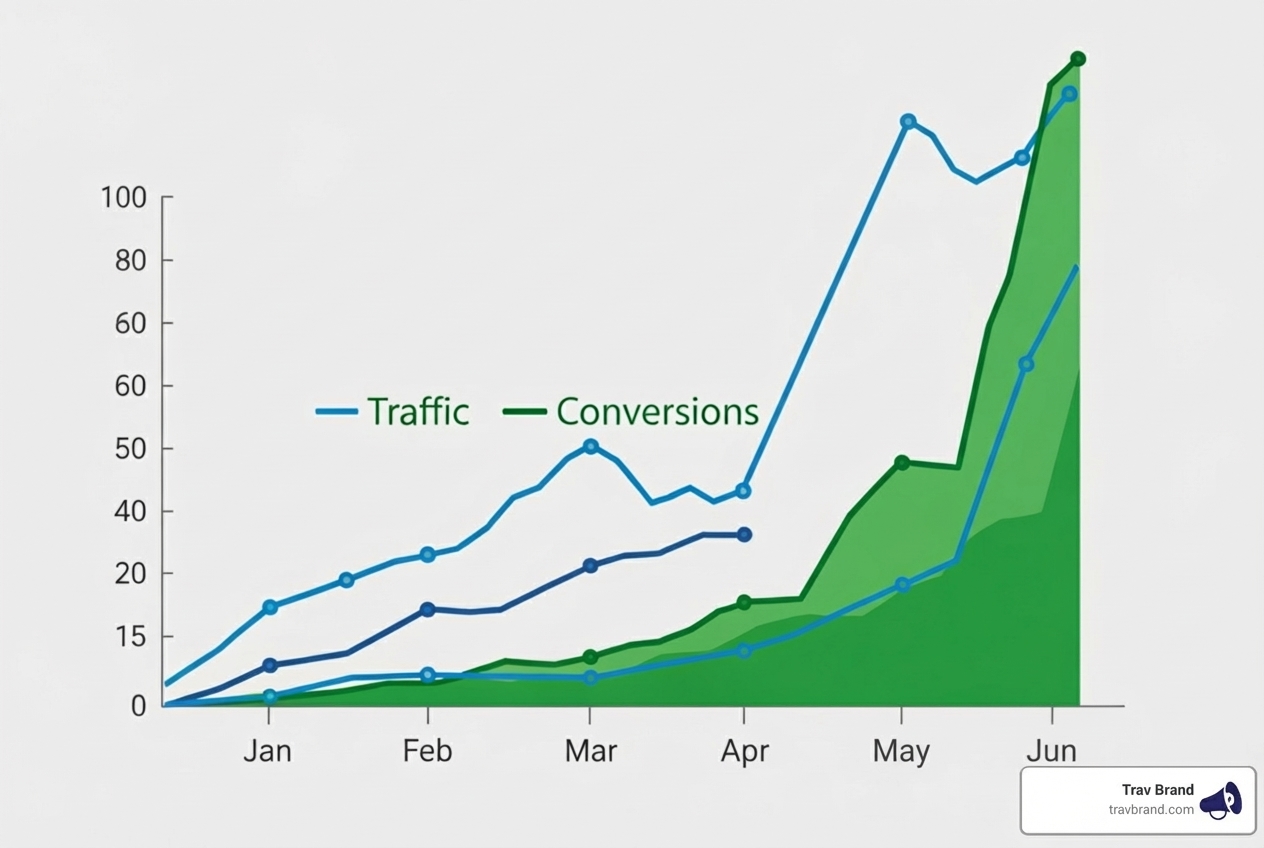
A content audit changes everything. It transforms guesswork into strategy, revealing exactly which content drives results and which content drags you down. Companies that audit regularly see tangible benefits: improved SEO rankings, higher engagement rates, and increased conversions.
I’m Trav Lubinsky. Through building and scaling multiple ventures, I’ve learned that effective audit content marketing is essential for maximizing ROI. At Trav Brand, we help companies turn content chaos into strategic assets that drive measurable business results.
What is a Content Audit & Why Does It Matter?
At its core, a content audit is a systematic health check of your entire content ecosystem. It’s about understanding how all your content works together to achieve business objectives. We assess everything you’ve published for performance, relevance, and quality to decide what to re-optimize, expand on, or remove.
Why does this matter? Think of your content as a garden. Without regular care, it becomes unproductive. A content audit is that care—ensuring every piece contributes to your ROI and brand recognition. It provides a data-backed roadmap for improving your online performance.
As the Content Marketing Institute (CMI) reports, 57% of B2B marketers struggle to create the “right” content for their audience. This challenge highlights a fundamental need: to understand what “right” content truly means for your audience. A content audit gives us the data to answer that question, moving us beyond assumptions to data-driven insights. It’s about ensuring every asset we create is backed by hard data, providing a concrete blueprint for success.
Content Inventory vs. Content Audit
These two terms are often used interchangeably, but they represent distinct, albeit complementary, activities. Understanding the difference is crucial for a successful audit content marketing project.
A content inventory is the “what”. It’s a comprehensive, quantitative list of every piece of digital content you currently have. This includes URLs, titles, authors, content types, dates, and other basic descriptive attributes. Think of it as creating a meticulous catalog of your entire content library. It’s the foundational step that gives us a clear picture of the breadth and depth of your content.
In contrast, a content audit is the “why”. It’s a qualitative analysis that examines, assesses, and evaluates the quality, performance, and effectiveness of the content listed in your inventory. This is where we uncover content that needs updating, identify gaps that new content could fill, and determine if certain pieces are ready for removal. While an inventory tells us what you have, an audit tells us how well it’s working and what to do about it. We recommend completing these activities together for a holistic view, and tools like the NN/g Content Inventory and Auditing Template (XLSX) can be incredibly helpful.
Key Benefits of Auditing Your Content
The effort we put into a thorough audit content marketing process yields significant rewards. It’s an investment that pays dividends across your entire marketing strategy. Here are some of the biggest benefits we consistently observe:
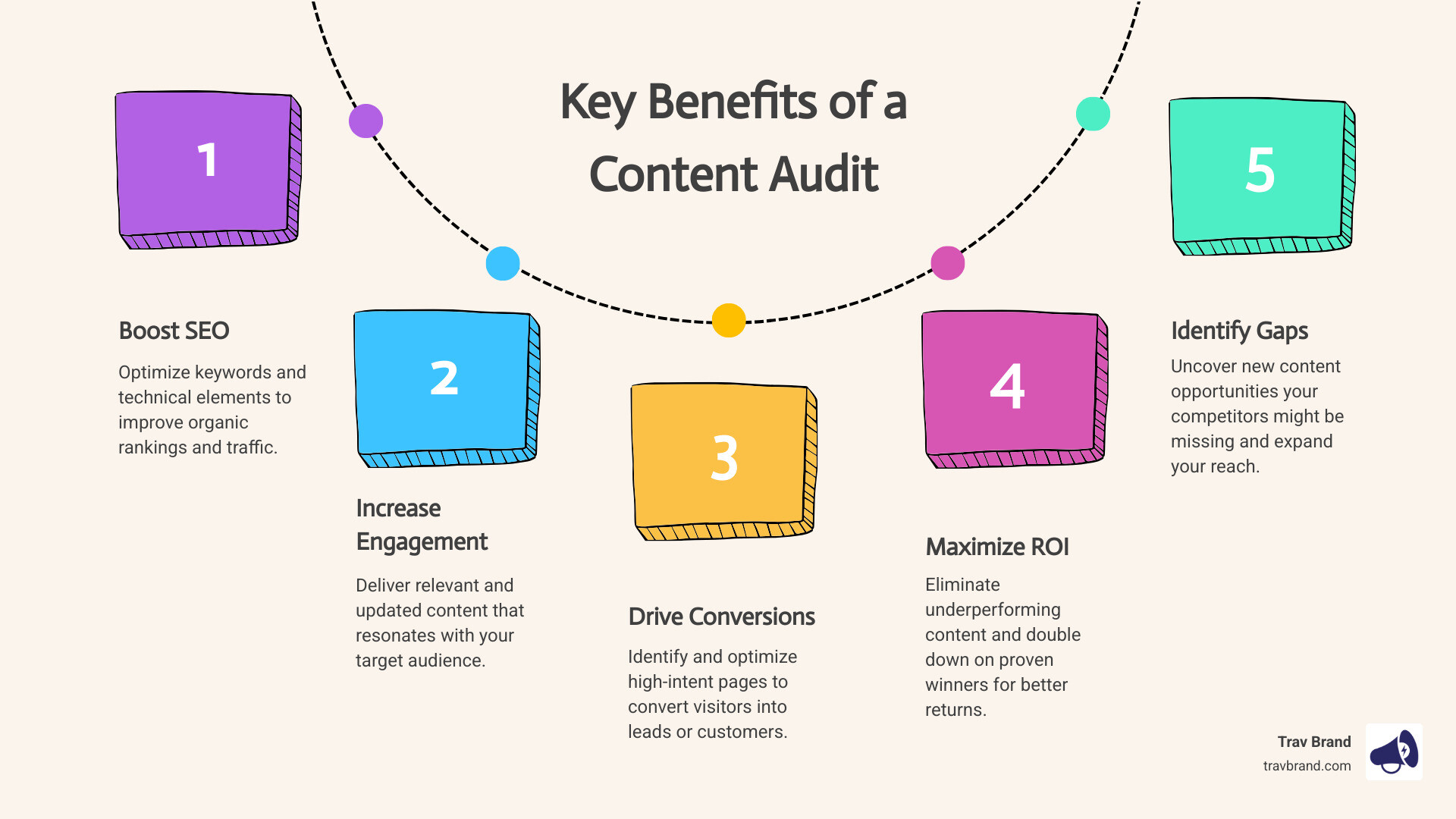
- Improve SEO Performance: A content audit helps us identify low-hanging fruit opportunities, such as on-page SEO optimizations, content refreshes, and fixing technical issues. We can pinpoint keyword cannibalization, identify stronger internal linking opportunities, and ensure your content is optimized for search engine visibility. This directly contributes to better rankings and organic traffic.
- Boost Conversions and Leads: By analyzing which types of content users are engaging with and converting on, we can scale successful initiatives. We identify content that effectively guides users through the conversion funnel and optimize underperforming pieces, ultimately driving more leads and sales.
- Increase Audience Engagement: Audits help us understand what truly resonates with your audience. We can spot content that drives high engagement (time on page, social shares, comments) and replicate its success, leading to a more engaged and loyal audience.
- Identify Content Gaps and Opportunities: By systematically reviewing your existing content and comparing it against audience needs and competitor strategies, we can uncover topics you’re missing. This allows us to fill those gaps with new, valuable content that meets user intent.
- Inform Your Content Repurposing Strategy: Why create new content when you can revive existing assets? Audits highlight content that can be updated, expanded, or transformed into different formats (e.g., a blog post into an infographic or video), maximizing its value and reach without starting from scratch.
A content audit is about making data-backed decisions that drive measurable business results. It helps us break old habits in content marketing and ensure every piece of content is pulling its weight.
Preparing for Your Audit: Goals, Scope, and Metrics
Before we dive headfirst into the data, a successful audit content marketing project requires careful planning. We need to define what we want to achieve, what content we’ll examine, and how we’ll measure success. This preparation phase is crucial for ensuring the audit is efficient, focused, and ultimately impactful.
Define Your Goals and Scope
The first step in any audit is to clearly define our objectives. What do we hope to accomplish? Without clear goals, an audit can quickly become an overwhelming data dump. Our goals should be specific, measurable, achievable, relevant, and time-bound (SMART). Common goals for a content audit include:
- SEO Improvement: This might involve increasing organic traffic, improving keyword rankings for specific terms, or fixing technical SEO issues like broken links or thin content.
- Conversion Rate Optimization (CRO): Here, we’d focus on identifying which content drives leads, sales, or other desired actions, and optimizing underperforming pages.
- Brand Voice and Consistency: Ensuring all content aligns with your brand’s messaging, tone, and visual identity.
- Content Quality Improvement: Improving readability, accuracy, and overall value for your audience.
Once our goals are clear, we define the scope of the audit. This involves deciding which content assets will be included. Will we audit:
- Your entire website?
- Just specific sections, like your blog or product pages?
- Content targeted at a particular buyer persona or stage of the buyer’s journey?
Starting with a manageable yet impactful subset of content can be a smart approach, especially for larger sites. This prevents overwhelm and allows us to gain momentum.
The Importance of a Regular Audit Content Marketing Schedule
A content audit isn’t a one-time task; it’s an ongoing process. The digital landscape is always changing, so your content needs regular check-ups to stay effective. We recommend a major audit content marketing project at least once a year. For larger sites with frequent new content, a semi-annual or quarterly audit might be better. It’s also wise to run ad hoc audits after a major content push or a change in business goals. A regular schedule helps catch issues early and capitalize on new opportunities, ensuring your content remains a powerful asset that continually drives value.
Choose Your Key Metrics
To effectively analyze your content, we need to decide which metrics will provide the most valuable insights related to our defined goals. These metrics act as our yardstick for success. Here’s a list of key metrics we typically track during an audit content marketing:
-
SEO Metrics:
- Organic Traffic: How many visitors are coming from search engines?
- Keyword Rankings: Where does your content rank for target keywords? We look at positions 1-10 (top visibility) and 11-30 (opportunities for improvement).
- Backlinks: The number and quality of external websites linking to your content, indicating authority and trust.
- Page Speed: How quickly your pages load, crucial for user experience and SEO.
- Technical SEO Issues: Errors like broken links, duplicate content, missing meta descriptions, or incorrect canonical tags.
-
Engagement Metrics:
- Time on Page/Average Read Depth: How long users spend consuming your content, indicating relevance and interest.
- Bounce Rate: The percentage of visitors who leave your site after viewing only one page.
- Social Shares/Comments: How often your content is shared or discussed on social media, showing its resonance.
- Click-Through Rate (CTR): For search results or internal links, indicating how compelling your titles and descriptions are.
-
Conversion Metrics:
- Goal Completions: Tracking specific actions users take (e.g., form submissions, downloads, purchases).
- Lead Generation: How many leads a piece of content directly or indirectly contributes to.
- Conversion Rate: The percentage of visitors who complete a desired action.
- Revenue/Sales: For e-commerce content, the direct financial impact.
By focusing on these metrics, we get a comprehensive picture of your content’s performance and can make informed decisions about its future.
The Step-by-Step Guide to Conducting a Powerful Content Marketing Audit
Now that we’ve laid the groundwork, let’s walk through the actionable steps involved in conducting a powerful audit content marketing project. This systematic process ensures we gather all necessary data, analyze it effectively, and translate insights into a winning strategy.

Step 1: Create Your Content Inventory
This is where we build the foundation of our audit: a comprehensive list of all your content.
- Gather All URLs: The most efficient way to do this is by using a website crawler tool. Screaming Frog is an excellent option that automatically scours your entire website and collects URLs, title tags, and other files. For smaller sites, the free version can audit up to 500 URLs. We can also extract URLs from your Content Management System (CMS) or sitemap.
- Set Up Your Spreadsheet: We recommend using a spreadsheet to organize your content. This improves visibility and allows you to track changes systematically. You can start with a free Google spreadsheet template or create your own. Essential columns for your inventory should include:
- URL
- Page Title
- Content Type (e.g., blog post, landing page, product page, guide)
- Date Published/Last Modified
- Author (if applicable)
- Content Category/Topic
- Word Count
- Meta Description
- Canonical Tag (if present)
- Index Status (indexable/noindex)
Organizing your URLs by category hierarchy or sitemap structure can also be very helpful, especially for larger sites.
Step 2: Collect Performance Data
With our inventory in place, the next step is to populate it with performance data. This is where we see how your content is actually performing.
- Google Analytics: This is our go-to for understanding user behavior. We’ll log in to Google Analytics (preferably GA4, as Universal Analytics was sunsetted in 2023) to gather metrics like:
- Organic traffic (sessions, users)
- Bounce rate
- Average time on page
- Goal completions/conversions
- Traffic sources (organic, direct, referral, social)
- Page-specific performance over a chosen time frame (e.g., last 6-12 months).
- Google Search Console: This free tool is invaluable for SEO insights. Google Search Console provides data on:
- Search queries that led users to your pages
- Impressions and clicks in search results
- Average ranking position
- Core Web Vitals and other technical SEO issues
- Index coverage reports
- SEO Tools: For deeper competitive analysis and backlink data, we leverage specialized SEO tools like Ahrefs or Semrush (which also offers a content audit tool). These tools help us:
- Check keyword rankings and visibility more broadly.
- Analyze backlink profiles for each URL, assessing quantity and quality.
- Identify on-page SEO issues beyond what Search Console offers.
- Perform competitor research (more on this in Step 4).
We systematically input these content-specific metrics into corresponding cells in our audit spreadsheet, ensuring we have a data-rich overview for each piece of content.
Step 3: Analyze and Qualify Your Content
Now comes the detective work: making sense of all that data. This is where we identify patterns, spot opportunities, and uncover areas for improvement.
- Identify Top Performers: Which pages consistently drive high organic traffic, engagement, and conversions? What do they have in common (topic, format, length, keywords)? These are our success stories to learn from and potentially replicate.
- Spot Underperformers: Which pages have low traffic, high bounce rates, or no conversions? These are prime candidates for updates, repurposing, or even deletion.
- Outdated Content: Content in the digital marketing world changes rapidly. We look for articles with time-sensitive references, old statistics, or technologies that are no longer relevant. Source links older than two years are often considered outdated.
- Thin Content Analysis: Pages with minimal content (often under 200-300 words) that don’t fully satisfy user search intent can be problematic. As Search Engine Journal reports, thin content can negatively impact your search rankings and on-site user experience. We identify these to either expand them or consolidate them with more robust pieces.
- Keyword Cannibalization: This occurs when multiple pages on your site target the same keywords, competing against each other in search results. An audit helps us identify these conflicts and restructure content (e.g., using a hub-and-spoke model) to consolidate authority.
- Content Gap Analysis: By comparing your content against your target audience’s needs and the keywords they search for, we can identify topics you’re not covering. This is a powerful way to find new content opportunities.
- Incorporate Social Media Data: Social media is a goldmine of audience insights. We include social performance in our audit because user behavior signals can influence search algorithms. Tools like Sprout Social, BuzzSumo, or platform-specific analytics help us understand:
- Which content gets the most shares, likes, and comments.
- Referral traffic from social channels.
- Audience demographics and interests.
- How social engagement influences the overall value of your website content.
By analyzing these aspects, we gain a clear understanding of what’s working, what’s not, and why.
Step 4: Integrate Competitor Analysis
An effective audit content marketing strategy looks outward as well as inward. Integrating competitor analysis provides a crucial external perspective, helping us find opportunities to outmaneuver the competition.
- Why It’s Crucial for SEO: Understanding what top competitors do successfully is vital. It helps identify industry benchmarks, spot algorithm changes, and find content gaps they’re exploiting (or missing).
- How to Audit Competitors: We select 3-5 core competitors and analyze their top-performing content using tools like Ahrefs and Semrush. We look at their top pages by traffic, keyword rankings, content formats, and overall strategy. This isn’t about copying, but understanding what resonates in your shared market.
- Find Content & SERP Gaps: We identify topics your competitors aren’t effectively covering, creating an opportunity for you to capture that audience. We also perform a SERP gap analysis, examining search results for key topics to see where you’re losing to competitors and how new content can help you gain ground.
We then format these findings into a competitive content matrix to compare your performance against rivals, illuminating pathways for growth.
From Audit to Action: Turning Insights into a Winning Strategy
The true power of an audit content marketing project lies not just in the findings, but in the actions we take based on them. This phase is about translating data into a concrete, prioritized plan that informs your future content strategy and drives measurable results. This is where we transform insights into a winning strategy, helping you build a Strategic Marketing Content plan that truly delivers.
Create Your Action Plan: Keep, Update, Delete, or Repurpose
For each piece of content, we decide on one of four actions based on its performance and relevance:
- Keep As-Is: These are your content goldmines—high-performing, evergreen pieces that consistently drive traffic, engagement, and conversions. They are accurate, relevant, and well-optimized. Our action here is to ensure they continue to perform and potentially promote them further.
- Update/Refresh: This category includes content that has good potential but is either outdated, could benefit from better SEO, or needs a fresh perspective. We might update statistics, add new sections, improve readability, optimize meta descriptions and title tags, or improve internal linking. Even a quick optimization of metadata can sometimes jump a ranking from position 12 to position three in SERPs.
- Repurpose: Don’t let good content die! Content that performs well but could reach new audiences or offer a different experience is perfect for repurposing. We can turn:
- Long blog posts into engaging videos or infographics.
- Case studies into social media carousels or short podcasts.
- Webinars into blog series or e-books.
This maximizes the value of your existing assets and extends their lifespan.
- Delete/Redirect: This is for low-quality, irrelevant, or severely underperforming content that offers no value to your audience or SEO. Thin content, duplicate topics, or content with zero organic traffic and no other strategic purpose might fall here. If we delete a page, we always implement a 301 redirect to the most relevant alternative page to avoid 404 errors and preserve any existing link equity. Google isn’t a fan of broken or dead links on a site!
We create a prioritized list of these action items, focusing on those that offer the highest impact for the least effort first—the low-hanging fruit.
Informing Your Future Content Strategy
The insights from your audit content marketing project are invaluable for shaping future content strategy, ensuring every new piece is purposeful and aligned with business objectives.
- Data-Driven Topic Ideation: We use the identified content gaps, successful topics, and keyword opportunities to brainstorm new content ideas. Instead of guessing what your audience wants, we create content around proven interests and unmet needs.
- Focusing on Successful Formats: If videos consistently drive high engagement, we’ll lean into more video content. If long-form guides convert well, we’ll prioritize those. The audit tells us which formats resonate most effectively with your audience.
- Filling Identified Content Gaps: We address the missing topics and buyer journey stages that the audit uncovered, ensuring a comprehensive content experience for your users.
- Creating Content Pillars and Cornerstone Content: The audit helps us identify core topics around which to build content pillars—clusters of related content that establish your authority. Within these, we can develop cornerstone content—the most important, comprehensive articles that serve as central hubs.
By understanding what works, what doesn’t, and what’s missing, we can craft a forward-looking content calendar that is strategic, efficient, and highly effective.
Overcoming Common Audit Challenges
A comprehensive audit content marketing project can be challenging. Common problems include:
- Data Overwhelm: The sheer volume of data from various tools can be daunting.
- Lack of Resources: 58% of B2B marketers cite a lack of resources as their biggest barrier to successful content creation, and this often extends to auditing.
- Analysis Paralysis: Getting stuck in the analysis phase without moving to action.
Here’s how we overcome these common problems:
- Start Small and Prioritize: Don’t try to audit everything at once. Focus on a specific section of your site or content type first. Prioritize the content that is most frequently accessed or supports your top business tasks.
- Use Templates and Tools: Leverage templates (like the Google Sheet we mentioned) and automation tools to streamline data collection. Visualization tools like Miro can also make identifying content gaps easier by mapping content visually.
- Present a Clear Business Case to Stakeholders: If you need more resources, clearly articulate the potential ROI of the audit. Show how it will lead to improved SEO, increased conversions, and saved resources from eliminating ineffective content.
- Collaborate and Delegate: Share the responsibility. Assign different team members to specific sections or data points. Ensure clear ownership for content updates and maintenance.
- Focus on Actionable Insights: The goal isn’t just to collect data, but to inform decisions. If a piece of data doesn’t help us make a decision (keep, update, delete, repurpose), we might reconsider if it’s essential for this particular audit.
By addressing these challenges proactively, we ensure your content audit is a productive and empowering process, not a frustrating one.
Conclusion: Your Blueprint for Content Success
A content audit is far more than a tedious task; it’s a powerful, strategic tool for understanding, optimizing, and dominating your digital landscape. By systematically evaluating your content, you gain insights into what resonates with your audience, drives business goals, and where untapped opportunities lie. This empowers you to break free from guesswork, make informed decisions, and ensure every piece of content is a valuable asset, not a wasted effort.
At Trav Brand, we specialize in building and scaling brands through comprehensive digital marketing, e-commerce, and content strategies. We don’t just audit; we partner with you to turn those audit findings into a powerful content ecosystem that drives measurable results. We believe in purpose-driven brands and measurable results, and a robust content audit is the first step towards achieving both.
Ready to uncover your digital goldmine and transform your content into a strategic powerhouse? Let us help you build a powerful content ecosystem with our comprehensive brand marketing services.