Convert Like a Pro Essential Website Optimization Strategies
Introduction: The Power of a Single Click
Website conversion best practices are the strategic actions you take to turn more visitors into customers. Here’s what works:
- Prioritize speed – Pages loading in under 3 seconds dramatically reduce bounce rates.
- Design mobile-first – Over 60% of web traffic is from mobile devices.
- Use clear CTAs – Action-oriented buttons with contrasting colors drive clicks.
- Build trust – Display testimonials, reviews, and security badges prominently.
- Simplify forms – Reducing form fields from 11 to 4 can increase conversions by 120%.
- Test everything – A/B testing validates what actually works for your audience.
- Leverage social proof – 92% of people trust recommendations over traditional advertising.
If your website doesn’t convert, your ad spend is wasted. The good news? Small, strategic changes can yield massive results. Bumping your conversion rate from 2% to 4% doubles your results with the same traffic.
While most businesses focus on traffic, the real leverage is in optimizing what happens after the click. Converting visitors is a systematic process of understanding user psychology, removing friction, and delivering value.
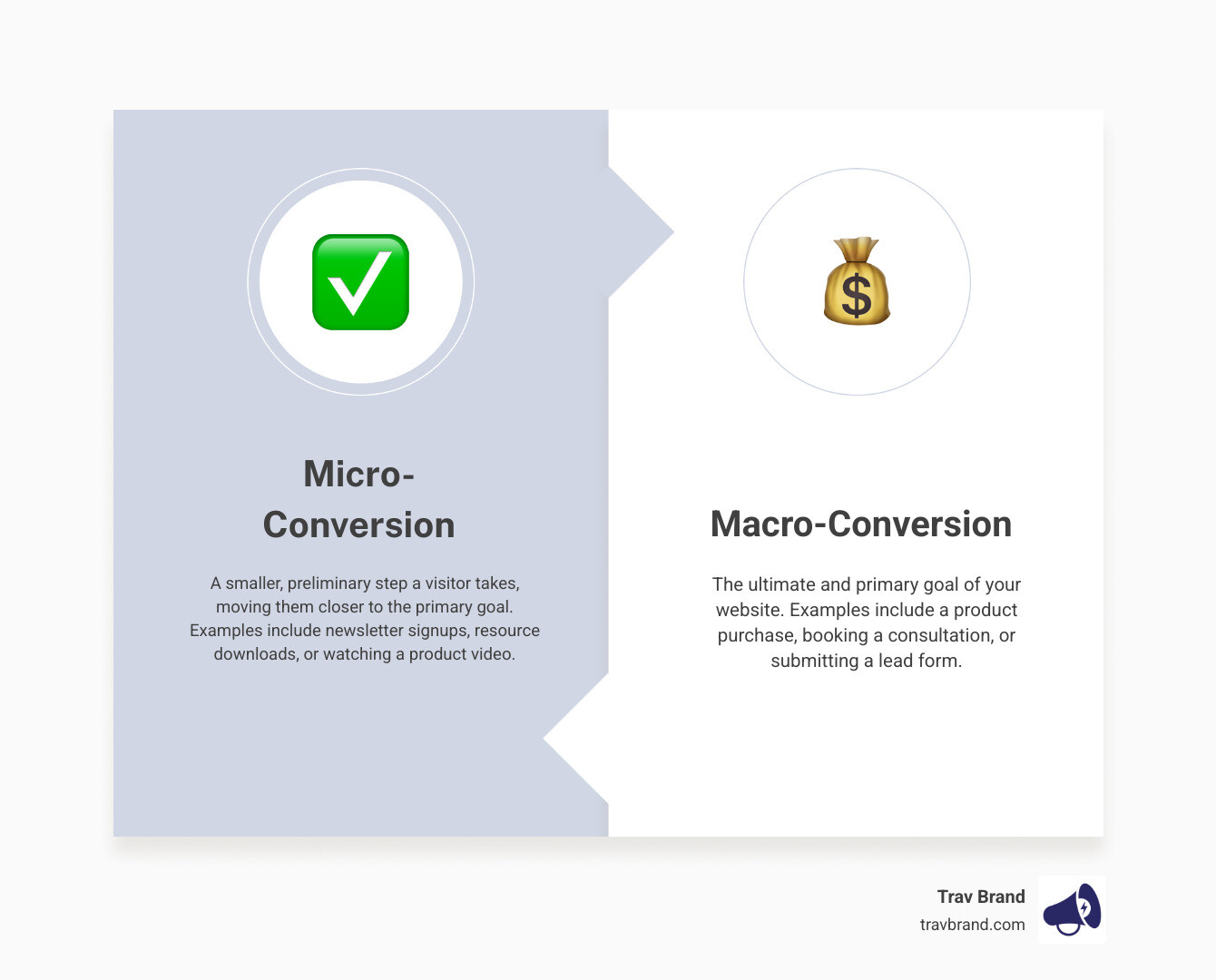
Before we dive in, understand that conversions come in different flavors. A macro-conversion is your primary goal—a purchase or a signed contract. A micro-conversion is a smaller step that moves someone closer, like a newsletter signup or a video view. Both matter, as micro-conversions build the relationship that leads to macro-conversions.
I’m Trav Lubinsky. Over the past decade, my team at Trav Brand and I have helped brands like Poppi and HexClad implement website conversion best practices to drive measurable revenue growth. We’ve learned that optimization isn’t about tricks; it’s about building experiences that align with how real people browse, decide, and buy.
The Foundation: Optimizing Design, User Experience, and Performance
A visitor’s first impression is visual and experiential. Your site’s design, user experience (UX), and user interface (UI) are critical drivers of whether someone stays or bounces. The goal is a seamless, intuitive journey that guides visitors toward conversion.
Conversion-focused design aligns with user psychology. A cluttered site increases cognitive load and hinders decisions, which is why simplicity often wins. As experts remind us, optimization is less about colors and more about understanding user behavior and design principles.
We ensure all design elements adhere to your brand guidelines for a consistent experience. Visual hierarchy is key to guiding the visitor’s eye to the most important information. People often scan a page in an “F” or “Z” pattern, so we strategically place key information and CTAs along these natural eye paths. This thoughtful approach is a cornerstone of our Brand Creation Strategy services.
The Need for Speed: How Performance Impacts Conversions
Slow loading times are conversion killers. A page load increase from one to three seconds can raise the bounce rate by 32%, and a five-second load time can increase it by 90%. Since 47% of consumers expect a page to load in 2 seconds or less, we aim for under four seconds—the shorter, the better.

Here’s how we achieve that:
- Optimize Images: We compress images using tools like TinyPNG or convert them to modern formats like WebP without sacrificing quality.
- Minimize Code: We streamline code and remove unnecessary plugins or scripts that weigh your site down.
- Fast Hosting: Your web host plays a huge role. We ensure you’re on a reliable, high-performance hosting service.
- Enable Browser Caching: This helps pages load faster for returning visitors by storing parts of your site on their device.
- Use a CDN: Content Delivery Networks (CDNs) distribute your content across multiple servers globally, so users load it from a server closer to them.
We continuously test website speed using tools like Google PageSpeed Insights and GTmetrix. A fast website is a fundamental website conversion best practice. For a deeper dive, check out our guide on how to improve your website speed.
Designing for a Mobile World
With mobile visits outpacing desktop since 2017 and nearly 98% of users accessing the internet via mobile, a mobile-first website is non-negotiable. If your site isn’t built for small screens, you’re losing clients.
We prioritize a mobile-first approach, designing for the smallest screen first and then scaling up. Here are our key strategies:
- Responsive Design: Your website must automatically adjust to different screen sizes. This is foundational to a good mobile experience. Learn more about responsive design.
- Finger-Friendly Tap Targets: Buttons and links need to be large enough (at least 44×44 pixels) and spaced appropriately for easy tapping on touchscreens.
- Simplified Mobile Navigation: We opt for clean menus with logical categories, avoiding clutter that can overwhelm small screens.
- Above the Fold Content: On mobile, your unique value proposition and primary call-to-action must be immediately visible without scrolling.
- Concise Copy: We use short sentences, bullet points, and clear headings to make content easily scannable for users on the go.
If you’re unsure about your site’s mobile performance, you can quickly check if your site is mobile-friendly.
Elements of Persuasion: Crafting Compelling Copy, CTAs, and Trust Signals
Once your website is fast and mobile-friendly, the next step is to make it persuasive. This is where your messaging, calls-to-action (CTAs), and trust signals come into play. We’re not just selling products; we’re selling solutions and peace of mind.

Your value proposition is the core of persuasion. You have about three seconds to answer a visitor’s question: “Why should I care?” We help you articulate a clear, concise value proposition (10 words or less) that explains what you do, who you help, and why you’re the best choice.
Persuasive copywriting focuses on the client’s needs, speaking directly to them using “you” and “your.” We connect your services to tangible benefits. For instance, instead of “We offer custom website design,” we say, “We create websites that turn visitors into paying customers.” It’s about showing, not just telling, how you solve their problems.
Mastering the Call-to-Action (CTA)
Your Call-to-Action (CTA) is the moment of truth where you ask your visitor to take the next step. A compelling CTA motivates them to act.
Here are our website conversion best practices for CTAs:
- Clear and Action-Oriented Language: Avoid vague phrases like “Click Here.” Use strong action verbs that state the benefit, such as “Get Your Free Trial Now” or “Book Your Consultation.” Zapier, for example, uses “Get started for free” instead of a generic “Sign Up.”
- Striking Color Contrast: Your CTA button needs to stand out. We use a bold button with a contrasting color that catches the eye and aligns with your brand.
- Strategic Placement: Place CTAs where they are most likely to be seen, such as above the fold, within relevant content, and at the end of articles.
- Urgency and Scarcity (Used Wisely): Phrases like “Limited Time Offer” or countdown timers can encourage immediate action. We ensure these tactics are genuine to avoid eroding trust.
- Appropriate Size: The CTA button should be large enough to be easily noticed and clicked, especially on mobile, but not so large that it overwhelms the design.
Mastering your CTAs is a continuous process of testing and refinement. To dive deeper, explore our guide on crafting compelling calls to action and see our blog for more tips.
Building Trust with Social Proof
In today’s digital landscape, trust is your most valuable currency. When someone’s on the fence, seeing that others have already taken the leap can be the final push they need. The statistics are compelling: 92 percent of people trust recommendations from others ahead of all other traditional forms of advertising.
Here’s how we effectively leverage social proof:
- Testimonials and Reviews: Authentic customer testimonials can increase conversion rates by 34%. We place these strategically near CTAs and product descriptions. A great testimonial highlights a specific benefit and includes a photo and name for credibility.
- Case Studies: Detailed case studies showcasing real results with data are incredibly powerful for demonstrating your capability and impact. You can explore some of our own successes in our Case Studies.
- User-Generated Content (UGC): Displaying customer photos, videos, or social media posts featuring your products adds an extra layer of authenticity.
- Trust Badges and Certifications: Security seals (like SSL certificates), client logos, and industry awards reassure visitors that your site is safe and your business is reputable, especially on checkout pages.
- Real Faces and Stories: People connect with people. Using real photos of satisfied customers makes social proof more relatable and trustworthy.
We focus on specific, relevant endorsements that speak directly to the concerns of your target audience.
The Engine of Improvement: Data-Driven Website Conversion Best Practices
Guessing is expensive; testing is profitable. The most effective website conversion best practices are built on data, not assumptions. Data analysis provides X-ray vision into user behavior—showing where people click, scroll, and focus—so we aren’t optimizing in the dark.
Using Data to Understand Your Audience
Understanding customer behavior is the foundation of a good CRO strategy. We translate data into actionable insights.
- Analytics Tools: Tools like Google Analytics 4 are essential for tracking metrics like traffic sources, bounce rates, and conversion paths. We set up goals to monitor progress and identify drop-off points.
- Behavior Analysis Tools: Platforms like Hotjar or CrazyEgg provide qualitative data through heatmaps, session recordings, and surveys, pinpointing areas of user confusion.
- User Segmentation: We segment audiences based on demographics, traffic source, or behavior to tailor experiences and better understand what different groups need.
- Funnel Analysis: We map the user journey to identify bottlenecks. Analyzing user flow and exit pages helps us understand why visitors leave at specific stages.
- Feedback Mechanisms: On-site surveys and customer interviews provide genuine perspectives, helping us uncover the “why” behind user actions.
- Keyword Analysis: Tools like Semrush help us understand the keywords driving traffic, informing our messaging to align with user expectations.
By delving into this data, we gain a deep understanding of user experience and make informed decisions for optimization. This data-driven approach is integral to all our digital marketing services.
A/B Testing for Continuous Growth
A/B testing, or split testing, is the engine of continuous improvement. It allows us to compare two versions of a webpage to see which one performs better, removing guesswork and replacing it with evidence.
Our approach to A/B testing:
- Clear Hypotheses: We always start with a clear hypothesis: “We believe changing X will lead to Y outcome because Z.” This ensures our tests are strategic.
- One Variable at a Time: To accurately attribute results, we test one significant variable at a time, such as a headline, CTA color, or image.
- Statistical Significance: We run tests long enough to reach statistical significance, ensuring the results are reliable and not due to chance.
- Document Everything: We carefully document all test results—both wins and losses—to gain valuable insights into user behavior.
- Prioritization: We use frameworks like PIE (Potential, Importance, Ease) to prioritize tests, focusing on high-impact pages first.
Examples of Effective A/B Tests:
- Headlines: Testing different headlines for landing pages can significantly impact engagement.
- Call-to-Action (CTA): Testing text (“Sign Up” vs. “Get Started Free”) or color (green vs. orange) can yield big wins.
- Page Layout: Testing whether testimonials are more effective at the top or bottom of a page.
- Form Fields: Testing the number and type of fields is crucial, as reducing them can dramatically increase conversions.
Many tools facilitate A/B testing, including AB Tasty, Optimizely, and Kameleoon. The key is to make experimentation a habit. Great CRO isn’t a campaign—it’s a mindset.
Advanced Strategies for Maximizing Conversions
Beyond the foundations, advanced strategies refine the user journey and personalize experiences to address specific conversion roadblocks like cart abandonment. These nuances can truly differentiate your website.
Creating High-Converting Landing Pages
A landing page is often the first interaction a customer has with your offer. Its only goal is to convert. We design high-converting landing pages using these website conversion best practices:
- Single-Goal Focus: Every element on the page should support one clear objective. We eliminate distractions like excessive navigation links that pull visitors away from the CTA.
- Message Matching: The landing page content must directly align with the message that brought the visitor there, whether from an ad, search query, or email.
- Clear, Benefit-Driven Headlines: Your headline is your first chance to grab attention. It should immediately answer “Why should I care?” and highlight a key benefit.
- Minimalist Design & Visual Hierarchy: A clean layout with ample white space focuses attention on key elements. We use visual cues to guide the visitor’s eye towards the CTA.
- Friction Reduction: We ruthlessly eliminate anything that makes it harder to convert, such as lengthy forms or confusing jargon. The “Breadcrumb Technique” can break down long forms into smaller steps.
For creative agencies, landing pages for specific services are paramount for showcasing expertise and offering a compelling reason for prospects to act. This is directly related to our expertise in Personal Branding.
Simplifying the Checkout to Reduce Cart Abandonment
The checkout process is the final hurdle where nearly 70% of online carts are abandoned. This isn’t just a problem; it’s a massive opportunity for conversion optimization.
Our strategies to minimize cart abandonment:
- Guest Checkout: Forcing users to create an account is a major deterrent. We always offer a guest checkout option for a frictionless transaction.
- Simplified Forms: Only ask for essential information. Every extra field is a point of friction. Expedia famously increased profits by $12 million by removing just one field.
- Multiple Payment Options: Cater to diverse preferences by offering credit cards, digital wallets (PayPal, Apple Pay), and “buy now, pay later” options (Klarna, AfterPay).
- Progress Indicators: Show customers where they are in the process (e.g., “Step 1 of 3”) to set expectations and reduce anxiety.
- Trust Signals: Reassure users with prominent security badges, clear refund policies, and contact information throughout the checkout.
- Cart Recovery: For those who still abandon, we implement strategies like abandoned cart emails to encourage them to complete the purchase.
By making the checkout process smooth and transparent, we significantly reduce abandonment rates. Explore our Shop to see these principles in action.
The Future of CRO: Personalization and Key Takeaways for 2025
The future of website conversion best practices is personal. Generic experiences are ignored; custom ones that feel human and intentional convert. Studies show personalized calls to action are 202% more likely to convert.
- Personalization Strategies: We achieve this through dynamic content that changes based on user data, behavioral targeting that recommends relevant products, and audience segmentation that tailors messages to specific groups. Tools like Intellimize and Kameleoon use machine learning for real-time personalization.
- AI-Driven Experiences: We leverage AI to analyze data, predict user intent, and deliver hyper-relevant experiences.
Key Takeaways for a Successful CRO Strategy in 2025:
- Accept Continuous Experimentation: Make testing a habit, not a project.
- Focus on User-Centricity: Deeply understand your audience and solve their problems.
- Prioritize Mobile and Speed: These are non-negotiable foundations for conversion.
- Integrate Content and Commerce: Seamlessly merge content with checkout to turn every scroll into a potential sale.
- Leverage AI for Insights: Use AI to analyze user behavior at scale and deliver personalized experiences.
- Build Trust Proactively: Earn trust through social proof, transparency, and security.
Frequently Asked Questions about Website Conversion
What is a good website conversion rate?
This is a common question, and the answer is “it depends.” A “good” conversion rate varies by industry, business model, and traffic source.
- General Average: The average website conversion rate is about 2.35%, though some sources cite 3.68% as of 2023. A rate of 2-3% is a reasonable starting benchmark.
- Top Performers: The top 10% of websites can achieve conversion rates of 11% or more, showing the potential of dedicated CRO.
- Industry Benchmarks: Averages vary widely across sectors:
| Industry | Average Conversion Rate |
|---|---|
| Retail and E-commerce | 1% – 3% |
| B2B Services | Around 2.23% |
| Travel and Hospitality | Around 3.6% |
| Finance and Banking | Around 4.3% |
Mobile often converts at about half the rate of desktop. We recommend benchmarking against your own historical data first, then against relevant industry averages.
What are the best tools for conversion rate optimization?
The best CRO tools provide user insights, facilitate testing, and enable personalization. Here are some key categories and examples:
- Analytics: Google Analytics 4 is fundamental for tracking traffic, behavior, and goals.
- Behavior Analysis (Heatmaps, Session Recordings): Hotjar, Lucky Orange, and CrazyEgg help visualize user interactions and identify friction.
- A/B Testing & Personalization Platforms: Optimizely, AB Tasty, and Kameleoon allow you to run experiments and deliver personalized experiences.
- Landing Page Builders: Unbounce or Leadpages often have built-in A/B testing and conversion-focused templates.
- SEO & Keyword Research: Semrush is invaluable for understanding search intent and ensuring message matching.
The right toolkit depends on your needs and budget. For a more comprehensive list, visit our guide to recommended analytics and optimization tools.
What’s the difference between CRO and SEO?
While both are crucial, Conversion Rate Optimization (CRO) and Search Engine Optimization (SEO) have different goals.
- SEO (Search Engine Optimization): Focuses on attracting more traffic to your website from search engines. Its goal is to improve your site’s visibility and ranking, bringing more potential customers to your digital doorstep. Think of it as getting more people to walk into your store.
- CRO (Conversion Rate Optimization): Focuses on what happens after visitors land on your site. Its goal is to increase the percentage of visitors who complete a desired action (a conversion). Think of it as making sure the people who walk into your store actually buy something.
How they work together:
CRO and SEO are complementary. Optimizing for user experience, page speed, and mobile responsiveness—all key website conversion best practices—not only boosts conversions but also supports SEO rankings. Google rewards sites that provide a good user experience. We ensure our strategies integrate both for holistic digital growth.
Conclusion: Turn Your Website into a Conversion Machine
In the digital world, attracting traffic isn’t enough. The real victory lies in converting that traffic into tangible results. Implementing website conversion best practices is not a one-time fix but a continuous journey of understanding, testing, and optimizing.
We’ve explored the critical elements: from ensuring your site is fast and mobile-friendly, to crafting persuasive copy and irresistible CTAs, to building trust with social proof. We’ve also covered the power of data, using analytics and A/B testing to drive growth, alongside advanced strategies like personalization.
At Trav Brand, we believe optimizing your website for conversions is a no-brainer. It maximizes the value of every marketing dollar, turning browsers into buyers. It’s about building experiences that resonate and deliver measurable results.
Are you ready to stop burning money on traffic that doesn’t convert? Let us help you transform your website into a powerful conversion machine. Explore our e-commerce strategies to start converting more visitors today and see how our comprehensive digital marketing approach can build and scale your brand.