
The Definitive Guide to Marketing Ecosystem Solutions
Why Your Business Needs Marketing Ecosystem Solutions
Marketing ecosystem solutions are integrated networks of technologies, processes, and partnerships that work together to attract, engage, and retain customers across every touchpoint. Instead of disconnected tools and siloed teams, these solutions create a unified system where data flows freely, campaigns coordinate seamlessly, and every marketing dollar drives measurable results.
Key components of effective marketing ecosystem solutions include:
- Customer Data Platforms (CDPs) – Centralize customer information from all sources into a single view
- Marketing Automation Tools – Enable personalized messaging at scale across email, SMS, and social channels
- Analytics & Attribution Systems – Track performance and ROI across the entire customer journey
- Content Management Platforms – Deliver consistent brand experiences across digital properties
- Integration & Orchestration Layers – Connect disparate tools so they work as one unified system
The stakes are high. Research shows that companies combining sales and marketing efforts see a 208% increase in revenue compared to average performers. Yet 31% of marketers lack a single source of truth for their data, and 72% of employees don’t fully understand their company’s strategy. This disconnect translates directly to wasted budget—49% of professionals reported increasing customer acquisition costs between 2021 and 2022.
The problem isn’t new, but it’s getting worse. When customers expect seamless digital experiences across every channel, disjointed marketing operations create friction at every turn. Your social team doesn’t know what your email team is doing. Your paid media campaigns aren’t informed by your CRM data. Your content strategy exists in isolation from your sales priorities.
Modern marketing has become incredibly complex. What used to be “convince people to buy your product” now involves SEO teams, paid media specialists, email marketers, social managers, content creators, data analysts, and more—all using different tools, tracking different metrics, and working toward goals that may or may not align.
Marketing ecosystem solutions solve this by creating structure around chaos. They provide the framework for teams to collaborate, the technology to share data, and the strategy to ensure every piece works toward the same objectives. When done right, they transform marketing from a cost center into a predictable growth engine.
I’m Trav Lubinsky, and over the past decade I’ve built and scaled multiple ventures while helping brands like HexClad, FightCamp, and Poppi develop high-performing marketing ecosystem solutions that drive real growth. Whether working with billion-dollar enterprises or emerging consumer brands, I’ve seen how the right ecosystem transforms fragmented efforts into measurable results.
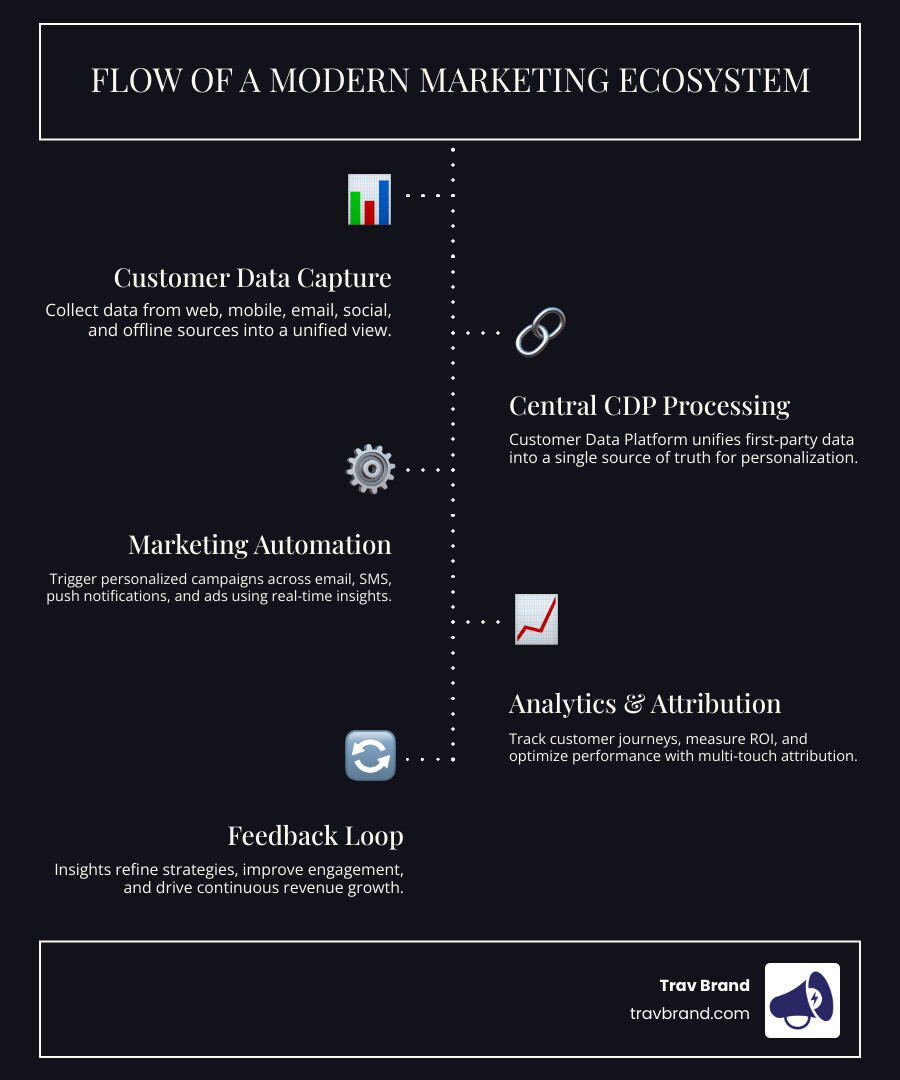
Defining Modern Marketing Ecosystem Solutions
When we talk about marketing ecosystem solutions, we are looking at something far more expansive than a simple “MarTech stack.” While the term MarTech is a common portmanteau In a world where technology is increasingly central to the way customers engage with your brand, your company’s MarTech ecosystem—aka a marketing technology ecosystem or a MarTech stack—plays a fundamental role in being able to foster meaningful customer relationships and achieve key gains incustome… of marketing and technology, an ecosystem represents the interconnected network of internal teams, external partners, and software architectures that create and share value.
According to McKinsey (2024) research on ecosystem revenue, these networked economies will account for nearly 30% of global revenue by 2030, representing more than $80 trillion. This isn’t just a trend for tech giants; it is a fundamental shift in how we approach a Digital Marketing Strategy Guide.
A true ecosystem solution isn’t just about having the latest tools; it’s about how those tools talk to each other to serve a shared mission. Without this synergy, we end up with the “average scaling company” problem—juggling 242 different SaaS tools that don’t communicate, leading to duplicated tasks and missed opportunities.
Core Components of a Marketing Ecosystem Solution
To build a high-performing system, we must understand the “pillars” that support it. These components ensure that we aren’t just shouting into the void, but actually engaging with humans in a meaningful way.
- Customer Data Platforms (CDPs): These serve as the brain of the operation. They ingest data from every touchpoint—website visits, store purchases, support tickets—to create a unified profile.
- Data Warehouses: Think of this as the library where all your raw data is stored securely. It allows for deep behavioral and product analytics that go beyond basic surface-level metrics.
- Customer Engagement Platforms: Tools like Customer engagement platforms Customer engagement platformsCustomer data platforms (CDPs)Data warehousesProduct and behavioral analytics platformsCustomer service platformsAdTech and ad retargeting toolsSocial media messaging (SMM) and social listening toolsConversion optimization tools, including UI/UX testing softwareContent m… allow us to trigger messages based on real-time behavior. If a customer abandons a cart, the engagement platform knows exactly when to send that “We missed you” SMS.
- Content Management Systems (CMS): This is where your brand voice lives. Integrating your Content Marketing Services with your tech stack ensures that the right message reaches the right person at the right time.
The Role of Data Integration and Identity
Data integration is the glue that holds marketing ecosystem solutions together. If your data is siloed, your marketing is blind. Currently, 31% of marketers admit they don’t have a single source of truth for their data, and only 27% say their data is fully integrated with their tools.
This lack of integration is why you might get an ad for a pair of shoes you already bought yesterday. It’s annoying for the customer and expensive for the brand. Most customers expect that if they message a company on social media and then call support a week later, the representative should already know the history of that conversation.
Establishing a consistent enterprise identity framework allows us to break down these silos. We use Brand Audit Services to identify where these gaps exist. By filling first-party data gaps with trusted sources, we gain a full 360-degree view of the customer, allowing for the kind of hyper-personalization that modern consumers demand.

The Strategic Importance of Integrated Ecosystems
Why go through the effort of unifying your tools and teams? Because the ROI is undeniable. When we align sales and marketing efforts within a cohesive ecosystem, we don’t just see incremental gains; we see a transformation.
Companies with strong sales and marketing alignment enjoy:
- 36% higher customer retention rates.
- 67% better close rates on deals.
- 208% increase in revenue compared to non-aligned competitors.
Despite these numbers, the “strategy gap” remains a major hurdle. A study by IBM found that 72% of employees don’t completely understand their company’s overall strategy. This is a massive internal failure. If the people building the ecosystem don’t know the goal, the ecosystem will never be efficient. Our Branding Services Complete Guide emphasizes that strategy must be the foundation before any tool is purchased.
Closing the Mobile Marketing Ecosystem Solutions Gap
One of the most significant weaknesses in modern stacks is the “mobile gap.” Many brands treat mobile as an afterthought—an extension of their desktop site. However, the modern consumer lives on their phone.
To close this gap, we need an omnichannel messaging strategy that prioritizes mobile-first engagement. This means more than just responsive design; it means utilizing push notifications, in-app messaging, and SMS in a way that feels natural, not intrusive. We often guide our clients through a Creative Agency Social Media Strategy Guide to ensure their mobile content is optimized for the platforms where their customers actually spend time.
Partnerships and Collaborative Orchestration
Success in the modern economy isn’t a solo sport. The Foundry Partner Marketing 2024 report reveals that 37% of marketing budgets are now dedicated to partner-related activities, with 62% of organizations planning to increase these investments.
Building a “brand ecosystem” means co-creating value with partners. According to WARC (2024), co-creation from the design stage increases perceived brand coherence by 24%. When you select partners who share your vision, you can leverage Brand Development Services to build a network that is greater than the sum of its parts. This collaborative dimension is what makes an ecosystem sustainable over the long term.
Best Practices for Building and Optimizing Your Stack
Building a stack is easy; building the right stack is hard. Many companies fall into the trap of “tool fatigue,” where they keep adding software to fix problems caused by the previous software.
| Feature | Single-Provider Suite | Best-in-Class (Hybrid) Stack |
|---|---|---|
| Flexibility | Low – Locked into one vendor’s roadmap | High – Swap tools as needs evolve |
| Integration | High (Native) | Medium (Requires CDPs/APIs) |
| Innovation | Slower – Vendor must update everything | Fast – Use the best tool for each task |
| User Experience | Consistent | Variable |
| Cost | Bundled (Can be cheaper or hidden) | Transparent per-tool costs |
We generally recommend a hybrid approach. This allows you to use the best possible tool for specific tasks—like using a specialized platform for mobile engagement while keeping your core data in a robust warehouse.
To avoid information overload, we must ensure that teams are only sharing the data they actually need to act. Too much noise leads to “dashboard blindness,” where no one knows which metrics actually matter. We use Brand Positioning Services to help brands identify their North Star metrics so they can cut through the clutter.
Future-Proofing for 2025 Trends
As we look toward 2025, the landscape of marketing ecosystem solutions is shifting toward AI-driven orchestration. CMSWire asked C-suite executives what shifts they expect to see in marketing technology in 2025, and the consensus is clear:
- AI Hyper-Personalization: Moving beyond “First Name” tags to predictive content delivery.
- First-Party Data Dominance: As third-party cookies vanish, your internal data ecosystem becomes your most valuable asset.
- Unified Stacks: A move away from fragmented tools toward platforms that offer end-to-end visibility.
Staying ahead means implementing 10 Effective Digital Marketing Strategies for 2025 and Beyond, focusing on predictive analytics and “owned” digital footprints.
Measuring ROI and Streamlining Operations
If you can’t measure it, you shouldn’t be doing it. Measuring ROI in a complex ecosystem requires sophisticated attribution models that look at the entire journey, not just the last click.
We’ve seen Customer Acquisition Costs (CAC) skyrocket recently. To combat this, we look at the Building Ecosystem Brands Playbook (2024) which suggests shifting focus toward Lifetime Value (LTV) and retention. By using Brand Transformation Services, we help companies move from “buying customers” to “building relationships,” which is a much more sustainable way to grow.
Frequently Asked Questions about Marketing Ecosystems
What is the difference between a MarTech stack and a marketing ecosystem?
A MarTech stack is a collection of tools. A marketing ecosystem is the broader environment where those tools, the people who use them, the data they generate, and the external partners involved all interact to create value. Think of the stack as the “equipment” and the ecosystem as the “entire league, the fans, and the stadium.”
How do I identify a disconnected marketing ecosystem?
The signs are usually internal frustration and external inconsistency. If your teams are constantly duplicating tasks, if you have no “single source of truth” for data, or if your customers are receiving conflicting messages across different channels, your ecosystem is disconnected. A diminished ROI despite high spend is the ultimate red flag.
What budget allocation is recommended for a new marketing ecosystem?
While every business is different, a healthy starting point is often the 45/45/10 rule:
- 45% for User Acquisition: Finding new customers.
- 45% for Re-engagement and Retention: Keeping the ones you have.
- 10% for Testing and New Tools: Innovation and future-proofing. As your ecosystem matures, you should see the retention budget become more efficient, allowing for more experimentation.
Conclusion
Building a high-performing marketing ecosystem is no longer a luxury; it is a requirement for survival in a digital-first world. The complexity of modern consumer behavior means that siloed, “old-school” marketing tactics simply won’t cut it anymore. We need systems that are agile, data-driven, and, most importantly, human-centric.
At Trav Brand, we don’t just consult on these problems—we build the solutions. We specialize in scaling purpose-driven brands by creating comprehensive digital marketing and e-commerce ecosystems that focus on measurable results. Whether you need to unify your data, optimize your mobile strategy, or completely transform your brand identity, we provide the strategy and the execution to make it happen.
Are you ready to stop managing a collection of tools and start orchestrating a growth engine? Partner with Trav Brand for comprehensive marketing ecosystem solutions and let’s build something that lasts.