
Ecommerce Brand Development 101
Unlocking Your Potential with Ecommerce Brand Development
In today’s crowded online marketplace, ecommerce brand development is no longer optional; it’s essential for survival and growth. It’s about much more than just a logo or a product.
So, what exactly is ecommerce brand development? It’s the process of:
- Defining Your Identity: Clearly stating who you are and what you stand for.
- Crafting Your Promise: Communicating a unique value that sets you apart.
- Shaping Perception: Controlling how customers see, feel, and think about your business.
- Building Trust: Creating consistent experiences that foster loyalty.
- Standing Out: Differentiating your store in a fiercely competitive digital world.
The e-commerce landscape is booming. Billions of users mean trillions in sales worldwide. But this growth also means intense competition. As one expert puts it, “A business without a brand is a ship without a sail – it floats adrift without a clear direction.” You need to capture attention and build lasting connections.
Customers expect more than just good products or prices. They look for authenticity, with 91% saying it’s crucial for trusting a brand. They want to connect with a story they love; 55% are more likely to buy from brands with compelling narratives. Your brand is the promise you make and the consistency with which you keep it.
As an entrepreneur, investor, and advisor, I’ve spent my career helping companies scale and build impactful brands, including through specialized ecommerce brand development. My agency, Trav Brand, focuses on guiding businesses through strategy, brand development, and performance marketing to achieve significant growth.
What is E-commerce Branding and Why Does It Matter?
At its core, branding is the “gut feeling” a person has about your business. While “brand” is the perception held by the public, “branding” is the active set of steps you take to shape that perception. In the digital world, where you can’t greet a customer at the door with a smile, your brand has to do all the heavy lifting of building confidence.
Why does this matter so much? Because the market is saturated. In 2018, e-commerce sales grew by 23.3%, and the global value has since soared past $4 trillion. To survive this gold rush, you need more than just a checkout button. You need The Power of Branding: How to Create a Memorable Ecommerce Brand.
A strong brand creates brand equity. This is the commercial value derived from consumer perception rather than the product itself. High brand equity means your customers are less price-sensitive; they aren’t just looking for the cheapest option—they are looking for your option. By utilizing Branding Services Complete Guide, you can move from being a commodity to a household name. 91% reporting authenticity is essential means that if you aren’t real with your audience, they’ll find someone who is.
The Role of Trust in Ecommerce Brand Development
In e-commerce, trust is the primary currency. Without a physical storefront, customers are essentially sending money into the “cloud” and hoping a box shows up. This requires immense digital confidence.
We know that 55% of consumers are more likely to make a purchase if they love a brand’s story. This isn’t just about “About Us” pages; it’s about An Essential Guide to Purpose-Driven Branding. When your brand has a clear purpose—like a commitment to sustainability or solving a specific, frustrating problem—you create an emotional connection. Reliability and authenticity aren’t just buzzwords; they are the foundation of loyalty. If you promise two-day shipping and a “no-hassle” return, keeping that promise is your branding.
The Strategic Foundation of Ecommerce Brand Development
Before you pick out your favorite shades of blue for a logo, you must lay a strategic foundation. Many businesses make the mistake of jumping into tactics before strategy. We believe that successful ecommerce brand development starts with two questions: Who are you selling to? and Why should they care?
This involves deep market research and the creation of detailed buyer personas. You need to understand the difference between demographics and psychographics:
| Feature | Demographics | Psychographics |
|---|---|---|
| Focus | Who they are (Age, Gender, Location) | Why they buy (Values, Pain Points, Aspirations) |
| Example | 30-year-old female in London | Values sustainability and time-saving tools |
| E-commerce Use | Ad targeting parameters | Copywriting tone and brand story |
Once you know who they are, you must define your unique value proposition (UVP). Your UVP is a summary of what makes you better or different. This is where Brand Positioning Services come into play, helping you find that “white space” in the market that competitors have ignored. If your brand is currently feeling a bit generic, Brand Transformation Services can help pivot your messaging to reach the right people.
Identifying Your Target Audience
Understanding your audience goes beyond knowing they have a credit card. You need to use social listening to find out where they hang out—be it Reddit, Instagram, or niche forums. For example, millennial brand loyalty is driven by reliability (68%) and quality (54%), rather than just the lowest price (only 24%).
By Understanding Ecommerce and Funnels, we can map out the customer journey from the first time they see an ad to the moment they become a repeat buyer. Data-driven insights allow us to see which pain points are driving them away and which aspirations are drawing them in. Are they looking for status? Convenience? Or perhaps a sense of belonging to a community?
Defining Your Unique Value Proposition
As Jeff Bezos once said, “Your brand is what people say about you when you’re not in the room.” To control that conversation, you need a provable point of difference.
Don’t just claim to have “high quality”—everyone says that. Instead, find a market gap. Maybe it’s an unboxing experience that feels like a gift, or a “pro-science” approach in an industry full of fluff. A Brand Audit Services check can reveal if your current brand promise is actually being felt by your customers or if it’s just words on a screen.
Building a Strong E-commerce Brand Identity
Identity is the visual and verbal “suit” your brand wears. It needs to be consistent, professional, and evocative. Did you know that 90% of customers make snap buying decisions based on color alone? This is color psychology in action.
You don’t need to be a master designer to start; you can use an online photo editor to maintain high-quality imagery. However, you do need a plan. The Essential Foundation: Why Your Brand Needs a Brand Guide explains that a style guide ensures your typography, palette, and logo usage remain the same whether a customer is on your website or looking at a Facebook ad. Consistency builds the subconscious recognition that leads to trust.
Crafting Your Brand Voice and Story
How does your brand speak? Is it witty and bold? Expert and reassuring? Or warm and encouraging? Developing a distinct brand voice is a powerful differentiator.
Your story should follow a narrative arc where the customer is the hero, and your brand is the guide helping them overcome a challenge. Look at various mission statement examples to see how powerful words can be when they align with business motives. Once you have this voice, you can apply it to How to Write E-Commerce Content Marketing That Converts, ensuring that your product descriptions and emails all sound like they are coming from the same “person.”
Essential Design Elements for Ecommerce Brand Development
When it comes to your logo and name, we recommend the “SSS rule”: Short, Simple, and Sensible. Look at the Source Example of brand guidelines from major players; they often start with a complex logo and evolve into something simpler as they grow.
Don’t forget the physical touchpoints. Since e-commerce lacks an in-store experience, the unboxing experience is your “grand opening.” Branded packaging, a handwritten note, or even a specific scent can make a customer feel valued. Finally, ensure everything is mobile-optimized. Why Most Shopify Stores Underperform (And How to Fix Them) often highlights that a poor mobile experience kills even the best branding efforts.
Scaling Your Brand Through Content and Experience
Scaling is where the rubber meets the road. You need to move from attracting visitors to fueling demand generation. This is done through consistent, high-quality content that resonates with your audience.
Social proof is your best friend here. We know that 89% of consumers buy from brands they follow on social media. By encouraging user-generated content (UGC), you let your customers do the branding for you. Seeing a “real person” use your product is worth more than a thousand professional photos. Implementing Ecommerce Conversion Best Practices ensures that once that social proof brings them to your site, the path to purchase is seamless. You can see examples of this in action in our Portfolio Categories E-Commerce.
Leveraging Social Media and Advertising
Social media isn’t just for posting; it’s for community building. Whether you are using localization strategies to reach international markets or partnering with influencers who share your values, your presence must feel authentic.
Think about this video example of a brand that went viral by being unapologetically itself. That’s the power of personality. For those looking to optimize their spend, our Ecommerce Conversion Optimisation Companies Guide offers insights into how to turn that social engagement into hard sales. You can explore more strategies in our Category Ecommerce section.
Frequently Asked Questions about E-commerce Branding
What are the “Three Cs” of e-commerce?
The “Three Cs” are Controls, Costs, and Consumer connections.
- Controls refers to your ability to manage your inventory and brand message.
- Costs involves managing your margins and acquisition spend.
- Consumer connections is the most vital—it’s the relationship and trust you build with your audience.
How do I brand my online store from scratch?
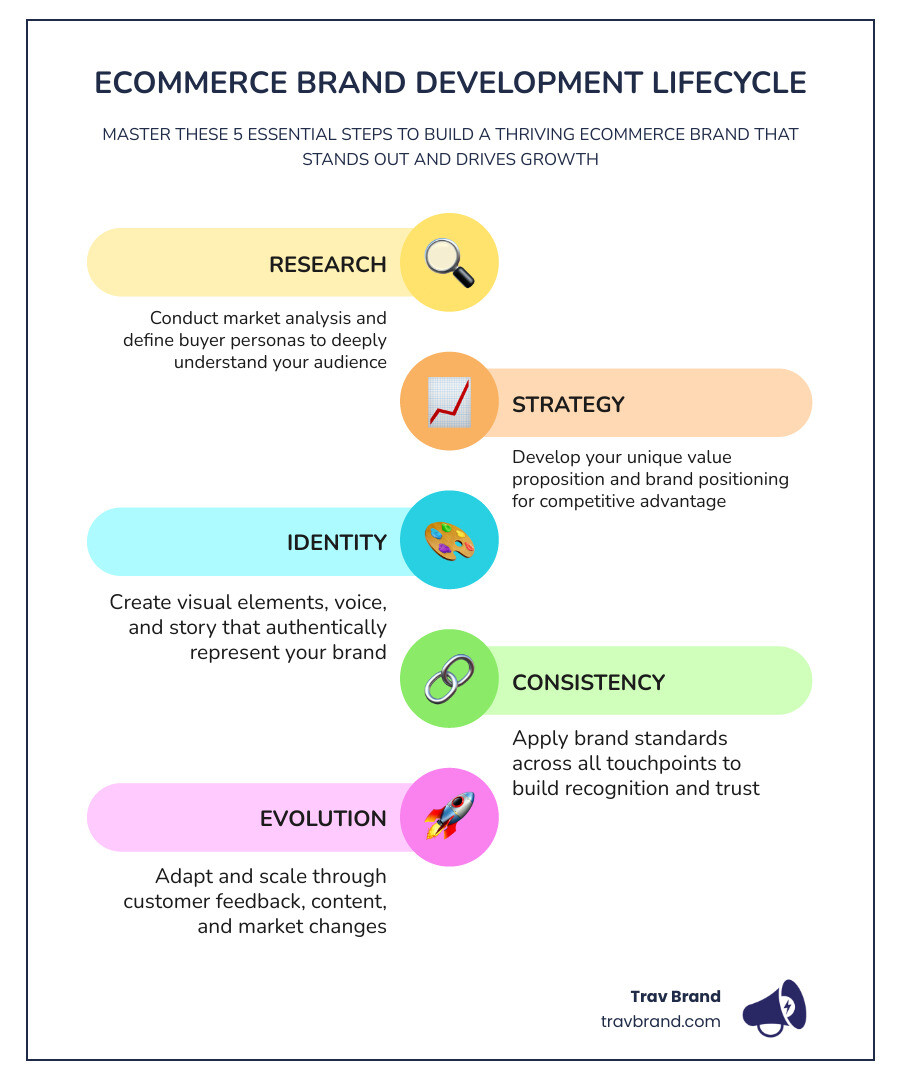
Start with audience research to find a gap in the market. Move into identity design (name, logo, colors) that reflects your UVP. Apply this identity consistently across your website and social channels. Finally, manage your reputation by listening to customer feedback and adapting as you grow.
What makes a good e-commerce brand?
A good brand offers a positive, frictionless experience. It has consistent visuals that are instantly recognizable and resonant messaging that speaks to the customer’s needs. Above all, it has authenticity—it does what it says it will do.
Conclusion
Building a brand is a marathon, not a sprint. It’s a long-term investment that requires constant market adaptation and brand evolution. At Trav Brand, we don’t just give you a “to-do” list; we build the ecosystem that allows your brand to thrive.
From the initial strategy to the final unboxing, every touchpoint is an opportunity to reinforce who you are. If you’re ready to stop being “just another store” and start being a brand people remember, explore our Ecommerce Brand Development Services. Let’s build something that lasts.