Checkout Chaos to Conversion King: Mastering Your Ecommerce Funnel
Why Your Conversion Funnel Is the Make-or-Break of Your Business
Optimize conversion funnel strategies are essential for turning website traffic into paying customers and maximizing your return on every marketing dollar spent. Here’s how to get started:
Quick Steps to Optimize Your Conversion Funnel:
- Map your funnel stages – Identify Awareness, Interest, Desire, and Action touchpoints
- Audit for drop-offs – Find where users abandon the journey using analytics tools
- Fix friction points – Streamline forms, improve page speed, add trust signals
- Test systematically – A/B test one element at a time (headlines, CTAs, layouts)
- Measure what matters – Track conversion rate, bounce rate, and cart abandonment by stage
Would you ever think that changing one word in a signup form could result in a double-digit increase in conversions? It happens all the time.
Yet most founders are stuck in what I call “checkout chaos”—watching traffic pour in while conversions trickle out. You’re spending money on ads, pouring energy into content, and driving visitors to your site. But somewhere between that first click and the final purchase, people just… disappear.
The truth is simple: Traffic without conversion is just expensive window shopping.
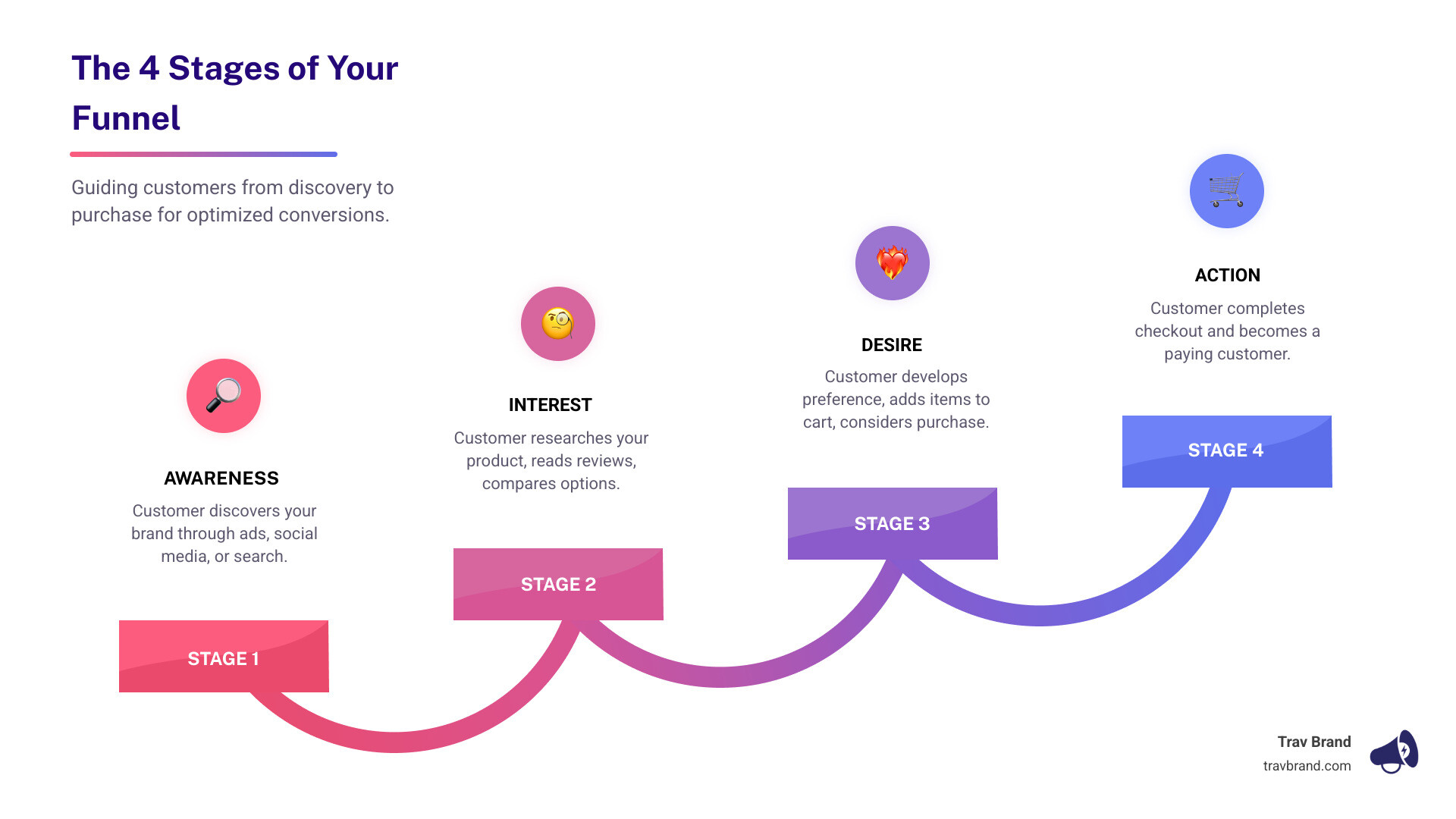
A conversion funnel is the step-by-step path your potential customers follow from first finding your brand to taking a desired action—usually making a purchase. Think of it as a guided journey with four key stages based on the proven AIDA model: Awareness (they find you exist), Interest (they want to learn more), Desire (they’re seriously considering buying), and Action (they complete the purchase).
Here’s why this matters: Nearly 70% of online shoppers abandon their carts due to long forms and tedious checkout processes. And it gets worse—73% of leads aren’t even ready to buy when they first encounter your brand. That means your funnel needs to do the heavy lifting of guiding, nurturing, and converting at every single stage.
When you optimize your conversion funnel, you’re not just tweaking a few buttons or changing colors. You’re systematically removing friction, answering objections, and making it easier for people who already want what you offer to actually buy it. The result? More customers, higher average order values, and a significantly better return on your marketing investment.
I’m Trav Lubinsky, and I’ve spent years building and scaling consumer brands from Flex Watches to working with billion-dollar companies on their growth strategies. Through Trav Brand, I help founders optimize conversion funnels by combining brand strategy with performance marketing to turn traffic into revenue.
Understanding Your Funnel: The Blueprint for Conversions
Imagine your customer’s journey as a grand, sprawling epic. They encounter your brand, explore its offerings, and eventually (hopefully!) become a loyal customer. A conversion funnel, on the other hand, is a gripping short story within that epic. It’s a focused narrative that maps the critical scenes guiding a potential customer towards a singular goal: conversion. While the customer journey encompasses every touchpoint from initial curiosity to loyalty and advocacy, the conversion funnel distills this into a precise path designed to maximize efficiency.

At Trav Brand, we break down this journey into typical stages, often aligning with the classic AIDA model:
- Awareness (Top of Funnel – TOFU): This is where potential customers first find your brand. They might be looking for solutions to a problem, or simply stumble upon your content. At this stage, buyers become aware of their problem and seek solutions. Our goal here is to attract attention, educate, and make a memorable first impression. Content at this stage should be informative, relevant, and consistent. This video we created at Matomo is a prime example of awareness-stage content, grabbing attention and educating viewers about Matomo.
- Interest (Middle of Funnel – MOFU): Once aware, prospects start to explore. They’re piqued, comparing options, and seeking more information. Here, interest is piqued, and leads might exchange contact information for valuable resources. We reinforce trust, nurture leads, and monitor their purchase intent. Content should answer questions, address concerns, and provide value.
- Desire (Middle of Funnel – MOFU): At this point, potential customers develop a preference for your product or service. They envision themselves enjoying what you offer, and their intent to buy solidifies. We focus on showcasing benefits and unique value propositions. Content should provide value and encourage action.
- Action (Bottom of Funnel – BOFU): This is the moment of truth—the commitment stage. Leads are ready to make a purchase or complete another desired action. We apply a sense of urgency to reminder emails, promotional offers, and retargeting ads. Content at this stage needs to be clear, compelling, and remove any remaining friction.
The role of content is paramount at each stage. In the Awareness stage, it’s all about telling an intriguing brand story and humanizing your brand to build connection. As they move to Interest, tailor content, ads, and offers to address specific needs. In the Desire stage, provide testimonials, case studies, and social proof to solidify their choice. Finally, in the Action stage, simplify the process to make it painless. This guided content strategy is how we ensure smooth sailing through the funnel.
Why Funnel Drop-Offs Happen
Even the most carefully crafted conversion funnel can have its leaks. We’ve all been there, browsing online, getting excited about a purchase, only to abandon our cart at the last minute. This “checkout chaos” is more common than you might think. Nearly 70% of internet shoppers leave their carts because of lengthy forms and painful checkout processes. This staggering statistic alone highlights a major friction point.
But it’s not just about the checkout. High drop-off rates can occur at any stage due to several common challenges:
- Not offering the next step: Users interact with your content, but then what? If there’s no clear path forward, they’ll wander off.
- Poor communication of benefits: In the Interest or Desire stages, if your message isn’t clearly articulating the value and unique selling points of your offer, prospects will lose interest.
- Complicated action stage: This is the big one. Lengthy forms, unexpected shipping costs, forced account creation, or confusing payment options can quickly turn desire into frustration.
- Fundamental issues: Sometimes, it’s not about persuasion but basic functionality. Bugs, poor mobile responsiveness (accessibility), or confusing navigation (usability) are silent killers of conversions.
It’s also important to remember that not every lead is ready to buy immediately. As many as 73% of leads are not even ready to be sold. This means patience and continuous nurturing are key. Our funnel needs to be designed to accommodate these different levels of readiness, guiding prospects gradually rather than forcing them into a premature decision. Identifying where these leaks occur and why is the first step to plugging them and turning chaos into conversion.
How to Optimize Your Conversion Funnel at Every Stage
Optimizing your conversion funnel isn’t a one-and-done task; it’s a continuous process of refinement, testing, and learning. At Trav Brand, we approach this systematically, focusing on specific strategies for each stage of the funnel to maximize impact.
Top of Funnel (TOFU): Attracting the Right Audience
The top of your funnel is all about casting a wide, yet targeted, net. It’s where potential customers first become aware of your brand, and your goal is to grab their attention and make them want to learn more.
- Audience Segmentation: Not all traffic is created equal. We segment your target audience based on demographics, interests, behaviors, and even how they found you. This allows us to tailor messaging, ads, and content, ensuring we’re speaking directly to their needs. For example, creating separate funnels for first-time visitors versus repeat customers can yield significantly different results.
- Creating Brand Value and Community Culture: In a crowded market, simply existing isn’t enough. We help you create brand value by focusing on informative, educational content that solves customer problems. Beyond that, fostering a sense of community around your brand can be incredibly powerful. A study found that 74% of consumers are more likely to trust a brand when they feel they are part of a community. Building a community for your customers not only increases brand loyalty but can also act as free marketing as they become advocates.
- Social Proof: People trust other people. Leveraging social proof, such as testimonials, reviews, and case studies, right from the awareness stage builds immediate credibility. 90% of prospects trust suggestions from family and friends. Highlighting positive experiences early can make a big difference.
- Content Marketing: At the TOFU, content should be engaging and educational, not overtly salesy. Think blog posts, infographics, short videos, and social media content that introduces your brand, addresses common pain points, and starts to position you as an authority. This is where you tell your intriguing brand story and humanize your brand.
Middle of Funnel (MOFU): Nurturing Interest and Desire
Once you have a prospect’s attention, the MOFU is where you nurture their interest and build desire for your product or service. This is about providing value, answering questions, and demonstrating why you’re the best solution.
- Lead Magnets: These are invaluable for capturing contact information and moving prospects further into the funnel. We design high-intent lead magnets such as free trials, demo sessions, special offers, discounts, e-books, webinars, or workshops. The key is to offer something genuinely valuable in exchange for their information.
-
Landing Page Optimization: Your landing pages are critical MOFU assets. We analyze them thoroughly to ensure they’re doing their job. This includes optimizing for speed, readability, and mobile responsiveness. Every element, from the headline to the call-to-action, must be aligned with the user’s intent and the ad they clicked.
Here are key elements we analyze on landing pages:
- Headlines: Are they clear, compelling, and value-driven?
- Copy: Is it concise, benefit-oriented, and easy to scan?
- Color & Font Style/Size: Do they improve readability and brand consistency?
- Unique Value Proposition (UVP): Is it immediately obvious what makes you different and better?
- Visuals: Are images and videos high-quality, relevant, and engaging?
- Call-to-Action (CTA): Is it prominent, action-oriented, and clear?
- Social Proof: Are testimonials, awards, or trust badges strategically placed?
- Forms: Are they simple, asking only for essential information?
- Purchase Path: Is the journey from landing page to desired action smooth and intuitive?
For more insights into our approach, you can find more info about our portfolio here: More info about our portfolio
- Personalized Email Marketing: Once you’ve captured an email, the real nurturing begins. We create personalized email sequences that guide leads through the funnel, delivering relevant content, addressing potential objections, and building a relationship. Personalized product recommendations can further improve this experience.
- Dynamic Text Replacement: For paid campaigns, dynamic text replacement can significantly boost relevance. This technology automatically switches text on your landing page to match the prospect’s search terms or ad copy, making the message more personal and specific to their needs. This level of personalization can dramatically increase conversions.
Bottom of Funnel (BOFU): Sealing the Deal
The BOFU is where prospects become customers. This stage demands absolute clarity, minimal friction, and a strong sense of trust and urgency. This is where we turn desire into action.
- Streamlining Checkout: This is arguably the most critical area for optimization. Nearly 70% of internet shoppers leave their carts because of lengthy forms and painful checkout processes. We evaluate your sign-up forms and checkout process to make them quick and painless. This means:
- Allowing guest checkout.
- Supporting 1-click payment options.
- Removing unnecessary fields and leveraging auto-fill.
- Offering flexible payment options (e.g., Afterpay, Klarna).
- Showing clear progress indicators during checkout.
- Adding trust signals like payment logos and security badges.
- Simplifying Sign-Up Forms: Whether it’s for a newsletter or an account, forms must be as simple as possible. We only include essential information, use clear headlines, and test different text box wording and placement. Multi-step forms (the “breadcrumb technique”) can also be effective, starting with low-threat questions and gradually building commitment.
- Exit-Intent Technology: Don’t let those almost-converters slip away! Exit-intent technology detects when a user is about to leave your site and can trigger a popup offering a discount, a free resource, or a reminder about their cart. This is a powerful tool to capture leads or recover abandoned carts, providing one last chance to convert.
The Analyst’s Toolkit: Measuring and Testing for Success
Optimizing your conversion funnel is a data-driven sport. Without precise measurements and rigorous testing, you’re just guessing. We empower our clients with the tools and insights to understand exactly what’s happening at each stage.
- Funnel Auditing: Regularly auditing your conversion funnel is like giving your business a health check-up. We perform comprehensive CRO audits to identify weak points, inefficiencies, and hidden obstacles. This involves a deep dive into user behavior, design elements, copywriting effectiveness, and funnel progression.
- Setting Clear KPIs: For every stage of the funnel, we establish clear Key Performance Indicators (KPIs). These might include click-through rates, bounce rates, time on page, cart abandonment rates, and, of course, conversion rates. Setting specific, measurable goals allows us to track progress and celebrate wins.
- Conversion Funnel Analysis: This is the practice of tracking and reviewing how potential customers progress through your funnel. Conversion funnel analysis lets you take a close look at the buyer journey, identifying points in the process where customers lose interest. It examines the specific steps that potential customers take, helping to identify where they convert and where they drop off. We sync marketing and product efforts by analyzing this data, aligning strategies and identifying areas for improvement.
- Heatmaps: Ever wished you could see through your users’ eyes? Heatmapping software tracks and visualizes user interactions on a webpage, showing exactly where users click, scroll, and hover. This invaluable visual data helps us understand how users are engaging (or not engaging) with your content.
- Session Replays: Taking it a step further, session replays allow us to watch anonymized recordings of actual user sessions. This is like having a digital security camera on your website, letting us see precisely why customers drop off, what friction points they encounter, and how they steer through your site.
- Syncing Marketing and Product Efforts: Conversion funnel analysis is a powerful bridge between marketing and product teams. By revealing the effectiveness of marketing strategies and identifying areas for product improvement (e.g., a confusing UI element), it ensures both teams are working towards the same conversion goals. Establishing clear communication and shared objectives is crucial for success.
How to effectively optimize your conversion funnel with A/B testing
A/B testing (also known as split testing) is our secret weapon for continuous improvement. It’s a scientific method to test the performance of two versions of a web page, an email, or an ad to determine which one performs better. The beauty of A/B testing is its simplicity: change one variable at a time, split your traffic, and let the data tell you the winner.
We use A/B testing to optimize various elements, including:
- Testing Headlines: A compelling headline can dramatically increase engagement. We test different headline variations to see which resonates most with your audience, leading to higher click-through rates and further engagement.
- Testing CTAs: The call-to-action button is often the most critical element on a page. We experiment with different CTA text, colors, sizes, and placements to find what drives the most conversions. Even changing one word can make a significant difference!
- Testing Page Layouts: Sometimes, a subtle rearrangement of elements can improve user flow and reduce friction. We test different page layouts, image placements, and content organization to create the most intuitive and conversion-friendly experience.
Tools like VWO (for website testing) allow us to set up and run these tests efficiently, ensuring statistical significance and reliable results.
Best practices to optimize your conversion funnel with website speed
Speed isn’t just a luxury; it’s a necessity. The impact of website speed on conversion rates cannot be overstated. A one-second delay in page response can result in a 7% reduction in conversions. To put that in perspective, when Firefox reduced its average load time by 2.2 seconds, they increased conversions by an impressive 15.4%.
This statistic powerfully illustrates why we prioritize page load time. Every millisecond counts.
Here’s how we improve site speed:
- Optimizing Images: Large, uncompressed images are often the biggest culprits for slow loading times. We ensure all images are properly sized, compressed, and use modern formats like WebP.
- Minifying Code: Unnecessary characters in HTML, CSS, and JavaScript files can add bloat. We minify these files to reduce their size without affecting functionality.
- Leveraging Browser Caching: By allowing browsers to store certain elements of your site, we reduce the amount of data that needs to be downloaded on subsequent visits.
- Using a Content Delivery Network (CDN): CDNs distribute your website’s content across multiple servers globally, delivering it faster to users based on their geographic location.
- Improving Web Hosting: A robust and responsive hosting provider is foundational to good site speed. We recommend and help implement high-performance hosting solutions.
To get a quick glance at your website’s speed, Google offers a free tool called PageSpeed Insights, which assesses performance based on what they call Core Web Vitals. We use these metrics as a benchmark to ensure your site is not just fast, but optimally fast for your users.
Frequently Asked Questions about Funnel Optimization
What are the typical stages of a conversion funnel?
The most common model, and one we frequently use, is AIDA: Awareness, where a user first finds your brand; Interest, where they research and consider their options; Desire, where they develop a preference for your product; and Action, where they make the purchase. Some models also include a Re-engage or Loyalty stage to emphasize post-purchase customer relationships.
What are the most common reasons for drop-off in a conversion funnel?
Common reasons for drop-off are multi-faceted. They include a complicated or lengthy checkout process, unexpected costs (like high shipping fees), poor website speed, lack of clear trust signals (e.g., security badges, customer reviews), content that doesn’t match user intent at a specific stage, and fundamental website issues like bugs, poor accessibility, or confusing navigation. Essentially, anything that creates friction or confusion can lead to abandonment.
What is a good conversion rate for a funnel?
While it varies significantly by industry, product, and traffic source, a good benchmark for many e-commerce sites is a conversion rate of 2% or higher across the entire funnel. However, it’s more impactful to focus on continuous improvement against your own historical data rather than chasing a generic industry average. What truly matters is the profitability and efficiency of your funnel, not just a raw percentage.
Conclusion
Mastering your e-commerce funnel is no longer optional; it’s the bedrock of sustainable business growth. We’ve explored how to transform “checkout chaos” into conversion gold by understanding each stage of the funnel, identifying common drop-off points, and implementing targeted optimization strategies.
The key takeaways are clear:
- Understand Your Customer’s Journey: Distinguish between the broad customer journey and the focused conversion funnel.
- Optimize Every Stage: From attracting the right audience at the TOFU with strong brand value and social proof, to nurturing interest and desire in the MOFU with lead magnets and personalized content, to finally sealing the deal in the BOFU with streamlined checkouts and exit-intent strategies.
- Accept Data and Testing: Make data-driven decisions using analytics, heatmaps, and session replays. A/B test relentlessly, focusing on elements like headlines, CTAs, and page layouts.
- Prioritize User Experience: Website speed is paramount, as even a one-second delay can significantly impact conversions.
At Trav Brand, we believe in the power of data-driven decisions and continuous improvement. We partner with purpose-driven brands to build and scale through comprehensive digital marketing, e-commerce, and content strategies, ensuring every step of your funnel is optimized for measurable results.
Ready to turn your traffic into revenue? Get a custom marketing plan custom to your business, or explore our ecommerce strategies to see how we can transform your funnel into a conversion king.