Unlock Your Sales: The Secrets of Stellar Email Copywriting
Why Email Copywriting Powers Modern Business Growth
Email copywriting is the art of writing persuasive content for marketing emails that drives recipients to take a specific action, like making a purchase or engaging with your brand. It’s a strategic approach to building relationships and generating revenue.
Quick Answer: What is Email Copywriting?
Email copywriting involves crafting four core components:
- Subject Lines – Compelling hooks that get emails opened (36-70 characters ideal)
- Email Body – Clear, engaging content that addresses customer needs and pain points
- Call-to-Action (CTA) – Direct prompts that guide readers to take specific actions
- Personalization – Custom messaging that makes customers feel valued and understood
The numbers are powerful: email marketing delivers an ROI of $42 for every $1 spent, making it one of the most profitable channels available. Despite this potential, many businesses struggle to write emails that convert. Their messages get ignored, deleted, or marked as spam.
The difference between emails that drive sales and those that fall flat often comes down to copy. Well-written email copy feels like a conversation, not a sales pitch. It addresses real problems, offers genuine value, and makes taking action feel natural.
I’m Trav Lubinsky, and over the past decade I’ve helped brands from Star Wars to Poppi craft email copywriting strategies that turn subscribers into loyal customers. Through Trav Brand, I’ve seen how the right words in the right inbox can transform struggling campaigns into revenue-generating machines.
Anatomy of a High-Converting Email
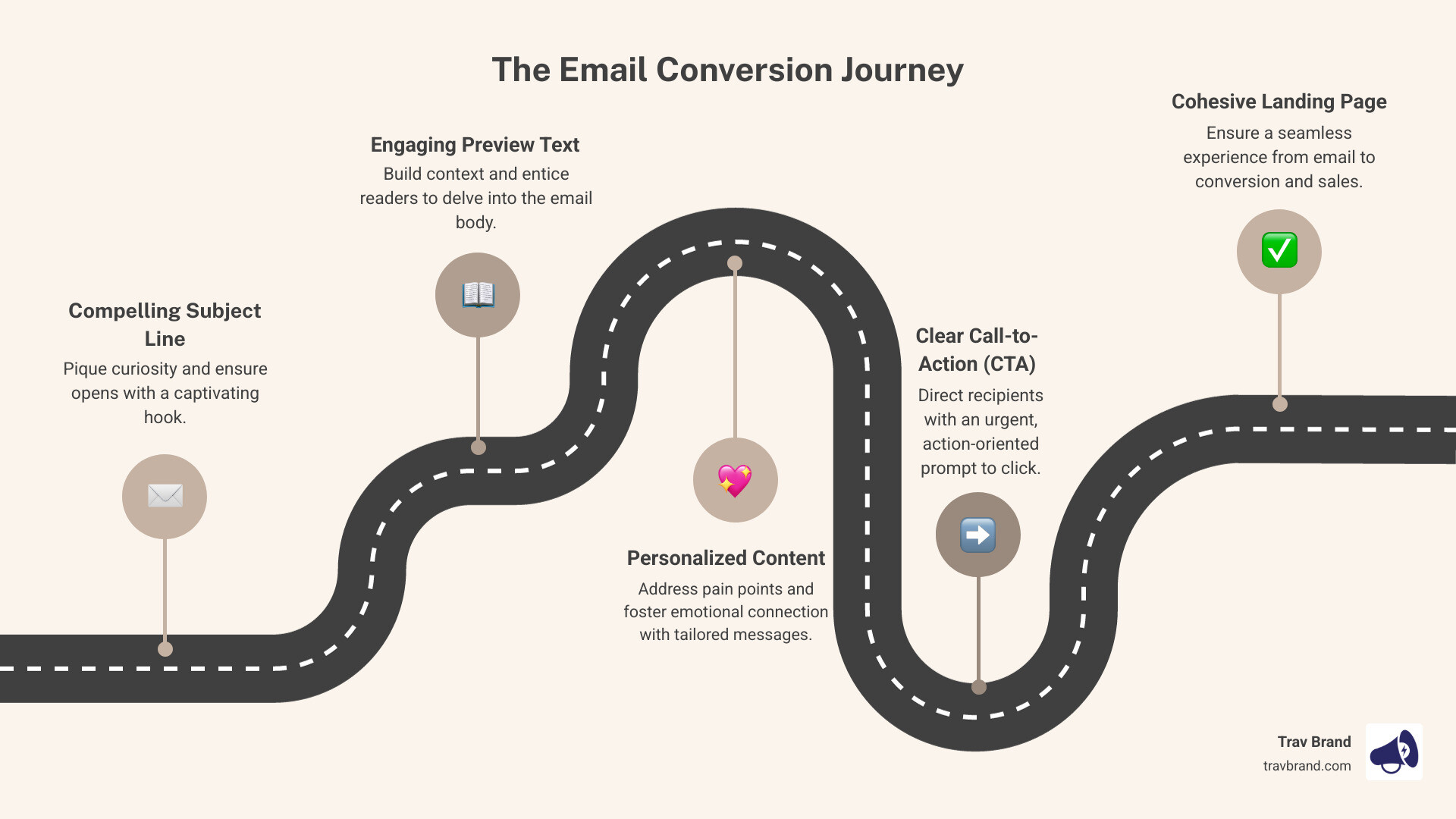
Every successful email is built on carefully crafted elements that work together to get your message opened, read, and acted upon.
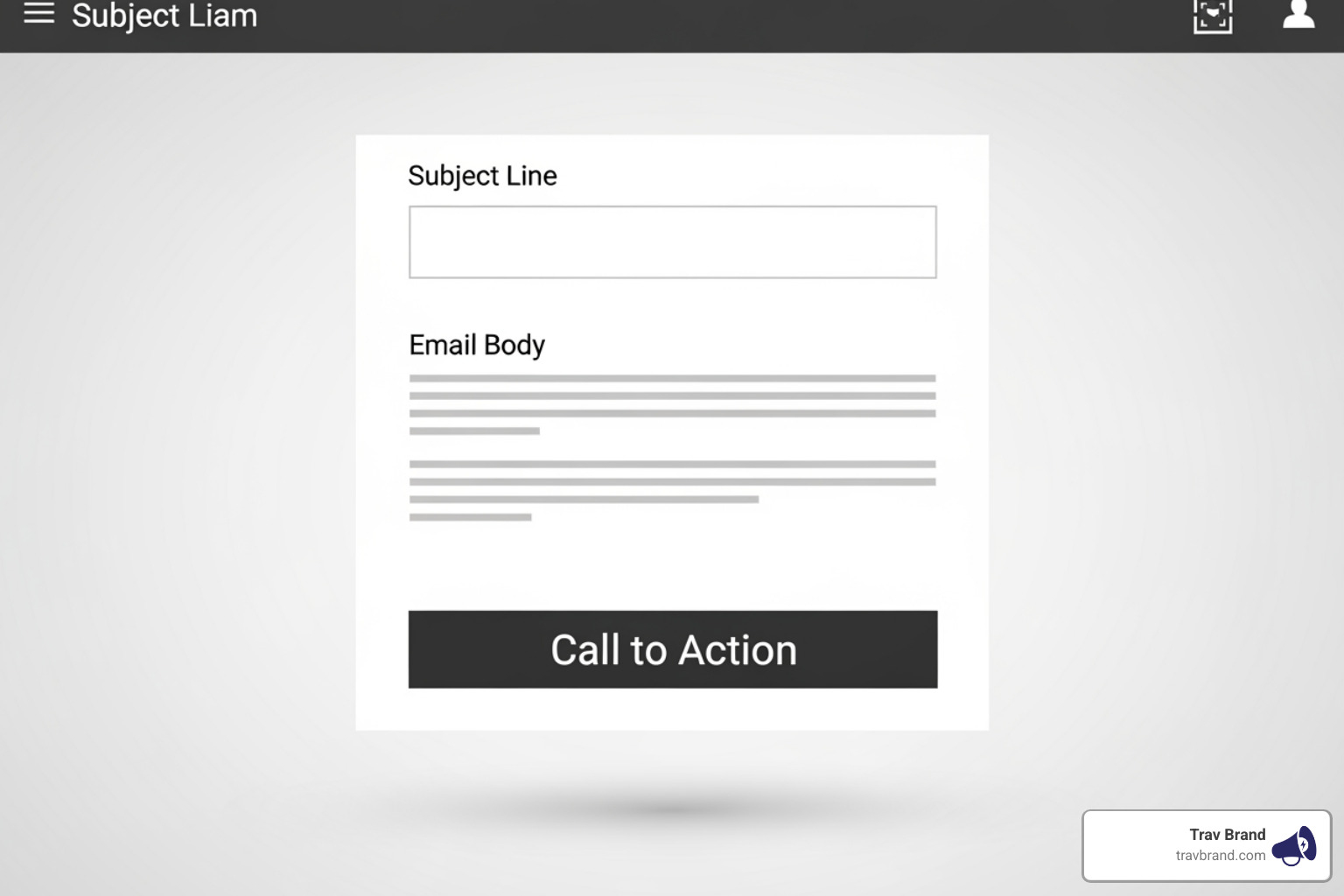
The Critical First Impression: Subject Line & Preview Text
Our journey to a high-converting email begins before the recipient even opens it. The subject line and preview text are our first—and often only—chance to grab attention in a crowded inbox. The average open rate for emails hovers around 20.81%, but we can do better with the right approach.
The subject line is a compelling hook that must cut through the noise. We aim for subject lines that are ideally between 36-70 characters to ensure they’re fully visible on most mobile devices. Why? Because mobile readers often spend only a few seconds per email, and if they can’t see our full message, we’ve lost them.
A great subject line creates curiosity. It doesn’t give everything away but hints at the value inside. We’ve seen that subject lines using numbers can have 57% better open rates, because they stand out visually and provide concrete information. For example, “7 Ways to Boost Your Sales This Quarter” is often more effective than “Boost Your Sales This Quarter.”
The preview text (or preheader text) works hand-in-hand with the subject line. It’s that short snippet of text that appears next to or below the subject line in the inbox. This is our opportunity to offer additional context or build on the curiosity. If our subject line is the headline, the preview text is the sub-headline, giving a little more flavor to the email copy. Together, they form a powerful duo for getting that crucial first click.
The Core Message: Crafting an Engaging Email Body
Once opened, the email body must deliver on the subject line’s promise, engage the reader, and build a connection. The core message should always provide relevant information that genuinely interests the reader, presenting a clear value proposition or update.
Our goal here is to make the email about the reader, not just about us. This is where personalization shines. We’ve learned that 91% of customers are more likely to do business with companies that offer personalized experiences. This goes beyond just using their first name; it means tailoring content based on their past behavior, preferences, or demographic information. When we make the message directly relevant to “you,” we’re speaking to their needs and making them feel understood.
Readability and scannability are paramount, especially given that mobile readers spend only a few seconds per email. We optimize our copy for quick digestion:
- Short paragraphs: Break up text into digestible chunks.
- Bullet points: Highlight key information and benefits.
- Bold text: Emphasize crucial phrases or calls to action.
- Whitespace: Give the eyes room to breathe.
Your readers are probably skimming your email, which means your copy should be optimized for that. We strive for clarity, conciseness, and a conversational tone. We want our emails to feel like a friendly chat, not a dense academic paper.
The Final Push: Call-to-Action (CTA) & Footer
After we’ve engaged our readers with valuable content, it’s time for the Call-to-Action (CTA). This is the moment we guide our readers toward the next step. A strong CTA is unambiguous, action-oriented, and impossible to miss. We use action words like “Shop Now,” “Learn More,” or “Download Your Guide.”
Beyond the words, the design of our CTA button is critical. For mobile users, we ensure a minimum CTA button size of 44×44 pixels for easy clickability. The button should also stand out with a contrasting color. We consider placing CTAs strategically, sometimes above the fold, and always after a compelling piece of information.
Creating a sense of urgency can also amplify our CTA’s effectiveness. Phrases like “Limited Time Offer,” “Ends Tonight,” or “Only 3 Spots Left” can motivate immediate action by leveraging the Fear of Missing Out (FOMO). But we use these judiciously, ensuring they’re genuine.
Finally, the footer is crucial for compliance and brand trust. Here, we include essential information such as our company’s contact details, physical address, and, most importantly, a clear and easy-to-find unsubscribe link. This demonstrates respect for our subscribers’ preferences and helps maintain our sending reputation. A trustworthy footer reinforces our professionalism and commitment to good email marketing practices.
Format Matters: Plain-Text vs. HTML Emails
When it comes to email design, we often face a choice: plain-text or HTML. Each has its strengths, and understanding their impact on email copywriting is key to choosing the right format for our message.
| Feature | Plain-Text Emails | HTML Emails |
|---|---|---|
| Visuals | Minimalist, text-only | Rich graphics, images, videos, GIFs |
| Branding | Relies on voice and content | Strong visual branding, logos, custom fonts |
| Deliverability | Often higher, less likely to trigger spam filters | Can be lower if poorly coded or image-heavy |
| Tracking | Limited (opens often inferred) | Detailed analytics (opens, clicks, device, location) |
| Complexity | Simple to create, universal compatibility | Requires coding or drag-and-drop builders, rendering issues |
| Copywriting Style | Conversational, direct, personal, concise | Can be more expansive, storytelling through visuals, scannable |
| Best For | Personal outreach, sales emails, transactional | Promotional campaigns, newsletters, brand building |
Plain-text emails, despite their simplicity, can be incredibly powerful. They often feel more personal, like a direct communication from one person to another. This makes them excellent for cold outreach or highly personalized messages. The copywriting for plain-text emails needs to be exceptionally strong and value-driven, as there are no visuals to lean on.
HTML emails, on the other hand, allow for rich visual experiences. We can incorporate our brand’s colors, fonts, and images. This is fantastic for showcasing products and creating a highly engaging brand experience. However, this visual richness means we need to ensure our copywriting complements the design. The copy must be scannable, with clear headings and bullet points. We also need to consider mobile responsiveness and loading times; a beautiful HTML email that takes ages to load on a mobile device defeats its purpose.
The choice depends on our campaign’s goal and our audience. Sometimes, a well-written, plain-text email can perform just as well, proving that strong copy is always king.
The Art of Persuasion: How to Write Copy That Connects
Effective email copywriting connects with your audience on a deeper level to build trust and inspire action. It’s the art of persuasion, rooted in understanding human psychology.

Address Customer Pain Points Directly
Addressing customer pain points directly is one of the most powerful techniques. Your audience wants solutions to their problems. When you show you understand their struggles, you build immediate empathy and trust.
This requires us to truly understand our audience’s needs, frustrations, and aspirations. We listen, research, and put ourselves in their shoes. For example, instead of just describing a product’s features, we write copy that highlights how it solves a specific problem. If our product helps alleviate back pain, our email copy won’t just list ingredients; it will speak to the relief and the improved quality of life.
Using solution-focused language shows our audience that we’re not just selling; we’re helping. It shifts the focus from our offerings to their benefits, making the email highly relevant and valuable.
Advanced Email Copy Writing: Storytelling and Psychology
Humans are wired for stories. We remember narratives far more vividly than dry facts or statistics. This is why incorporating storytelling into our email copywriting is such an effective technique. By [creating a narrative](https://zapier.com/blog/story-based-email-marketing/), we make our emails more engaging and memorable.
Our stories can take many forms:
- Brand origin stories: How did we start? What problem were we trying to solve? This humanizes our brand.
- Customer testimonials and case studies: Real-life examples of how our product or service transformed someone’s life.
- Product journeys: The journey of a product from conception to creation, highlighting the care and thought behind it.
When we tell a story, we evoke emotion. We invite our readers into a world where they can see themselves achieving their goals. This emotional connection is far stronger than any logical argument. The best email examples often tell a story, making the reader feel part of the narrative.
Beyond storytelling, we also tap into subtle psychological triggers. For instance, [color psychology](https://www.verywellmind.com/color-psychology-2795824) can influence mood and perception. While we might not use bright colors in plain text, understanding the emotional impact of certain words or phrases (e.g., “safe,” “urgent,” “growth”) can guide our word choice.
Leverage the Power of Social Proof
In a world full of choices, people look to others for guidance. This is where social proof becomes an incredibly powerful tool in our email copywriting. Social proof involves using the experiences and opinions of others to build trust and credibility. It’s essentially saying, “Don’t just take our word for it; look at what others are saying!”
We integrate social proof in various ways:
- Customer reviews and testimonials: Direct quotes from satisfied customers, highlighting their positive experiences. For example,
[Caudalie](https://en.caudalie.com/)effectively uses reviews from buyers to highlight product benefits. - Star ratings: A simple visual cue that quickly conveys product satisfaction.
- Case studies: In-depth stories of how our product or service helped a client achieve significant results.
- User-generated content: Photos or videos from customers using our products, which feels authentic and relatable.
- Numbers: “Over 10,000 satisfied customers” or “Rated 4.8 stars by 500+ users” are compelling statistics.
Social proof reduces perceived risk and helps potential customers overcome skepticism. When they see that others like them have benefited from our offerings, they’re much more likely to trust us and take action.
Proven Email Copywriting Formulas
Sometimes, the blank page can be intimidating. That’s why we rely on proven email copywriting formulas to structure our messages. These aren’t rigid rules but helpful guides that ensure our copy flows logically and persuasively.
-
The 4 P’s Formula:
- Promise: Promise a compelling benefit or solution.
- Picture: Paint a vivid picture of the positive outcome for the reader.
- Proof: Provide evidence that your promise is real (testimonials, statistics).
- Push: A clear, strong Call-to-Action to tell them what to do next.
-
PAS (Problem, Agitate, Solution):
- Problem: Identify a pain point your audience faces.
- Agitate: Stir up that pain point by describing the negative consequences of not addressing it.
- Solution: Present your product or service as the perfect remedy.
-
AIDA (Attention, Interest, Desire, Action):
- Attention: Grab their attention with a strong headline or opening.
- Interest: Keep them reading with engaging and relevant information.
- Desire: Build desire for your product by highlighting benefits and emotional connections.
- Action: Tell them exactly what you want them to do with a clear CTA.
The Science of Optimization: How to Improve Your Email Copy Writing
Even the best email copy can be improved. The science of optimization in email copywriting involves continuous testing, analysis, and refinement to maximize performance. The key is to send, learn, and iterate.
Master the Subject Line
The subject line is our email’s gatekeeper. Mastering it is an ongoing process of refinement. Here’s how we approach it:
- Action Verbs: We use strong, active verbs that tell the reader what they can do or get. “Find,” “Save,” and “Get” are more engaging than passive alternatives.
- Personalization Tokens: Beyond just “Hi [Name],” we use personalization to reference relevant details like past purchases or location. This creates a highly relevant message.
- Using Numbers: As we’ve seen, numbers catch the eye and provide concrete value. “5 Tips for Better Sleep” or “Save 20% This Week” often outperform vague alternatives. A study indicates that email subject lines with numbers have 57% better open rates.
- Emojis: When appropriate for our brand, emojis can add personality and visual appeal. However, we use them judiciously and always test to see if they resonate with our specific audience.
- A/B Testing Subject Lines: This is non-negotiable. We test different lengths, word choices, emojis, and personalization strategies. The data tells us what works best for our audience.
Designing a Strong Call-to-Action (CTA)
A strong CTA is about its message, design, and placement. We design them to be irresistible:
- Clarity: The CTA must explicitly state the desired action. “Download Your Free Guide” is better than “Click Here.”
- Placement: We ensure our primary CTA is easily visible, ideally without excessive scrolling on mobile. We often include multiple CTAs throughout longer emails.
- Contrasting Colors: The CTA button should visually pop against the email’s background. We use colors that align with our brand but stand out.
- Mobile-Friendly Size: As mentioned, a minimum CTA button size of 44×44 pixels is crucial for easy tapping on touchscreens.
- Creating FOMO: We integrate urgency into our CTA copy. “Shop Now Before It’s Gone” or “Claim Your Discount Today” can create a psychological nudge for immediate action.
Best Practices for Your First Email Copy Writing Project
Starting an email copywriting project can feel overwhelming, but focusing on a few best practices sets you up for success:
- Mobile-First Approach: Always design and write with mobile users in mind first. Over 55% of emails are opened on mobile devices. This means concise copy and tap-friendly elements.
- Font Size and Readability: For optimal mobile readability, we recommend at least 14 pixels for body text and 22-28 pixels for headings. We stick to clean, sans-serif fonts like Arial or Helvetica.
- Single-Column Layout: This simplifies rendering across devices and makes emails easier to read on smaller screens.
- Cohesive User Experience: The journey doesn’t end with the email. Our email copy, subject lines, and CTAs must align perfectly with the landing page they lead to. If our email promises a “20% Off Sale,” the landing page should immediately reflect that offer. This creates a seamless and trustworthy experience.
Measuring What Matters: Key Performance Metrics
To truly optimize our email copywriting, we need to know what’s working. We carefully track key performance metrics:
- Open Rate: The percentage of recipients who opened our email. This tells us how effective our subject line and preview text are. The average is around 20.81%, but we always aim higher.
- Click-Through Rate (CTR): The percentage of recipients who clicked on a link inside the email. This measures the effectiveness of our email body copy and CTAs.
- Conversion Rate: The percentage of recipients who completed the desired action (e.g., made a purchase) after clicking through. This is the ultimate measure of our email’s revenue-generating power.
- Bounce Rate: The percentage of emails that couldn’t be delivered. A high bounce rate indicates issues with our email list hygiene.
- Unsubscribe Rate: The percentage of recipients who opted out. While some unsubscribes are normal (as they remove uninterested parties), a high rate can signal problems with our content or sending frequency.
Frequently Asked Questions about Email Copywriting
Here are answers to some of the most common questions we receive about email copywriting.
How do I start email copywriting?
Starting your journey in email copywriting is an exciting endeavor! We recommend a structured approach:
- Understand Your Audience: Before writing a single word, know who you’re talking to. What are their pain points, aspirations, and communication style?
- Learn the Basics: Familiarize yourself with the core components: compelling subject lines, engaging body copy, and strong CTAs. There are many excellent resources available, including guides like this one.
- Practice Writing: The best way to learn is by doing. Start by writing emails for your own projects, or even rewrite existing emails from brands you admire.
- Analyze Successful Emails: We constantly study emails that catch our eye. Why did we open it? What made us click? Websites like
[Really Good Emails](https://reallygoodemails.com/)and[Milled](https://milled.com/)are treasure troves of inspiration. - Use Editing Tools: Tools like Grammarly or Hemingway Editor can help refine your grammar, style, and readability as you learn.
It’s not overly hard to learn, but it does require practice and a good understanding of marketing principles.
What are the most common mistakes to avoid?
Even seasoned marketers can fall into common traps. Here are some of the biggest mistakes we strive to avoid in our email copywriting:
- Being Too Salesy: Focus on providing value and building trust before asking for a sale. A good guideline is the “three-to-one rule”: three value-driven emails for every one sales email.
- Vague CTAs: “Click Here” is ineffective. We ensure our CTAs are clear, actionable, and tell the reader exactly what to expect.
- Ignoring Mobile Users: With most opens happening on mobile, failing to optimize for small screens (tiny fonts, wide images, non-clickable buttons) is a critical error.
- Inconsistent Brand Voice: Our brand’s voice is its personality. We maintain consistency across all emails to build recognition and trust.
- Not Proofreading: Typos, grammatical errors, or broken links instantly erode credibility. We always proofread and get a second pair of eyes on every email.
- Misaligned Subject Lines and Content: If our subject line promises one thing and the email delivers another, we’re breaking trust. This is a top reason subscribers leave.
- Sending Emails That Are Too Long: People skim. We keep our copy concise and scannable, prioritizing impact over length.
How can I use email templates effectively?
Email templates are fantastic tools to streamline our email copywriting process, but they’re not a set-it-and-forget-it solution. We use them strategically:
- Streamline Workflow: Templates provide a pre-designed structure, saving us time on layout and basic design. This allows us to focus more on crafting compelling copy.
- Maintain Brand Consistency: Templates ensure that our emails consistently reflect our brand’s visual identity and tone, reinforcing recognition.
- Use for Common Campaigns: We leverage templates for recurring campaigns like:
- Welcome Emails: To make a strong first impression.
- Abandoned Cart Emails: To recover potentially lost sales.
- Promotional Emails: For product launches, sales, or special offers.
- Transactional Emails: For order confirmations and shipping updates.
- Customize with Personalization: While templates provide a framework, we always customize them. This includes personalizing content and tailoring the message to specific segments. A template is a starting point, not the final destination.
Templates are there to help, not to replace, the unique voice and strategic thinking that goes into great email copywriting. Many free marketing email templates are available online to kickstart your efforts.
Conclusion: Turn Your Words into Revenue
The world of email copywriting is dynamic, challenging, and incredibly rewarding. We’ve explored its core components, the art of persuasion through storytelling and psychology, and the science of optimization through testing and metrics. From crafting that perfect subject line to designing an irresistible CTA, every word and every design choice plays a pivotal role in open uping sales and building lasting customer relationships.
The consistent message is clear: great copy is the secret ingredient. It’s what turns a simple message into a powerful sales engine, drives that impressive $42 ROI, and helps us stand out in an overflowing inbox. By embracing a customer-centric approach, focusing on value, and continuously refining our craft, we can transform our emails from forgotten messages into revenue-generating conversations.
At Trav Brand, we believe in the power of words to build and scale purpose-driven brands. We apply these very principles to help our clients achieve measurable results and connect deeply with their audience.
Ready to transform your email campaigns and see your sales soar? [Start scaling your brand with expert content strategies](https://travbrand.com/services/) and let’s craft an email strategy that truly converts.