
Crafting Campaigns: Your Blueprint for Creative Strategy in Advertising
Why Creative Strategy in Advertising is the Difference Between Noise and Impact
Creative strategy in advertising is the blueprint for how your brand communicates its message through compelling visuals and storytelling to achieve specific business goals. Here’s what you need to know:
- What it is: A plan guiding your brand’s advertising message, look, and feel across all channels.
- Why it matters: It ensures consistent, targeted messaging that resonates with your audience and drives conversions.
- Core components: Business objectives, target audience, brand positioning, key messaging, KPIs, budget, and timeline.
- Key outcome: Memorable advertising that builds brand loyalty faster with less media spend.
The market is saturated, and every brand is fighting for attention. Most are losing.
The problem is that most businesses use fragmented assets and one-off campaigns, creating ads without a unifying strategy. This results in wasted spend, lower conversion rates, and diluted brand equity.
Ask any professional what the key to success is, and you’ll hear this: “Nothing is more efficient than creative advertising. Creative advertising is more memorable, longer lasting, works with less media spending, and builds a fan community…faster.”
But creative advertising isn’t accidental. It requires a creative strategy in advertising that bridges artistic vision and business results. It’s the difference between ads that get ignored and campaigns that drive measurable growth.
Data shows that businesses with consistent, strategic creative see exponentially more profit and brand growth. In contrast, brands with weak strategies get lost in the noise, drain their budgets, and fall behind competitors.
A creative strategy isn’t just about aesthetics. It’s about making things work. It connects your brand identity, marketing goals, and bottom line, ensuring every dollar and effort moves you closer to your objectives.
I’m Trav Lubinsky, and I’ve spent my career building brands from the ground up—from launching Flex Watches to scaling multiple ventures and partnering with everyone from Marcus Lemonis to Jake Paul. Through Trav Brand, I’ve helped countless companies develop and execute a winning creative strategy in advertising that drives real, measurable results.
The Foundation: Core Components and Strategic Alignment
Before diving into the “how,” let’s clarify the “what” and “why.” Understanding the core components of a creative strategy in advertising and its alignment with business objectives is crucial.
First, let’s distinguish brand strategy from creative strategy. Brand strategy is the “who” and “why”—the soul of your business, defining your identity, values, and long-term market position. It’s what you stand for.
Creative strategy in advertising is the “how” and “what” of communication. It executes the brand strategy through compelling campaigns and messages. It’s how you express what you stand for.
| Aspect | Brand Strategy (The ‘Who’ & ‘Why’) | Creative Strategy (The ‘How’ & ‘What’) |
|---|---|---|
| Focus | Core identity, values, mission, long-term positioning | Campaign messaging, visuals, execution across channels |
| Objective | Define who the brand is and what it stands for | Communicate the brand’s message creatively to achieve specific goals |
| Scope | Overarching, guides all business decisions | Specific to advertising and marketing campaigns |
| Output | Brand guidelines, brand story, value proposition | Ad campaigns, content, visual assets, taglines |
| Time Horizon | Long-term, foundational | Campaign-specific, often shorter-term tactical execution |
A robust creative strategy in advertising is a direct extension of your business objectives and brand values. This alignment fosters team direction, eliminates silos between departments, and guides decisions, leading to greater efficiency and measurable results.
What is a Creative Strategy?
At its heart, a creative strategy in advertising is the long-term approach to developing visuals and messaging for your brand. It’s the blueprint outlining how to meet specific goals through ads, dictating the theme, look, and feel of all assets to ensure they adhere to the overarching brand strategy.
It’s the core advertising message that unifies your campaigns. As a meta-analysis on advertising creativity highlights, understanding when and how creativity works is crucial, emphasizing both originality and appropriateness. Read more here: A Meta-Analysis of When and How Advertising Creativity Works.
The Importance of a Creative Strategy in Advertising
A detailed creative strategy in advertising drives performance marketing and turns your efforts into powerful tools for growth.
- Effective Messaging: A clear strategy ensures your message is compelling, consistent, and targeted, cutting through the noise to make your brand’s voice distinct.
- Brand Retention and Loyalty: Consistent storytelling builds trust and loyalty. Memorable creative advertising builds a fan community faster, leading to more profit and brand growth.
- Standing Out: In a competitive landscape, a well-crafted creative strategy differentiates your brand and captures attention.
- Avoiding Dull Advertising: Uninspired ads drain resources and brand equity. Consistent brands, however, achieve greater long-term brand-building potential.
- Compound Creativity: Consistently delivering strategic, creative ads leads to “compound creativity,” where consistent execution results in higher quality, more profit, and greater brand growth over time.
- Increased ROI: Creative advertising is more efficient, working with less media spend due to its memorability and lasting impact.
Aligning with Business and Brand Objectives
A creative strategy in advertising is deeply integrated with your overall business and brand objectives, outlining how campaigns contribute to your company’s goals.
- Connecting to Sales Goals: The strategy supports sales by crafting messages that drive conversions like purchases or sign-ups.
- Supporting Brand Identity: Every ad reinforces your brand’s unique identity, values, and personality to build recognition and trust.
- Ensuring Consistency: A unified strategy prevents confusing messages, building a strong brand reputation and fostering customer loyalty.
- Eliminating Silos: A clear framework aligns internal teams, making decision-making more efficient and collaborative.
- Long-term Growth: A well-aligned creative strategy is a roadmap for sustainable growth and success.
The Blueprint: A 7-Step Guide to Developing Your Creative Strategy
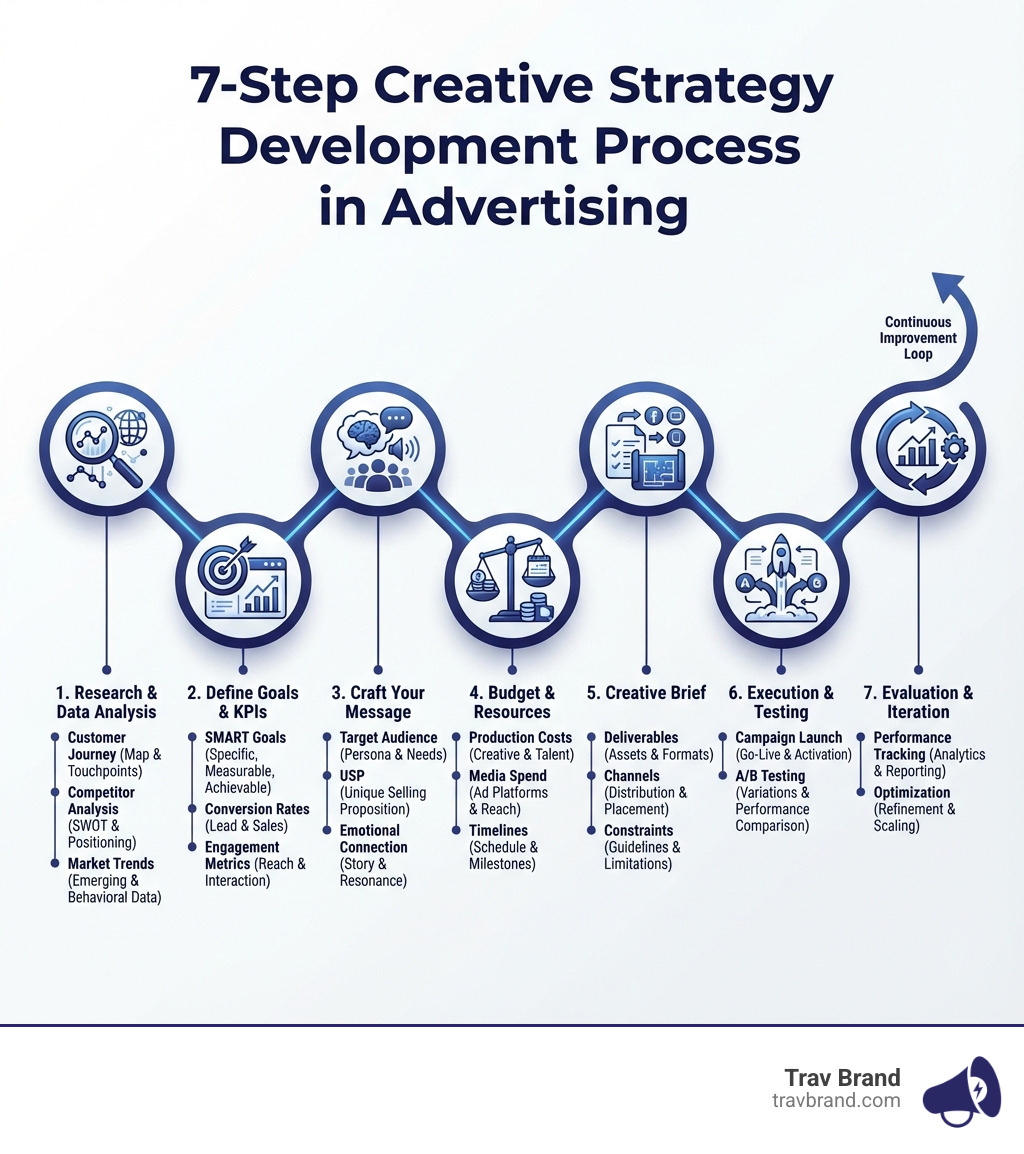
Developing a robust creative strategy in advertising is a clear, 7-step process. Think of it as a creative strategy flywheel—a continuous loop of research, ideation, execution, and analysis that drives ongoing success.

Step 1: Research and Data Analysis
Effective creative is informed by data. This foundational step provides the objective insights upon which we build our creative vision.
- Customer Journey Mapping: We map the customer’s journey to understand their pain points and motivations, helping us craft messages that resonate at each touchpoint.
- Competitor Analysis: We analyze competitors’ strategies to find gaps and opportunities for your brand to stand out.
- Past Performance Review: We analyze historical ad data—top performers, hook/hold rates, and conversions—to see what resonates with your audience.
- Market Trends: We look at broader industry shifts, emerging platforms, and evolving consumer behaviors to stay ahead.
- Audience Insights & Data Mining: We go beyond demographics by mining customer reviews, social media, and forums (like Reddit). AI tools like Perplexity help us quickly gather insights on pain points, benefits, and trends.
Step 2: Define Goals and Success Metrics (KPIs)
With a clear understanding of the landscape, we define our destination using SMART goals (Specific, Measurable, Achievable, Relevant, and Time-bound).
- Marketing Objectives: These directly support business goals. For example, a goal to increase market share might have a marketing objective to increase brand awareness by 20% in six months.
- Key Performance Indicators (KPIs): We select specific metrics to track progress, such as:
- Conversion Rates
- Engagement Metrics (likes, shares, hook/hold rates)
- Brand Awareness Lift
- Click-Through Rate (CTR)
- Cost Per Acquisition (CPA)
- Return on Ad Spend (ROAS)
- Measurable Objectives: It’s crucial to craft specific and measurable objectives to track performance and make necessary adjustments.
Step 3: Crafting the Message for Your Creative Strategy in Advertising
This is where the art and science of creative strategy in advertising meet to sculpt your message.
- Target Audience Definition: We build detailed user personas beyond demographics, understanding their aspirations and fears to speak directly to their needs.
- Unique Selling Proposition (USP): Our message will highlight what makes your brand unique and superior to the competition.
- Core Message: This is the central idea we want to convey. It must be clear, concise, and compelling, distilling your USP into a focused narrative.
- Emotional Connection: Effective ads evoke emotion. We create messages that resonate deeply through humor, inspiration, or empathy.
- Tone of Voice: The message must align with your brand’s established tone of voice to build trust and awareness.
Step 4: Budget and Resource Planning
A brilliant strategy requires resources for execution. This step ensures we can bring our vision to life.
- Itemized Budget: We create a detailed budget covering production costs, media spend, software, and vendor fees.
- Timelines and Milestones: We establish realistic timelines with clear milestones to keep the project on track and manage expectations.
- Resource Allocation: We assess team bandwidth and allocate resources effectively, balancing creative ideas with practical constraints.
Step 5: The Creative Brief
The creative brief is our compass, a concise document that distills strategy into actionable guidance for the creative team.
- Single Source of Truth: It serves as the definitive reference point for everyone involved, ensuring alignment.
- Project Roadmap: It outlines the path from strategy to execution, including key deliverables, channel selection, and any mandatories or constraints.
Essential elements of our creative briefs include:
- Project Title & Campaign Name
- Background & Overview
- Business Objectives & Marketing Goals
- Target Audience & Key Insights
- Key Message & USP
- Desired Audience Action (CTA)
- Creative Tone & Style
- Deliverables & Formats
- Channels for Distribution
- Budget & Timeline
- Mandatories & Legal Requirements
- Competitor Examples
Execution and Evaluation: Bringing Your Creative Strategy in Advertising to Life
Once the creative strategy in advertising is planned, we bring it to life and evaluate its performance. This is a continuous cycle of launching, learning, and iterating.

This phase involves campaign launch, real-time performance tracking, continuous A/B testing, and using data insights to refine future creative.
How to Stand Out in a Crowded Marketplace
In a saturated market, creative must grab and hold attention.
- Originality and Appropriateness: Creativity isn’t just being different; it’s being both original and appropriate for your brand and audience. We assess an ad’s creativity using established psychological frameworks.
- Emotional Storytelling: We craft narratives that evoke emotion, making your brand memorable and relatable.
- Memorable Visuals: We create striking, high-quality visuals that are instantly recognizable and align with your brand aesthetic.
- Unique Brand Voice: Consistency in tone and messaging helps your brand develop a distinct, recognizable voice.
- Avoiding Clichés: We avoid generic approaches, ensuring our creative projects a positive image and builds a strong brand reputation.
Leveraging Technology and AI
Technology and AI make our creative strategy in advertising more efficient and data-driven.
- AI for Ideation and Research: Tools like Perplexity rapidly gather market insights, analyze competitors, and suggest creative angles.
- AI in Content Creation: AI helps generate ad copy, identify trending visuals, and create AI talent for rapid content production and testing.
- Predictive Analytics: AI platforms can predict which creative elements will perform best with specific audiences.
- Automated Ad Testing: Tools can automate A/B testing to continuously optimize ad performance.
- Personalization at Scale: AI enables highly personalized ad experiences based on user behavior.
- Data Analysis Tools: Platforms offer detailed reports on video drop-offs and other metrics for precise optimization.
Common Pitfalls to Avoid
Even the best creative strategy in advertising can stumble. We avoid these common pitfalls:
- Inconsistent Messaging: Fragmented messages dilute your brand. Every ad must reinforce your core message.
- Ignoring Data: Relying on intuition over data leads to wasted spend. Awards don’t always equal market performance, as some award-winning campaigns have seen sales decline, according to a new study in the Journal of Marketing.
- Unrealistic Budgets: An ambitious vision requires adequate financial resources to succeed.
- Misunderstanding the Audience: If you don’t truly know your audience, your message will fall flat.
- Poor Creative Brief: A vague brief leads to misaligned creative and frustration. Clarity is key.
- Fear of Taking Risks: Aversion to calculated risks leads to “dull advertising,” which drains resources and brand equity.
Inspiring Success: Real-World Examples and Lasting Impact
The power of a well-executed creative strategy in advertising is evident in iconic brands that forge lasting connections and build immense loyalty. These examples show how strategic creativity translates into measurable business impact.
Strategies That Built Iconic Brands
Let’s look at how some of the biggest names leverage creative strategy in advertising:
- Red Bull: Experiential Marketing & Content Strategy: Since 1987, Red Bull has used direct sampling, sponsored extreme sports events, and created high-quality content. Its slogan, “Red Bull gives you wings,” allows for endless creative interpretations.
- Spotify: User-Generated Content & Personalization: The “Wrapped” campaign is a masterclass in turning user data into shareable stories. This drives organic engagement and strengthens user connection.
- Nike: Purpose-Driven Messaging & Emotional Connection: Nike’s campaigns empower and inspire. Supporting Colin Kaepernick during his protest showed their commitment to purpose. Campaigns like “A Feel For Every You” create deep emotional connections by empowering athletes.
- Valorant: Character-Driven Storytelling & Community Engagement: Riot Games engaged its community by dropping beta keys during live streams, causing massive viewership spikes on Twitch. This community-first approach built immense anticipation for the game.
- Barbie: Reinvention & Multi-Channel Storytelling: The Barbie Movie’s strategy was brilliant. The “You Can Be Anything” campaign addressed gender stereotypes with diverse role models, using nostalgia, vibrant visuals, and memes for maximum exposure.
How Creative Strategy Drives Brand Loyalty
Creative strategy in advertising is a powerful tool for cultivating brand loyalty, changing consumers into advocates.
Here’s how our creative strategies contribute to lasting loyalty:
- Consistent Brand Experience: A defined strategy ensures every brand interaction is consistent, building familiarity, trust, and reliability.
- Emotional Connection: By tapping into universal emotions with compelling stories, we forge deeper connections. People buy into feelings and experiences, not just products.
- Building Trust: Authentic creative builds trust. When advertising consistently delivers on your brand’s promise, customers feel more secure.
- Fostering Community: Creative campaigns can create a sense of belonging through user-generated content or interactive experiences, making customers part of your brand’s story.
- Turning Customers into Advocates: When customers trust your brand, they become powerful advocates, driving organic growth. This is the ultimate goal of a successful creative strategy.
Frequently Asked Questions about Creative Strategy
What is the difference between a creative strategy and a creative concept?
A creative strategy in advertising is the long-term blueprint defining the “what” (goals, audience, message) and “why” (business alignment). A creative concept is the specific “big idea” for a campaign that brings the strategy to life, such as a tagline or visual theme.
How often should a creative strategy be updated?
While a creative strategy is long-lasting, review it annually or when major shifts occur (e.g., market changes, new business goals, performance data shifts). The goal is evolution, not revolution, to ensure continued relevance.
Can a small business with a limited budget have an effective creative strategy?
Absolutely. An effective creative strategy in advertising is about smart planning, not budget size. For small businesses, a defined strategy is critical for maximizing every dollar. It focuses limited resources on the most impactful messages and channels to prevent waste and drive results.
Conclusion
We’ve journeyed through the intricate world of creative strategy in advertising, showing it as the indispensable blueprint for any brand aiming to cut through the noise and make a lasting impact. From understanding its core components and strategic alignment with your business objectives to carefully crafting your message and measuring its success, a robust creative strategy is the bedrock of effective advertising.
It’s the difference between ads that are forgotten and campaigns that build iconic brands, foster deep loyalty, and drive exponential growth. As we’ve seen through examples like Red Bull, Spotify, Nike, Valorant, and Barbie, strategic creativity isn’t just an art; it’s a science—a powerful tool for measurable results.
At Trav Brand, we believe that every purpose-driven brand deserves a comprehensive strategy that translates vision into tangible success. We don’t just consult; we build and scale brands through integrated digital marketing, e-commerce, and content strategies, focusing on execution that delivers measurable results.
Ready to transform your advertising from fragmented efforts into a cohesive, high-impact force? Let us help you craft your blueprint for success. Start building your comprehensive brand and marketing strategy with Trav Brand today.